Market Summary
Executive Summary and Market Analysis
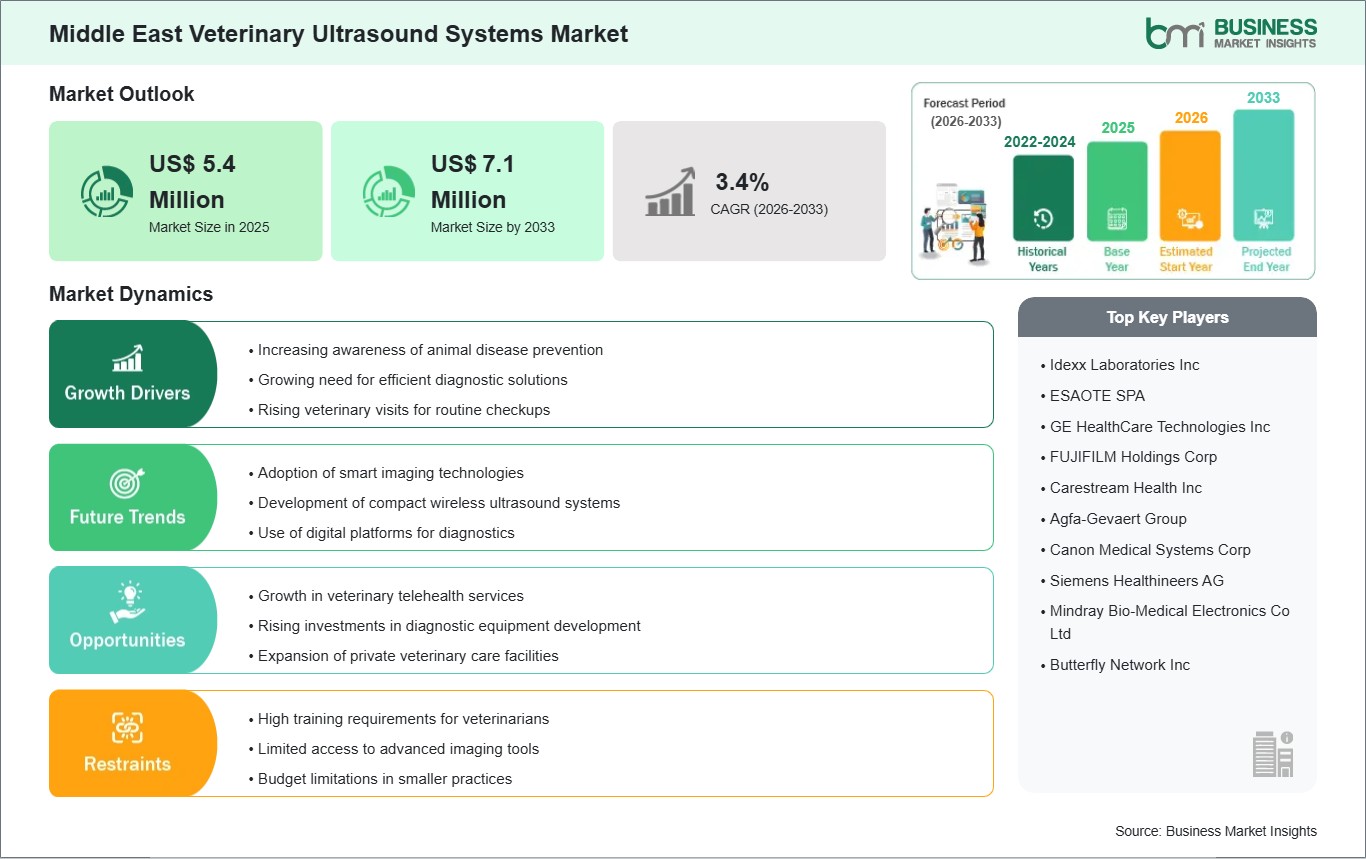
The Middle East veterinary ultrasound systems market is experiencing steady growth, driven by modernization of livestock operations, increasing urban companion animal ownership, and rising awareness of preventive veterinary care. Advanced diagnostic equipment is being utilized throughout the countries in the area for better reproduction monitoring, herd health management, and disease identification in cattle, sheep, and camel breeding. Food security, improved livestock production, and animal welfare through government-led projects are also boosting the application of ultrasound in these regions. Technology is another factor that drives the demand, with portable, handheld, and high-definition ultrasound devices becoming increasingly popular owing to their convenience and feasibility in field conditions. Durability, battery-operable features, and intuitive design are other attributes that are emphasized by the vendors to address the need for various levels of expertise among veterinarians. Professional training and educational programs for veterinarians in this region are also fueling the growth of ultrasound imaging technology. The presence of international, regional, and local players is contributing to the competitiveness of the market, with procurement processes influenced by parameters such as reliability, after-sales services, and availability of local service providers. Despite factors such as uneven infrastructure, cost-sensitivity, and lack of technical expertise in some parts of the region, the market shows high growth prospects due to urbanization, increased disposable incomes, and technological advancements in diagnostics.
Segment Analysis
Middle East Veterinary Ultrasound Systems Market Segmentation
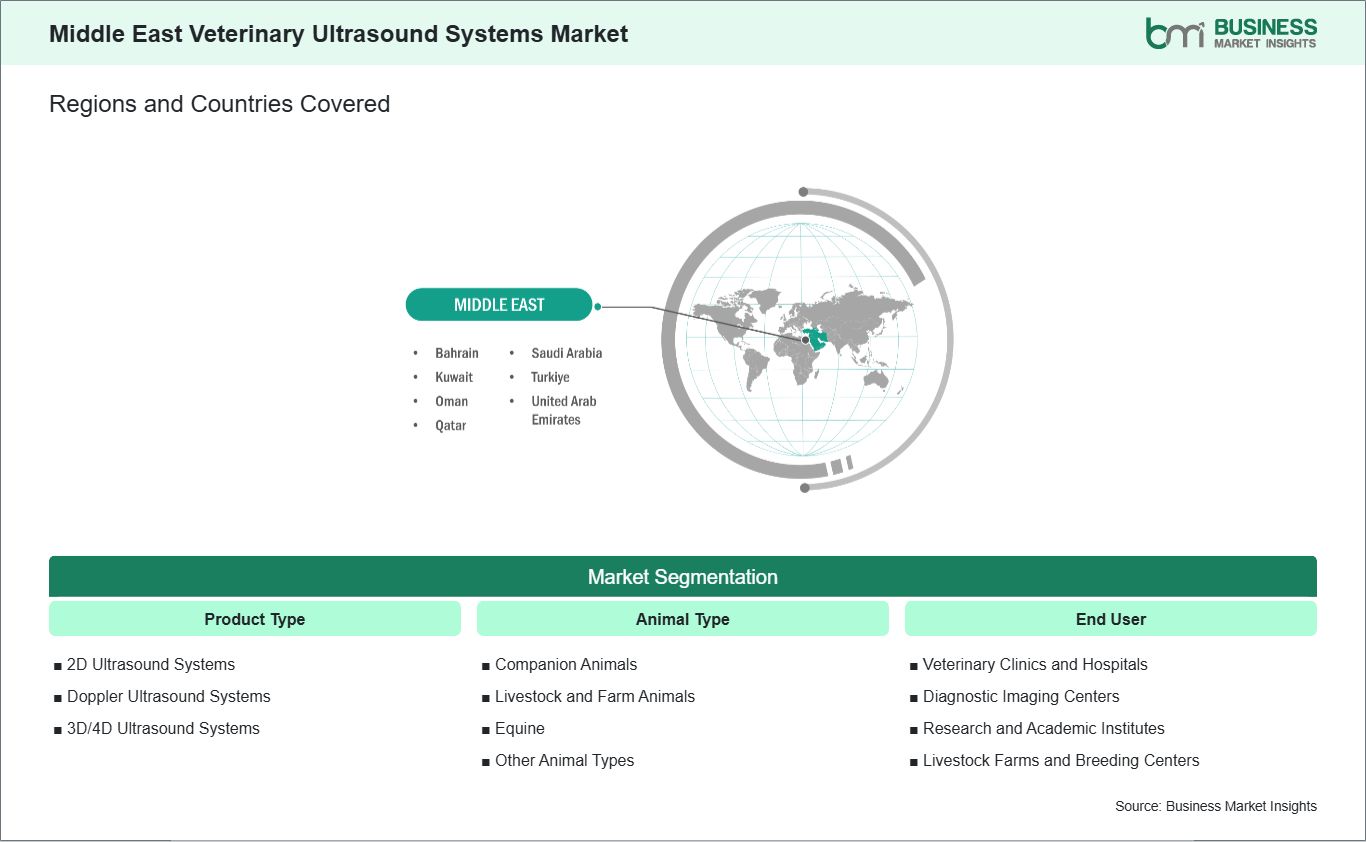
Key segments that contributed to the derivation of the Middle East veterinary ultrasound systems market analysis are product type, animal type, and end user.
- By product type, the veterinary ultrasound systems market is segmented into 2d ultrasound systems, doppler ultrasound systems, 3d/4d ultrasound systems. The digital 2d ultrasound systems segment dominated the market in 2025.
- Based on animal type, the veterinary ultrasound systems market is categorized into companion animals, livestock and farm animals, equine, other animal types. The companion animals segment dominated the market in 2025.
- In terms of end user, the veterinary ultrasound systems market is categorized into veterinary clinics and hospitals, diagnostic imaging centers, research and academic institutes, livestock farms and breeding centers. The veterinary clinics and hospitals segment dominated the market in 2025.
Market Forces
Middle East Veterinary Ultrasound Systems Market Drivers and Opportunities
Expanding camel and livestock breeding programs
The Middle East veterinary ultrasound systems market is being driven by the expansion of camel and livestock breeding programs. The development of advanced genetic and reproductive practices is taking place at an accelerated pace in countries like Saudi Arabia, UAE, and Qatar in order to address the increasing need for meat, milk, and camel products within the domestic market. The use of ultrasound equipment plays a vital role in monitoring pregnancy, diagnosing reproductive problems, and breeding efficiency.
The government is making huge investments in upgrading livestock farms through various programs that aim at selecting quality breeds, managing herds, and preventing diseases. In order to accomplish this goal, there is a need for proper diagnostic imaging techniques. Camel breeding farms in Saudi Arabia utilize ultrasound machines to enhance fertility and monitor pregnancies.
Also, the rising interest in animal welfare and productivity in the area is resulting in an increase in the demand for modern diagnostic equipment in veterinary medicine. Ultrasound systems have become a common tool in animal husbandry and have been found to be effective in improving breeding efficiency and reducing animal product loss. With increased breeding programs in the region, veterinary ultrasound systems will become increasingly popular.
Rising demand for portable diagnostic devices
The increasing need for portable veterinary diagnostic devices presents a significant opportunity in the Middle East. Since many livestock farms are situated in distant desert regions or cover vast stretches of land, it becomes very convenient to use portable ultrasounds for monitoring the reproductive health of these animals.
Portable ultrasounds are increasingly gaining prominence in nations such as Oman, UAE, and Saudi Arabia, as more and more mobile veterinary practices are being established. Not only do these machines make it easier to examine the animals on the spot, but they also significantly reduce the stress experienced by the livestock as well as the logistics involved in taking them somewhere.
Additionally, veterinary training programs in the Middle East are emphasizing the use of portable diagnostic tools, ensuring professionals are skilled in operating these devices effectively. As awareness grows and farms increasingly adopt mobile veterinary practices, portable ultrasound systems are expected to become standard tools for livestock health management across the region.
Size and Share Analysis
Middle East Veterinary Ultrasound Systems Market Size and Share Analysis
The Middle East veterinary ultrasound systems market demonstrates steady growth, with size and share analysis highlighting evolving trends and competitive dynamics among key players. The report examines subsegments categorized within product type, animal type, and end user, offering insights into their contribution to overall market performance.
By product type, the 2d ultrasound systems subsegment dominated the market in 2025, driven by their widespread clinical utility, cost-effectiveness, ease of use and strong adoption in routine veterinary diagnostics across Middle East veterinary practices.
Based on animal type, the companion animals subsegment dominated the market in 2025, driven by increasing pet ownership, rising disposable incomes, and growing demand for advanced veterinary care services across the Middle East.
In terms of end user, the veterinary clinics and hospitals subsegment dominated the market in 2025, driven by expanding veterinary infrastructure and rising investments in diagnostic imaging technologies across clinics and hospitals in the Middle East.
Report Coverage
Middle East Veterinary Ultrasound Systems Market Report Coverage and Deliverables
The "Middle East Veterinary Ultrasound Systems Market Size and Forecast (2022–2033)" report provides a detailed analysis of the market covering below areas:
- Middle East Veterinary Ultrasound Systems Market size and forecast at global, regional, and country levels for all the key market segments covered under the scope
- Middle East Veterinary Ultrasound Systems Market trends, as well as drivers, restraints, and opportunities
- Middle East Veterinary Ultrasound Systems Market analysis covering key trends, global and regional framework, major players, regulations, and recent developments
- Industry landscape and competition analysis covering market concentration, heat map analysis, prominent players, and recent developments for the Middle East Veterinary Ultrasound Systems Market
- Detailed company profiles, including SWOT analysis
Geographic Insights
Middle East Veterinary Ultrasound Systems Market Geographic Insights
The geographical scope of the Middle East Veterinary Ultrasound Systems Market report is divided into UAE, Saudi Arabia, Bahrain, Oman, Kuwait, Qatar, and Turkiye. The Saudi Arabia held the largest share in 2025.
Country-level insights in the Middle East reveal varied adoption trends across livestock and companion animal sectors. Saudi Arabia emerges as the dominant market, driven by its large-scale livestock operations, government-backed animal health programs, and strong focus on companion animal care. Ultrasound systems are widely adopted for reproductive monitoring, herd health management, and disease prevention, while urban veterinary clinics increasingly integrate high-resolution imaging technologies. Institutional support, advanced veterinary infrastructure, and growing awareness of preventive care reinforce Saudi Arabia’s leadership position in the region. The UAE demonstrates significant growth, fueled by urban veterinary clinics, livestock modernization programs, and rising awareness of animal welfare and preventive veterinary care. Portable and user-friendly ultrasound systems are increasingly utilized for both farm-based and clinical applications. Bahrain, Oman, Kuwait, and Qatar represent smaller, niche markets, with adoption primarily concentrated in companion animal diagnostics and selective livestock applications. These markets are gradually expanding as disposable incomes rise and urban pet ownership increases. Turkiye shows strong market potential, supported by a sizable livestock sector, government initiatives for animal health, and growing integration of diagnostic imaging in veterinary practice. Adoption is focused on reproductive monitoring, herd management, and preventive care programs. Across the Middle East, regulatory frameworks, veterinary infrastructure, technical expertise, and awareness of preventive animal healthcare remain key factors shaping market growth. Saudi Arabia’s dominance is reinforced by the scale of its livestock sector, institutional support, and high integration of advanced diagnostic technologies, positioning it as the primary hub for veterinary ultrasound system adoption in the region.
Industry Activity
Recent Developments
The Middle East Veterinary Ultrasound Systems Market is evaluated by gathering qualitative and quantitative data post primary and secondary research, which includes important corporate publications, association data, and databases. A few of the key developments in the Middle East veterinary ultrasound systems market are:
- In April 2024, Recor Medical, Inc. announced the first commercial uses of its Paradise ultrasound‑based renal denervation (uRDN) system in the United Arab Emirates (UAE) at Al Qassimi Hospital in Sharjah demonstrating local regulatory authorization and clinical adoption of this ultrasound‑based interventional device in the Middle East.
- In February 2026, GE HealthCare announced a strategic collaboration to integrate AI‑powered fetal ultrasound technology into its Voluson ultrasound systems with Fetoly noting that the imaging platform has received both FDA 510(k) clearance and European CE marking, approvals that support device registration and use across many Middle Eastern markets where FDA/CE marks are accepted as key evidence for local regulatory clearance.
Trust & Transparency
Research Methodology
The market analysis combines proprietary research with secondary data from government agencies, company disclosures, regulatory filings, industry databases and expert interviews. Market estimates are validated through data triangulation, cross-market benchmarking and analyst
review.
View Full Research Methodology
Key Sources Referred:
World Health Organization (WHO)Organisation for Economic Cooperation and Development (OECD)The World Bank GroupWorldometerThe LancetInternational Bar AssociationInternational Trade Administration