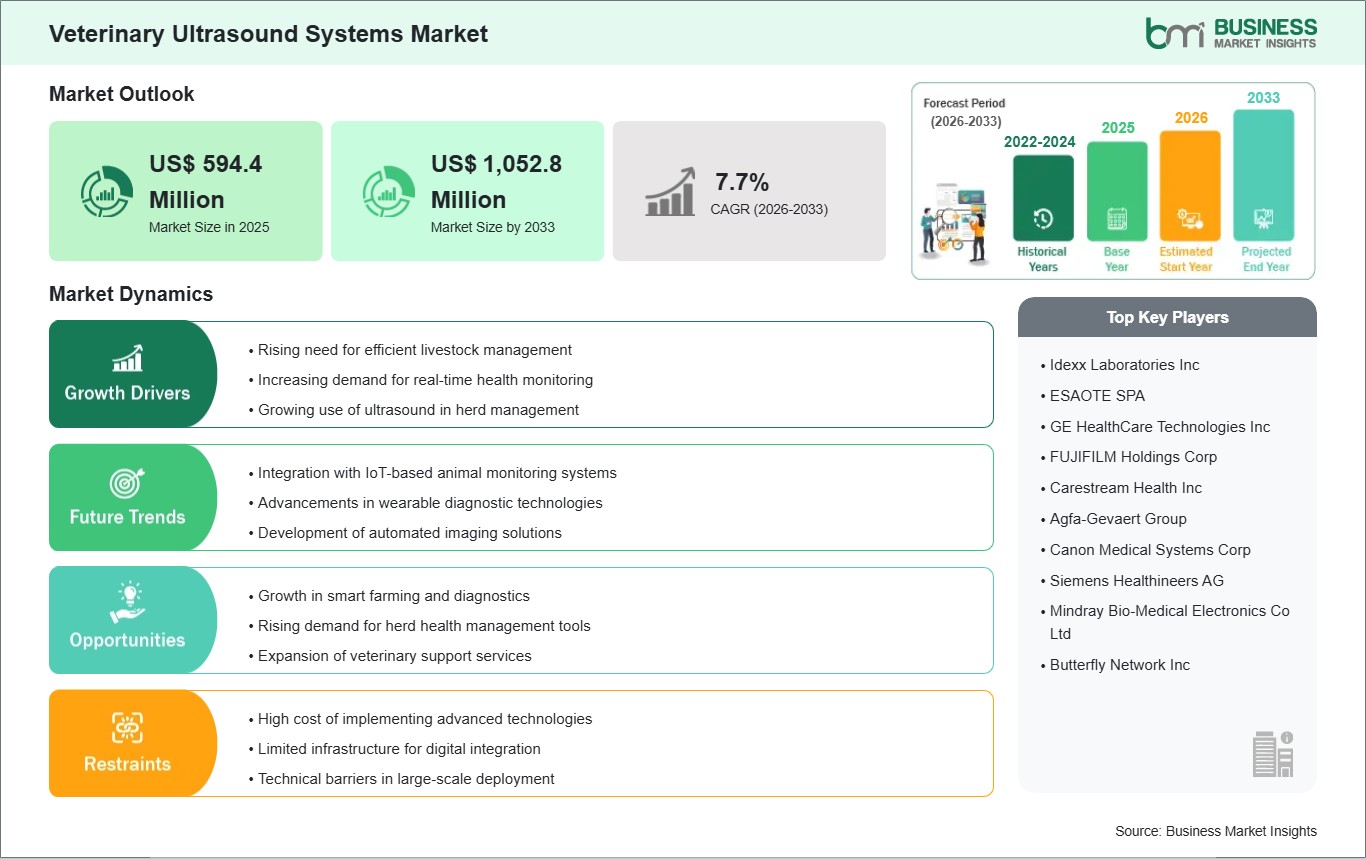
The veterinary ultrasound systems market size is expected to reach US$1,052.8 million by 2033 from US$594.4 million in 2025. The market is estimated to register a CAGR of 7.7% from 2026 to 2033.
The veterinary ultrasound systems market is experiencing sustained growth, driven by increasing demand for advanced diagnostic tools in both livestock and companion animal care. The increase in awareness for preventive healthcare, the increasing number of companion animals, and the modernization of livestock farming are some of the key aspects contributing to the popularity of ultrasound systems around the world. The use of such equipment is prevalent in reproduction screening, disease identification, and herd management to improve productivity while minimizing losses. Technology is critical in enabling the growth of the ultrasound market in the industry. This is seen through technology that can be used anywhere, easy usability, and increased precision. Manufacturers are concerned with offering equipment that is easy to use, cost-effective, and durable. Training programs and vet education programs will be instrumental in encouraging more people to invest in the market by addressing skills shortages and proper usage of equipment. Market players include global manufacturers, regional distributors, and local suppliers. The market players are evaluated based on post-sale services, technical support, and reliability. There are regulations that advocate for animal welfare, the safety of food, and the good health of livestock, which have benefited the market. Although there is price elasticity and poor technical skills among other constraints, the market has huge potential owing to urbanization and disposable income, among others.

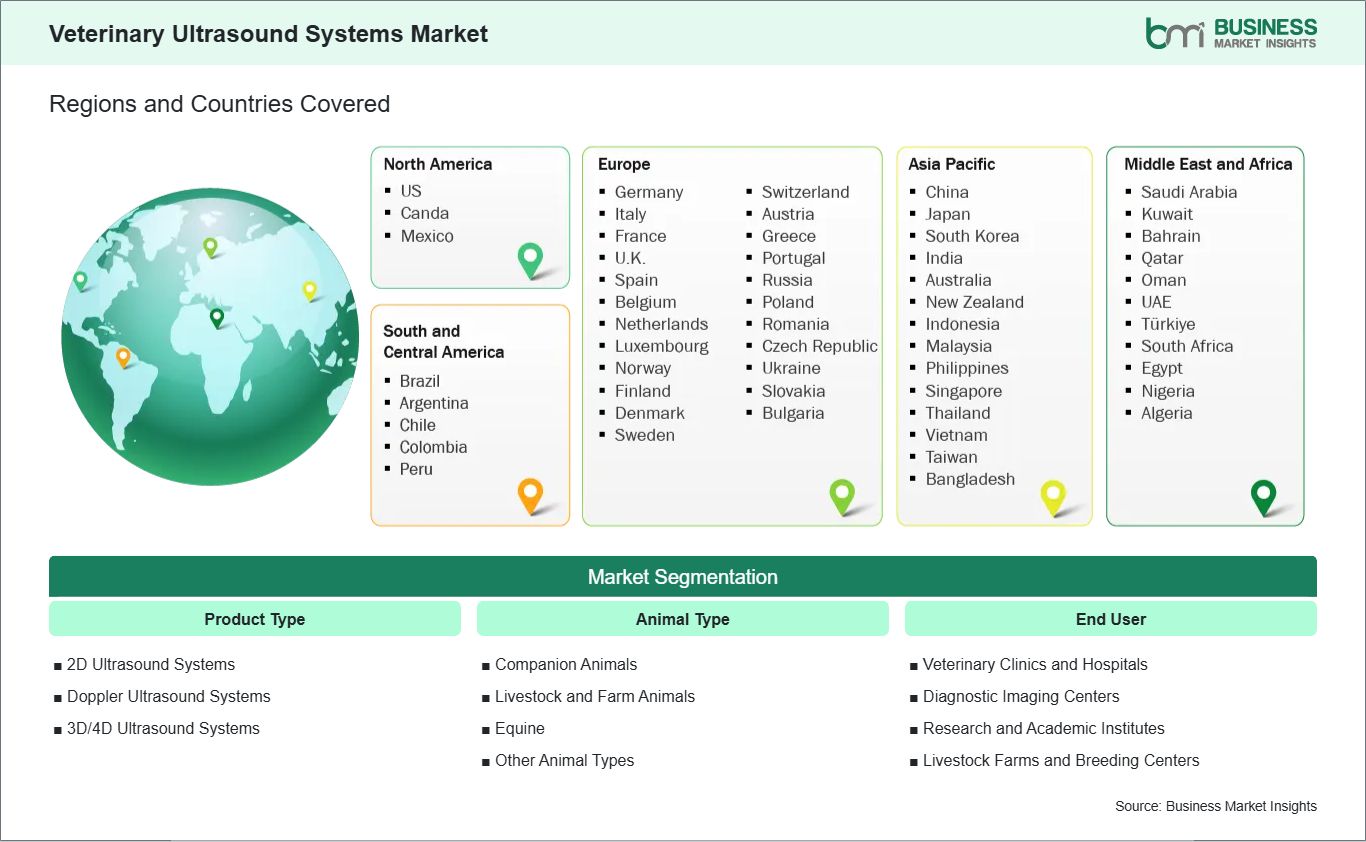
Key segments that contributed to the derivation of the veterinary ultrasound systems market analysis are product type, animal type, and end user.
The veterinary ultrasound systems market is driven by the increasing need to enhance livestock productivity across continents. Population growth and increasing protein intake levels are causing many nations across the globe to make use of veterinary ultrasound systems to improve their animal reproductive abilities and enhance productivity levels by reducing loss. Veterinary ultrasound systems are crucial devices used to check pregnancies and identify any health complications in animals, which improves productivity.
Governments around the world are encouraging their nations to take part in livestock improvement programs that assist the farmers. Through subsidies and awareness programs, even smaller farms are able to incorporate diagnostic techniques such as ultrasound systems to improve yield. It is very easy to see this trend, especially in nations with huge commercial farms, such as Brazil, India, and the USA.
Consumer demand for high-quality, ethically produced meat, dairy, and poultry products has made preventive animal healthcare a priority. Accurate and timely diagnosis using ultrasound imaging allows farmers and veterinarians to manage breeding, reduce mortality rates, and maintain high-quality production standards. As a result, rising global livestock productivity needs are driving veterinary ultrasound system adoption worldwide.
The increasing integration of AI-based imaging technologies presents a major opportunity in the global veterinary ultrasound market. With AI-powered devices, abnormalities can be detected, reproductive cycles can be monitored, and the health condition of internal organs can be assessed. Such methods are helpful in areas where there is a lack of professional veterinarians or where there is a large number of livestock animals that need to be monitored and treated.
Ultrasound devices that utilize AI technologies also permit telemedicine, which means that veterinarians can consult remotely and exchange medical images without restrictions. This feature becomes important for remote locations in Africa, Latin America, and Asia, where livestock monitoring is crucial in maintaining animal health and productivity.
Veterinary education and professional training programs are incorporating AI-driven imaging into their curriculum. As awareness and technical adoption grow, AI-based ultrasound systems are expected to transform global veterinary diagnostics by providing more efficient, precise, and scalable solutions, benefiting both livestock and companion animal healthcare on a worldwide scale.

The veterinary ultrasound systems market demonstrates steady growth, with size and share analysis highlighting evolving trends and competitive dynamics among key players. The report examines subsegments categorized within product type, animal type, and end user, offering insights into their contribution to overall market performance.
By product type, the 2d ultrasound systems subsegment dominated the market in 2025, driven by their widespread clinical utility, cost-effectiveness, ease of use and strong adoption in routine veterinary diagnostics across global veterinary practices.
Based on animal type, the companion animals subsegment dominated the market in 2025, driven by rising pet ownership, growing awareness of animal health, and increasing expenditure on preventive and diagnostic veterinary care worldwide.
In terms of end user, the veterinary clinics and hospitals subsegment dominated the market in 2025, driven by expansion of veterinary infrastructure and investments in advanced diagnostic imaging technologies across clinics and hospitals globally.
| Report Attribute | Details |
|---|---|
| Market size in 2025 | US$ 594.4 Million |
| Market Size by 2033 | US$ 1,052.8 Million |
| Global CAGR (2026 - 2033) | 7.7% |
| Historical Data | 2022-2024 |
| Forecast period | 2026-2033 |
| Segments Covered | By Product Type
|
|
Regions and Countries Covered
| |
| North America | US, Canada, Mexico |
| Europe | Germany, Italy, France, U.K., Spain, Belgium, Netherlands, Luxembourg, Norway, Finland, Denmark, Sweden, Switzerland, Austria, Greece, Portugal, Russia, Poland, Romania, Czech Republic, Ukraine, Slovakia, Bulgaria |
| Asia-Pacific | China, Japan, South Korea, India, Australia, New Zealand, Indonesia, Malaysia, Philippines, Singapore, Thailand, Vietnam, Taiwan, Bangladesh |
| South and Central America | Brazil, Argentina, Chile, Colombia, Peru |
| Middle East and Africa | Saudi Arabia, United Arab Emirates, Kuwait, Bahrain, Qatar, Oman, Turkiye, South Africa, Egypt, Nigeria, Algeria |
| Market leaders and key company profiles |
|
The "Veterinary Ultrasound Systems Market Size and Forecast (2022–2033)" report provides a detailed analysis of the market covering below areas:
The geographical scope of the Veterinary Ultrasound Systems Market report is divided into North America, Asia Pacific, Europe, Middle East & Africa, and South & Central America. North America held the largest share in 2025.
Regional insights into the global veterinary ultrasound systems market reveal differences in adoption, infrastructure, and growth potential. North America emerges as the dominant market, driven by advanced veterinary infrastructure, high companion animal ownership, and large-scale livestock operations. The US and Canada lead the adoption of high-resolution and portable ultrasound systems across both livestock and companion animal sectors. Widespread awareness of preventive veterinary care, strong regulatory frameworks, and extensive professional training programs reinforce North America’s leadership in the global market. Asia Pacific demonstrates rapid growth, with China and India at the forefront. Expanding livestock populations, rising companion animal ownership, and government-backed initiatives for livestock productivity and animal health are key growth drivers. Adoption of portable and cost-effective ultrasound systems is increasing in rural and urban veterinary practices, supported by rising disposable incomes and the modernization of veterinary infrastructure. Europe remains a mature and diversified market, with Germany as the dominant hub. Adoption is driven by advanced livestock farming, high companion animal care demand, and well-established veterinary institutions. Other markets such as France, the UK, Italy, and the Netherlands show steady growth, fueled by regulatory compliance, precision farming practices, and urban veterinary services. The Middle East and Africa are emerging markets, with Turkiye, Saudi Arabia, and Egypt leading adoption. Livestock modernization, government health programs, and increasing urban companion animal care services support growth. Portable and user-friendly ultrasound systems are important in these regions due to dispersed farming operations and infrastructure variability. South & Central America are witnessing steady growth, dominated by Mexico and Brazil. Large-scale livestock operations, government livestock programs, and expanding companion animal care markets are driving adoption. Portable ultrasound systems are favored due to geographically dispersed farms and increasing focus on herd productivity and preventive care. Across these regions, market growth is influenced by regulatory frameworks, veterinary infrastructure, technical expertise, and rising awareness of preventive animal healthcare, with North America maintaining its dominant position globally.

The Veterinary Ultrasound Systems Market is evaluated by gathering qualitative and quantitative data post primary and secondary research, which includes important corporate publications, association data, and databases. A few of the key developments in the veterinary ultrasound systems market are:
The Veterinary Ultrasound Systems Market is valued at US$ 594.4 Million in 2025, it is projected to reach US$ 1,052.8 Million by 2033.
As per our report Veterinary Ultrasound Systems Market, the market size is valued at US$ 594.4 Million in 2025, projecting it to reach US$ 1,052.8 Million by 2033. This translates to a CAGR of approximately 7.7% during the forecast period.
The Veterinary Ultrasound Systems Market report typically cover these key segments-
The historic period, base year, and forecast period can vary slightly depending on the specific market research report. However, for the Veterinary Ultrasound Systems Market report:
The Veterinary Ultrasound Systems Market is populated by several key players, each contributing to its growth and innovation. Some of the major players include:
The Veterinary Ultrasound Systems Market report is valuable for diverse stakeholders, including:
Essentially, anyone involved in or considering involvement in the Veterinary Ultrasound Systems Market value chain can benefit from the information contained in a comprehensive market report.
Please tell us your area of interest
(Market Segments/ Regions and Countries/ Companies)