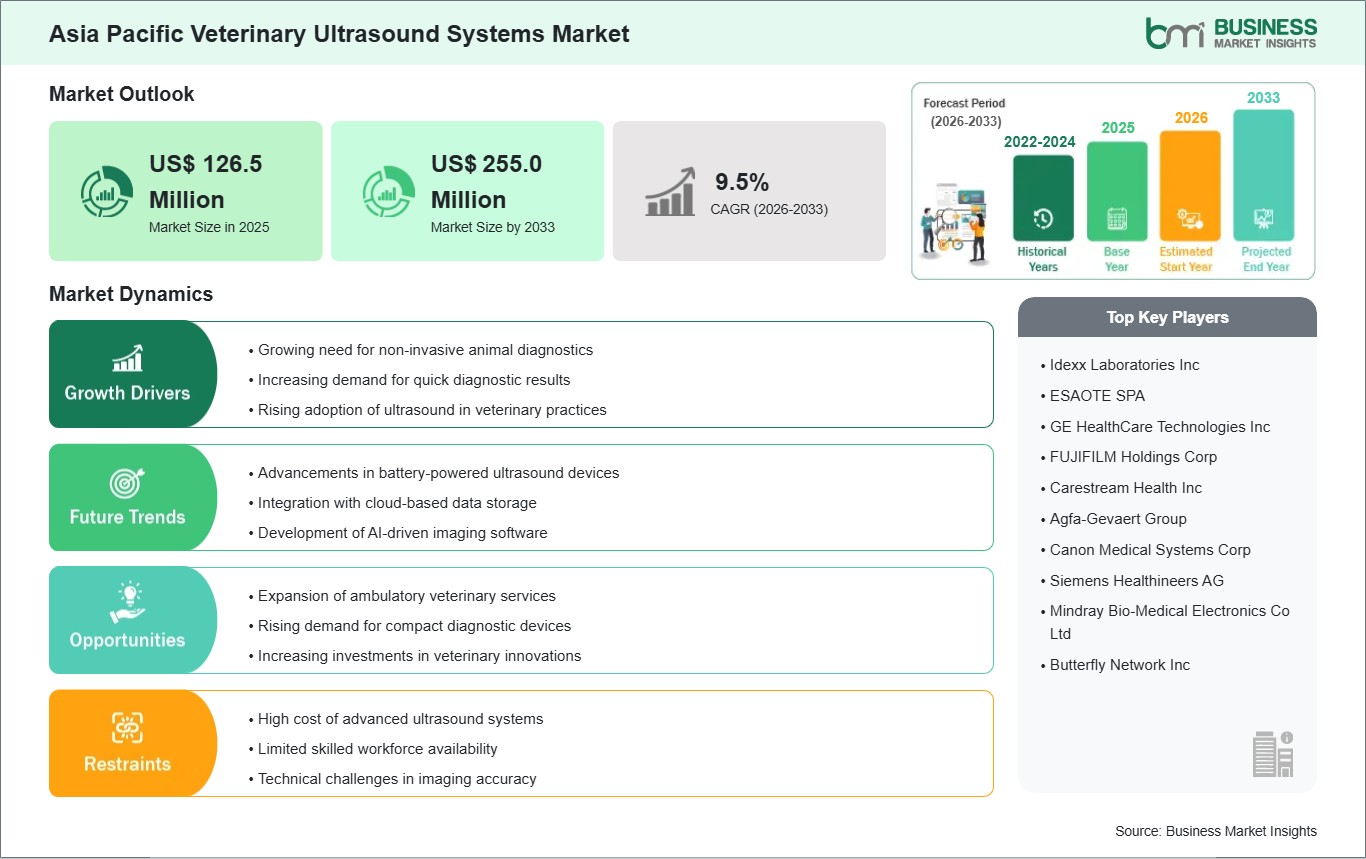
The Asia Pacific veterinary ultrasound systems market size is expected to reach US$255.0 million by 2033 from US$126.5 million in 2025. The market is estimated to record a CAGR of 9.5% from 2026 to 2033.
The Asia Pacific veterinary ultrasound systems market is witnessing robust growth, underpinned by the region’s expanding livestock production, rising companion animal ownership, and increasing investments in advanced veterinary diagnostics. Key drivers include the intensification of commercial farming across major economies and heightened awareness of preventive animal healthcare. Veterinary professionals are increasingly adopting ultrasound systems to improve reproductive efficiency, monitor herd health, and reduce losses from undiagnosed diseases, particularly in large-scale dairy, poultry, and swine operations. Technological innovation is shaping the market, with portable and handheld devices gaining popularity due to their cost-effectiveness, ease of transport, and suitability for field applications. Vendors are focusing on user-friendly interfaces, battery-powered solutions, and durable systems designed to withstand diverse environmental conditions. Training programs and professional education initiatives are also driving adoption, addressing gaps in operator expertise that have historically limited widespread utilization. Competitive dynamics in the region are influenced by global equipment manufacturers, regional distributors, and local solution providers. Market players are leveraging partnerships with veterinary associations, academic institutions, and government livestock programs to enhance penetration and build trust with end-users. Regulatory harmonization across countries, along with initiatives promoting animal health monitoring and food safety, further bolsters market growth. While challenges such as price sensitivity, infrastructure disparities, and inconsistent technical skills remain, the Asia Pacific market demonstrates strong long-term potential, supported by economic growth, modernization of veterinary services, and evolving consumer attitudes toward animal care.

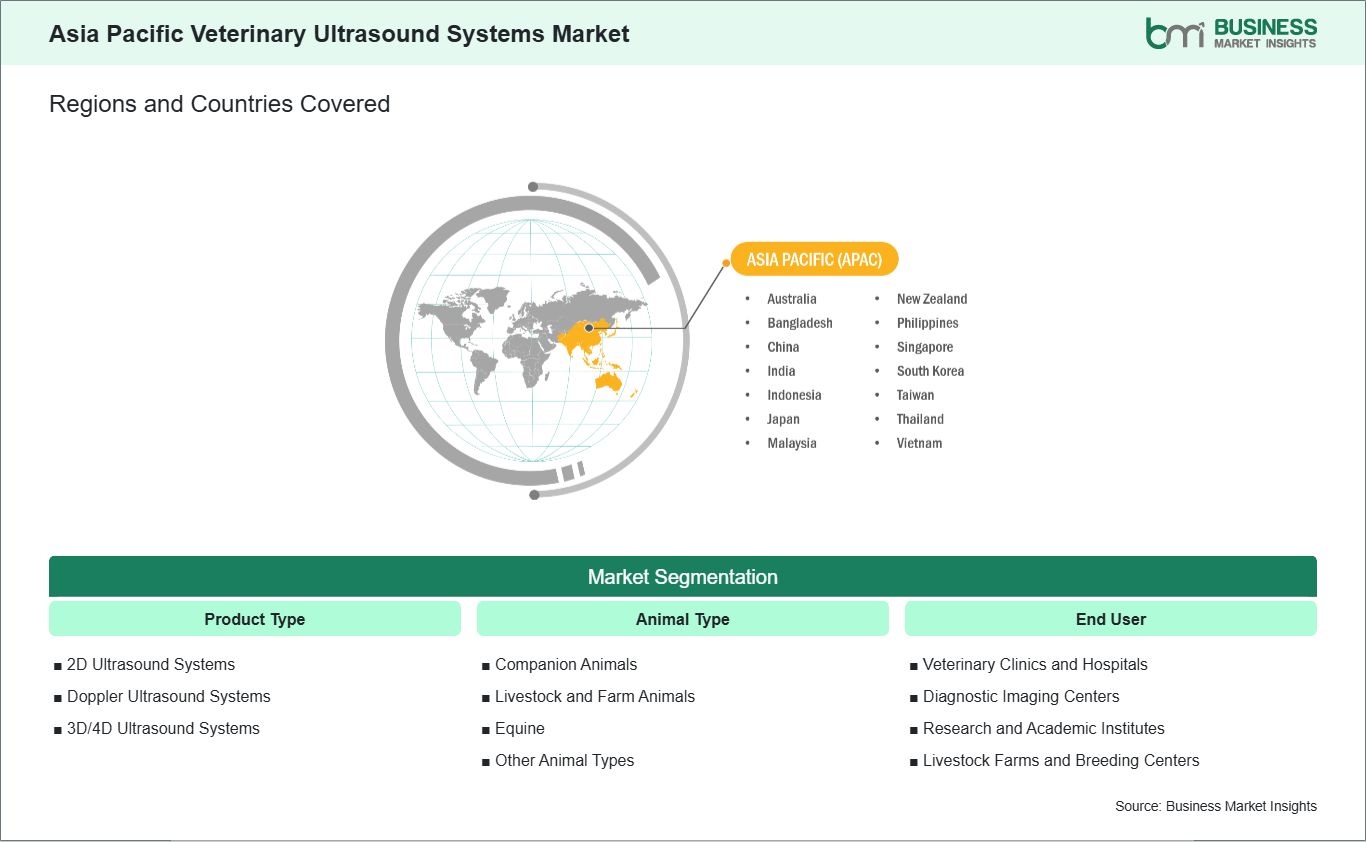
Key segments that contributed to the derivation of the Asia Pacific veterinary ultrasound systems market analysis are product type, animal type, and end user.
Ultrasound systems for veterinarians in the Asia Pacific region have been greatly positively impacted by rising pet ownership and an increase in people taking care of their pet's health. Countries such as China, Japan and India are seeing huge increases in the number of pet owners (dogs, cats and exotic animals) primarily due to the investment of urban households in these pets. Partly due to the growing focus on early diagnosis and preventive care by pet owners, veterinary clinics have upgraded their diagnostic capabilities and ultrasound systems have become a significant investment for providing accurate imaging of the inside of animals, monitoring reproductive health, and detecting disease at an early stage.
At the same time, the growth in urbanization and disposable income in many parts of Asia Pacific have been increasing demand for professional veterinary services. Pet owners are willing to pay more for high-quality veterinary care including wellness visits, imaging, and preventive treatment. Ultrasound systems for veterinarians are non-invasive imaging techniques which provide real-time imaging of the animal's body for purposes such as identifying tumors and organ abnormalities, and identifying potential pregnancy complications. Urban areas in particular such as Shanghai, Tokyo, and Mumbai will continue to be leading areas for the new demand as many advanced veterinary practices have opened in order to offer services for both ultrasound imaging as well as other specialty diagnostics.
Furthermore, governments and other organizations in South Korea and Australia are promoting responsible pet ownership and also encouraging pet owners to take their pets to the veterinarian regularly through various programs. As these programs can help educate pet owners on preventative health care and ultimately lead to an increase in the use of advanced diagnostic technologies, the market for veterinary ultrasound machines in the Asia Pacific region will continue to grow.
The growing trend of using portable or handheld ultrasound machines greatly benefits the Asia Pacific veterinary market. Many rural and semi-urban areas do not have large veterinary facilities to offer care; therefore, having mobile diagnostic solutions will be very helpful. The use of portable ultrasound machines can give veterinarians the ability to perform examinations on livestock and pets at the location of the animal, allowing for an accurate diagnosis and treatment to occur in a timely manner, even in remote areas.
In addition, there is an increased integration of the use of portable ultrasound machines within mobile veterinary services, tele-health and outreach programs in various countries including India, Indonesia and Thailand. Handheld ultrasound devices are affordable, easy to use and can be adapted for many different types of animals including livestock and family pets. Now that these machines are portable, large-scale clinic infrastructure is not needed; therefore, it will allow small- and medium-sized practices to use portable ultrasound machines to provide quality care to both urban and rural areas.
Moreover, veterinary training and developing skills will continue to increase the use of portable devices. Many Japanese, Australian and Malaysian veterinary schools now offer students practical training with handheld ultrasound devices, which should help to increase the confidence of new veterinarians using portable devices. As mobile diagnostic solutions become more well-known, the use of portable ultrasound machines will establish themselves as standard tools in both urban and rural veterinary practices throughout the Asia Pacific region, stimulating the market and the development of new technologies.

The Asia Pacific veterinary ultrasound systems market demonstrates steady growth, with size and share analysis highlighting evolving trends and competitive dynamics among key players. The report examines subsegments categorized within product type, animal type, and end user, offering insights into their contribution to overall market performance.
By product type, the 2d ultrasound systems subsegment dominated the market in 2025, driven by their widespread clinical utility, cost‑effectiveness, ease of use and strong adoption in routine veterinary diagnostics across practices in the region.
Based on animal type, the companion animals subsegment dominated the market in 2025, driven by rapidly growing pet ownership and increasing owner expenditure on advanced diagnostic care for dogs and cats.
In terms of end user, the veterinary clinics and hospitals subsegment dominated the market in 2025, driven by rising in‑house diagnostic demand and investment in imaging equipment as primary care points for animal health services.
| Report Attribute | Details |
|---|---|
| Market size in 2025 | US$ 126.5 Million |
| Market Size by 2033 | US$ 255.0 Million |
| CAGR (2026 - 2033) | 9.5% |
| Historical Data | 2022-2024 |
| Forecast period | 2026-2033 |
| Segments Covered | By Product Type
|
|
Regions and Countries Covered
| |
| Asia Pacific | China, India, Japan, Australia, Bangladesh, Indonesia, Malaysia, New Zealand, Philippines, Singapore, South Korea, Taiwan, Thailand, Vietnam |
| Market leaders and key company profiles |
|
The "Asia Pacific Veterinary Ultrasound Systems Market Size and Forecast (2022–2033)" report provides a detailed analysis of the market covering below areas:
The geographical scope of the Asia Pacific Veterinary Ultrasound Systems China, India, Japan, Australia, Bangladesh, Indonesia, Malaysia, New Zealand, Philippines, Singapore, South Korea, Taiwan, Thailand, Vietnam. The China held the largest share in 2025.
Country-level insights in the Asia Pacific reveal varied adoption trends shaped by livestock density, companion animal ownership, veterinary infrastructure, and regulatory frameworks. China emerges as the dominant market, supported by its massive livestock population, strong government-backed animal health initiatives, and growing urban middle class driving demand for companion animal care. The country benefits from extensive veterinary networks, increasing investments in modern diagnostic technologies, and the integration of ultrasound systems for reproductive management and disease monitoring in large-scale dairy, poultry, and swine operations. India is a high-growth market with demand primarily driven by its expansive dairy, poultry, and goat farming sectors. Government programs promoting livestock productivity and food security, coupled with rising veterinary awareness in rural regions, are accelerating the adoption of cost-effective and portable ultrasound devices. Japan and South Korea represent technologically advanced markets, emphasizing precision diagnostics in both livestock and companion animals. High veterinary service standards, well-established infrastructure, and premium product adoption characterize these markets. Australia and New Zealand focus on large-scale commercial livestock operations, with a preference for durable, portable ultrasound systems for herd reproductive monitoring and disease management. Regulatory emphasis on animal welfare further supports demand. Southeast Asian markets—Indonesia, Thailand, Vietnam, Malaysia, Philippines, and Singapore—are experiencing steady growth. Indonesia, as a leading market in the region after China, demonstrates strong adoption driven by geographically dispersed livestock farms and government-backed programs. Thailand and Vietnam are adopting modern veterinary practices, while Malaysia, Singapore, and the Philippines show growing demand primarily in companion animal care and urban veterinary clinics. Bangladesh and Taiwan are emerging markets, with increasing awareness of preventive animal healthcare and gradual integration of ultrasound systems in livestock and small animal practices. Across the Asia Pacific, country-specific regulations, infrastructure, and technical expertise remain critical factors influencing market penetration.

The Asia Pacific Veterinary Ultrasound Systems Market is evaluated by gathering qualitative and quantitative data post primary and secondary research, which includes important corporate publications, association data, and databases. A few of the key developments in the Asia Pacific veterinary ultrasound systems market are:
The Asia Pacific Veterinary Ultrasound Systems Market is valued at US$ 126.5 Million in 2025, it is projected to reach US$ 255.0 Million by 2033.
As per our report Asia Pacific Veterinary Ultrasound Systems Market, the market size is valued at US$ 126.5 Million in 2025, projecting it to reach US$ 255.0 Million by 2033. This translates to a CAGR of approximately 9.5% during the forecast period.
The Asia Pacific Veterinary Ultrasound Systems Market report typically cover these key segments-
The historic period, base year, and forecast period can vary slightly depending on the specific market research report. However, for the Asia Pacific Veterinary Ultrasound Systems Market report:
The Asia Pacific Veterinary Ultrasound Systems Market is populated by several key players, each contributing to its growth and innovation. Some of the major players include:
The Asia Pacific Veterinary Ultrasound Systems Market report is valuable for diverse stakeholders, including:
Essentially, anyone involved in or considering involvement in the Asia Pacific Veterinary Ultrasound Systems Market value chain can benefit from the information contained in a comprehensive market report.
Please tell us your area of interest
(Market Segments/ Regions and Countries/ Companies)