Market Summary
Executive Summary and Market Analysis
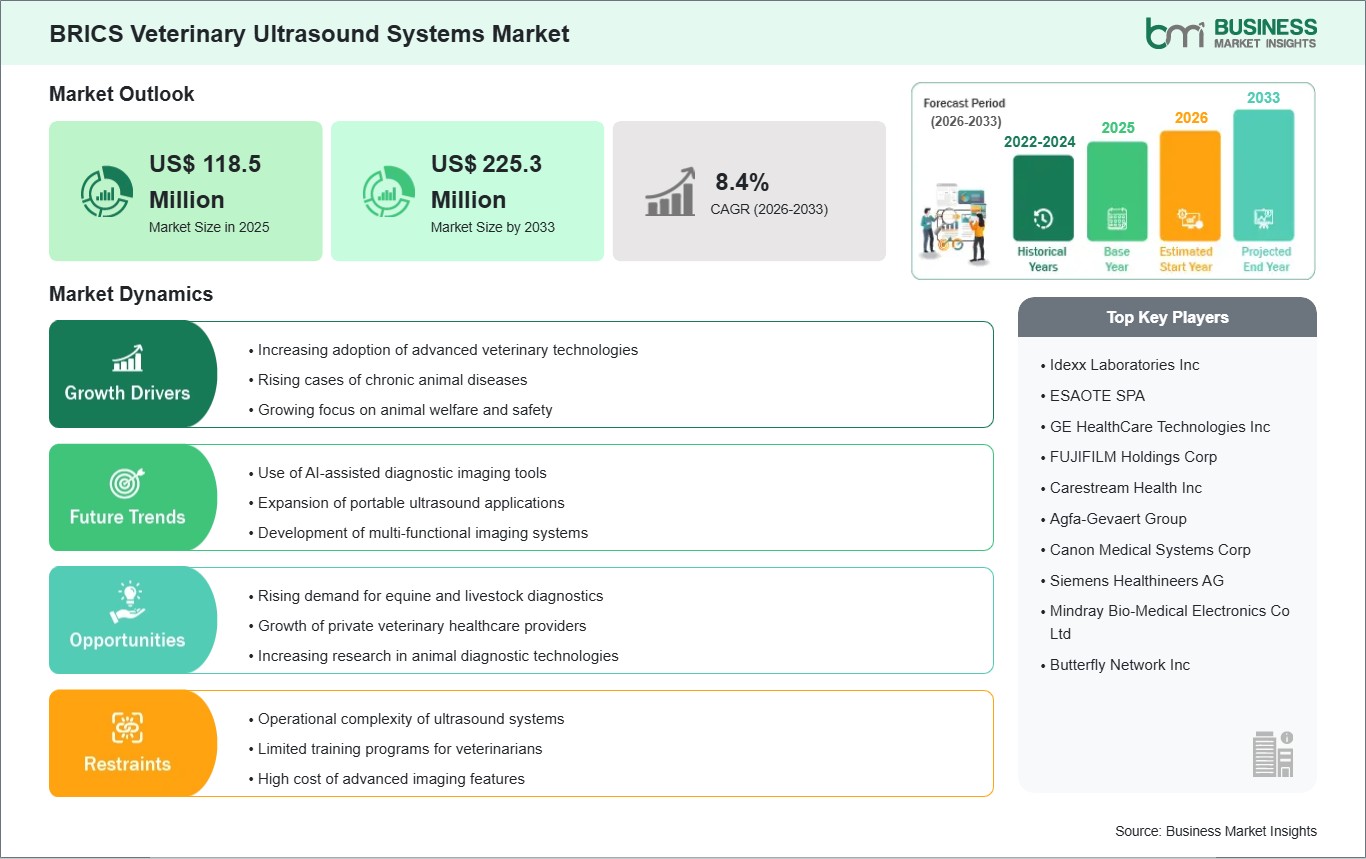
The BRICS veterinary ultrasound systems market is experiencing dynamic growth, driven by large livestock population, expanding companion animal ownership and increasing investment in animal health care infrastructure. Brazil, Russia, India, China and South Africa collectively account for a significant share of regional demand, based on their diverse agricultural and veterinary landscapes. Growth has been fueled by the increasing acceptance of ultrasound systems for fertility management, herd health monitoring and disease detection in both commercial and smallholder livestock operations. Technological advancements are at the heart of market expansion, with portable, handheld and high-resolution ultrasound devices gaining popularity. These solutions provide practical benefits for field-based applications, especially in remote or resource-constrained areas. Vendors are focusing on affordability, durability, and user-friendly interfaces to address varying levels of technical expertise among veterinary professionals. Government initiatives and public-private partnerships supporting livestock productivity, food safety and veterinary education are further driving market demand. In the companion animal sector, urbanization and rising disposable incomes are driving the adoption of advanced diagnostic technologies in veterinary clinics. The competitive dynamic consists of a mix of global manufacturers and regional distributors, with after-sales support, training programs and local service playing an important role in purchasing decisions. While challenges such as infrastructure limitations, price sensitivity and uneven skill levels remain, the BRICS veterinary ultrasound market exhibits strong long-term potential, supported by the modernization of animal health care practices.
Segment Analysis
BRICS Veterinary Ultrasound Systems Market Segmentation
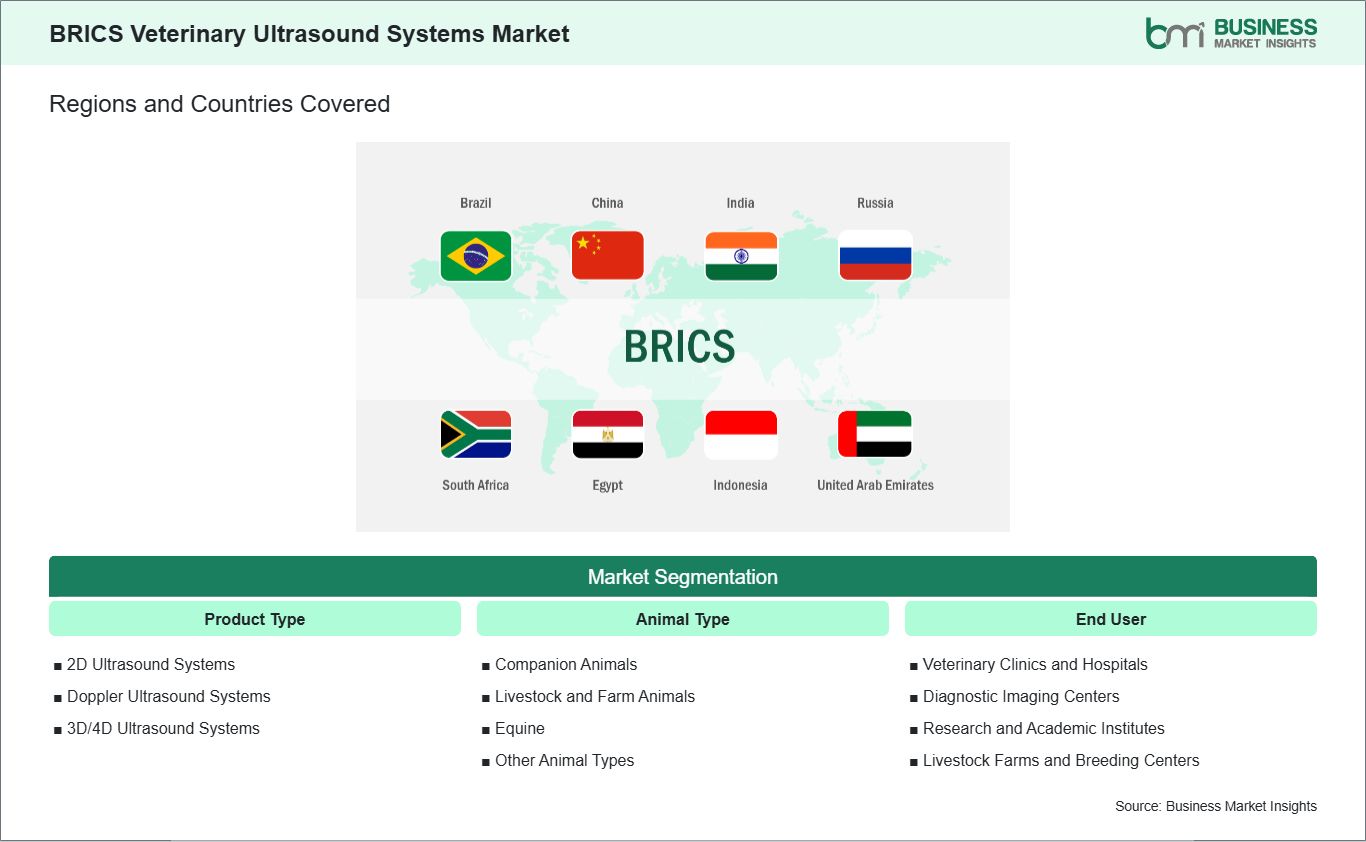
Key segments that contributed to the derivation of the BRICS veterinary ultrasound systems market analysis are product type, animal type, and end user.
- By product type, the veterinary ultrasound systems market is segmented into 2d ultrasound systems, doppler ultrasound systems, 3d/4d ultrasound systems. The digital 2d ultrasound systems segment dominated the market in 2025.
- Based on animal type, the veterinary ultrasound systems market is categorized into companion animals, livestock and farm animals, equine, other animal types. The companion animals segment dominated the market in 2025.
- In terms of end user, the veterinary ultrasound systems market is categorized into veterinary clinics and hospitals, diagnostic imaging centers, research and academic institutes, livestock farms and breeding centers. The veterinary clinics and hospitals segment dominated the market in 2025.
Market Forces
BRICS Veterinary Ultrasound Systems Market Drivers and Opportunities
Growing livestock sector and meat demand
The BRICS veterinary ultrasound systems market is primarily driven by the expansion of the livestock sector to meet the increasing meat and dairy consumption. Brazil and China are leaders in large-scale cattle and poultry farming, while India focuses on both dairy and small ruminant farming. The increasing consumer demand for protein-rich diets has encouraged farmers to improve productivity and efficiency through modern livestock management practices.
Veterinary ultrasound systems are increasingly being used to increase fertility and monitor herd health. In areas such as Maharashtra (India) and Mato Grosso (Brazil), ultrasound helps detect pregnancies early, manage reproductive cycles, and identify internal health problems before they affect production. This reduces losses due to reproductive failures or disease and contributes directly to higher production and profitability.
Additionally, the governments of BRICS countries are supporting livestock modernization programs through training, subsidies and disease control initiatives. These programs emphasize preventive health care and productivity monitoring, awareness raising, and adoption of advanced diagnostic tools. As the livestock sector continues to grow, veterinary ultrasound systems are becoming an essential part of herd management strategies in BRICS countries.
Expansion of mobile veterinary diagnostic services
The growth of mobile veterinary services across BRICS presents a huge opportunity for the ultrasound systems market. In countries such as India, Brazil and Russia, large rural areas and dispersed livestock populations make on-site diagnosis necessary. Mobile clinics equipped with portable ultrasound equipment allow veterinarians to provide timely care, monitor reproductive cycles, and detect internal diseases without requiring animals to travel long distances.
Portable ultrasound equipment also facilitates disease surveillance in emerging livestock sectors. Early detection of reproductive or organ-related problems reduces economic losses and improves herd health management. This capability is increasingly relevant in China and South Africa, where intensive and smallholder farming co-exist and veterinary access can be unequal.
Training initiative for veterinary professionals in BRICS countries further accelerates adoption of mobile diagnostic technologies. Practical programs improve familiarity with ultrasound systems, allowing veterinarians to take advantage of the technology for both preventive care and emergency diagnosis. As mobile veterinary services expand, portable ultrasound systems are expected to become standard equipment to improve herd health, productivity and animal welfare throughout BRICS countries.
Size and Share Analysis
BRICS Veterinary Ultrasound Systems Market Size and Share Analysis
The Eastern Europe veterinary ultrasound systems market demonstrates steady growth, with size and share analysis highlighting evolving trends and competitive dynamics among key players. The report examines subsegments categorized within product type, animal type, and end user, offering insights into their contribution to overall market performance.
By product type, the 2d ultrasound systems subsegment dominated the market in 2025 driven by their widespread clinical utility, cost‑effectiveness, ease of use and strong adoption in routine veterinary diagnostics across practices in Eastern Europe.
Based on animal type, the companion animals subsegment dominated the market in 2025, driven by their widespread clinical utility, cost‑effectiveness, ease of use and strong adoption in routine veterinary diagnostics across practices in Eastern Europe.
In terms of end user, the veterinary clinics and hospitals subsegment dominated the market in 2025, driven by their widespread clinical utility, cost‑effectiveness, ease of use and strong adoption in routine veterinary diagnostics across practices in Eastern Europe.
Report Coverage
BRICS Veterinary Ultrasound Systems Market Report Coverage and Deliverables
The "Eastern Europe Veterinary Ultrasound Systems Market Size and Forecast (2022–2033)" report provides a detailed analysis of the market covering below areas:
- Eastern Europe Veterinary Ultrasound Systems Market size and forecast at global, regional, and country levels for all the key market segments covered under the scope
- Eastern Europe Veterinary Ultrasound Systems Market trends, as well as drivers, restraints, and opportunities
- Eastern Europe Veterinary Ultrasound Systems Market analysis covering key trends, global and regional framework, major players, regulations, and recent developments
- Industry landscape and competition analysis covering market concentration, heat map analysis, prominent players, and recent developments for the Eastern Europe Veterinary Ultrasound Systems Market
- Detailed company profiles, including SWOT analysis
Geographic Insights
BRICS Veterinary Ultrasound Systems Market Geographic Insights
The geographical scope of the Eastern Europe Veterinary Ultrasound Systems Market report is divided into Russia, Poland, Ukraine, Romania, the Czech Republic, Slovakia, Bulgaria, Greece. The Russia held the largest share in 2025.
Country-level insights in Eastern Europe highlight varied adoption trends influenced by livestock density, companion animal care, and veterinary infrastructure. Russia emerges as the dominant market, supported by its large livestock population, extensive commercial farming, and government-backed animal health initiatives. High demand for ultrasound systems exists in both reproductive monitoring and herd health management, while urban veterinary clinics increasingly adopt advanced imaging technologies for companion animals. Well-established veterinary institutions and growing awareness of preventive care reinforce Russia’s leading position in the region. Poland represents a strong market driven by a modernized livestock sector, particularly in dairy and swine farming. Adoption of ultrasound systems is supported by structured veterinary services, government programs promoting herd productivity, and increasing awareness of reproductive health management among farmers. Ukraine shows steady growth, fueled by modernization of poultry and cattle farming and increasing use of portable ultrasound devices in rural and semi-urban areas. Veterinary clinics are gradually expanding diagnostic capabilities to meet rising companion animal care demand. Romania and Bulgaria demonstrate gradual adoption, primarily focused on livestock management and reproductive monitoring. Growth is supported by government initiatives for animal health improvement and partnerships with veterinary associations. The Czech Republic and Slovakia exhibit niche growth, with demand concentrated in both companion animal clinics and commercial farms that are integrating modern diagnostic technologies. Greece represents a smaller market within the region, with adoption largely driven by livestock reproductive monitoring and select urban veterinary practices. Across Eastern Europe, regulatory support, veterinary infrastructure, and technical expertise remain key determinants for market penetration, while Russia’s scale, institutional backing, and high integration of diagnostic technologies establish it as the dominant hub for veterinary ultrasound systems.
Industry Activity
Recent Developments
The Eastern Europe Veterinary Ultrasound Systems Market is evaluated by gathering qualitative and quantitative data post primary and secondary research, which includes important corporate publications, association data, and databases. A few of the key developments in the Eastern Europe veterinary ultrasound systems market are:
- In October 2025, Clarius Mobile Health released the Auto Preset AI VET tool—an AI‑powered ultrasound feature for veterinary care that automatically optimizes imaging settings on Clarius handheld ultrasound devices to improve workflow and full‑body exams.
- In July 2024, Mindray Animal Medical announced the debut launch of its Vetus 80 veterinary ultrasound machine during the ZST & Vetus 80 Launching Conference in Bucharest, Romania, unveiling a new high‑end diagnostic ultrasound platform designed for advanced veterinary imaging in clinical settings, marking a direct product introduction event in Eastern Europe.
Trust & Transparency
Research Methodology
The market analysis combines proprietary research with secondary data from government agencies, company disclosures, regulatory filings, industry databases and expert interviews. Market estimates are validated through data triangulation, cross-market benchmarking and analyst
review.
View Full Research Methodology
Key Sources Referred:
World Health Organization (WHO)Organisation for Economic Cooperation and Development (OECD)The World Bank GroupWorldometerThe LancetInternational Bar AssociationInternational Trade Administration