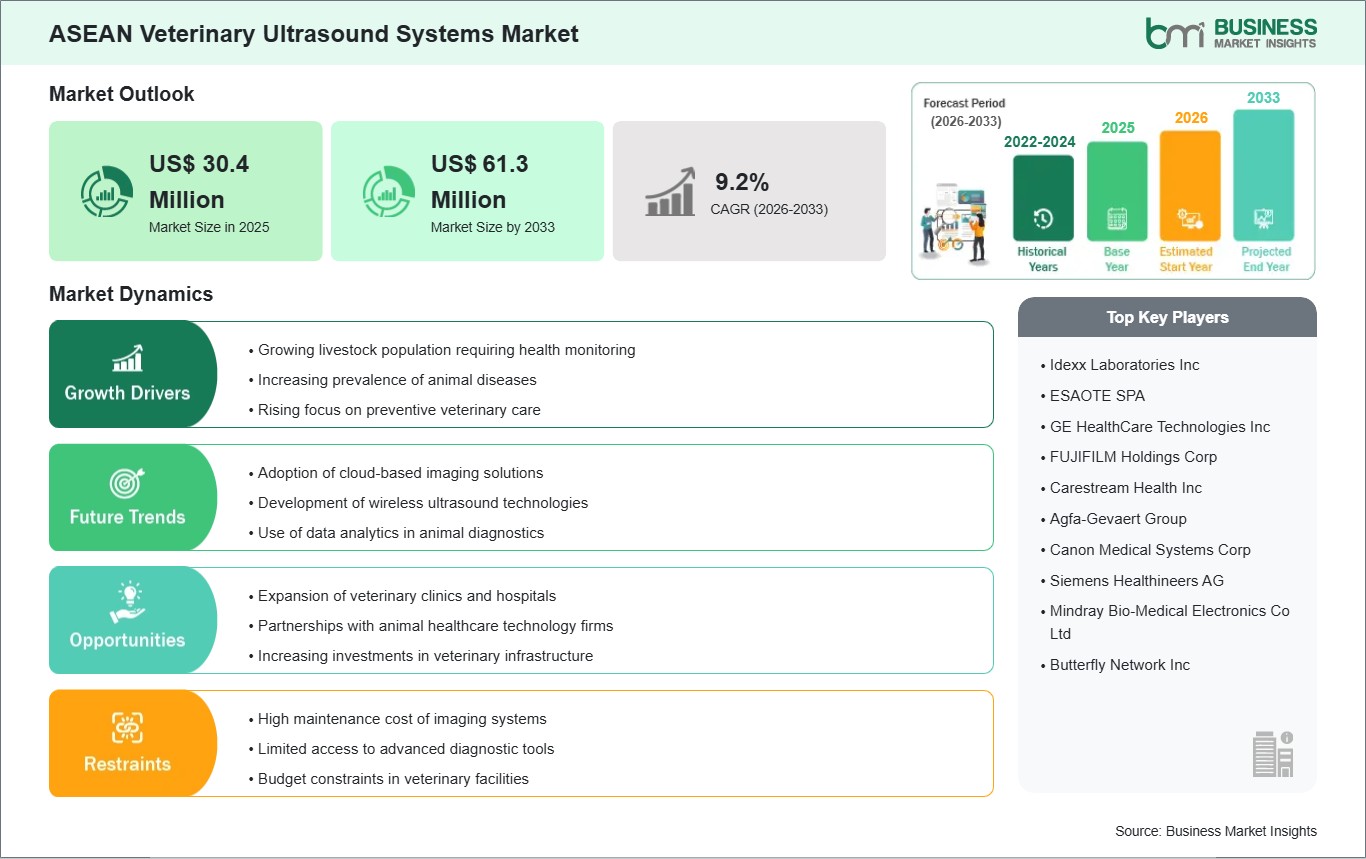
The ASEAN veterinary ultrasound systems market size is expected to reach US$61.3 million by 2033 from US$30.4 million in 2025. The market is estimated to record a CAGR of 9.2% from 2026 to 2033.
The ASEAN veterinary ultrasound systems market is undergoing notable expansion, driven by the region’s evolving animal healthcare ecosystem and increasing integration of technology into veterinary diagnostics. A key growth driver is the rising commercialization of livestock farming, particularly in countries with strong poultry, aquaculture, and swine industries. Producers are increasingly prioritizing early disease detection and reproductive monitoring to improve yield efficiency and reduce operational risks. This shift is encouraging the adoption of ultrasound systems as a reliable, non-invasive diagnostic tool across both large-scale farms and mid-sized agricultural operations. In parallel, the companion animal segment is gaining momentum due to urbanization, rising disposable incomes, and changing consumer attitudes toward pet care. Veterinary clinics are expanding their diagnostic capabilities to meet growing expectations for advanced treatment, thereby supporting demand for compact and high-resolution ultrasound devices. Market participants are also introducing cost-optimized and portable systems tailored to diverse clinical and field requirements, enhancing accessibility across urban and rural settings. The competitive landscape is shaped by the presence of international manufacturers alongside regional distributors who focus on localized service delivery and pricing strategies. Training and technical support remain critical components of vendor differentiation, as skill gaps in ultrasound operation persist in certain markets. Additionally, government initiatives aimed at strengthening animal health surveillance and food safety standards are indirectly contributing to market growth. Despite challenges such as uneven infrastructure development and regulatory fragmentation, the ASEAN market presents strong long-term potential supported by agricultural modernization and expanding veterinary care awareness.

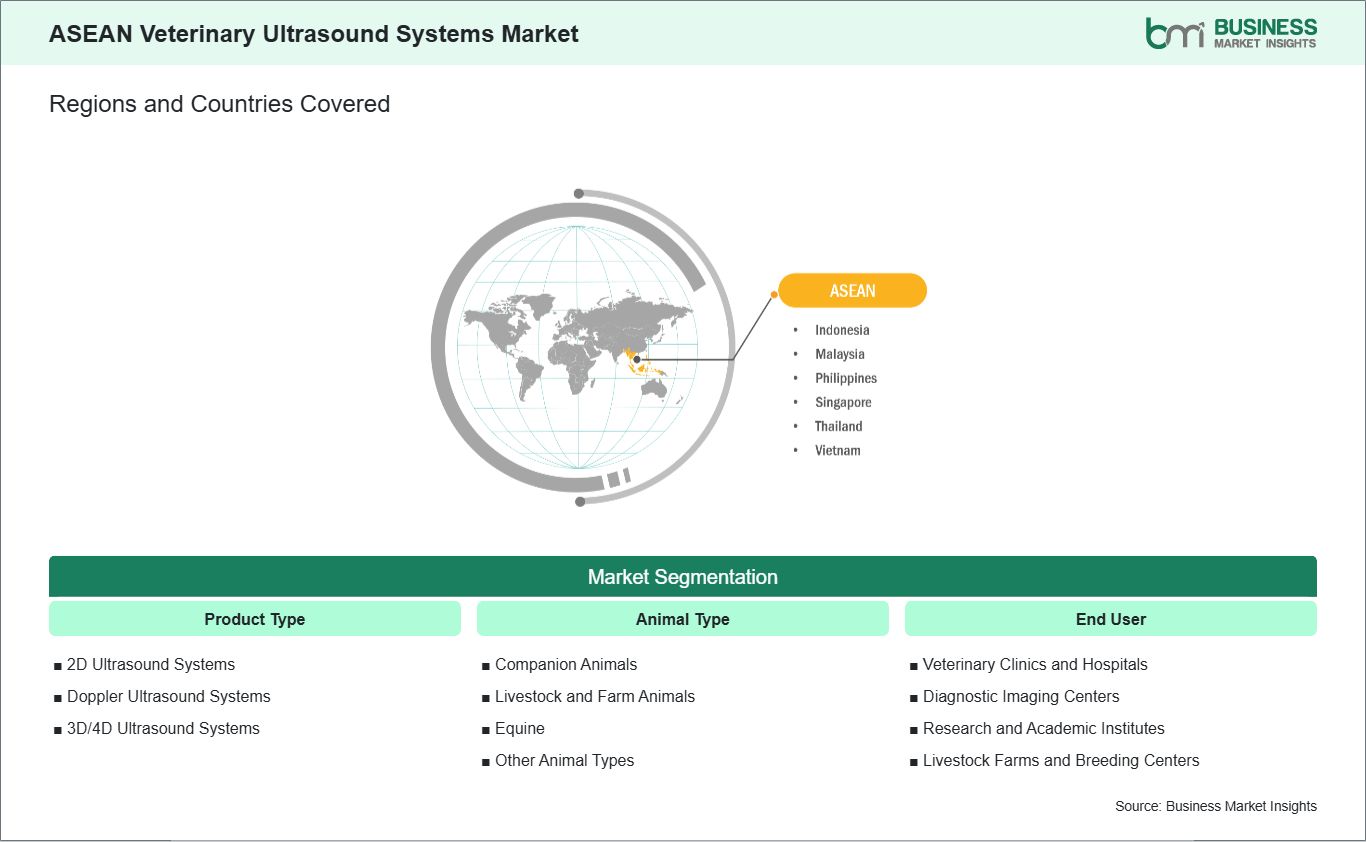
Key segments that contributed to the derivation of the ASEAN veterinary ultrasound systems market analysis are product type, animal type, and end user.
Government-sponsored initiatives are increasingly driving the veterinary ultrasound industry for livestock in the ASEAN region to achieve higher productivity of livestock. Examples of these programs are in Thailand, Vietnam, and the Philippines, where governments have implemented initiatives to support artificial insemination, herd health management, and breeding efficiency. In these programs, farmers are encouraged to use new technologies, including veterinary ultrasound systems, to monitor their livestock's reproductive cycles and produce better quality livestock.
In addition to these government contracts, the use of ultrasound technology is often paired with the provision of subsidies and technical assistance to smallholder farmers in Indonesia and Myanmar, where most smallholder farmers depend heavily on livestock as a primary source of income. By providing smallholder farmers with access to advanced reproductive imaging technology, governments help reduce reproductive inefficiencies and improve the overall quality of livestock.
Veterinary ultrasound technology has played a significant role in helping farmers achieve these goals by allowing farmers to accurately determine if a sow is pregnant, detect the presence of disease at early stages of its development, and manage and raise higher value animals.
The ASEAN Livestock Network, through regional collaboration, creates opportunities for member countries to share knowledge and experience and establish standard operating procedures for livestock health. These collaborations enhance the use of veterinary diagnostic technologies that are already utilized by member countries in their respective countries and across national borders.
Thus, the growing integration of veterinary diagnostic ultrasound systems into government-led productivity improvement programs will promote further improvement of livestock productivity in the ASEAN region for years to come.
The trend of using AI-enabled ultrasound systems is rapidly taking place in the ASEAN region. AI-based imaging technology offers advanced imaging solutions by using artificial intelligence to automatically identify potential issues; evaluate reproductive status; and monitor herds for changes in health, thereby reducing dependence on human interpretation of images. This type of technology is especially beneficial in high-density livestock regions, such as Vietnam's Red River Delta and Java, Indonesia, where rapid and accurate diagnosis is critical to effective management of herds.
AI-assisted ultrasound also supports telemedicine applications for veterinarians to conduct remote consultations in rural or isolated areas. Combining the imaging results with data analytics provides users with the opportunity to manage herd health proactively, monitor disease before it occurs, and make informed decisions about breeding programs. These benefits are consistent with the ASEAN objective of supporting the development of digital agriculture and precision livestock farming, allowing farmers to achieve optimal levels of production, while at the same time minimizing losses from disease or reproductive inefficiencies.
In addition, there is a growing emphasis on incorporating AI-enabled imaging tools into the veterinary curriculum at several universities throughout Asia, including in Thailand, Malaysia, and the Philippines. Incorporating these tools into the training programs enhances the skills of veterinary professionals, instilling confidence in using advanced ultrasound equipment while increasing the speed that new technology is adopted. With AI-enabled diagnostic systems becoming more accessible, they will have a profound impact on veterinary medicine, providing a superior quality of care to animals.

The ASEAN veterinary ultrasound systems market demonstrates steady growth, with size and share analysis highlighting evolving trends and competitive dynamics among key players. The report examines subsegments categorized within product type, animal type, and end user, offering insights into their contribution to overall market performance.
By product type, the 2d ultrasound systems subsegment dominated the market in 2025, driven by its enhanced image quality, faster processing time, and growing adoption in modern veterinary practices.
Based on animal type, the companion animals subsegment dominated the market in 2025, driven by increasing pet ownership and rising demand for advanced diagnostic imaging in routine veterinary care.
In terms of end user, the veterinary clinics and hospitals subsegment dominated the market in 2025, driven by the widespread adoption of x-ray systems for comprehensive diagnostic and treatment services.
| Report Attribute | Details |
|---|---|
| Market size in 2025 | US$ 30.4 Million |
| Market Size by 2033 | US$ 61.3 Million |
| CAGR (2026 - 2033) | 9.2% |
| Historical Data | 2022-2024 |
| Forecast period | 2026-2033 |
| Segments Covered | By Product Type
|
|
Regions and Countries Covered
| |
| ASEAN | Indonesia, Malaysia, the Philippines, Singapore, Thailand, Vietnam |
| Market leaders and key company profiles |
|
The "ASEAN Veterinary Ultrasound Systems Market Size and Forecast (2022–2033)" report provides a detailed analysis of the market covering below areas:
The geographical scope of the ASEAN Veterinary Ultrasound Systems Market report is divided into Indonesia, Malaysia, the Philippines, Singapore, Thailand, Vietnam. The Indonesia held the largest share in 2025.
The adoption of veterinary diagnostic tools varies considerably by country in the ASEAN region and is affected by several factors including each country’s level of economic development, their priorities for agricultural development, and the maturity of their veterinary infrastructure. Indonesia is the largest marketplace for veterinary diagnostic tools in the region because there are a large number of animals kept for food production, Indonesia has a growing commercial farming industry, and the Government of Indonesia is placing increasing emphasis on improving animal health and productivity. The distance between farms located throughout the country has generated a large demand for portable and cost-effective ultrasound equipment so that veterinarians and farmers can efficiently monitor herd reproduction and identify disease. In addition, various public sector initiatives and international development programs that promote livestock production in Indonesia support the country’s leadership in the regional veterinary diagnostic tools marketplace. Thailand is a mature market with very high rates of adoption of advanced veterinary diagnostic tools. The success of Thailand’s livestock sector can be attributed to strong government support for livestock production, the existence of an extensive network of veterinary clinics and diagnostic laboratories, and the continual requirement for higher quality goods to export to international markets. Precision livestock production practices and companion animal healthcare in urban areas will continue to increase the technological sophistication of the market for veterinary diagnostic tools in Thailand. Vietnam is rapidly becoming an emerging market as it adopts modern livestock production practices in addition to implementing government-sponsored efforts to control diseases. Both B2B and B2C customers are making significant investments in ultrasound systems so as to increase herd health and comply with evolving animal welfare and food safety regulations; thus, the growth of the marketplace for ultrasound in Vietnam will continue. Malaysia continues to demonstrate steady growth supported by a strong regulatory environment, modern agricultural practices, and consistent economic growth.

The ASEAN Veterinary Ultrasound Systems Market is evaluated by gathering qualitative and quantitative data post primary and secondary research, which includes important corporate publications, association data, and databases. A few of the key developments in the ASEAN veterinary ultrasound systems market are:
The ASEAN Veterinary Ultrasound Systems Market is valued at US$ 30.4 Million in 2025, it is projected to reach US$ 61.3 Million by 2033.
As per our report ASEAN Veterinary Ultrasound Systems Market, the market size is valued at US$ 30.4 Million in 2025, projecting it to reach US$ 61.3 Million by 2033. This translates to a CAGR of approximately 9.2% during the forecast period.
The ASEAN Veterinary Ultrasound Systems Market report typically cover these key segments-
The historic period, base year, and forecast period can vary slightly depending on the specific market research report. However, for the ASEAN Veterinary Ultrasound Systems Market report:
The ASEAN Veterinary Ultrasound Systems Market is populated by several key players, each contributing to its growth and innovation. Some of the major players include:
The ASEAN Veterinary Ultrasound Systems Market report is valuable for diverse stakeholders, including:
Essentially, anyone involved in or considering involvement in the ASEAN Veterinary Ultrasound Systems Market value chain can benefit from the information contained in a comprehensive market report.
Please tell us your area of interest
(Market Segments/ Regions and Countries/ Companies)