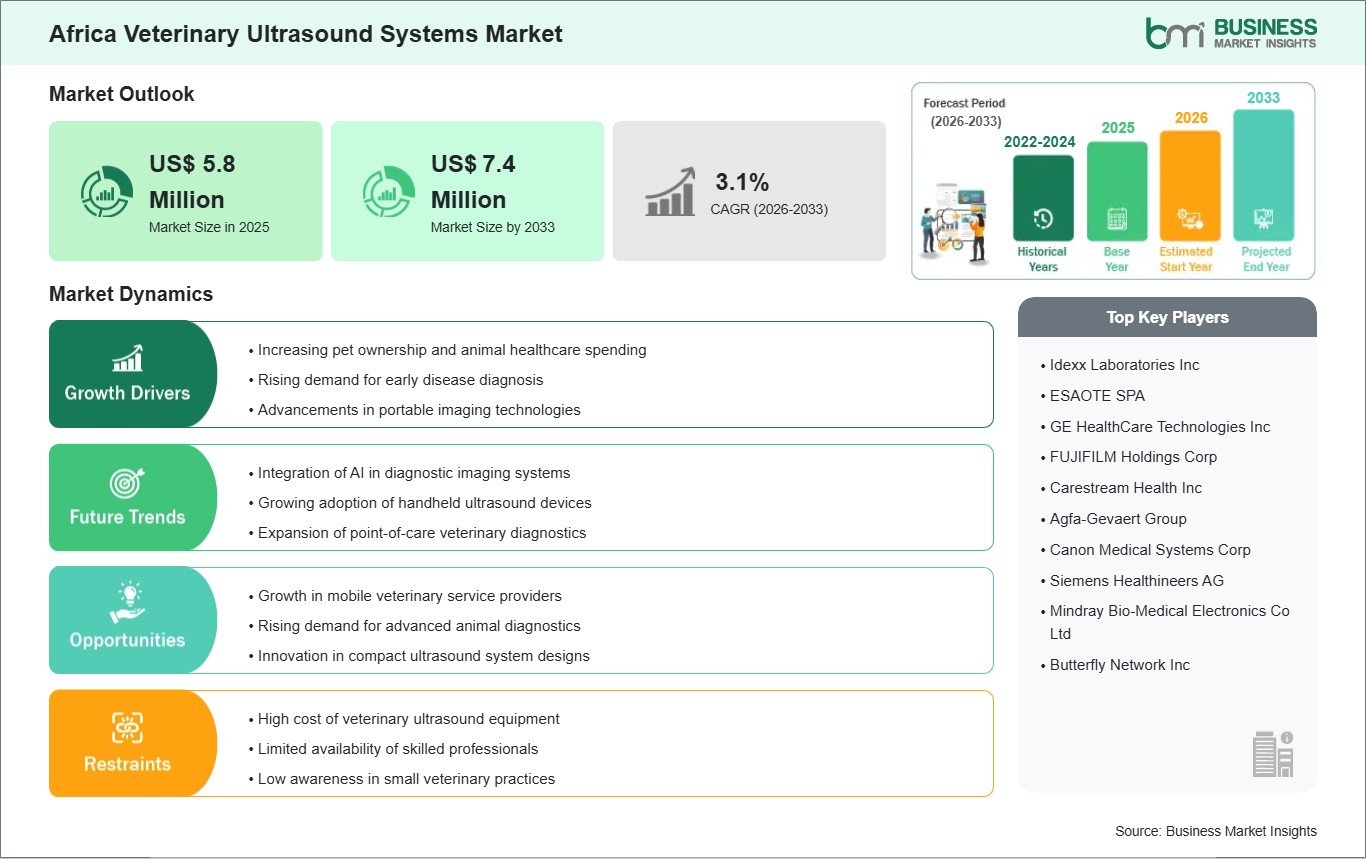
The Africa veterinary ultrasound systems market size is expected to reach US$7.4 million by 2033 from US$5.8 million in 2025. The market is estimated to record a CAGR of 3.1% from 2026 to 2033.
The Africa veterinary ultrasound systems market is experiencing a steady transformation driven by the gradual modernization of animal healthcare infrastructure and the increasing recognition of preventive diagnostics in veterinary practice. Market dynamics are influenced by the dual structure of the continent’s livestock economy and companion animal care segment. On the commercial side, livestock producers are adopting ultrasound systems to enhance reproductive efficiency, monitor herd health, and reduce economic losses associated with undetected diseases. This is particularly relevant in cattle, sheep, and goat farming, where productivity optimization is directly tied to diagnostic accuracy. The urban middle-class expansion is fostering growth in companion animal ownership, leading to higher demand for advanced diagnostic imaging in veterinary clinics. Technological evolution is shaping the market landscape. Portable and handheld ultrasound devices are gaining traction due to their affordability, ease of use, and suitability for remote and field-based veterinary applications. Vendors are focusing on durable, battery-operated systems tailored for challenging environments with limited infrastructure. Additionally, training and education initiatives are playing a crucial role in market development, as the availability of skilled veterinary professionals capable of operating ultrasound systems remains uneven across the region. The competitive environment is characterized by a mix of global manufacturers and regional distributors, with pricing sensitivity and after-sales support emerging as decisive factors in procurement decisions. Partnerships with veterinary associations and government-backed livestock programs are also influencing market penetration strategies. While infrastructure limitations and budget constraints continue to pose challenges, the outlook remains positive, supported by increasing awareness of animal health management and gradual improvements in veterinary service delivery frameworks.

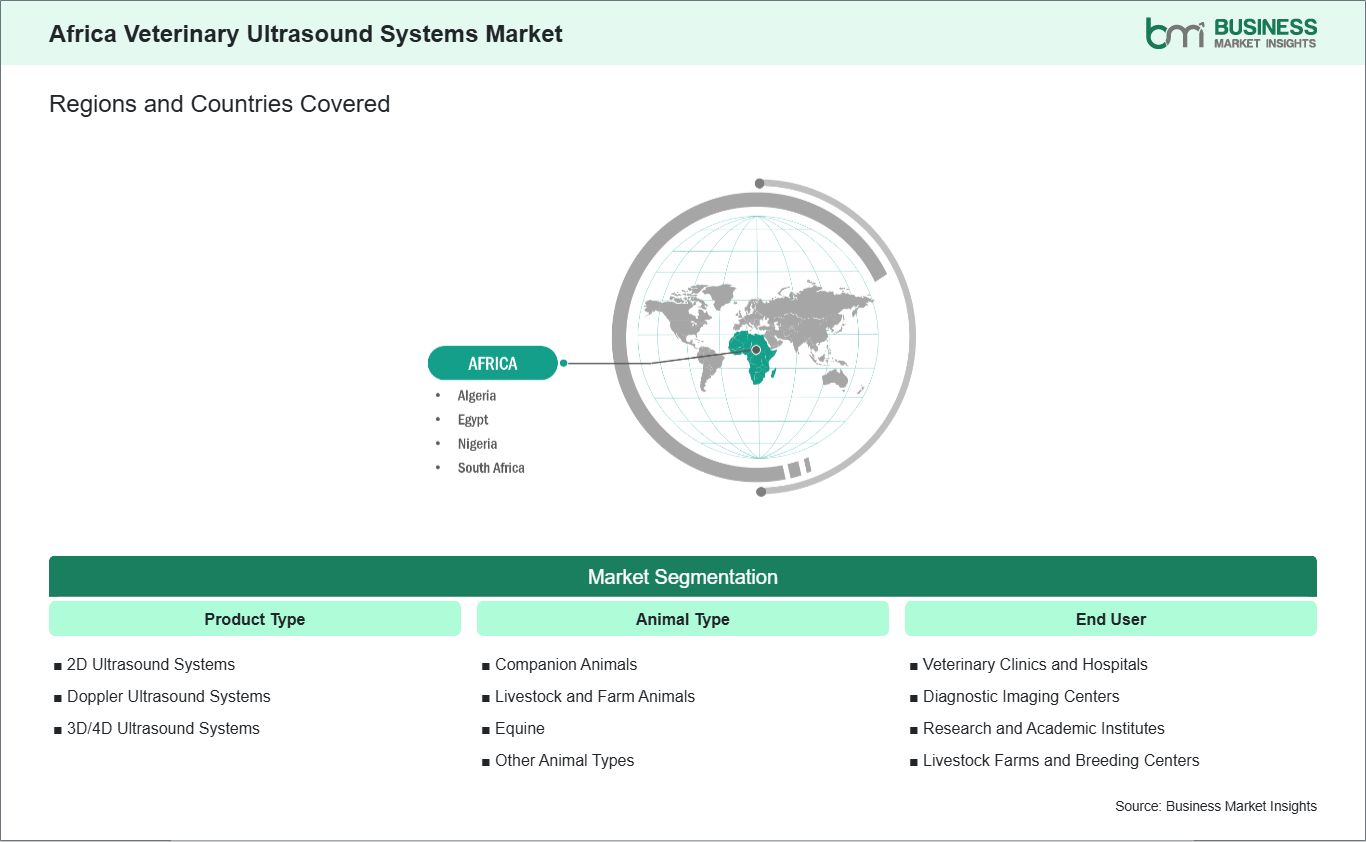
Key segments that contributed to the derivation of the Africa veterinary ultrasound systems market analysis are product type, animal type, and end user.
The veterinary ultrasound systems industry in Africa is driven by the rapid growth of the continent's livestock population, which plays an essential role in rural economies and food supplies. The countries that have a lot of livestock include Ethiopia, Sudan, and Kenya, and these three countries have hundreds of millions of cattle, sheep, and goats between them. In some agricultural regions, the livestock industry can contribute as much as 30–40% of the region's agricultural GDP. This steady increase in herd size has created a greater need for efficient tools to manage reproduction and monitor health, which has established the veterinary ultrasound systems as essential tools to help create more efficient productivity and support the sustainable development of livestock.
The need for more sophisticated diagnostic tools is increasing because of the high prevalence of animal disease throughout the region. Outbreaks of transboundary diseases such as foot-and-mouth disease and peste des petits ruminants are occurring and have detrimentally impacted herd health and the average farmer's income. The use of veterinary ultrasound systems enables the veterinarian to quickly diagnose internal abnormalities, complications arising from pregnancy, and disease of the internal organs, which allows for quicker treatment of the animals. This is important in regions where there is a delay in diagnosis that can lead to a loss of significant amounts of revenue and reduced quality of the livestock.
As a result of the increased awareness of agriculture and veterinary practitioners about preventive health care, there is a phased-in approach to adopting imaging technologies. Governments have also begun livestock health initiatives and have developed regional disease surveillance systems.
The development of veterinary capabilities in rural Africa will provide a growth opportunity for the veterinary ultrasound systems industry. The availability of veterinary services to remote areas has been limited, but continued investment in infrastructure for animal healthcare is beginning to expand service coverage. Many countries are building veterinary centers on the district level and developing community-based animal health programs, which will provide new channels for integrating technological innovations related to veterinary diagnostics, such as ultrasonic systems.
The role of mobile veterinary units is changing the way veterinarians provide services to urban veterinary clinics and livestock in rural areas, and they are becoming widespread in countries such as Tanzania and Nigeria, where they are utilizing portable, rapidly deployable diagnostic tools to help provide veterinary services to pastoral communities and smallholder farmers. By utilizing portable ultrasound equipment as part of mobile veterinary units, veterinarians have much more capacity for performing onsite diagnostics such as pregnancy checks, assessing internal trauma, and regularly tracking an animal's health without requiring farmers to travel long distances.
The increased focus on providing adequate veterinary education and capacity-building initiatives will solidify the groundwork for long-term sustainable adoption of veterinary technology. By implementing training programs targeted toward veterinarians and para-veterinarians, familiarity with the application of ultrasound technology will continue to increase for use in the livestock industry. As more veterinarians and para-veterinarians become more comfortable using imaging units, their acceptance of utilizing imaging units will continue to increase.

The Africa veterinary ultrasound systems market demonstrates steady growth, with size and share analysis highlighting evolving trends and competitive dynamics among key players. The report examines subsegments categorized within product type, animal type, and end user, offering insights into their contribution to overall market performance.
By product type, the 2d ultrasound systems subsegment dominated the market in 2025, driven by its enhanced image quality, faster processing time, and growing adoption in modern veterinary practices.
Based on animal type, the companion animals subsegment dominated the market in 2025, driven by increasing pet ownership and rising demand for advanced diagnostic imaging in routine veterinary care.
In terms of end user, the veterinary clinics and hospitals subsegment dominated the market in 2025, driven by the widespread adoption of x-ray systems for comprehensive diagnostic and treatment services.
| Report Attribute | Details |
|---|---|
| Market size in 2025 | US$ 5.8 Million |
| Market Size by 2033 | US$ 7.4 Million |
| CAGR (2026 - 2033) | 3.1% |
| Historical Data | 2022-2024 |
| Forecast period | 2026-2033 |
| Segments Covered | By Product Type
|
|
Regions and Countries Covered
| |
| Africa | Egypt, South Africa, Nigeria, Algeria |
| Market leaders and key company profiles |
|
The "Africa Veterinary Ultrasound Systems Market Size and Forecast (2022–2033)" report provides a detailed analysis of the market covering below areas:
The geographical scope of the Africa Veterinary Ultrasound Systems Market report is divided into Egypt, South Africa, Nigeria, and Algeria. The Nigeria held the largest share in 2025.
Country-level dynamics across Africa reveal variation in adoption patterns, regulatory environments, and investment priorities within the veterinary ultrasound systems market. Egypt emerges as the dominant market, supported by its relatively advanced veterinary infrastructure and strong government-backed livestock development initiatives. The country has a well-established network of veterinary institutions and diagnostic centers, enabling broader adoption of ultrasound systems in routine animal health management. Increasing focus on poultry and dairy productivity, with improved access to imported technologies, continues to strengthen Egypt’s leading position. South Africa represents a mature and technology-driven market, with widespread adoption of advanced veterinary diagnostic tools. The presence of a well-developed private veterinary sector and high awareness among animal owners contribute to consistent demand for high-performance ultrasound systems. The country’s emphasis on precision livestock farming and companion animal care accelerates the integration of imaging technologies into veterinary practices. Nigeria reflects a high-potential but developing market, driven by its large livestock base and increasing emphasis on improving animal health outcomes. Despite challenges such as cost sensitivity and limited infrastructure, demand is rising due to government agricultural programs and international support initiatives. Portable and affordable ultrasound devices are particularly gaining traction in this market. Algeria is witnessing gradual growth, supported by government efforts to enhance agricultural productivity and strengthen veterinary services. While adoption remains at an early stage, increasing awareness of disease prevention and herd monitoring is encouraging the use of ultrasound systems, particularly in state-supported livestock programs and emerging veterinary facilities.

The Africa Veterinary Ultrasound Systems Market is evaluated by gathering qualitative and quantitative data post primary and secondary research, which includes important corporate publications, association data, and databases. A few of the key developments in the Africa veterinary ultrasound systems market are:
The Africa Veterinary Ultrasound Systems Market is valued at US$ 5.8 Million in 2025, it is projected to reach US$ 7.4 Million by 2033.
As per our report Africa Veterinary Ultrasound Systems Market, the market size is valued at US$ 5.8 Million in 2025, projecting it to reach US$ 7.4 Million by 2033. This translates to a CAGR of approximately 3.1% during the forecast period.
The Africa Veterinary Ultrasound Systems Market report typically cover these key segments-
The historic period, base year, and forecast period can vary slightly depending on the specific market research report. However, for the Africa Veterinary Ultrasound Systems Market report:
The Africa Veterinary Ultrasound Systems Market is populated by several key players, each contributing to its growth and innovation. Some of the major players include:
The Africa Veterinary Ultrasound Systems Market report is valuable for diverse stakeholders, including:
Essentially, anyone involved in or considering involvement in the Africa Veterinary Ultrasound Systems Market value chain can benefit from the information contained in a comprehensive market report.
Please tell us your area of interest
(Market Segments/ Regions and Countries/ Companies)