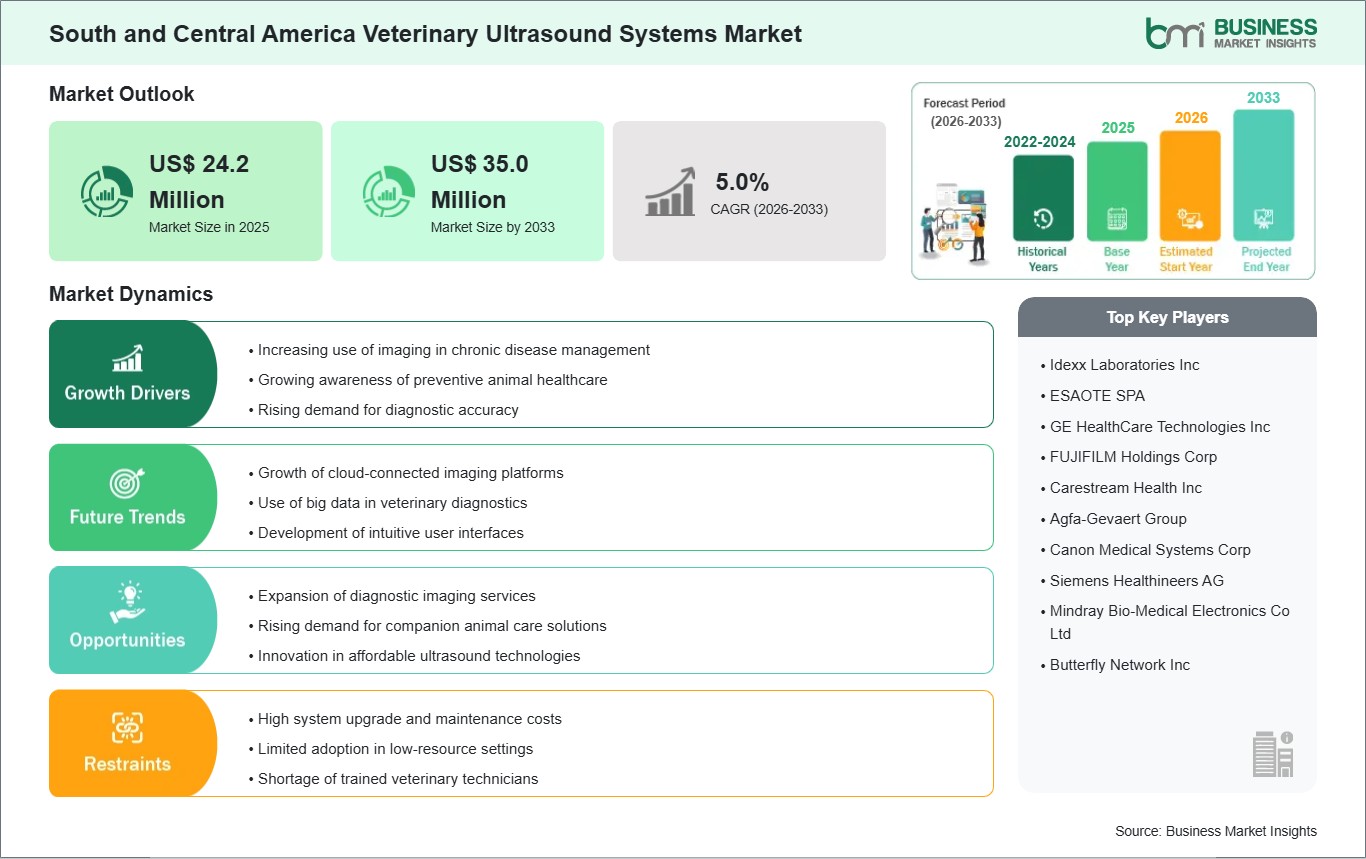
The South and Central America veterinary ultrasound systems market size is expected to reach US$35.0 million by 2033 from US$24.2 million in 2025. The market is estimated to record a CAGR of 5.0% from 2026 to 2033.
The South and Central America veterinary ultrasound systems market is experiencing steady growth, driven by the region’s extensive livestock industry, modernization of farming practices, and rising companion animal ownership. The large-scale production of cattle, poultry, and pigs is an important factor, considering that the use of ultrasound systems for reproduction monitoring, herd management, and disease identification is widely practiced. Government policies concerning the promotion of livestock health, food safety, and sustainable farming practices play a role in promoting technological solutions within veterinary medicine. Urbanization, along with rising disposable income, leads to higher demands for companion animal services, hence the purchase of higher-end and portable ultrasound devices by veterinary clinics. The portability of such solutions allows veterinarians to perform diagnoses in the field because of the geographic nature of farms and rural areas. Innovation, in this case, may refer to technological advances, including compact, easy-to-use ultrasound solutions. Market players include foreign manufacturers, local producers, and distributors. The purchase decision depends on the following factors: reliability, quality of post-sale service, and cost-effectiveness. Although there are problems in terms of cost sensitivity, underdeveloped infrastructure, and a lack of professional skills, the outlook seems positive due to livestock modernization trends and growing pet populations.

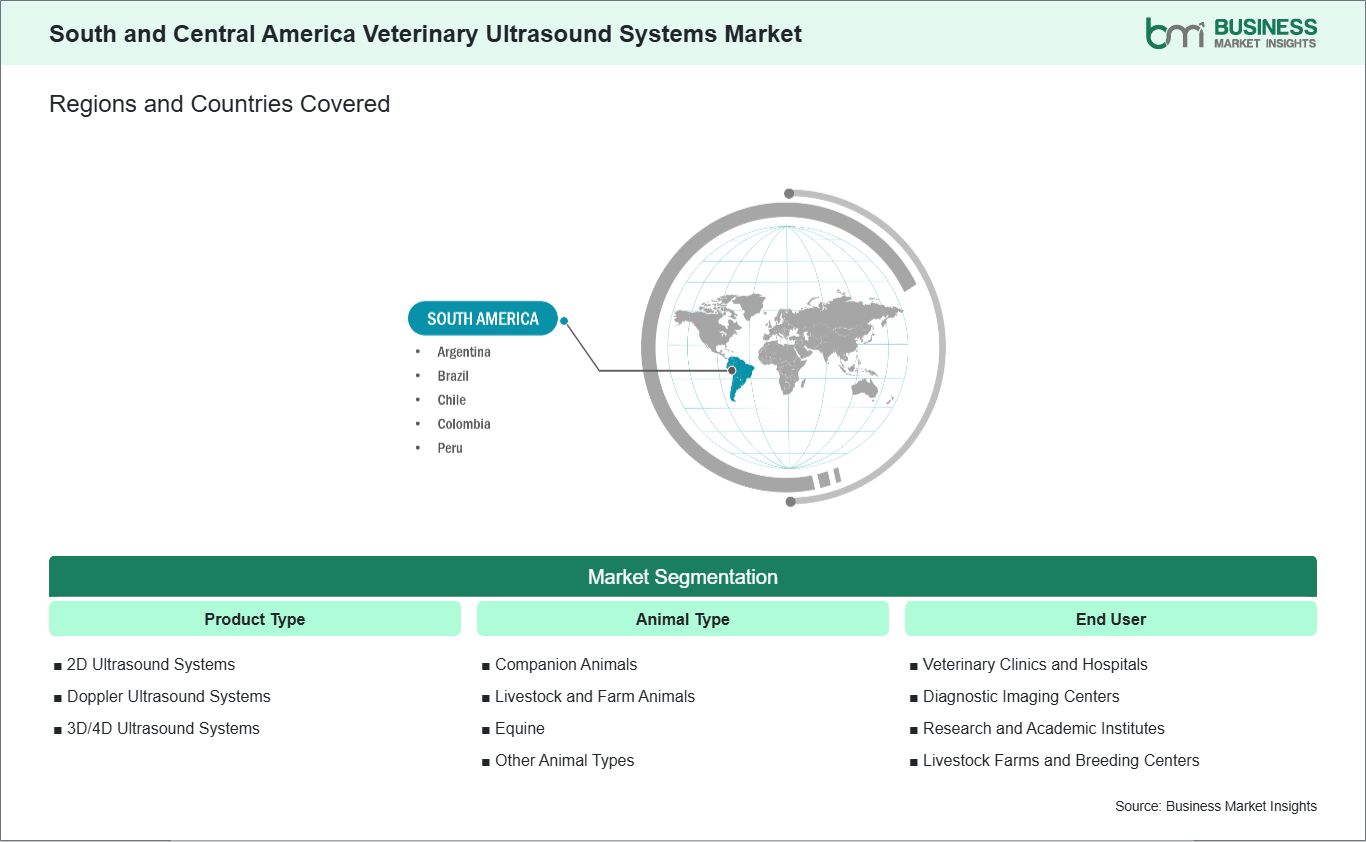
Key segments that contributed to the derivation of the South and Central America veterinary ultrasound systems market analysis are product type, animal type, and end user.
The South and Central America veterinary ultrasound systems market is driven by expanding commercial livestock and dairy production. Countries like Brazil, Argentina, Chile, and Colombia are setting up industrial cattle, pigs, and poultry farms to cater to the growing demand for meat and milk products. Ultrasound equipment in veterinary medicine plays an important role in ensuring that their reproductive performance is optimized while keeping any internal illnesses under control.
Governments and private organizations are also providing incentives for modernization. Programs focused on promoting improved herd fertility and disease prevention through ultrasound scans are leading to greater use of ultrasound technology among livestock farmers. For example, farmers in Argentina’s Pampas region and Southern Brazil are using ultrasound scans to improve calving success and prevent financial losses from any reproductive problems.
Moreover, awareness of the importance of livestock welfare and food quality has made the use of such diagnostic tools more relevant in the export market. By incorporating ultrasounds, they can guarantee healthy livestock and high-quality products for export purposes. With the growth of industrial farms across South and Central America, the need for ultrasounds will continue to increase.
The increasing use of mobile and field veterinary services presents a significant opportunity in South and Central America. Most farms are situated in isolated and rural settings where clinics are inaccessible. With the help of portable ultrasounds, the vet can perform reproductive evaluations, checkups, and diagnoses right on the spot.
The use of mobile veterinary units has gained popularity in countries like Brazil, Colombia, and Peru. Mobile veterinary units utilize portable ultrasound technology to diagnose livestock, including cattle and pigs. This technique helps improve herding techniques, early detection of diseases, and reproductive efficiency among scattered farms in South and Central America.
In addition, training for veterinary technicians involves using portable ultrasound devices. By teaching veterinarians to operate these devices, adoption levels are anticipated to increase. As mobile diagnostics continue to develop, the demand for veterinary ultrasound technology is projected to grow significantly throughout South and Central America.

The South and Central America veterinary ultrasound systems market demonstrates steady growth, with size and share analysis highlighting evolving trends and competitive dynamics among key players. The report examines subsegments categorized within product type, animal type, and end user, offering insights into their contribution to overall market performance.
By product type, the 2d ultrasound systems subsegment dominated the market in 2025, driven by their widespread clinical utility, cost-effectiveness, ease of use, and strong adoption in routine veterinary diagnostics across South and Central American veterinary practices.
Based on animal type, the companion animals subsegment dominated the market in 2025, driven by rising pet ownership, increasing awareness of animal health, and growing expenditure on veterinary diagnostic and preventive care in South and Central America.
In terms of end user, the veterinary clinics and hospitals subsegment dominated the market in 2025, driven by gradual expansion of veterinary infrastructure and adoption of modern imaging technologies across clinics and hospitals in South and Central America.
| Report Attribute | Details |
|---|---|
| Market size in 2025 | US$ 24.2 Million |
| Market Size by 2033 | US$ 35.0 Million |
| CAGR (2026 - 2033) | 5.0% |
| Historical Data | 2022-2024 |
| Forecast period | 2026-2033 |
| Segments Covered | By Product Type
|
|
Regions and Countries Covered
| |
| South and Central America | Brazil, Argentina, Peru, Chile, Colombia |
| Market leaders and key company profiles |
|
The "South and Central America Veterinary Ultrasound Systems Market Size and Forecast (2022–2033)" report provides a detailed analysis of the market covering below areas:
The geographical scope of the South and Central America Veterinary Ultrasound Systems Market report is divided into Brazil, Argentina, Peru, Chile, Colombia. The Brazil held the largest share in 2025.
Country-level insights in South and Central America reveal varying adoption trends across livestock and companion animal sectors. Brazil emerges as the dominant market, supported by its large-scale cattle, poultry, and swine operations, advanced veterinary infrastructure, and government-backed livestock productivity programs. Ultrasound systems are extensively used for reproductive monitoring, herd health management, and early disease detection, while urban veterinary clinics increasingly integrate high-resolution and portable devices for companion animal care. Strong institutional support, professional training programs, and modernization of livestock practices reinforce Brazil’s leadership position in the region. Argentina shows steady adoption, particularly in commercial livestock operations focused on reproductive efficiency and disease prevention. Veterinary clinics and farms are gradually investing in portable ultrasound systems to enhance herd management and optimize productivity. Peru represents a niche market, with adoption primarily concentrated on small- to mid-sized livestock farms seeking cost-effective reproductive and herd monitoring solutions. Portable and user-friendly systems are favored due to infrastructure limitations and dispersed farm locations. Chile demonstrates emerging growth, driven by livestock modernization and an increasing focus on companion animal diagnostics. High-resolution and field-capable ultrasound systems are gradually being integrated into veterinary practices to improve diagnostic accuracy. Colombia exhibits rising adoption in both livestock and companion animal segments, supported by government initiatives for animal health and increasing urban pet ownership. Portable ultrasound devices are gaining traction in rural and urban veterinary applications alike. Across South and Central America, market growth is shaped by regulatory frameworks, veterinary infrastructure, technical expertise, and growing awareness of preventive animal healthcare, with Brazil maintaining its dominant position due to scale, institutional backing, and widespread integration of veterinary ultrasound technologies.

The South and Central America Veterinary Ultrasound Systems Market is evaluated by gathering qualitative and quantitative data post primary and secondary research, which includes important corporate publications, association data, and databases. A few of the key developments in the South and Central America veterinary ultrasound systems market are:
The South and Central America Veterinary Ultrasound Systems Market is valued at US$ 24.2 Million in 2025, it is projected to reach US$ 35.0 Million by 2033.
As per our report South and Central America Veterinary Ultrasound Systems Market, the market size is valued at US$ 24.2 Million in 2025, projecting it to reach US$ 35.0 Million by 2033. This translates to a CAGR of approximately 5.0% during the forecast period.
The South and Central America Veterinary Ultrasound Systems Market report typically cover these key segments-
The historic period, base year, and forecast period can vary slightly depending on the specific market research report. However, for the South and Central America Veterinary Ultrasound Systems Market report:
The South and Central America Veterinary Ultrasound Systems Market is populated by several key players, each contributing to its growth and innovation. Some of the major players include:
The South and Central America Veterinary Ultrasound Systems Market report is valuable for diverse stakeholders, including:
Essentially, anyone involved in or considering involvement in the South and Central America Veterinary Ultrasound Systems Market value chain can benefit from the information contained in a comprehensive market report.
Please tell us your area of interest
(Market Segments/ Regions and Countries/ Companies)