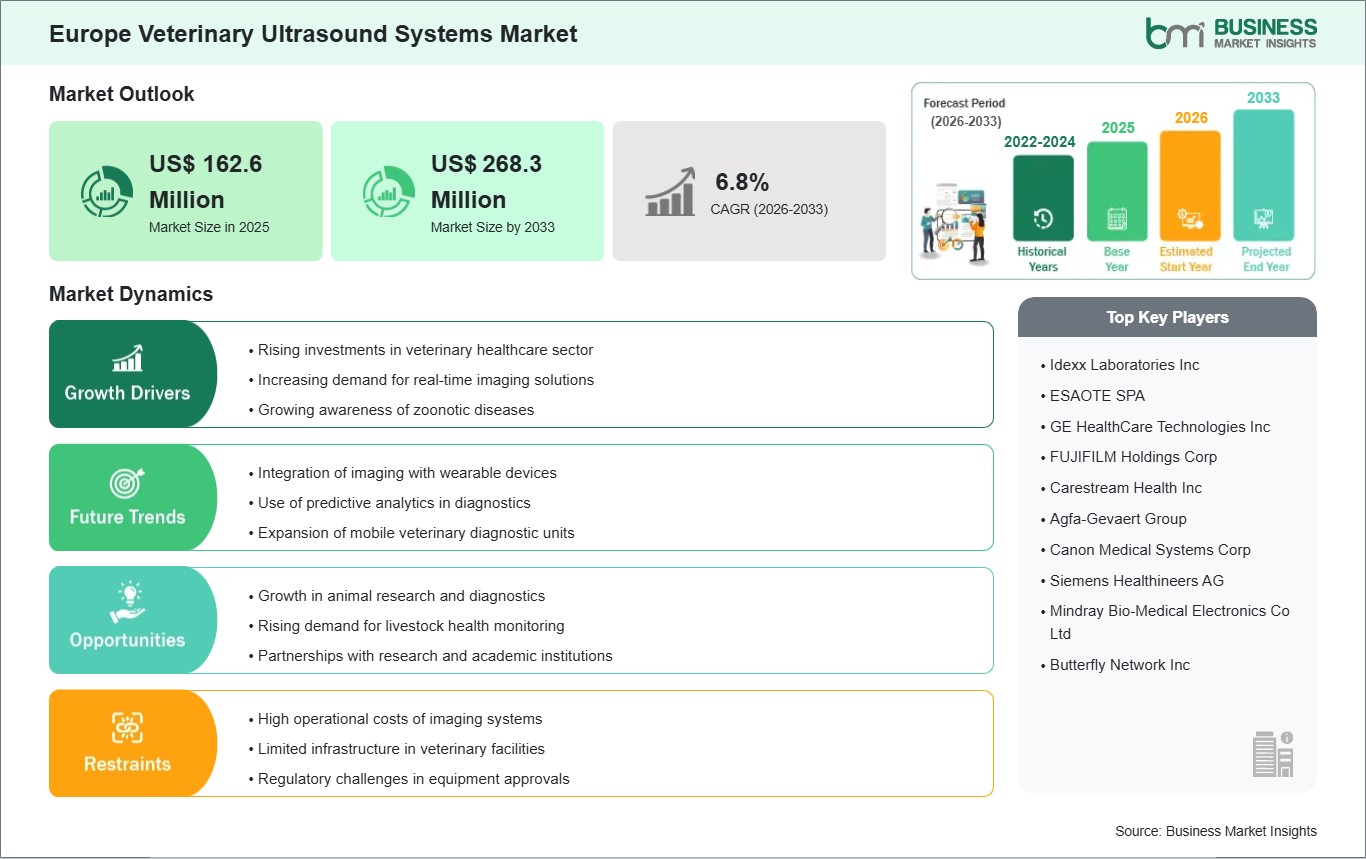
The Europe veterinary ultrasound systems market size is expected to reach US$268.3 million by 2033 from US$162.6 million in 2025. The market is estimated to record a CAGR of 6.8% from 2026 to 2033.
The Europe veterinary ultrasound systems market is experiencing steady growth, driven by modernization in livestock management, increasing companion animal ownership, and heightened awareness of preventive veterinary care. Livestock producers across the region are increasingly adopting ultrasound systems for reproductive monitoring, early disease detection, and herd productivity optimization. The dairy, swine, and poultry sectors are particularly focused on integrating diagnostic imaging into routine farm management practices to reduce losses and enhance operational efficiency. In parallel, urbanization and rising disposable incomes are boosting demand for companion animal care, prompting veterinary clinics to expand diagnostic capabilities. Portable and high-resolution ultrasound systems are increasingly preferred due to their versatility, field applicability, and ease of integration into veterinary workflows. Technological innovation, including user-friendly interfaces and durable designs, is facilitating broader adoption among veterinarians with varying levels of technical expertise. The competitive landscape in Europe features a combination of global equipment manufacturers, regional distributors, and specialized local providers. Procurement decisions are strongly influenced by factors such as after-sales support, training programs, pricing strategies, and service accessibility. Regulatory frameworks promoting animal welfare, food safety, and veterinary education indirectly support market growth, while infrastructure disparities and cost sensitivity remain challenges in certain regions. Overall, Europe presents a mature and diversified market for veterinary ultrasound systems, underpinned by strong institutional support, evolving consumer expectations, and widespread integration of diagnostic technologies across livestock and companion animal healthcare.

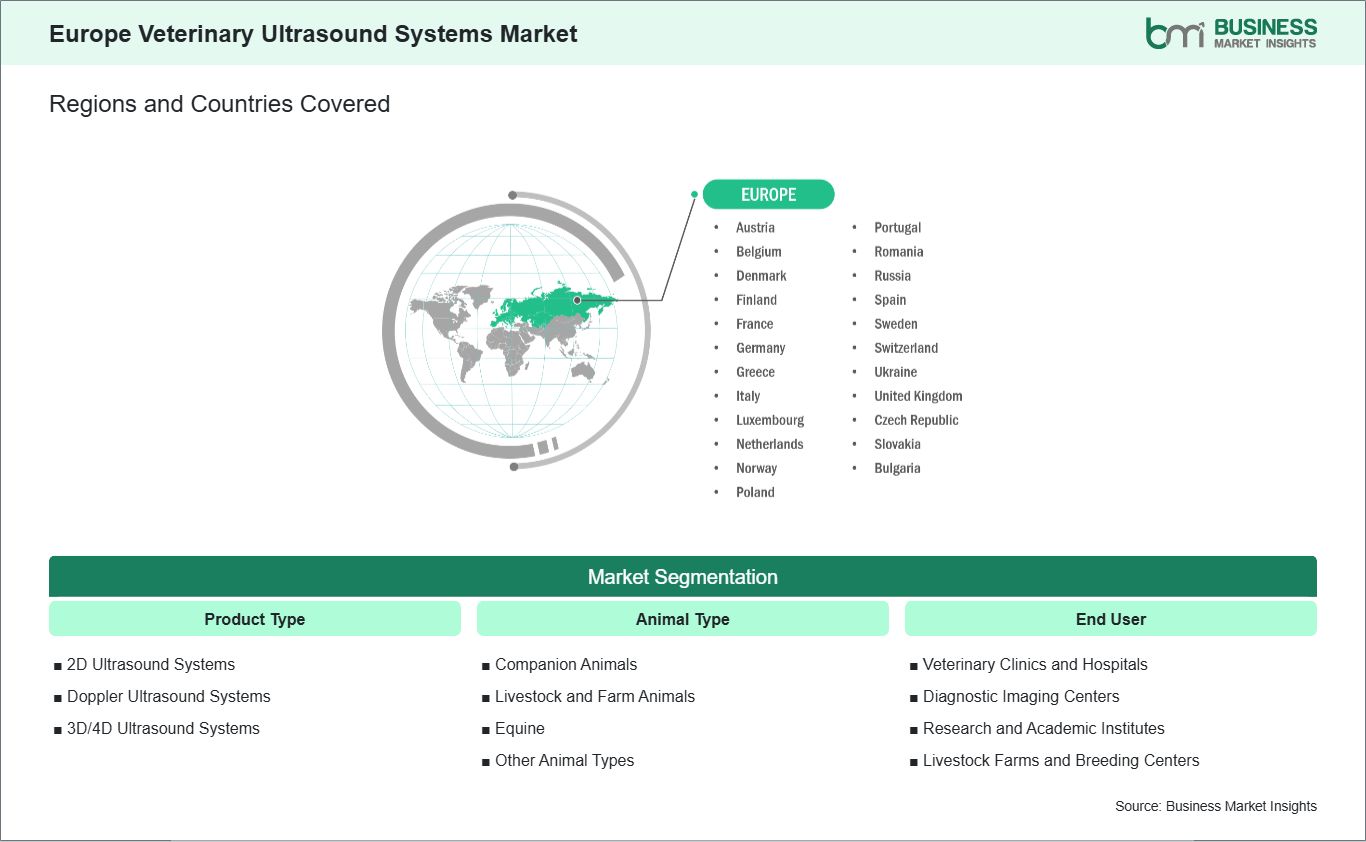
Key segments that contributed to the derivation of the Europe veterinary ultrasound systems market analysis are product type, animal type, and end user.
The growing use of precision livestock farming (PLF) practices in Europe is driving growth in veterinary ultrasound market. In countries such as Germany, France and Netherlands there is a trend toward smart farming solutions that enhance herd productivity, reproductive efficiency and animal welfare. Ultrasound systems play an essential role in PLF by allowing farmers and veterinarians to accurately monitor pregnancy, identify reproductive problems and evaluate internal organ health.
Consumer demand for high quality animal product has also increased the need to manage herds efficiently. Dairy and meat processors are using ultrasound technology for better breeding schedule optimisation, shorter calving times and more effective herd health monitoring. The integration of ultrasound diagnostics into farm management is resulting in significant increases in both productivity and quality of herds in areas such as Bavaria and Normandy.
European Union agricultural policy creates incentives to use sustainable and efficient methods of managing livestock. The availability of subsidies and technical assistance for digital farming technologies, which includes enhanced diagnostic technologies, is expected to continue to drive growing adoption of ultrasound systems. As PLF becomes more common practice, veterinary ultrasound devices will be viewed as critical tools for improving herd performance, providing animal welfare and complying with regulatory requirements.
The use of advanced veterinary imaging technologies continues to rise in Europe. Veterinary clinics and large animal hospitals in the U.K., France, and Germany are investing in high-resolution, three-dimensional, and Doppler ultrasound systems to enhance their diagnostic imaging capabilities. These systems can help veterinarians visualize the reproductive organs, the cardiac function of animals, and the internal structures so they can detect a disease early and provide more accurate medical care interventions.
Additionally, portable and networked ultrasound systems can support mobile and remote veterinary care. These systems are being increasingly applied in rural and areas of high livestock density, providing veterinarians with the ability to perform on-site diagnostic imaging, assess herd health, and transmit data to specialists or central databases. This combination of diagnostic imaging and digital data management adds efficiency to the delivery of care.
Furthermore, European universities and veterinary continuing education programs emphasize training in advanced imaging in preparation for graduates to perform with ultrasound technology. The increased awareness of veterinary ultrasound and the ability to access and use ultrasound systems will accelerate the adoption of advanced veterinary imaging technology, resulting in improved accuracy of diagnosis, quicker intervention, and better outcomes for both livestock and companion animals.
The Europe veterinary ultrasound systems market demonstrates steady growth, with size and share analysis highlighting evolving trends and competitive dynamics among key players. The report examines subsegments categorized within product type, animal type, and end user, offering insights into their contribution to overall market performance.
By product type, the 2d ultrasound systems subsegment dominated the market in 2025, driven by their widespread clinical utility, cost‑effectiveness, ease of use and strong adoption in routine veterinary diagnostics across practices in Europe.
Based on animal type, the companion animals subsegment dominated the market in 2025, driven by rising pet ownership, increasing veterinary care expenditure, and growing demand for preventive and diagnostic imaging in Europe.
In terms of end user, the veterinary clinics and hospitals subsegment dominated the market in 2025, driven by expansion of multi-specialty animal care centers and investments in advanced diagnostic equipment across European clinics and hospitals.
| Report Attribute | Details |
|---|---|
| Market size in 2025 | US$ 162.6 Million |
| Market Size by 2033 | US$ 268.3 Million |
| CAGR (2026 - 2033) | 6.8% |
| Historical Data | 2022-2024 |
| Forecast period | 2026-2033 |
| Segments Covered | By Product Type
|
|
Regions and Countries Covered
| |
| Europe | Belgium, Austria, Finland, Denmark, Greece, Poland, Romania, Russia, Ukraine, Czech Republic, Slovakia, Bulgaria, Italy, Luxembourg, Germany, Switzerland, France, Netherlands, Norway, Portugal, Spain, Sweden, United Kingdom |
| Market leaders and key company profiles |
|
The "Europe Veterinary Ultrasound Systems Market Size and Forecast (2022–2033)" report provides a detailed analysis of the market covering below areas:
The geographical scope of the Europe Veterinary Ultrasound Systems Market report is divided into Belgium, Austria, Finland, Denmark, Greece, Poland, Romania, Russia, Ukraine, Czech Republic, Slovakia, Bulgaria, Italy, Luxembourg, Germany, Switzerland, France, Netherlands, Norway, Portugal, Spain, Sweden, United Kingdom. The Germany held the largest share in 2025.
Adoption trends differ across Europe at the country level based on factors such as livestock density, companion animal care, and veterinary infrastructure. Germany is the preeminent market in Europe, thanks to a sophisticated veterinary services framework, considerable livestock farming operations, as well as an extensive number of companion animals. The use of veterinary ultrasound systems is commonplace in both livestock and clinical applications, where they are used for reproductive tracking, herd health monitoring, and early disease identification. These factors as well as strong regulatory regimes, mature veterinary institutions, and a high level of understanding and awareness regarding preventive care, support Germany's leadership in the region. Following Germany, France, the UK, and Italy are also important markets due to their advanced veterinary infrastructure, established commercial livestock farms and increasing demand for companion animal care. The growth of high definition and portable ultrasound devices used by urban veterinarians in these countries has also improved diagnostic capability. Rapid growth has been demonstrated in Poland, Romania, Russia, Ukraine, the Czech Republic, Slovakia, and Bulgaria, driven largely by governmental initiatives for livestock modernization, animal health and wellness, and the increased usage of portable ultrasound technology in rural areas. Russia particularly stands out as a major player in the eastern European market due to its large livestock population and institutional support. The Netherlands, Belgium, Austria, Luxembourg, Switzerland, and Denmark reflect moderate adoption with a larger focus on precision livestock farming.

The Europe Veterinary Ultrasound Systems Market is evaluated by gathering qualitative and quantitative data post primary and secondary research, which includes important corporate publications, association data, and databases. A few of the key developments in the Europe veterinary ultrasound systems market are:
The Europe Veterinary Ultrasound Systems Market is valued at US$ 162.6 Million in 2025, it is projected to reach US$ 268.3 Million by 2033.
As per our report Europe Veterinary Ultrasound Systems Market, the market size is valued at US$ 162.6 Million in 2025, projecting it to reach US$ 268.3 Million by 2033. This translates to a CAGR of approximately 6.8% during the forecast period.
The Europe Veterinary Ultrasound Systems Market report typically cover these key segments-
The historic period, base year, and forecast period can vary slightly depending on the specific market research report. However, for the Europe Veterinary Ultrasound Systems Market report:
The Europe Veterinary Ultrasound Systems Market is populated by several key players, each contributing to its growth and innovation. Some of the major players include:
The Europe Veterinary Ultrasound Systems Market report is valuable for diverse stakeholders, including:
Essentially, anyone involved in or considering involvement in the Europe Veterinary Ultrasound Systems Market value chain can benefit from the information contained in a comprehensive market report.
Please tell us your area of interest
(Market Segments/ Regions and Countries/ Companies)