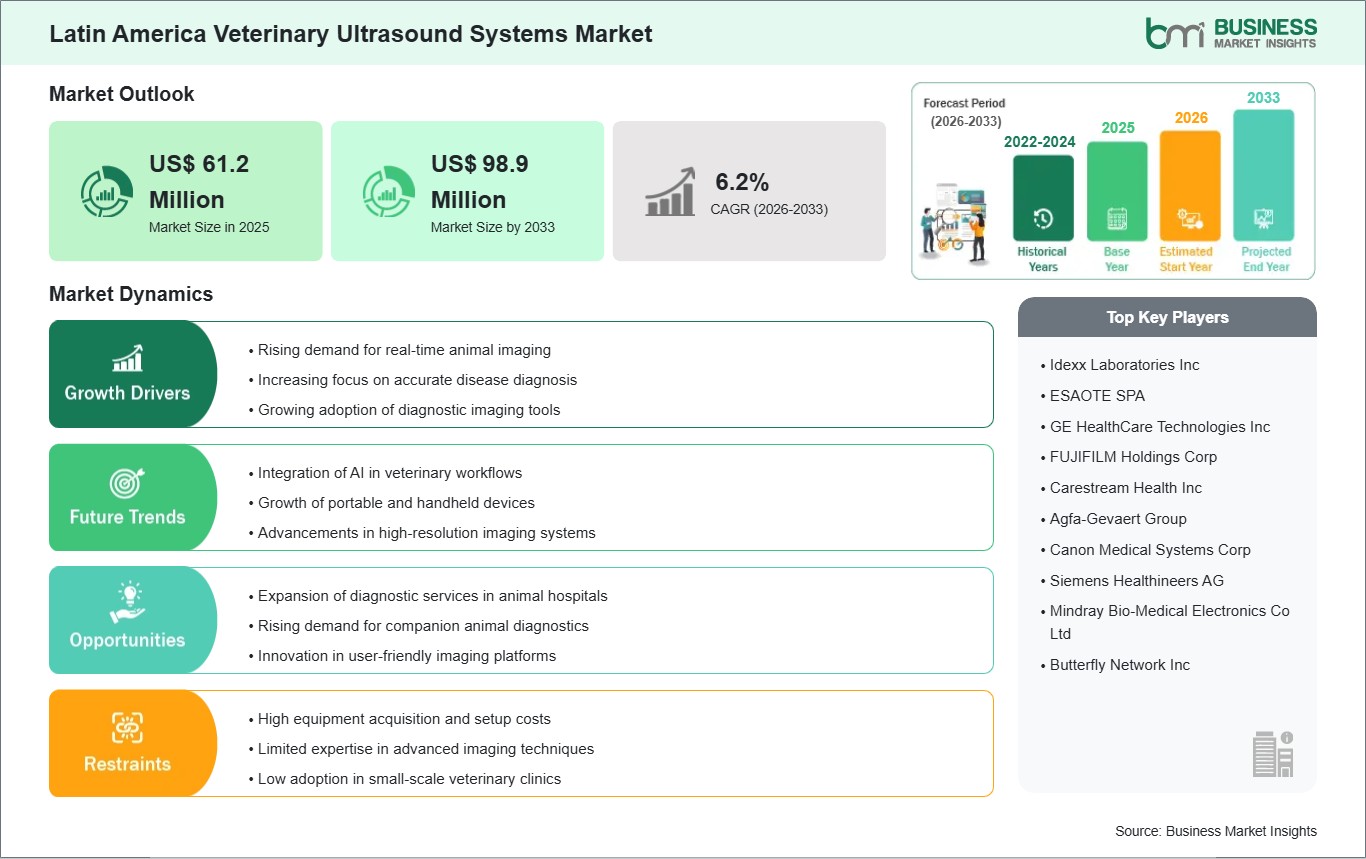
The Latin America veterinary ultrasound systems market size is expected to reach US$98.9 million by 2033 from US$61.2 million in 2025. The market is estimated to record a CAGR of 6.2% from 2026 to 2033.
The Latin America veterinary ultrasound systems market is experiencing steady growth, driven by the region’s extensive livestock industry, growing companion animal ownership, and increasing adoption of modern veterinary diagnostic technologies. Animal farming industries, including cattle, poultry, and swine, are important contributors to the market, as many farmers use ultrasonic equipment for reproductive screening, disease prevention, and improved productivity. Governmental efforts focusing on improving livestock health, ensuring food safety, and enhancing agricultural productivity are also encouraging the uptake of imaging technology by veterinarians. Urbanization and increased disposable income levels are increasing pet ownership, thus creating a need for specialized animal clinics that are well-equipped with portable and high-resolution ultrasound imaging equipment. Portability is an important consideration because of the scattered nature of many farming industries within the region. Manufacturers are focusing on durability, cost-effectiveness, and ease of use to cater to varied end-user needs. Latin America competitive structure is made up of both global players and regional distributors. After-sales services, local availability, and cost-effectiveness are key factors in the purchasing decision process. Despite issues such as pricing pressure, inconsistent infrastructure, and human resource shortages, the Latin America veterinary ultrasound systems market has considerable growth prospects as nations advance their agricultural techniques and improve companion animal health care. In conclusion, the Latin America veterinary ultrasound systems market is characterized by a combination of technological advancement, preventative health care awareness, and demand in the region.

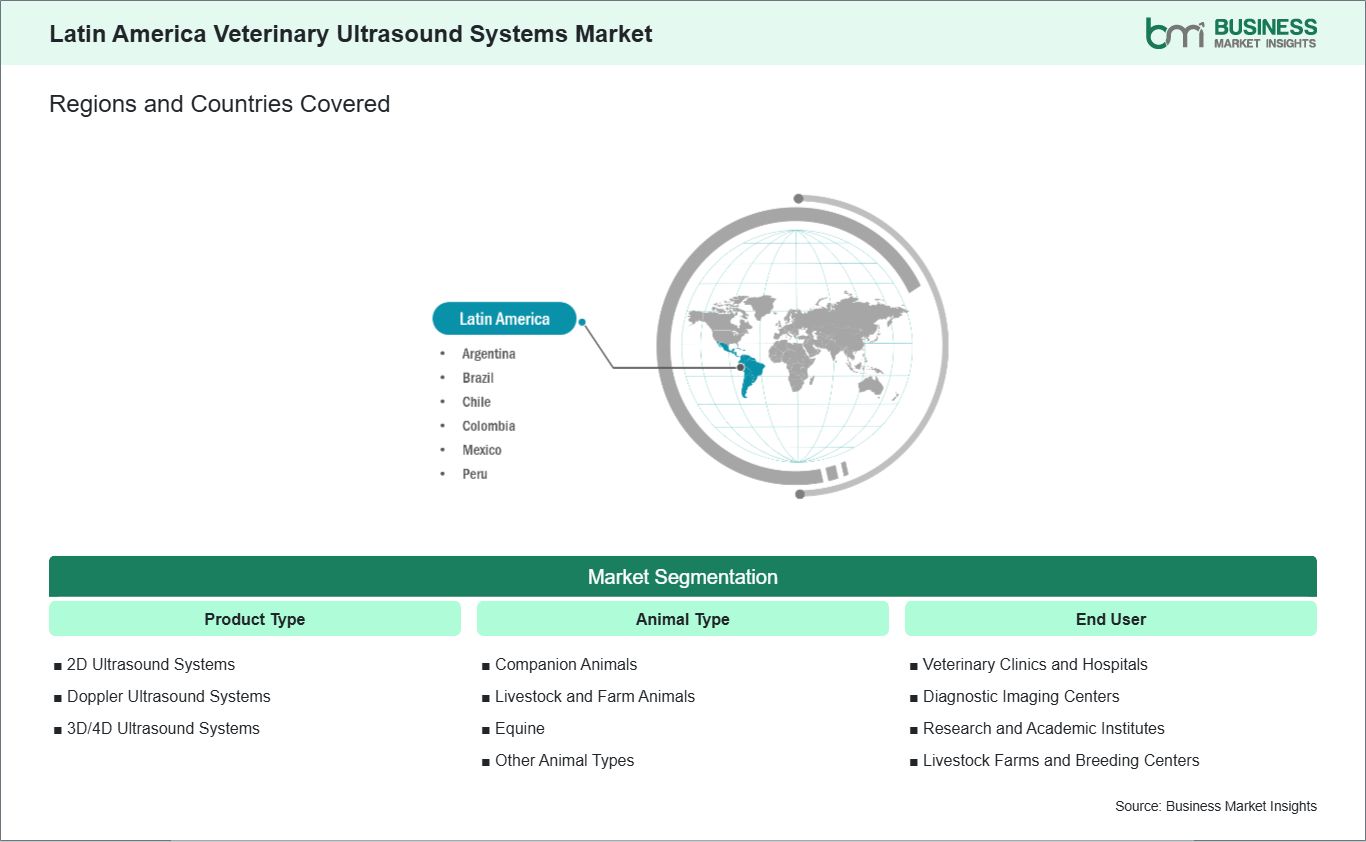
Key segments that contributed to the derivation of the Latin America veterinary ultrasound systems market analysis are product type, animal type, and end user.
The Latin America veterinary ultrasound systems market is primarily driven by the rapid growth of livestock exports and the region’s meat industry. Brazil, Argentina, and Uruguay are countries that export significant amounts of meat products such as beef, poultry, and pork; therefore, they require efficient and productive livestock. Ultrasound technology is now widely used to assess reproduction, identify inner health conditions, and ensure that animals are healthy and productive for both local use and exportation purposes.
The government, together with other stakeholders, has initiated projects that are aimed at increasing modernization in livestock breeding through the adoption of efficient practices, which include ultrasound scanning. Such practices help in minimizing losses, particularly during calving. This practice improves production efficiency and makes products suitable for exportation.
Furthermore, the growing focus on animal welfare and food safety in export markets is pushing farmers to adopt modern diagnostic tools. Ultrasound systems help identify reproductive disorders and internal health complications early, minimizing losses and ensuring animals meet stringent international standards. As Latin America continues to expand its meat production and export capabilities, the adoption of veterinary ultrasound systems is expected to rise steadily.
The increasing adoption of telemedicine and remote diagnostic solutions presents a key opportunity in Latin America. Vast expanses of land and scattered farms do not have easy access to veterinarian clinics, which makes the mobile and networked ultrasound machines extremely useful. Mobile ultrasound machines facilitate the process of carrying out an imaging of the animal's condition right there, and the results are transmitted online to experts for proper diagnosis.
Telemedicine technology ensures monitoring of the health status of livestock, their reproductive periods, and inner organs. It can be applied in cases where small to mid-sized farms are predominant. In countries such as Brazil, Colombia, and Mexico, telemedicine would prove most applicable.
Additionally, veterinary education programs are increasingly integrating telemedicine and remote diagnostic training, equipping professionals with skills to operate connected ultrasound devices. As digital tools and remote services expand, Latin America is poised to see significant growth in portable and connected veterinary ultrasound systems, improving herd management, reproductive efficiency, and animal welfare across the region.

The Latin America veterinary ultrasound systems market demonstrates steady growth, with size and share analysis highlighting evolving trends and competitive dynamics among key players. The report examines subsegments categorized within product type, animal type, and end user, offering insights into their contribution to overall market performance.
By product type, the 2d ultrasound systems subsegment dominated the market in 2025, driven by their widespread clinical utility, cost‑effectiveness, ease of use and strong adoption in routine veterinary diagnostics across Latin American veterinary practices.
Based on animal type, the companion animals subsegment dominated the market in 2025, driven by rising pet ownership, increased awareness of pet healthcare, and growing expenditure on veterinary diagnostics in Latin America.
In terms of end user, the veterinary clinics and hospitals subsegment dominated the market in 2025, driven by development of veterinary infrastructure and adoption of advanced imaging technologies in clinics and hospitals across Latin America.
| Report Attribute | Details |
|---|---|
| Market size in 2025 | US$ 61.2 Million |
| Market Size by 2033 | US$ 98.9 Million |
| CAGR (2026 - 2033) | 6.2% |
| Historical Data | 2022-2024 |
| Forecast period | 2026-2033 |
| Segments Covered | By Product Type
|
|
Regions and Countries Covered
| |
| Latin America | Mexico, Brazil, Argentina, Peru, Chile, Colombia |
| Market leaders and key company profiles |
|
The "Latin America Veterinary Ultrasound Systems Market Size and Forecast (2022–2033)" report provides a detailed analysis of the market covering below areas:
The geographical scope of the Latin America Veterinary Ultrasound Systems Market report is divided into Mexico, Brazil, Argentina, Peru, Chile, Colombia. The Mexico held the largest share in 2025.
Country-level insights in Latin America reveal diverse adoption trends influenced by livestock density, companion animal care, and veterinary infrastructure. Mexico emerges as the dominant market, supported by its large-scale livestock operations, modern veterinary services, and government-backed animal health initiatives. Ultrasound systems are widely adopted for reproductive monitoring, herd health management, and early disease detection, while urban veterinary clinics increasingly integrate advanced imaging technologies for companion animals. Strong institutional support and growing awareness of preventive care reinforce Mexico’s leadership position in the region. Brazil demonstrates strong growth, driven by its massive cattle, poultry, and swine sectors. Adoption of portable and high-resolution ultrasound devices is rising due to increasing livestock commercialization, export-oriented operations, and modernization programs aimed at improving productivity and herd health. Argentina shows steady adoption in commercial livestock operations, particularly for reproductive monitoring and disease prevention. Veterinary clinics and mid-sized farms are gradually investing in portable ultrasound systems to enhance herd management practices. Colombia and Chile represent emerging markets, with increasing awareness of preventive veterinary care and growing investments in companion animal diagnostics. Portable and affordable ultrasound devices are particularly favored in these countries due to dispersed livestock operations and infrastructure variability. Peru demonstrates niche adoption, primarily among small- to mid-sized livestock farms seeking cost-effective reproductive and herd health monitoring solutions. Across Latin America, market growth is influenced by regulatory frameworks, veterinary infrastructure, technical expertise, and awareness of preventive animal healthcare. Mexico’s dominance is reinforced by its scale, institutional support, and strong integration of diagnostic technologies, positioning it as the primary hub for veterinary ultrasound system adoption in the region.

The Latin America Veterinary Ultrasound Systems Market is evaluated by gathering qualitative and quantitative data post primary and secondary research, which includes important corporate publications, association data, and databases. A few of the key developments in the Latin America veterinary ultrasound systems market are:
The Latin America Veterinary Ultrasound Systems Market is valued at US$ 61.2 Million in 2025, it is projected to reach US$ 98.9 Million by 2033.
As per our report Latin America Veterinary Ultrasound Systems Market, the market size is valued at US$ 61.2 Million in 2025, projecting it to reach US$ 98.9 Million by 2033. This translates to a CAGR of approximately 6.2% during the forecast period.
The Latin America Veterinary Ultrasound Systems Market report typically cover these key segments-
The historic period, base year, and forecast period can vary slightly depending on the specific market research report. However, for the Latin America Veterinary Ultrasound Systems Market report:
The Latin America Veterinary Ultrasound Systems Market is populated by several key players, each contributing to its growth and innovation. Some of the major players include:
The Latin America Veterinary Ultrasound Systems Market report is valuable for diverse stakeholders, including:
Essentially, anyone involved in or considering involvement in the Latin America Veterinary Ultrasound Systems Market value chain can benefit from the information contained in a comprehensive market report.
Please tell us your area of interest
(Market Segments/ Regions and Countries/ Companies)