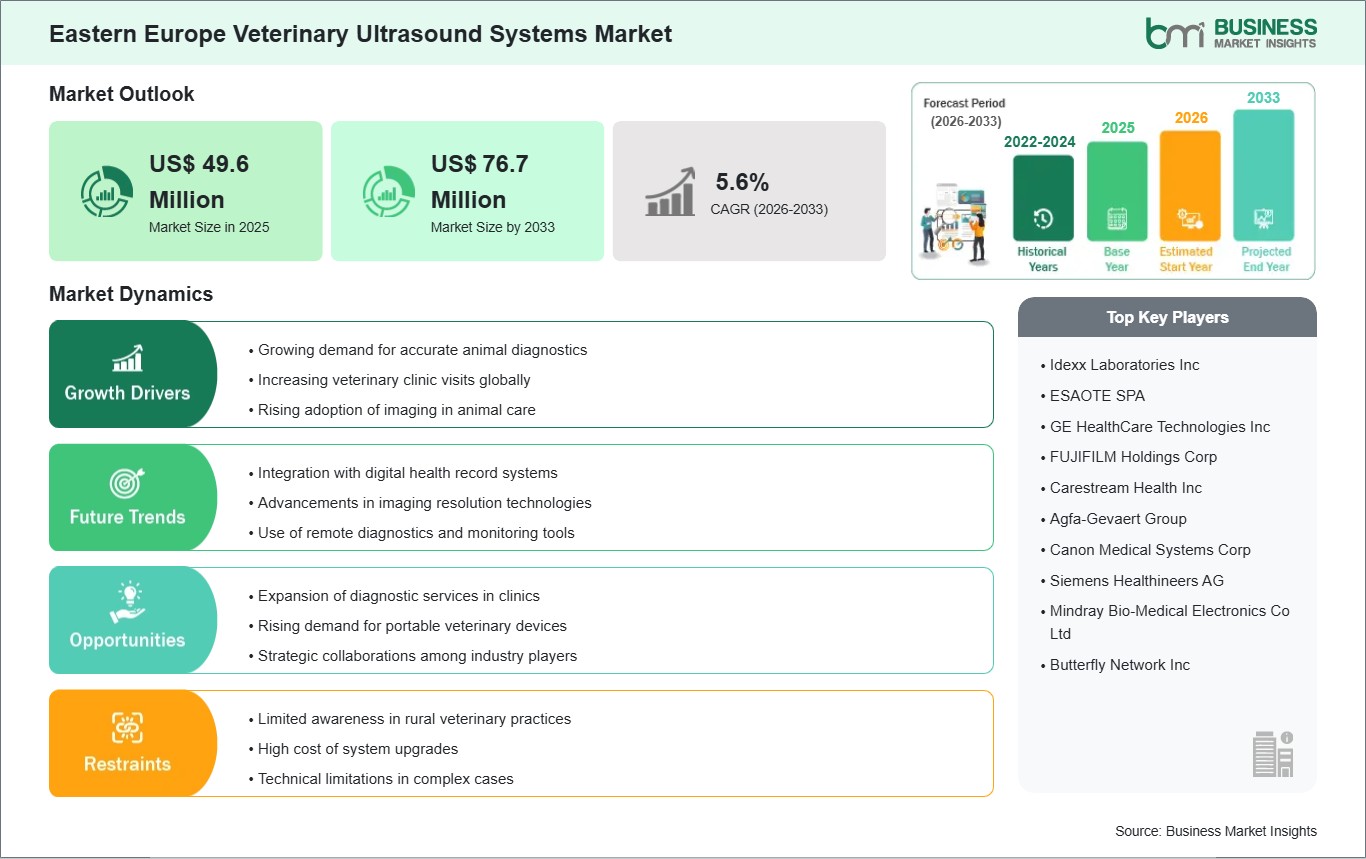
The Eastern Europe veterinary ultrasound systems market size is expected to reach US$76.7 million by 2033 from US$49.6 million in 2025. The market is estimated to record a CAGR of 5.6% from 2026 to 2033.
Ultrasound systems for veterinary use in Eastern Europe are expanding due to modernizing of livestock production and an increase in awareness regarding animal health. Countries in the region are investing in veterinary diagnostic technologies to increase herd reproductive efficiency, disease detection and productivity levels throughout all types of herds including dairy, poultry and swine. Additionally, there is a growing trend towards preventive healthcare for animals as a result of increased urban pet ownership, thus driving the demand for ultrasound systems in companion animal clinics. Technological advances are also having an impact on this industry as there has been much success with portable and handheld devices because they are affordable and easy-to-use; therefore, lend themselves to be used both on farms and out in the field. Manufacturers are offering user-friendly interfaces, robust design and the ability to produce high-resolution images that can accommodate different requirements. Trainers and professional education programs are also promoting ultrasound system usage by providing training for individuals who are lacking in terms of their skills or where there has been no demand for such systems to date in certain regions. The competitive landscape includes both international manufacturers and local distributors with their purchasing decisions based on after-sale service(s), pricing strategy and technical support. In addition to these factors, government-sponsored initiatives to improve food safety, livestock health, etc., provide indirect support for the market. Although there continue to be challenges such as inconsistent infrastructure, not enough trained personnel and price sensitivity among all users, it is likely that the veterinary ultrasound system market in Eastern Europe will continue to grow.

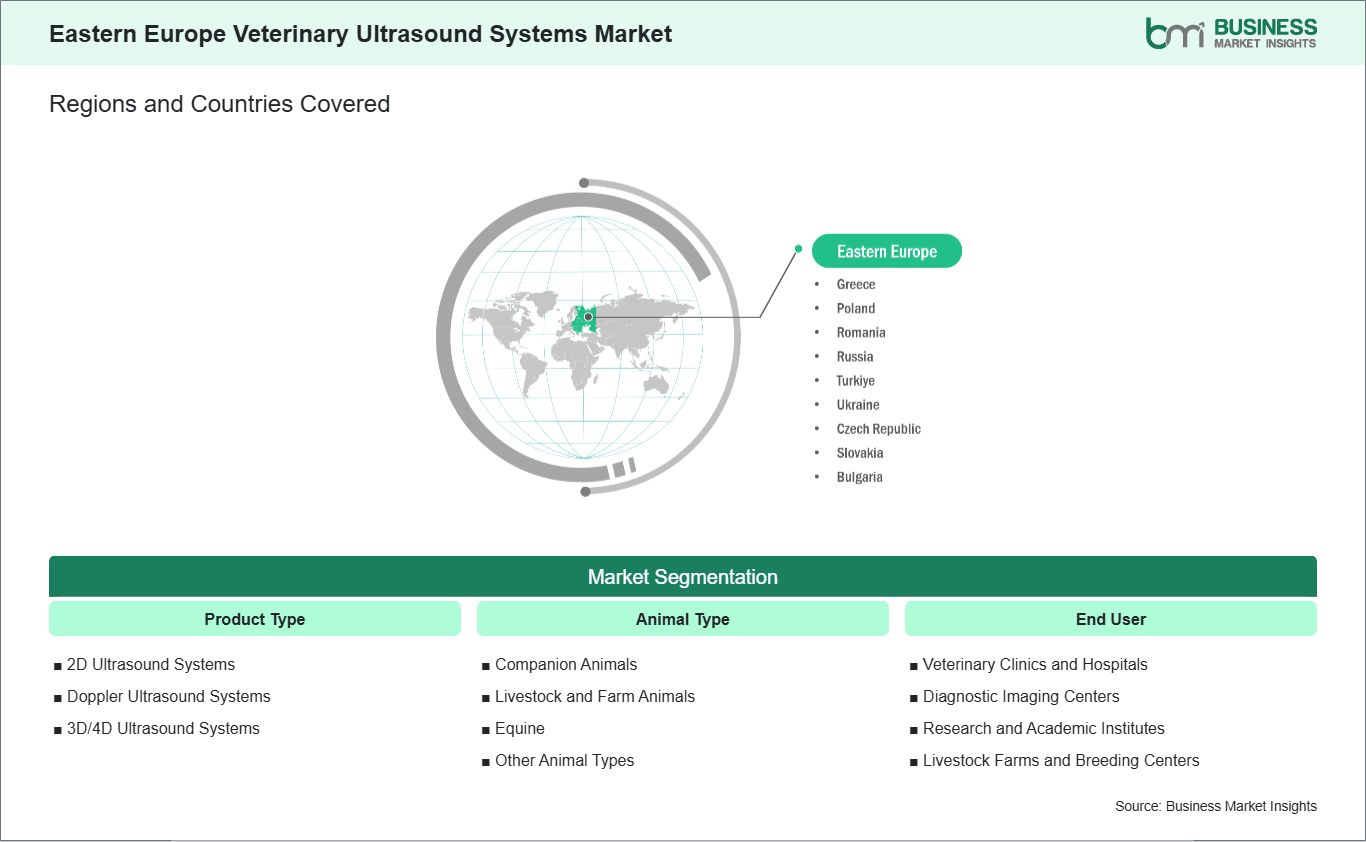
Key segments that contributed to the derivation of the Eastern Europe veterinary ultrasound systems market analysis are product type, animal type, and end user.
The Veterinary Ultrasound market of Eastern Europe is largely influenced by the substantial investments being made in the area of Dairy and Livestock production. Many Eastern European countries including Poland, Hungary, and Romania are upgrading their farms to maximize production through the implementation of high-yield cattle, better breeding techniques, and improved herd management practices. This upgrading of farms requires the purchase of many new diagnostic tools, including ultrasound systems, which are used for the monitoring of animal reproduction, identification of internal health problems, and maximization of herd/animal performance.
There are also funds available from the government, as well as from agricultural grants, to assist with the investments made in upgrading farms. In Romania, for instance, a series of grant programs are available to assist small and mid-sized farms with purchasing modern Veterinary Technologies, including ultrasound imaging equipment. These programs are aimed at increasing the efficiency of reproduction and decreasing the number of livestock that die as a result of undiagnosed health issues, thereby impacting the profitability of the farm and the quality of food that is made available.
Furthermore, a growing number of Private Investments are now being made in large commercial Farming Operations, resulting in the increased Adoption of Technology on dairy farms. The use of ultrasound systems for the early detection of pregnancy, monitoring fertility, and assessing organ health is becoming an industry standard amongst Modern Dairy Farms in Eastern Europe. As investments in Livestock production continue throughout Eastern Europe, the amount of Veterinary Ultrasound systems will continue to grow as a means of improving productivity and implementing sustainable farming practices.
There is an increasing sense of urgency for portable ultrasound equipment in veterinary medicine, it is creating a great opportunity to be realized within Eastern Europe. Many livestock are located in the countryside and in isolated locations that do not have large, multi-service veterinary clinics within reasonable service distance from their location. Portable and hand-held devices allow veterinarians to be able to produce images at the farm when pregnant, conducting disease diagnostics, and monitoring animal reproductive status without having to move the animals to a large, multi-service veterinary clinic to obtain an ultrasound image.
The use of portable ultrasound equipment will allow mobile veterinary practices, which are becoming more common in Eastern Europe, to provide veterinary services to smaller farms on a regular basis, better monitoring the health of the herd, and responding more quickly to reproductive health issues. By providing these services using portable equipment, there is less potential for logistics and providing services at a farm and increase production efficiency.
Moreover, universities and technical colleges in Eastern Europe that provide training for veterinarians are incorporating training on portable ultrasound equipment into the curricula, allowing for veterinarians to develop confidence and to increase adoption rates of the portable ultrasound equipment. With the increasing demand for mobile, time-efficient, and economical diagnostic tools for veterinarians, the market for portable ultrasound equipment is expected to grow significantly throughout Eastern Europe.

The Eastern Europe Veterinary Ultrasound Systems Market demonstrates steady growth, with size and share analysis highlighting evolving trends and competitive dynamics among key players. The report examines subsegments categorized within product, application, and end user, offering insights into their contribution to overall market performance.
By product, the medication cyberknife systems segment dominated the market in 2025, driven by broader clinical adoption due to their capability to perform precise, real‑time image‑guided non‑invasive treatment across diverse tumor types with minimal harm to healthy tissue.
In terms of application, the laparoscopy subsegment dominated the market in 2025, driven by an increasing preference for minimally invasive treatment options that offer reduced recovery times and lower procedural risk.
Based on end user, the hospitals subsegment dominated the market in 2025, driven by higher patient volumes, established oncology infrastructure, and investment capacity that support deployment and utilization of advanced radiosurgery robotic systems.
| Report Attribute | Details |
|---|---|
| Market size in 2025 | US$ 49.6 Million |
| Market Size by 2033 | US$ 76.7 Million |
| CAGR (2026 - 2033) | 5.6% |
| Historical Data | 2022-2024 |
| Forecast period | 2026-2033 |
| Segments Covered | By Product Type
|
|
Regions and Countries Covered
| |
| Eastern Europe | Russia, Poland, Ukraine, Romania, the Czech Republic, Slovakia, Bulgaria, Greece |
| Market leaders and key company profiles |
|
The "Eastern Europe Veterinary Ultrasound Systems Market Size and Forecast (2022–2033)" report provides a detailed analysis of the market covering below areas:
The geographical scope of the Eastern Europe Veterinary Ultrasound Systems Market report is divided Russia, Poland, Ukraine, Romania, the Czech Republic, Slovakia, Bulgaria, and Greece. Russia held the largest share in 2025.
The Eastern Europe Veterinary Ultrasound Systems Market shows significant diversity in adoption patterns across Russia, Poland, Ukraine, Romania, the Czech Republic, Slovakia, Bulgaria, and Greece, driven by differences in healthcare infrastructure, investment priorities, and clinical expertise. Russia emerges as the dominant market within the region, with major metropolitan hospitals and specialized oncology and neurosurgery centers actively integrating robotic radiosurgery systems to enhance treatment precision and operational efficiency. Cities such as Moscow and St. Petersburg serve as hubs for advanced oncology programs, supported by substantial government investment in healthcare modernization and the growing presence of private hospital networks. The country’s adoption is further accelerated by partnerships with international technology providers, research institutions, and structured clinical training programs that ensure effective utilization of sophisticated robotic systems. Poland and the Czech Republic represent secondary growth markets, with hospitals in Warsaw, Krakow, Prague, and Brno gradually incorporating robotic radiosurgery platforms to improve patient outcomes in oncology and neurology. These countries focus on leveraging advanced imaging capabilities and clinical expertise to expand the scope of precision treatments. Romania, Ukraine, Slovakia, Bulgaria, and Greece are emerging markets where adoption remains concentrated in major urban hospitals and tertiary care centers. In these countries, high capital costs, workforce training limitations, and variable regulatory frameworks slow broader deployment, although pilot programs and cross-border collaborations are beginning to introduce robotic radiosurgery into key medical facilities. Across all eight countries, successful market penetration is closely tied to vendor strategies that offer flexible acquisition models, robust clinical training, and responsive technical support. High-volume hospitals and leading oncology centers drive adoption, while smaller institutions often rely on referral-based models to access advanced treatment technologies. Overall, Russia’s dominance reflects its larger healthcare infrastructure, higher investment capacity, and concentrated urban adoption, positioning it as the primary driver of regional growth, while the other Eastern European markets present incremental opportunities for expansion as healthcare modernization progresses.

The Eastern Europe Veterinary Ultrasound Systems Market is evaluated by gathering qualitative and quantitative data post primary and secondary research, which includes important corporate publications, association data, and databases. A few of the key developments in the Eastern Europe Veterinary Ultrasound Systems Market are:
The Eastern Europe Veterinary Ultrasound Systems Market is valued at US$ 49.6 Million in 2025, it is projected to reach US$ 76.7 Million by 2033.
As per our report Eastern Europe Veterinary Ultrasound Systems Market, the market size is valued at US$ 49.6 Million in 2025, projecting it to reach US$ 76.7 Million by 2033. This translates to a CAGR of approximately 5.6% during the forecast period.
The Eastern Europe Veterinary Ultrasound Systems Market report typically cover these key segments-
The historic period, base year, and forecast period can vary slightly depending on the specific market research report. However, for the Eastern Europe Veterinary Ultrasound Systems Market report:
The Eastern Europe Veterinary Ultrasound Systems Market is populated by several key players, each contributing to its growth and innovation. Some of the major players include:
The Eastern Europe Veterinary Ultrasound Systems Market report is valuable for diverse stakeholders, including:
Essentially, anyone involved in or considering involvement in the Eastern Europe Veterinary Ultrasound Systems Market value chain can benefit from the information contained in a comprehensive market report.
Please tell us your area of interest
(Market Segments/ Regions and Countries/ Companies)