Market Summary
Executive Summary and Market Analysis
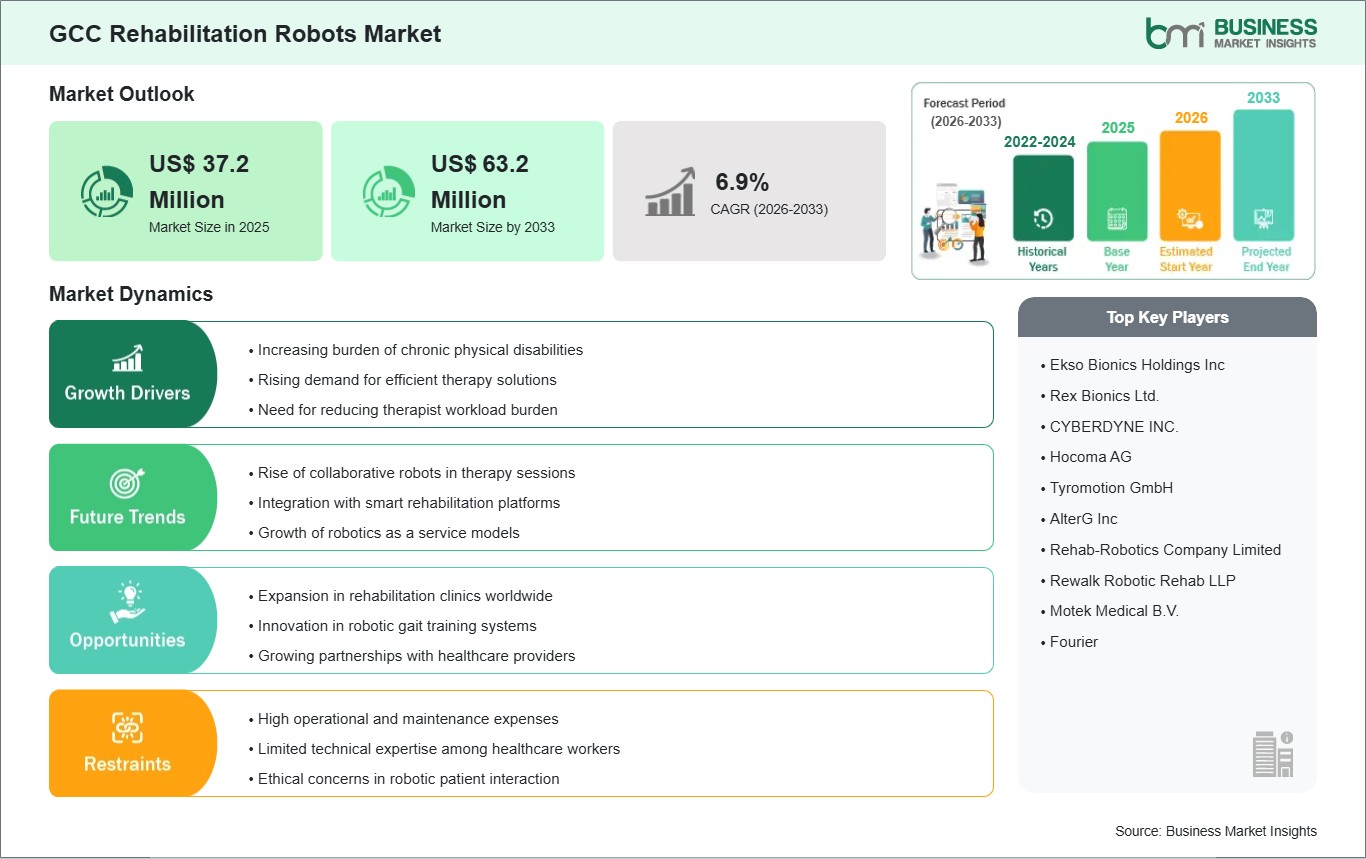
The GCC rehabilitation robots market is steadily emerging as a significant component of the region’s healthcare technology ecosystem, driven by strong government investment in advanced medical infrastructure and a growing emphasis on high-quality rehabilitation services. Healthcare providers across the Gulf Cooperation Council are increasingly exploring robotics-assisted therapy to enhance patient recovery outcomes, particularly for neurological disorders, post-surgical rehabilitation, and musculoskeletal injuries. Market analysis indicates that the integration of robotics in rehabilitation settings is gaining traction within large tertiary hospitals, specialized rehabilitation centers, and academic medical institutions. These facilities are leveraging robotic systems to deliver precise, repetitive, and data-driven therapy sessions that improve patient engagement and accelerate functional recovery. The region’s healthcare modernization initiatives, supported by national development strategies, have encouraged the adoption of innovative medical technologies, including robotics, artificial intelligence, and digital health platforms. Private healthcare providers are also playing a significant role by investing in advanced rehabilitation equipment to differentiate their services and attract medical tourism. Competitive dynamics in the GCC market involve collaborations between global robotics manufacturers and regional distributors, enabling localized deployment, clinician training, and after-sales support. Hospitals are increasingly prioritizing robotic devices capable of integrating with digital monitoring platforms that allow clinicians to track patient progress and adjust therapy protocols accordingly. However, despite strong growth potential, the market faces challenges related to high capital investment requirements, limited availability of trained rehabilitation specialists, and the need for standardized clinical protocols. Nevertheless, the overall market environment remains favorable due to rising awareness of robotics-assisted therapy, increasing healthcare spending, and government-led initiatives aimed at establishing world-class healthcare systems. As healthcare providers continue to focus on improving patient outcomes and operational efficiency, rehabilitation robotics is gradually transitioning from experimental deployments to a more integrated component of modern therapeutic care in the GCC region.
Segment Analysis
GCC Rehabilitation Robots Market Segmentation
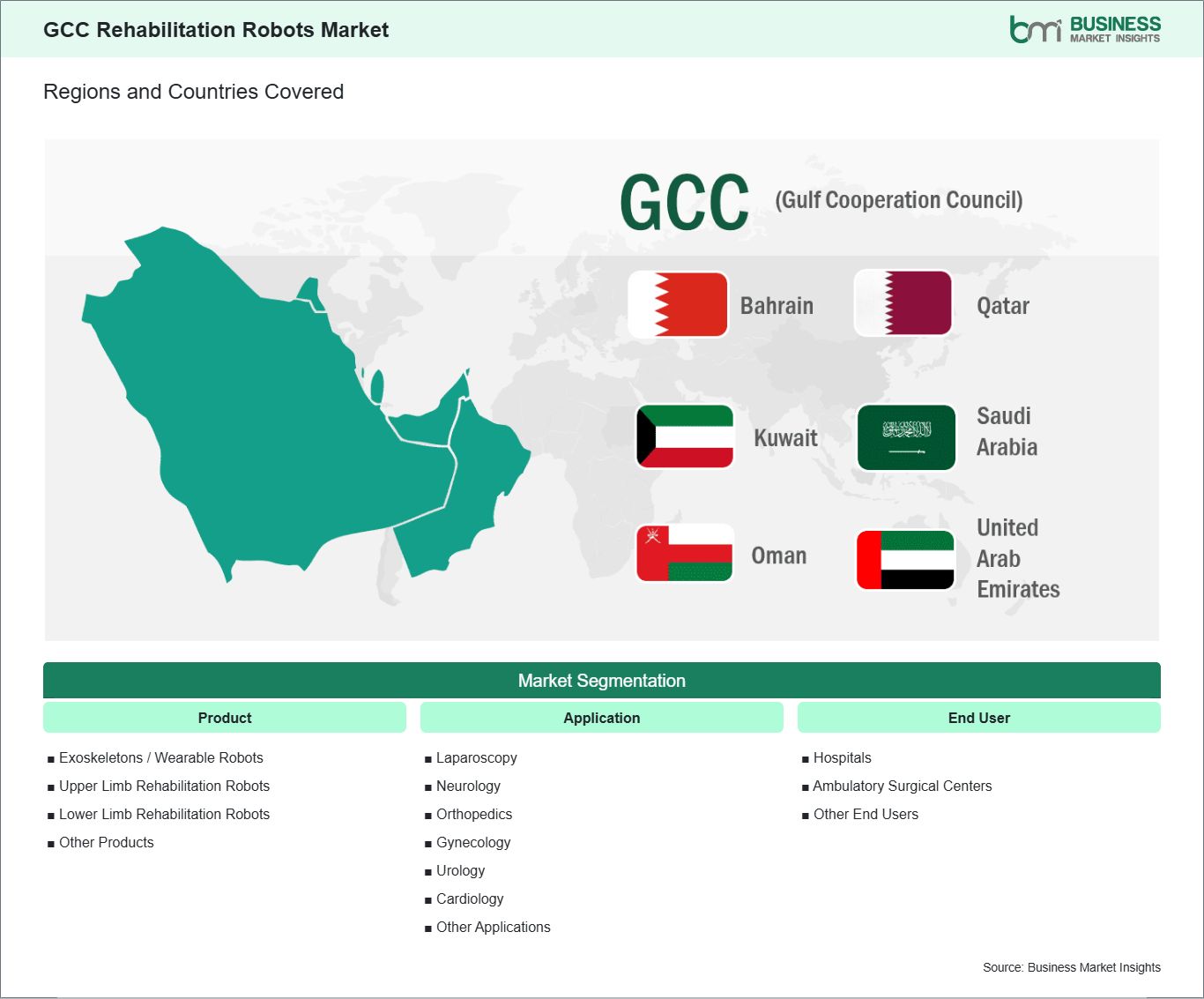
Key segments that contributed to the derivation of the GCC rehabilitation robots market analysis are product, application, and end user.
- By product, the rehabilitation robots market is segmented into exoskeletons / wearable robots, upper limb rehabilitation robots, lower limb rehabilitation robots, and other products. The exoskeletons / wearable robots segment dominated the market in 2025.
- In terms of application, the rehabilitation robots market is categorized into laparoscopy, neurology, orthopedics, gynecology, urology, cardiology and other applications. The laparoscopy segment dominated the market in 2025.
- Based on end user, the market is classified into hospitals, ambulatory surgical centers and other end users. The hospitals segment dominated the market in 2025.
Market Forces
GCC Rehabilitation Robots Market Drivers and Opportunities
Demand to shorten patient recovery periods
The GCC rehabilitation robots market is increasingly influenced by the demand to shorten patient recovery periods and improve rehabilitation outcomes. Healthcare systems across Gulf countries are investing in advanced technologies that can accelerate post-surgical and neurological recovery while maintaining high standards of care. Rehabilitation robots enable repetitive, controlled therapeutic movements that support faster functional recovery for patients with mobility impairments. These systems also help clinicians deliver more intensive therapy sessions without increasing the workload on medical staff, making them attractive for hospitals that aim to improve patient throughput and treatment efficiency. In countries such as Saudi Arabia and the United Arab Emirates, large healthcare modernization programs are encouraging hospitals to incorporate robotics into rehabilitation departments. New medical facilities and specialized rehabilitation centers in cities like Riyadh, Dubai, and Abu Dhabi are adopting robotic therapy systems as part of broader efforts to enhance patient care quality. These initiatives align with national healthcare transformation strategies that emphasize advanced medical technologies and improved rehabilitation services. As hospitals focus on reducing hospitalization periods and enabling quicker functional recovery, robotic rehabilitation solutions are becoming a valuable component of modern therapy programs. Other GCC countries including Qatar, Kuwait, and Oman are also expanding rehabilitation services to address rising demand for post-injury and post-surgical therapy. Healthcare providers in these markets are exploring robotic systems that assist patients with gait training, upper-limb rehabilitation, and mobility restoration. By delivering consistent and precise therapy sessions, these technologies help reduce the time required for functional improvement and enable patients to return to daily activities sooner. As the region continues to invest in healthcare infrastructure and patient-centered care models, the adoption of rehabilitation robots is expected to support faster recovery pathways and enhance overall rehabilitation efficiency across GCC healthcare systems.
Rehabilitation-as-a-service subscription models growth
The emergence of rehabilitation-as-a-service subscription models is creating new opportunities in the GCC rehabilitation robots market. Rather than requiring healthcare providers to purchase expensive robotic systems outright, subscription-based models allow hospitals and rehabilitation centers to access advanced technologies through service agreements. These arrangements often include equipment leasing, software updates, maintenance, and technical support within a single package. This approach reduces the initial financial burden associated with robotics adoption and allows healthcare institutions to integrate rehabilitation robots more gradually into their therapy programs. In the United Arab Emirates, private healthcare networks and specialized rehabilitation clinics are beginning to explore service-based robotics solutions that allow facilities to access advanced equipment without significant upfront investment. These models are particularly attractive for newly established hospitals and rehabilitation centers that aim to offer innovative therapy services while managing operational costs. Subscription-based access to robotic rehabilitation technologies also allows providers to scale their services as patient demand grows, enabling flexible expansion without large capital expenditures. Saudi Arabia and other GCC countries are also evaluating service-oriented robotics deployment models as part of broader healthcare innovation initiatives. With many hospitals expanding their rehabilitation capabilities, subscription-based robotics solutions allow healthcare providers to test new technologies and integrate them into treatment programs with lower financial risk. This model also supports continuous technology upgrades, ensuring that healthcare facilities can adopt the latest advancements in robotic therapy without replacing entire systems. As the GCC healthcare sector continues to prioritize modernization and technology adoption, rehabilitation-as-a-service models are expected to play a growing role in making advanced rehabilitation robotics more accessible across hospitals and therapy centers in the region.
Size and Share Analysis
GCC Rehabilitation Robots Market Size and Share Analysis
The GCC rehabilitation robots market demonstrates steady growth, with size and share analysis highlighting evolving trends and competitive dynamics among key players. The report examines subsegments categorized within product, application, and end user, offering insights into their contribution to overall market performance.
By product, the exoskeletons / wearable robots segment dominated the market in 2025, driven by rising demand for robotic gait-training and mobility restoration for stroke, spinal cord injury, and neurological rehabilitation patients, alongside increasing adoption of wearable rehabilitation technologies in GCC healthcare facilities.
In terms of application, the laparoscopy subsegment dominated the market in 2025, driven by the growing preference for minimally invasive robotic-assisted procedures in GCC countries that improve surgical precision, reduce hospital stays, and align with regional investments in advanced surgical technologies.
Based on end user, the hospitals subsegment dominated the market in 2025, driven by strong healthcare infrastructure, government-funded hospital modernization programs, and the concentration of advanced rehabilitation robotics installations within major tertiary care centers across GCC countries.
Report Coverage
GCC Rehabilitation Robots Market Report Coverage and Deliverables
The "GCC Rehabilitation Robots Market Size and Forecast (2022–2033)" report provides a detailed analysis of the market covering below areas:
- GCC Rehabilitation Robots Market size and forecast at regional and country levels for all segments covered under the scope
- GCC Rehabilitation Robots Market trends, as well as drivers, restraints, and opportunities
- GCC Rehabilitation Robots Market analysis covering key trends, regional framework, major players, regulations, and recent developments
- Industry landscape and competition analysis covering market concentration, heat map analysis, prominent players, and recent developments for the GCC Rehabilitation Robots Market
- Detailed company profiles, including SWOT analysis
Geographic Insights
GCC Rehabilitation Robots Market Geographic Insights
The geographical scope of the GCC Rehabilitation Robots Market report is divided into UAE, Bahrain, Saudi Arabia, Oman, Qatar, and Kuwait. UAE held the largest share in 2025.
The GCC Rehabilitation Robots Market exhibits diverse adoption trends across its member countries, with the United Arab Emirates (UAE) emerging as the dominant market due to its advanced healthcare infrastructure, high private sector participation, and strong emphasis on technological innovation. The UAE’s hospitals and specialized rehabilitation centers have been early adopters of robotics-assisted therapy, particularly in neurological, orthopedic, and post-surgical rehabilitation programs. Advanced hospital networks in cities like Dubai and Abu Dhabi integrate AI-driven therapy devices, sensor-based performance monitoring, and exoskeleton systems to optimize patient recovery. Adoption is further accelerated by government-backed healthcare initiatives, robust investment in medical technology, and partnerships with global robotics vendors that provide clinician training, maintenance support, and localized service networks. The UAE also leverages its position as a hub for medical tourism to deploy cutting-edge rehabilitation solutions, creating both a clinical and commercial leadership position within the GCC region. Saudi Arabia represents a major market where large-scale healthcare modernization initiatives are driving adoption of rehabilitation robotics. Tertiary hospitals and rehabilitation centers are incorporating robotic systems to improve therapy efficiency and outcomes, particularly for post-stroke and musculoskeletal rehabilitation. Government-funded pilot programs, combined with collaborations with international technology providers, are facilitating gradual scale-up of robotics deployment across key urban centers. Qatar demonstrates increasing adoption through specialized hospitals and research-focused medical centers. Investments in state-of-the-art rehabilitation facilities and pilot robotics programs are designed to optimize therapy outcomes and generate clinical evidence for broader implementation. Oman is in the early stages of adoption, focusing on select urban hospitals to introduce robotics-assisted rehabilitation, supported by government initiatives to upgrade healthcare infrastructure. Kuwait is exploring pilot programs in major hospitals and rehabilitation clinics, emphasizing clinician training and cost-effective deployment strategies. Bahrain, although smaller in scale, is gradually integrating robotics into specialized centers and collaborating with international vendors to evaluate advanced rehabilitation solutions. Across these six countries, common growth drivers include rising awareness of robotics-assisted therapy, government support for healthcare modernization, and increasing private sector involvement. While adoption maturity varies, the UAE leads in scale, technological sophistication, and commercial deployment, while Saudi Arabia, Qatar, Oman, Kuwait, and Bahrain offer strong growth potential through targeted investments, pilot initiatives, and partnerships with global robotics providers. The GCC’s shared focus on healthcare innovation ensures that robotics-assisted rehabilitation will continue to expand across the region.
Industry Activity
Recent Developments
The GCC Rehabilitation Robots Market is evaluated by gathering qualitative and quantitative data post primary and secondary research, which includes important corporate publications, association data, and databases. A few of the key developments in the GCC rehabilitation robots market are:
- In May 2025, Aster Al Raffah Hospitals & Clinics launched the Walk Again Advanced Robotic Rehabilitation Centre in Al Ghubra, Muscat the first private facility of its kind in Oman incorporating state‑of‑the‑art robotic rehabilitation technologies. The centre offers interdisciplinary care using robotics such as Cyberdyne HAL exoskeletons to support recovery from neurological and musculoskeletal conditions. This launch marks a significant technological leap for neuro‑rehabilitation services across the GCC region. The facility is positioned as a regional hub aiming to attract patients from across GCC.
- In February 2026, Curexo showcased its Morning Walk gait rehabilitation robot and other med‑robotics systems at the World Healthcare Exhibition (WHX) Dubai 2026, strengthening its visibility among Middle Eastern healthcare distributors. The company held meetings with potential regional partners and healthcare institutions to expand its market footprint in the UAE and wider GCC. This participation reflects strategic steps toward establishing local distribution networks for rehabilitation robots. Ongoing conversations are expected to lead to adoption agreements and collaborations in the regional medical robotics ecosystem.
Trust & Transparency
Research Methodology
The market analysis combines proprietary research with secondary data from government agencies, company disclosures, regulatory filings, industry databases and expert interviews. Market estimates are validated through data triangulation, cross-market benchmarking and analyst
review.
View Full Research Methodology
Key Sources Referred:
World Health Organization (WHO)Organisation for Economic Cooperation and Development (OECD)The World Bank GroupWorldometerThe LancetInternational Bar AssociationInternational Trade Administration