Market Summary
Executive Summary and Global Market Analysis
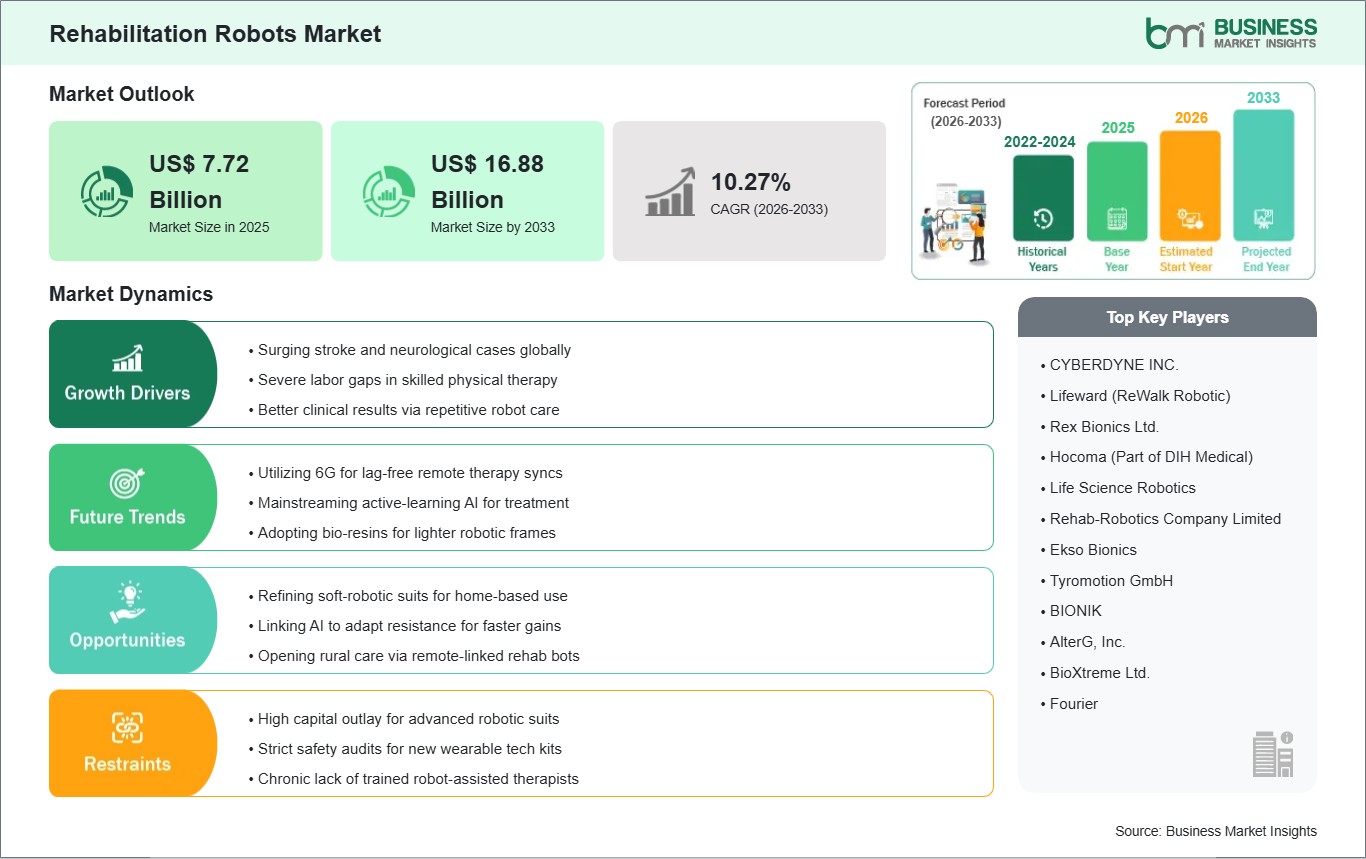
The global rehabilitation robots market is evolving as a specialized segment within medical robotics, driven by the increasing need for advanced therapy solutions that enhance patient recovery outcomes and clinical productivity. Rehabilitation robots are designed to assist patients with mobility impairments, neurological disorders, and musculoskeletal injuries by providing consistent and repetitive therapeutic movements. A major catalyst for market adoption is the rising prevalence of neurological conditions such as stroke, spinal cord injuries, Parkinson’s disease, and cerebral palsy, all of which require prolonged rehabilitation protocols. Globally, millions of individuals experience mobility limitations that necessitate structured therapy, creating strong demand for robotic-assisted rehabilitation technologies. From a technological perspective, the market has witnessed significant innovation in exoskeleton systems, therapy robots, and assistive robotic devices. Exoskeleton robots represent a prominent category due to their ability to support gait training and restore mobility in patients with lower-limb disabilities. Alongside this, upper-limb rehabilitation robots are gaining traction in stroke therapy, enabling precise and repetitive movement patterns that improve neuroplastic recovery. Additionally, integration of artificial intelligence, advanced sensors, and machine learning algorithms allows devices to personalize therapy regimens based on patient progress and biomechanical feedback. Another important aspect shaping the market is the increasing use of robotic rehabilitation platforms in both clinical and home-care environments. Hospitals and specialized rehabilitation centers are deploying robotics to enhance therapy efficiency and address the shortage of trained physiotherapists. Robotic platforms enable therapists to supervise multiple patients simultaneously while maintaining standardized treatment quality. Furthermore, home-based rehabilitation robots are emerging as a viable solution for long-term therapy management, particularly for chronic conditions that require continuous monitoring and repetitive exercises. Despite strong technological progress, several operational challenges remain within the market ecosystem. High capital costs, limited reimbursement coverage in certain healthcare systems, and the need for specialized training to operate robotic systems continue to affect adoption in smaller healthcare facilities. Nevertheless, the ongoing convergence of robotics, digital health platforms, and remote monitoring technologies is gradually improving accessibility. As healthcare providers increasingly prioritize outcome-driven therapy models, rehabilitation robotics is becoming an integral component of modern rehabilitation strategies, supporting both clinical efficiency and improved patient mobility recovery.
Segment Analysis
Rehabilitation Robots Market Segmentation
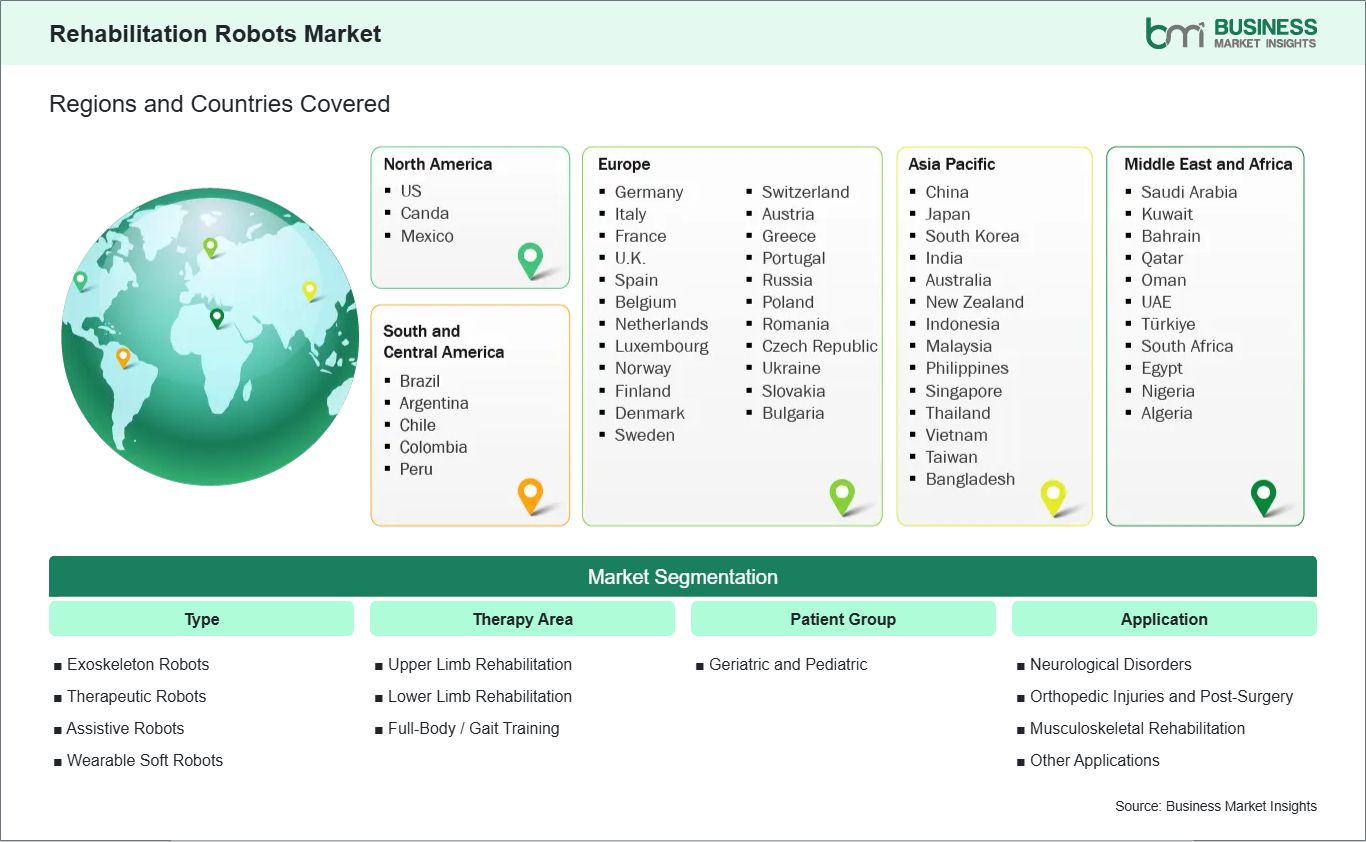
Key segments that contributed to the derivation of the Africa rehabilitation robots market analysis are product, application, and end user.
- By product, the rehabilitation robots market is segmented into exoskeletons / wearable robots, upper limb rehabilitation robots, lower limb rehabilitation robots, and other products. The exoskeletons / wearable robots segment dominated the market in 2025.
- In terms of application, the rehabilitation robots market is categorized into laparoscopy, neurology, orthopedics, gynecology, urology, cardiology and other applications. The laparoscopy segment dominated the market in 2025.
- Based on end user, the market is classified into hospitals, ambulatory surgical centers and other end users. The hospitals segment dominated the market in 2025.
Market Forces
Rehabilitation Robots Market Drivers and Opportunities
Rising demand for post-stroke rehabilitation support
The increasing prevalence of stroke-related disabilities worldwide is creating a strong need for advanced rehabilitation solutions, which is supporting the growth of the global rehabilitation robots market. Stroke recovery often requires repetitive and intensive physical therapy to restore motor functions and mobility. Traditional rehabilitation methods can be time-consuming and physically demanding for both patients and therapists. Rehabilitation robots provide structured and consistent movement training that supports the recovery of affected muscles and neurological pathways. As healthcare providers aim to improve patient outcomes and therapy efficiency, robotic systems are becoming an important component of modern stroke rehabilitation programs. Healthcare institutions around the world are gradually incorporating robotic rehabilitation devices into clinical therapy settings to enhance the quality of post-stroke care. These systems support repetitive therapeutic movements that are essential for improving muscle coordination and restoring mobility. Robotic rehabilitation devices can assist patients with limited strength by guiding their movements in a controlled manner, allowing them to complete therapy exercises more effectively. At the same time, these technologies help therapists manage therapy sessions more efficiently by reducing physical strain and enabling consistent monitoring of patient progress. As rehabilitation centers seek to improve treatment consistency and recovery timelines, robotic therapy solutions are gaining wider acceptance in neurological rehabilitation practices. Another important factor contributing to the global demand for rehabilitation robots is the growing focus on patient independence and long-term recovery support. Stroke survivors often require extended rehabilitation programs that continue beyond hospital stays. Robotic rehabilitation systems can support this need by providing structured therapy solutions that help patients gradually rebuild strength and mobility. Many healthcare providers are exploring the integration of robotic devices into both clinical and home-based rehabilitation programs to ensure continuity of care. As the global healthcare industry increasingly prioritizes improved rehabilitation outcomes and patient-centered treatment approaches, rehabilitation robots are becoming essential tools in supporting effective post-stroke recovery.
Integration with AI-powered personalized therapy
The integration of artificial intelligence into rehabilitation robotics is creating new opportunities for more advanced and personalized therapy solutions in the global market. AI technologies allow rehabilitation robots to analyze patient movements, identify performance patterns, and adjust therapy programs accordingly. This capability enables more individualized rehabilitation plans that align with each patient’s recovery progress and physical condition. By combining robotics with intelligent data analysis, healthcare providers can deliver therapy programs that are more responsive to patient needs, improving both treatment accuracy and rehabilitation effectiveness. AI-powered rehabilitation robots also support continuous monitoring of patient performance during therapy sessions. These systems can evaluate movement quality, track progress over time, and provide feedback that helps therapists refine treatment strategies. Through machine learning capabilities, rehabilitation robots can gradually adapt therapy exercises by adjusting resistance levels, motion assistance, or training intensity. This adaptability helps maintain optimal therapy conditions for patients throughout different stages of recovery. As healthcare organizations increasingly adopt digital technologies, the use of AI-enabled robotic rehabilitation systems is becoming an important advancement in improving therapy precision and efficiency. Another advantage of integrating artificial intelligence with rehabilitation robotics is the potential to enhance patient engagement and long-term therapy adherence. Intelligent rehabilitation platforms can incorporate interactive features that guide patients through therapy exercises while providing real-time feedback and progress insights. These features encourage patients to remain actively involved in their rehabilitation programs and maintain consistent therapy routines. Healthcare providers are recognizing that AI-driven robotic systems can support more personalized and engaging rehabilitation experiences. As technological innovation continues to evolve, the combination of robotics and artificial intelligence is expected to play a significant role in shaping the future of global rehabilitation therapy solutions.
Size and Share Analysis
Rehabilitation Robots Market Size and Share Analysis
The rehabilitation robots market demonstrates steady growth, with size and share analysis highlighting evolving trends and competitive dynamics among key players. The report examines subsegments categorized within product, application, and end user, offering insights into their contribution to overall market performance.
By product, the exoskeletons / wearable robots segment dominated the market in 2025, driven by rising demand for mobility assistance and rehabilitation in patients with neurological and musculoskeletal disorders.
In terms of application, the laparoscopy segment dominated the market in 2025, driven by increasing adoption of minimally invasive surgical procedures requiring robotic rehabilitation support.
Based on end user, the hospitals segment dominated the market in 2025, driven by high patient inflow, advanced infrastructure, and greater investment in robotic rehabilitation technologies.
Report Coverage
Rehabilitation Robots Market Report Coverage and Deliverables
The "Rehabilitation Robots Market Size and Forecast (2022–2033)" report provides a detailed analysis of the market covering below areas:
- Rehabilitation Robots Market size and forecast at global, regional, and country levels for all the key market segments covered under the scope
- Rehabilitation Robots Market trends, as well as drivers, restraints, and opportunities
- Rehabilitation Robots Market analysis covering key trends, global and regional framework, major players, regulations, and recent developments
- Industry landscape and competition analysis covering market concentration, heat map analysis, prominent players, and recent developments for the Rehabilitation Robots Market
- Detailed company profiles, including SWOT analysis
Geographic Insights
Rehabilitation Robots Market Geographic Insights
The geographical scope of the rehabilitation robots market report is divided into North America, Asia Pacific, Europe, Middle East & Africa, and South & Central America. North America held the largest share in 2025.
The global rehabilitation robots market demonstrates varying levels of adoption across key regions including North America, Europe, Asia Pacific, the Middle East & Africa, and South & Central America. Among these, North America remains the dominant regional market due to its advanced healthcare infrastructure, strong clinical research ecosystem, and early adoption of robotic technologies in medical rehabilitation. The region benefits from a well-established network of rehabilitation centers and hospitals that are increasingly integrating robotic therapy solutions to enhance patient recovery outcomes and operational efficiency. In addition, the presence of leading medical robotics manufacturers, strong investment in healthcare innovation, and favorable reimbursement frameworks support the widespread deployment of robotic rehabilitation systems. Growing awareness of technology-assisted therapy among healthcare professionals and patients further contributes to sustained demand across the United States and Canada. Europe represents another significant region in the rehabilitation robots landscape, driven by increasing investments in healthcare technology and rehabilitation research. Several European countries have implemented initiatives aimed at promoting advanced medical technologies to improve long-term patient care and reduce healthcare costs associated with chronic disabilities. Rehabilitation centers across the region are increasingly adopting robotic therapy devices to address the growing need for structured and efficient physiotherapy solutions. Additionally, collaboration between academic institutions, healthcare providers, and robotics developers has accelerated the development of innovative rehabilitation platforms tailored to neurological and orthopedic recovery. The Asia Pacific region is emerging as a rapidly expanding market for rehabilitation robots, supported by improving healthcare infrastructure and rising demand for advanced rehabilitation solutions. Countries across the region are witnessing a steady increase in neurological disorders and mobility-related conditions, which is encouraging hospitals and rehabilitation facilities to explore robotic therapy technologies. Governments and private healthcare providers are also investing in digital healthcare systems and automation technologies, which indirectly supports the integration of robotics in rehabilitation practices. In the Middle East & Africa, adoption of rehabilitation robots is gradually increasing as healthcare modernization initiatives gain momentum. Major healthcare hubs in the region are investing in advanced medical equipment and specialized rehabilitation centers to enhance treatment quality. Although the market is still in the early stages of development, growing interest in innovative healthcare technologies is expected to create opportunities for robotic rehabilitation systems. South & Central America is also witnessing gradual market development, supported by expanding healthcare infrastructure and increasing awareness of advanced physiotherapy technologies. Private hospitals and specialty rehabilitation clinics are beginning to adopt robotic therapy systems to improve rehabilitation efficiency and patient outcomes, particularly in urban healthcare centers. As healthcare investment continues to grow across the region, adoption of rehabilitation robotics is expected to steadily expand.
Industry Activity
Recent Developments
The rehabilitation robots market is evaluated by gathering qualitative and quantitative data post primary and secondary research, which includes important corporate publications, association data, and databases. A few of the key developments in the rehabilitation robots market are:
- In January 2026, Neofect unveiled its Smart Board Robotics system at the World Healthcare Exhibition Dubai 2026, adding an intelligent robotic module to its established Smart Board rehab platform. The enhanced solution supports Continuous Passive Motion, Active Assist, and Resist modes, tailoring therapy to patient recovery stages. Its plug‑and‑play modularity lets existing users upgrade without replacing hardware, improving cost‑efficiency and scalability. This hybrid robot aims to broaden adoption in clinics and hospitals globally with advanced robotic control and interaction features.
- In January 2025, Genrobotics launched the G‑Gaiter Paediatric, India’s first robotic gait trainer for children at a ceremony in Thiruvananthapuram, marking a major step in pediatric neuro‑ Designed to help kids with mobility impairments regain gait function, the system combines robotic support with clinical rehabilitation protocols. The launch highlights an expanding focus on specialized rehab robotics for younger patients and regional healthcare innovation. This product also reflects broader trends in robotic gait therapy adoption within emerging markets.
Trust & Transparency
Research Methodology
The market analysis combines proprietary research with secondary data from government agencies, company disclosures, regulatory filings, industry databases and expert interviews. Market estimates are validated through data triangulation, cross-market benchmarking and analyst
review.
View Full Research Methodology
Key Sources Referred:
World Health Organization (WHO) Organisation for Economic Cooperation and Development (OECD) The World Bank Group Worldometer The Lancet International Bar Association International Trade Administration