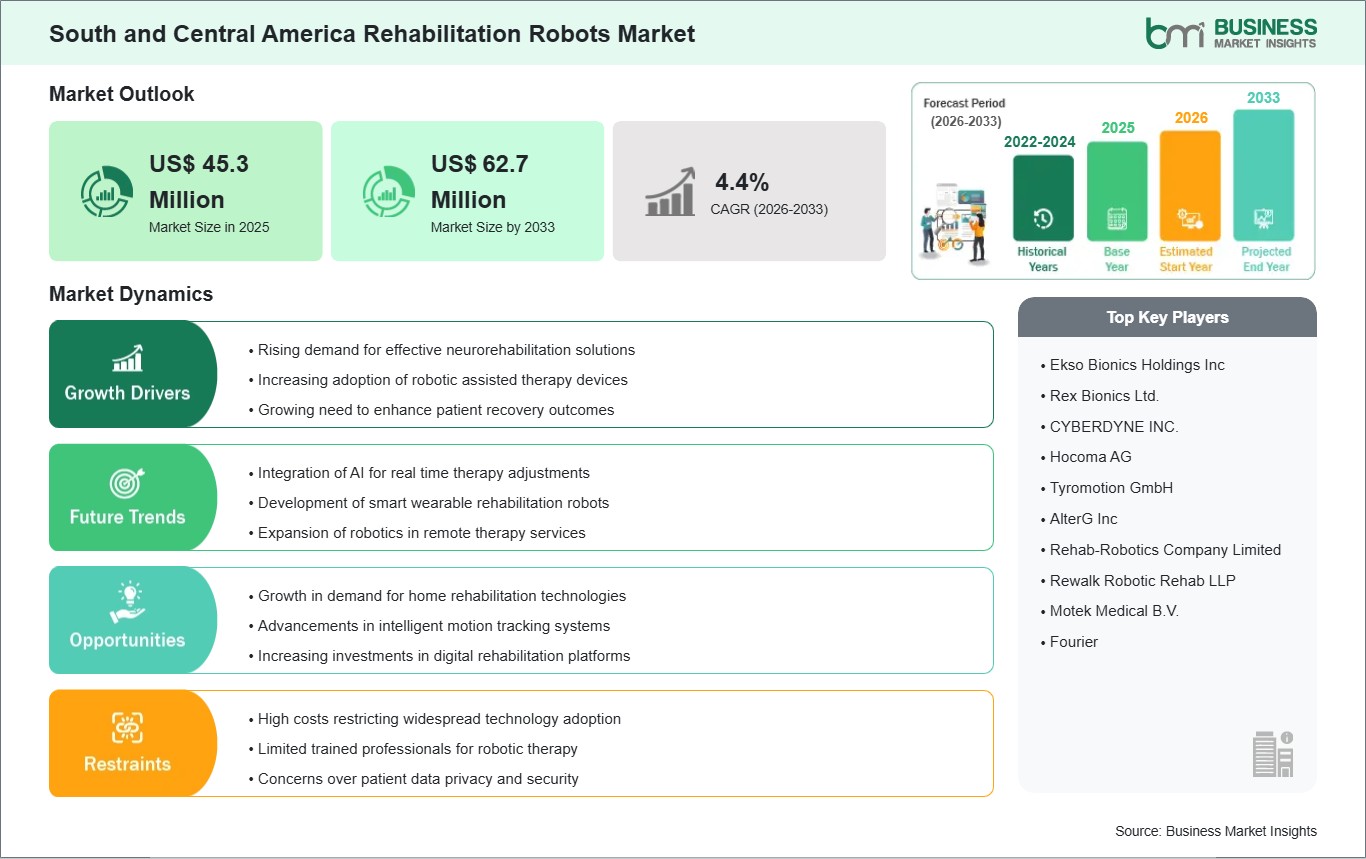
The South and Central America rehabilitation robots market size is expected to reach US$62.7 million by 2033 from US$45.3 million in 2025. The market is estimated to record a CAGR of 4.4% from 2026 to 2033.
The South and Central America Rehabilitation Robots Market is witnessing a gradual yet strategic expansion, driven by rising demand for advanced healthcare solutions to address post-stroke rehabilitation, neurological disorders, and musculoskeletal impairments. Hospitals, specialized rehabilitation centers, and research institutions in countries such as Brazil, Mexico, Argentina, Chile, Colombia, and Peru are increasingly adopting robotics-assisted therapy to improve patient outcomes, therapy efficiency, and clinical precision. Market analysis indicates that the adoption of rehabilitation robotics is fueled by the need for repetitive, data-driven, and personalized therapy, which traditional rehabilitation methods often struggle to deliver. Exoskeletons, robotic gait trainers, and sensor-integrated therapy devices are being deployed to optimize recovery timelines while enhancing clinician oversight through real-time performance tracking. Competitive dynamics are shaped by international robotics manufacturers establishing local partnerships, offering pilot programs, clinician training, and ongoing maintenance support. Governments in select countries are also encouraging modernization initiatives for rehabilitation services, creating a supportive policy environment that fosters clinical trials, technology adoption, and public-private collaborations. However, adoption faces challenges, including high initial investment costs, limited reimbursement frameworks, and the need to develop skilled personnel capable of operating sophisticated robotics systems. Despite these barriers, the market reflects strong potential for growth due to the increasing awareness of robotics-assisted rehabilitation benefits, rising prevalence of neurological and orthopedic conditions, and the presence of urban centers capable of deploying advanced technology. Overall, South and Central America presents a heterogeneous but promising landscape for rehabilitation robotics, where technology integration, clinician training, and patient-centric applications converge to transform the quality and accessibility of rehabilitation care.

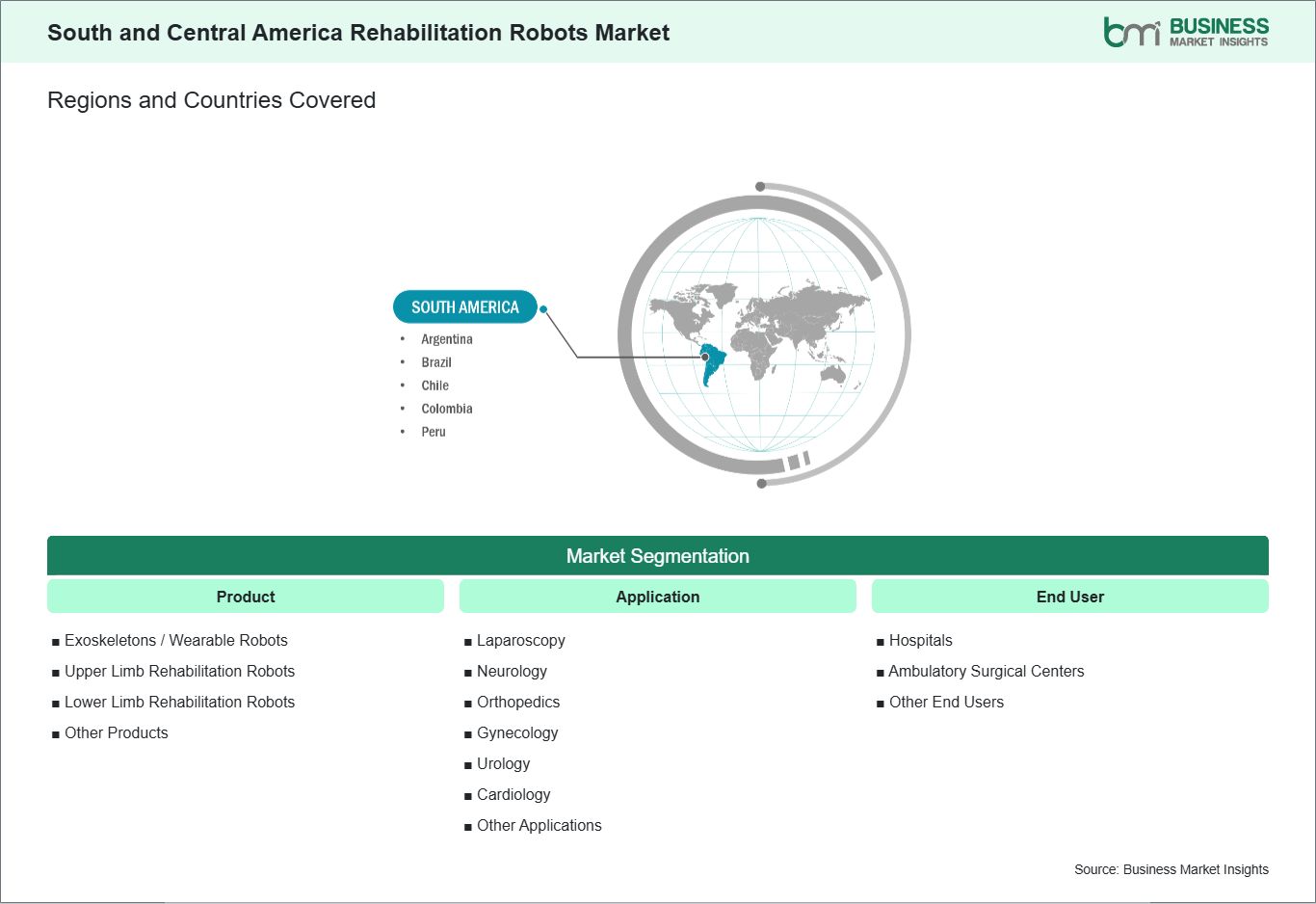
Key segments that contributed to the derivation of the South and Central America rehabilitation robots market analysis are product, application, and end user.
The South and Central America rehabilitation robots market is seeing notable growth driven by the development of wearable exoskeleton robotic systems. These devices support patients in performing movements that may be difficult due to neurological or musculoskeletal impairments, such as walking, balance training, and limb exercises. Wearable exoskeletons provide targeted assistance, helping patients regain mobility, improve strength, and participate more effectively in rehabilitation sessions. Their portability and adaptability make them suitable for both clinical and home-based rehabilitation, increasing access to advanced therapy across urban and semi-urban healthcare facilities. In countries such as Brazil and Argentina, hospitals and rehabilitation centers are increasingly adopting wearable exoskeletons to assist patients recovering from strokes, spinal cord injuries, and orthopedic procedures. These systems allow therapists to provide precise, repetitive exercises while continuously monitoring patient performance. Clinicians can adjust assistance levels to match patient capabilities, supporting incremental improvements in mobility and functional independence. By incorporating wearable robotics, rehabilitation providers are enhancing therapy quality and modernizing rehabilitation programs to meet evolving patient needs. Other countries in the region, including Colombia and Chile, are also piloting wearable exoskeleton technology in clinical and outpatient rehabilitation settings. These systems combine real-time sensor feedback with adaptive control to tailor therapy to individual patient requirements. Patients benefit from safe and guided movement, while therapists can track progress over time and modify exercises as needed. Across South and Central America, wearable exoskeleton robotic systems are transforming rehabilitation, making therapy more accessible, personalized, and effective for patients with mobility limitations.
The South and Central America rehabilitation robots market is expanding into geriatric and long-term care due to the growing aging population and increased demand for continuous mobility support. Older adults often face reduced mobility, balance issues, and chronic musculoskeletal conditions that require ongoing rehabilitation to maintain independence. Robotic devices such as exoskeletons, robotic walkers, and upper-limb assistive systems provide structured therapy that can be integrated into long-term care programs, promoting functional maintenance and fall prevention while reducing the risk of secondary injuries. In Brazil and Argentina, hospitals and long-term care facilities are incorporating rehabilitation robots into programs tailored for elderly patients. These systems assist with walking, strength exercises, and upper-limb rehabilitation, while also capturing performance data to inform therapy adjustments. By integrating robotic therapy into geriatric care, providers can deliver consistent, high-quality rehabilitation even when staffing resources are limited. This ensures older adults maintain mobility, independence, and confidence in their daily activities. Other countries in the region, including Colombia and Chile, are exploring the adoption of robotic rehabilitation in community-based and long-term care settings. Devices equipped with adaptive control and sensor feedback allow therapists to personalize therapy intensity and movement patterns for each patient. The technology encourages active participation while enhancing safety during exercises. Across South and Central America, the expansion of rehabilitation robotics into geriatric and long-term care is helping healthcare providers address the needs of aging populations, delivering consistent, personalized, and effective therapy solutions for elderly patients.
The South and Central America rehabilitation robots market demonstrates steady growth, with size and share analysis highlighting evolving trends and competitive dynamics among key players. The report examines subsegments categorized within product, application, and end user, offering insights into their contribution to overall market performance.
By product, the exoskeletons / wearable robots segment dominated the market in 2025, driven by rising incidence of neurological and mobility‑impairing conditions and growing adoption of advanced rehabilitation technologies in regional healthcare facilities.
In terms of application, the laparoscopy subsegment dominated the market in 2025, driven by increasing demand for minimally invasive robotic‑assisted surgical procedures that improve precision, reduce recovery times, and support modernization of surgical care in South and Central America.
Based on end user, the hospitals subsegment dominated the market in 2025, driven by expanding healthcare capacity and rising investments by public and private hospitals in robotic rehabilitation and surgical systems to meet growing patient needs.
| Report Attribute | Details |
|---|---|
| Market size in 2025 | US$ 45.3 Million |
| Market Size by 2033 | US$ 62.7 Million |
| CAGR (2026 - 2033) | 4.4% |
| Historical Data | 2022-2024 |
| Forecast period | 2026-2033 |
| Segments Covered | By Product
|
|
Regions and Countries Covered
| |
| South and Central America | Brazil, Argentina, Peru, Chile, Colombia |
| Market leaders and key company profiles |
|
The "South and Central America Rehabilitation Robots Market Size and Forecast (2022–2033)" report provides a detailed analysis of the market covering below areas:
The geographical scope of the South and Central America Rehabilitation Robots Market report is divided into Brazil, Argentina, Peru, Chile, and Colombia. Brazil held the largest share in 2025.
The South and Central America Rehabilitation Robots Market displays significant variation in adoption, infrastructure, and technological sophistication across countries, with Brazil emerging as the dominant market due to its advanced healthcare infrastructure, large patient base, and early integration of robotics-assisted rehabilitation. Brazilian hospitals and specialized rehabilitation centers have been at the forefront of deploying AI-enabled robotic exoskeletons, sensor-integrated therapy devices, and robotic gait trainers for post-stroke, neurological, and orthopedic rehabilitation. The country benefits from government-led healthcare modernization initiatives, strong private sector investment, and partnerships with global robotics manufacturers, which support technology transfer, clinician training, and maintenance programs. Brazil’s emphasis on research-driven deployment ensures both high operational efficiency and measurable clinical outcomes, solidifying its position as the regional leader in scale, sophistication, and adoption. Argentina serves as a secondary market with increasing adoption in tertiary hospitals and private rehabilitation centers. Robotics-assisted therapy in Argentina is primarily applied to neurological and musculoskeletal rehabilitation programs. Hospitals focus on validating clinical outcomes, improving therapy efficiency, and integrating cost-effective robotic solutions. Partnerships with international robotics providers and academic institutions play a critical role in pilot deployments, workforce training, and protocol development, supporting gradual market expansion. Peru, Chile, and Colombia are emerging markets where adoption is concentrated in major urban hospitals and specialized rehabilitation facilities. Robotics-assisted therapy is typically applied to post-stroke recovery, mobility enhancement, and neurological rehabilitation. Pilot programs, academic collaborations, and partnerships with regional or global technology providers are crucial in these countries for demonstrating clinical efficacy, building local expertise, and ensuring sustainable implementation. While infrastructure and investment levels vary, rising awareness of the benefits of robotics-assisted rehabilitation is gradually driving adoption. Together, these five countries form a heterogeneous South and Central America rehabilitation robotics market, where Brazil leads in scale, technological sophistication, and clinical adoption, Argentina provides steady secondary growth, and Peru, Chile, and Colombia represent emerging markets with significant potential for expansion. Growth across the region is expected to be driven by targeted investments, pilot programs, and strategic partnerships that modernize rehabilitation services and enhance patient outcomes.

The South and Central America Rehabilitation Robots Market is evaluated by gathering qualitative and quantitative data post primary and secondary research, which includes important corporate publications, association data, and databases. A few of the key developments in the South and Central America rehabilitation robots market are:
The South and Central America Rehabilitation Robots Market is valued at US$ 45.3 Million in 2025, it is projected to reach US$ 62.7 Million by 2033.
As per our report South and Central America Rehabilitation Robots Market, the market size is valued at US$ 45.3 Million in 2025, projecting it to reach US$ 62.7 Million by 2033. This translates to a CAGR of approximately 4.4% during the forecast period.
The South and Central America Rehabilitation Robots Market report typically cover these key segments-
The historic period, base year, and forecast period can vary slightly depending on the specific market research report. However, for the South and Central America Rehabilitation Robots Market report:
The South and Central America Rehabilitation Robots Market is populated by several key players, each contributing to its growth and innovation. Some of the major players include:
The South and Central America Rehabilitation Robots Market report is valuable for diverse stakeholders, including:
Essentially, anyone involved in or considering involvement in the South and Central America Rehabilitation Robots Market value chain can benefit from the information contained in a comprehensive market report.
Please tell us your area of interest
(Market Segments/ Regions and Countries/ Companies)