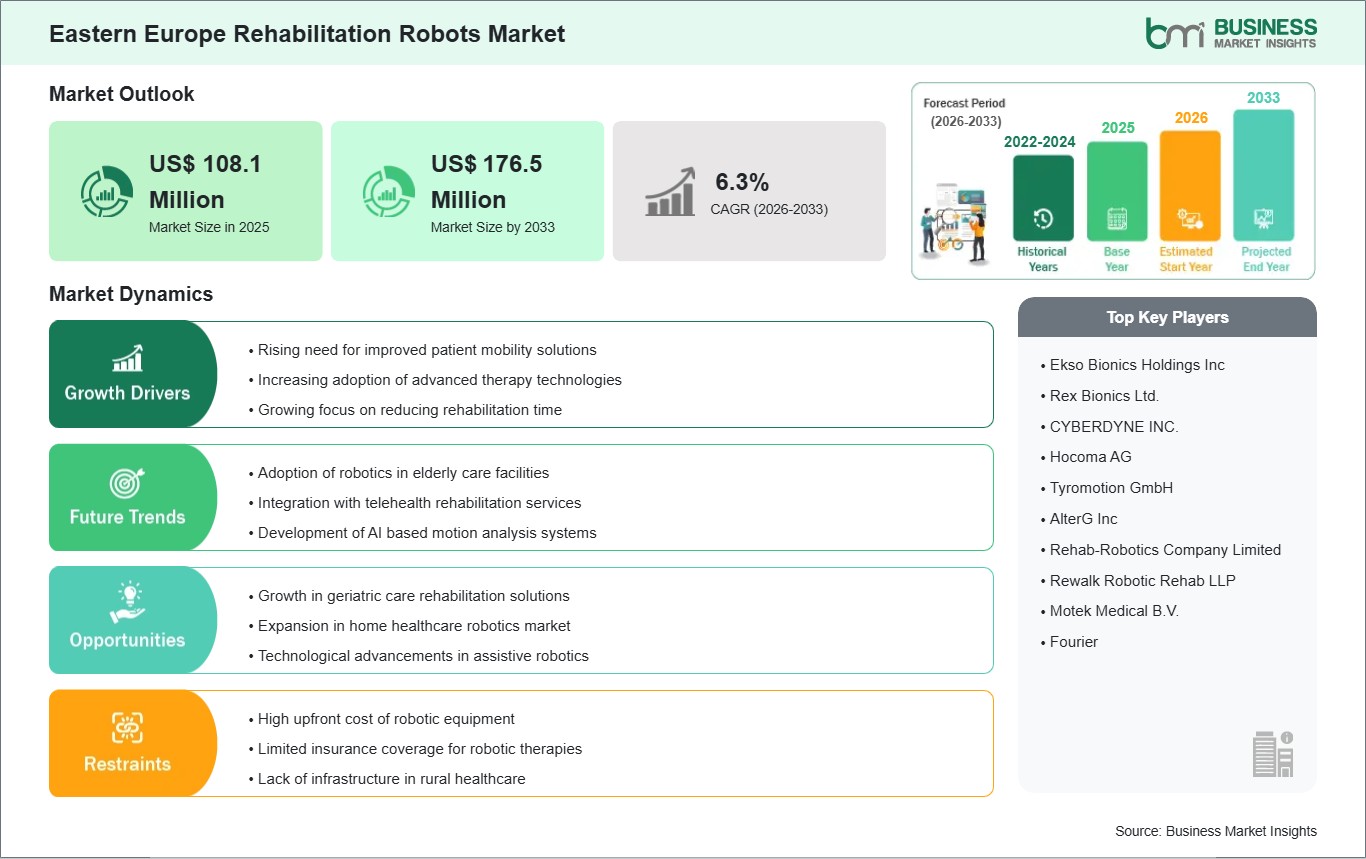
The Eastern Europe rehabilitation robots market size is expected to reach US$176.5 million by 2033 from US$108.1 million in 2025. The market is estimated to record a CAGR of 6.3% from 2026 to 2033.
The Eastern Europe Rehabilitation Robots Market is undergoing gradual transformation as healthcare providers increasingly adopt advanced therapeutic technologies to improve patient outcomes, operational efficiency, and access to specialized rehabilitation services. Market analysis reveals that the region’s demand is primarily driven by the growing incidence of neurological disorders, stroke-related disabilities, and orthopedic conditions requiring long-term rehabilitation. Hospitals and rehabilitation centers are integrating robotics to enhance therapy precision, repeatability, and objective performance monitoring, complementing conventional physiotherapy methods. The market is characterized by a heterogeneous competitive landscape, comprising international robotics manufacturers and emerging regional technology providers focusing on cost-effective, locally adaptable solutions. Countries such as Poland, the Czech Republic, and Hungary are leading early adoption due to relatively advanced healthcare infrastructure, whereas nations like Romania, Slovakia, and Bulgaria are observing pilot programs and demonstration projects aimed at assessing clinical efficacy and cost viability. Key trends identified include the increasing use of exoskeletons, AI-assisted rehabilitation devices, and sensor-driven feedback systems that enable personalized therapy protocols. Despite opportunities, adoption is tempered by challenges such as high initial investment, limited clinician training programs, and variable reimbursement mechanisms. Partnerships between hospitals and academic institutions are emerging as a strategic approach to validate clinical outcomes, optimize deployment, and generate evidence-based adoption frameworks. Furthermore, regional collaboration and cross-border research initiatives are helping bridge knowledge gaps, facilitating technology transfer, and accelerating acceptance. Overall, Eastern Europe presents a market environment that balances growth potential with structural challenges, positioning rehabilitation robotics as a strategic tool for enhancing care quality, operational efficiency, and long-term patient recovery.

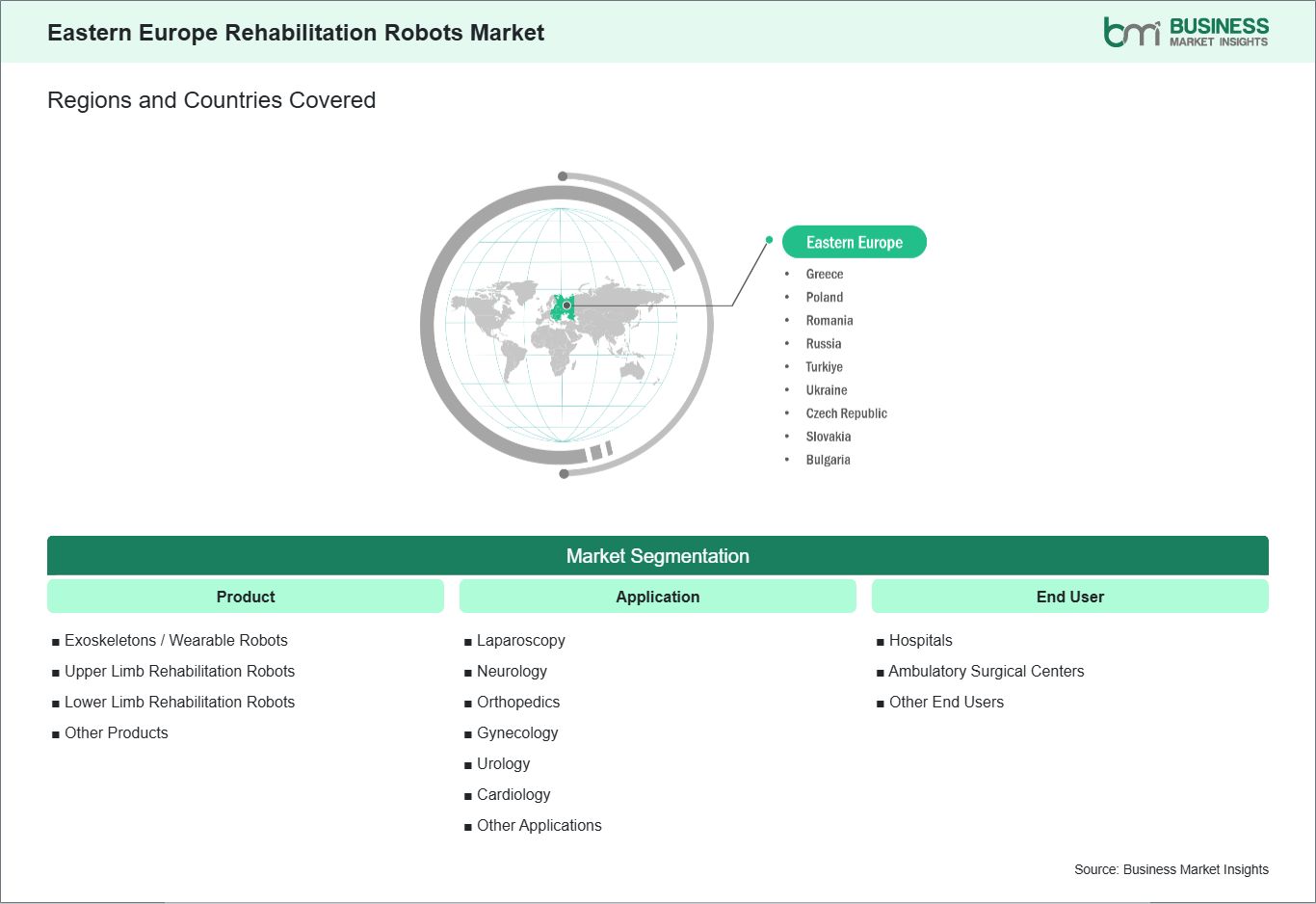
Key segments that contributed to the derivation of the Eastern Europe rehabilitation robots market analysis are product, application, and end user.
The Eastern Europe rehabilitation robots market is being shaped in part by a notable shortage of skilled physical therapists, which is prompting healthcare providers to explore technology‑assisted solutions. In many Eastern European countries, the training and retention of highly qualified rehabilitation professionals have struggled to keep pace with growing demand from aging populations and individuals recovering from neurological and musculoskeletal conditions. Traditional therapy programs require significant one‑on‑one time between patients and therapists, placing pressure on limited human resources. Rehabilitation robots offer a way to extend the reach of existing clinical staff by providing consistent, repeatable therapy movements that supplement hands‑on treatment and help maintain quality of care where therapist availability may be constrained. In Poland, hospitals and outpatient centers are increasingly evaluating robotic devices to support busy therapy units that often operate with a smaller workforce relative to patient needs. Rehabilitation robots help distribute clinical workload more effectively, allowing skilled therapists to oversee multiple patients or focus their expertise on more complex clinical decisions rather than repetitive manual exercises. Patients can receive structured, guided therapy with robotics while still benefiting from professional oversight, helping overcome bottlenecks created by workforce limitations. This has encouraged rehabilitation units to view robotics as a practical way to enhance service delivery in a constrained labor market. In Romania, Czechia, and Hungary, similar workforce pressures are driving interest in rehabilitation robotics. Healthcare administrators are recognizing that robots can support basic and intermediate therapy tasks, freeing human therapists to concentrate on individualized treatment adjustments and patient education. Clinics in larger urban centers are piloting systems that can deliver consistent therapeutic motions for gait training, upper limb exercises, and balance support, reducing dependency on direct therapist contact for every session. By relieving physical therapists from repetitive duties, rehabilitation robotics improve efficiency, extend access to therapy, and help address service bottlenecks in regions where skilled professionals are in short supply.
The emergence of AI‑enhanced adaptive robotic therapy systems is transforming the rehabilitation landscape in Eastern Europe, enabling smarter, more personalized treatment experiences. Traditional robotic devices delivered pre‑set movements; however, modern systems integrate artificial intelligence to interpret patient performance in real time and adjust therapy parameters accordingly. These adaptive capabilities make robotic therapy more responsive and effective for patients with varying levels of ability. Clinicians in Eastern Europe are increasingly attracted to AI‑driven robotics because they can tailor assistance levels, track progress with precision, and provide nuanced recovery paths that were once possible only through intensive human supervision. In Poland, leading rehabilitation centers are exploring AI‑enhanced robotic systems that monitor patient effort and movement quality during each session. These systems use embedded sensors and machine learning algorithms to determine how much support a patient needs, automatically adjusting resistance or assistance. This adaptivity helps patients engage in therapy that matches their current ability while challenging them appropriately to promote progress. Physical therapists appreciate the way AI assistance frees them from constant manual adjustment, allowing them to interpret broader recovery trends and plan long‑term treatment strategies. Across Slovakia, Bulgaria, and the Baltic states, AI‑powered rehabilitation robots are gaining attention for their ability to deliver data‑informed therapy that tracks performance over time and identifies subtle improvements or setbacks. These systems can offer comparative feedback, identify patterns in patient motion, and alert clinicians when adjustments are needed. In regions where clinical resources are stretched, the combination of adaptive robotics and professional oversight enhances both efficiency and quality of care. By leveraging AI to optimize therapy delivery, rehabilitation programs in Eastern Europe are evolving toward more intelligent, responsive, and outcome‑oriented models that better support patient recovery journeys.
The Eastern Europe rehabilitation robots market demonstrates steady growth, with size and share analysis highlighting evolving trends and competitive dynamics among key players. The report examines subsegments categorized within product, application, and end user, offering insights into their contribution to overall market performance.
By product, the exoskeletons / wearable robots segment dominated the market in 2025, driven by growing clinical adoption for gait and mobility rehabilitation in aging and post‑injury patients, supported by technological advancements and increasing demand for effective neurorehabilitation solutions across healthcare facilities in Eastern Europe.
In terms of application, the laparoscopy subsegment dominated the market in 2025, driven by the rising integration of robotic systems into minimally invasive surgical procedures that enhance precision, reduce recovery times, and address the increasing demand for advanced laparoscopic care across regional medical centers.
Based on end user, the hospitals subsegment dominated the market in 2025, driven by their capacity to invest in high‑cost rehabilitation and robotic surgical technologies, centralized infrastructure for complex care, and a higher volume of patients requiring intensive therapy and robot‑assisted procedures.
| Report Attribute | Details |
|---|---|
| Market size in 2025 | US$ 108.1 Million |
| Market Size by 2033 | US$ 176.5 Million |
| CAGR (2026 - 2033) | 6.3% |
| Historical Data | 2022-2024 |
| Forecast period | 2026-2033 |
| Segments Covered | By Product
|
|
Regions and Countries Covered
| |
| Eastern Europe | Russia, Poland, Ukraine, Romania, the Czech Republic, Slovakia, Bulgaria, Greece |
| Market leaders and key company profiles |
|
The "Eastern Europe Rehabilitation Robots Market Size and Forecast (2022–2033)" report provides a detailed analysis of the market covering below areas:
The geographical scope of the Eastern Europe Rehabilitation Robots Market report is divided into Russia, Poland, Ukraine, Romania, the Czech Republic, Slovakia, Bulgaria, and Greece. Russia held the largest share in 2025.
The Eastern Europe Rehabilitation Robots Market exhibits significant variability across its constituent countries, with Russia emerging as the dominant market due to its large population, extensive healthcare infrastructure, and growing adoption of advanced rehabilitation technologies. Russian hospitals and specialized rehabilitation centers are increasingly integrating robotics into post-stroke, neurological, and musculoskeletal therapy programs, supported by government-backed healthcare modernization initiatives and partnerships with international robotics manufacturers. High patient volume, combined with urban concentration of tertiary hospitals, allows Russia to implement large-scale clinical programs, pilot new robotic solutions, and generate robust evidence of efficacy. Investments in clinician training, AI-enabled therapy protocols, and sensor-based feedback systems further reinforce Russia’s position as the regional leader in rehabilitation robotics deployment and adoption. Poland is a growing market with significant activity in urban hospitals and private rehabilitation centers. Adoption is driven by academic collaborations, pilot programs, and government initiatives that encourage the integration of robotics to improve clinical outcomes, particularly for post-stroke and orthopedic patients. Polish hospitals are increasingly leveraging sensor-driven systems and data analytics to optimize therapy personalization and efficiency. The Czech Republic demonstrates strong adoption in tertiary care facilities and specialty rehabilitation clinics, emphasizing multidisciplinary rehabilitation programs and AI-assisted robotics to enhance patient engagement and recovery tracking. Collaboration with universities and technology vendors accelerates research and clinical validation. Ukraine, Romania, and Slovakia represent emerging markets where pilot programs and demonstration projects are the primary avenues for adoption. Hospitals in these countries are exploring robotics-assisted therapy for neurological and mobility disorders, with emphasis on cost-effective solutions, clinician training, and evidence-based validation to support larger deployments. Bulgaria and Greece are in the early adoption phase, relying mainly on urban medical centers and academic institutions to trial rehabilitation robotics. Growth is being supported through technology partnerships, government pilot initiatives, and targeted private hospital programs. Across these eight countries, common growth drivers include rising prevalence of neurological and musculoskeletal conditions, increasing healthcare digitization, and awareness of robotics’ clinical benefits. However, adoption varies due to infrastructure readiness, budget constraints, and workforce capabilities. Collectively, these nations form a heterogeneous Eastern Europe landscape, with Russia leading in scale, technological sophistication, and market influence, while Poland, the Czech Republic, and the other countries present high growth potential through focused investments, pilot programs, and strategic collaborations.

The Eastern Europe Rehabilitation Robots Market is evaluated by gathering qualitative and quantitative data post primary and secondary research, which includes important corporate publications, association data, and databases. A few of the key developments in the Eastern Europe rehabilitation robots market are:
The Eastern Europe Rehabilitation Robots Market is valued at US$ 108.1 Million in 2025, it is projected to reach US$ 176.5 Million by 2033.
As per our report Eastern Europe Rehabilitation Robots Market, the market size is valued at US$ 108.1 Million in 2025, projecting it to reach US$ 176.5 Million by 2033. This translates to a CAGR of approximately 6.3% during the forecast period.
The Eastern Europe Rehabilitation Robots Market report typically cover these key segments-
The historic period, base year, and forecast period can vary slightly depending on the specific market research report. However, for the Eastern Europe Rehabilitation Robots Market report:
The Eastern Europe Rehabilitation Robots Market is populated by several key players, each contributing to its growth and innovation. Some of the major players include:
The Eastern Europe Rehabilitation Robots Market report is valuable for diverse stakeholders, including:
Essentially, anyone involved in or considering involvement in the Eastern Europe Rehabilitation Robots Market value chain can benefit from the information contained in a comprehensive market report.
Please tell us your area of interest
(Market Segments/ Regions and Countries/ Companies)