Market Summary
Executive Summary and Market Analysis
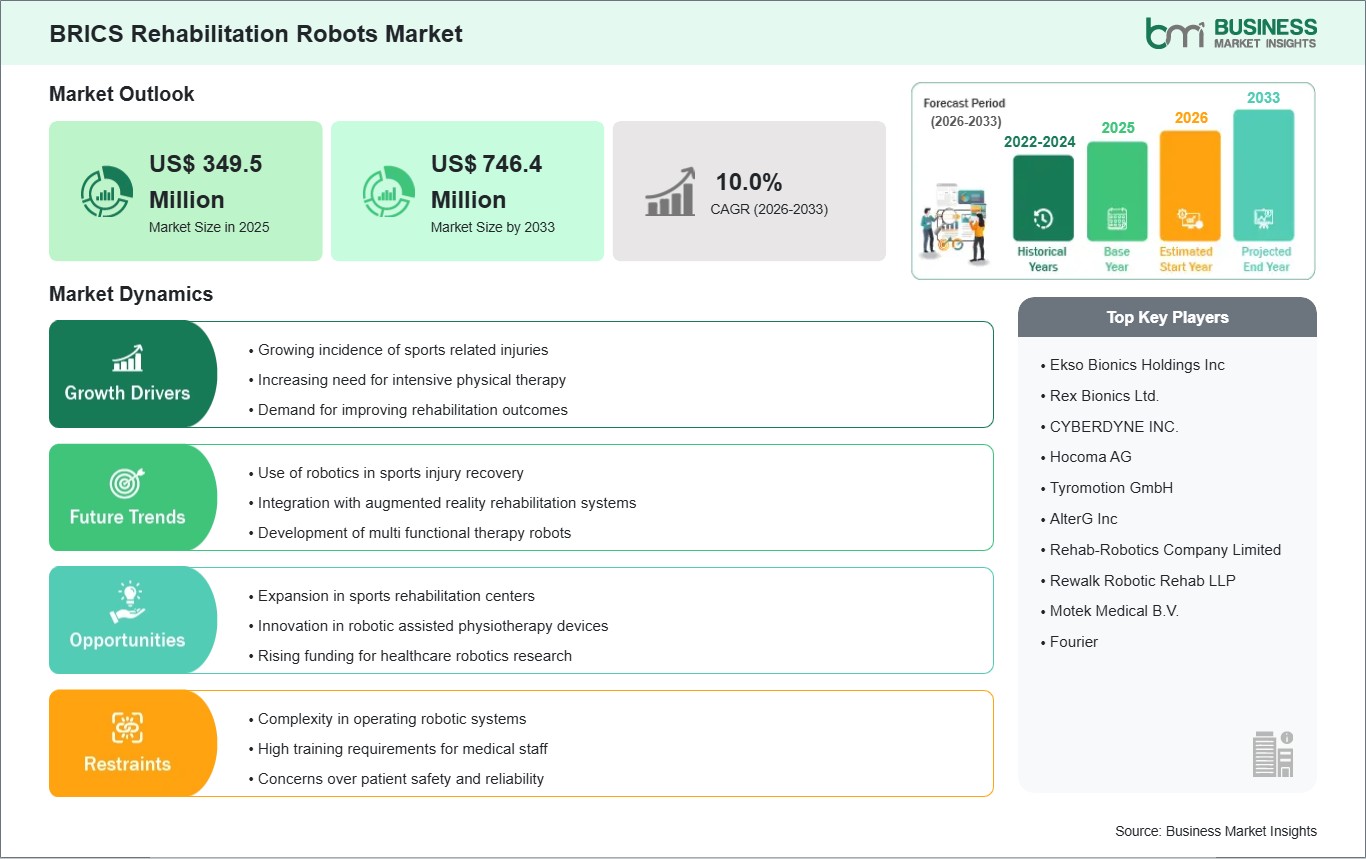
The BRICS rehabilitation robots market is evolving into a critical component of the region’s healthcare transformation, reflecting rising demand for technologically advanced rehabilitation solutions in Brazil, Russia, India, China, and South Africa. Market analysis indicates that the adoption of robotics in rehabilitation is being driven by the increasing prevalence of neurological disorders, musculoskeletal injuries, and age-related functional decline across these emerging economies. Healthcare providers are increasingly turning to robotics to enhance therapy efficiency, improve patient engagement, and generate objective data for performance monitoring. Unlike traditional rehabilitation methods, robotic solutions allow for highly repeatable and customizable therapy protocols, facilitating accelerated recovery and reduced therapist workload. The competitive landscape reflects a combination of global robotics manufacturers entering the market and regional players tailoring solutions to local clinical needs and economic contexts. In countries like China and Brazil, urban tertiary hospitals and private rehabilitation centers serve as early adoption hubs, leveraging robust healthcare infrastructure and clinical research collaborations to validate efficacy. In India, Russia, and South Africa, pilot programs and government-backed initiatives are playing a pivotal role in introducing robotics while focusing on cost-effectiveness and scalability. Key trends include the integration of artificial intelligence, sensor-based feedback systems, and cloud-enabled therapy tracking, all of which enhance personalization and enable remote monitoring. Challenges such as high upfront investment, clinician training requirements, and variable reimbursement policies remain, yet the market benefits from increasing healthcare digitization and government interest in modernizing rehabilitation services. Overall, the BRICS Rehabilitation Robots Market is positioned to shift from early-stage experimentation to more structured clinical adoption, driven by the dual imperatives of improving patient outcomes and optimizing rehabilitation workflows.
Segment Analysis
BRICS Rehabilitation Robots Market Segmentation
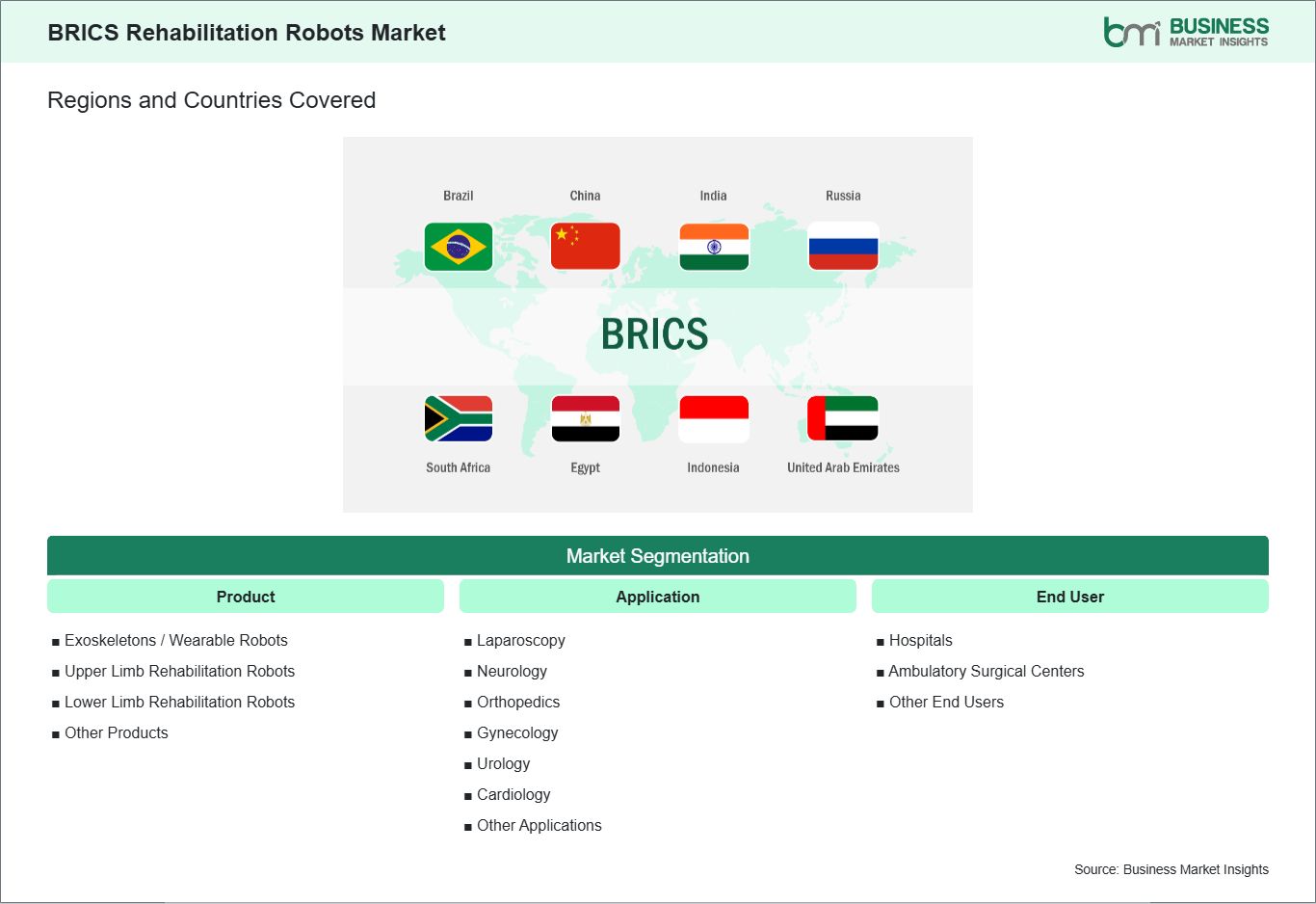
Key segments that contributed to the derivation of the BRICS rehabilitation robots market analysis are product, application, and end user.
- By product, the rehabilitation robots market is segmented into exoskeletons / wearable robots, upper limb rehabilitation robots, lower limb rehabilitation robots, and other products. The exoskeletons / wearable robots segment dominated the market in 2025.
- In terms of application, the rehabilitation robots market is categorized into laparoscopy, neurology, orthopedics, gynecology, urology, cardiology and other applications. The laparoscopy segment dominated the market in 2025.
- Based on end user, the market is classified into hospitals, ambulatory surgical centers and other end users. The hospitals segment dominated the market in 2025.
Market Forces
BRICS Rehabilitation Robots Market Drivers and Opportunities
Expansion of tele-rehabilitation services availability
The BRICS rehabilitation robots market is increasingly shaped by the rapid expansion of tele‑rehabilitation services across member countries. As healthcare providers seek ways to serve larger patient populations with limited clinical resources, tele‑rehabilitation has emerged as a key delivery model that extends therapy beyond traditional settings. Rehabilitation robots connected to remote care platforms enable clinicians to monitor patient progress, adjust exercise programs, and provide real‑time guidance without requiring frequent in‑person visits. This approach supports continuity of care, enhances patient engagement, and improves adherence to prescribed therapy regimens, particularly for individuals living outside major urban centers. In Brazil, tele‑rehabilitation services are being integrated with robotic systems to support patients in remote or underserved regions. Public and private healthcare networks are exploring remote monitoring capabilities that allow therapists to track performance data and communicate with patients virtually. Rehabilitation robots equipped with telecommunication interfaces are helping clinicians deliver consistent, structured therapy while overcoming geographic barriers that traditionally limited access to specialized care. This model is particularly valuable where travel distances to rehabilitation centers can present significant challenges for patients with mobility impairments. In India and China, the expansion of tele‑rehabilitation services is being driven by both government initiatives and private sector innovation. Large populations and varied levels of healthcare infrastructure make remote care models attractive for extending the reach of rehabilitation services. Rehabilitation robots with integrated tele‑monitoring features allow therapists to observe exercise execution, review performance metrics, and refine treatment plans in real time. These capabilities improve the efficiency of therapy delivery and reduce the burden on high‑volume clinical facilities. Meanwhile, in Russia and South Africa, tele‑rehabilitation is gaining traction as healthcare organizations look to streamline care for patients with chronic conditions and post‑acute needs, using robotic systems to bridge gaps between hospital‑based therapy and home‑based recovery. Across the BRICS region, the expansion of tele‑rehabilitation availability reflects a broader shift toward connected care that prioritizes accessibility, continuity, and personalized support. By enabling remote supervision and data‑driven adjustments, rehabilitation robots linked to tele‑health systems are transforming how therapy is delivered and making quality rehabilitation services more widely available to diverse patient populations.
Lower-cost modular robotic designs emerging
The BRICS rehabilitation robots market is also being influenced by the emergence of lower‑cost modular robotic designs that aim to make advanced therapy solutions more affordable and adaptable. Traditional rehabilitation robots have often been associated with high acquisition and maintenance costs, limiting adoption in resource‑constrained environments. In response, manufacturers and local innovators are developing modular systems that break down complex robotic platforms into more cost‑effective units. These designs allow clinicians to select modules tailored to specific rehabilitation needs—such as gait training, upper limb assistance, or balance support—without investing in a full‑scale system upfront. This modular approach increases flexibility and reduces financial barriers for healthcare providers. In China, domestic robotics firms are introducing modular rehabilitation devices that emphasize simplicity, scalability, and ease of integration with existing therapy programs. These designs appeal to a wide range of facilities from urban rehabilitation centers to smaller community clinics. By offering modules that can be deployed independently or combined for more comprehensive therapy programs, these solutions help clinicians deliver targeted care while managing costs. This trend supports broader adoption of robotics‑assisted therapy in markets where budget constraints previously limited technology penetration. In India and Brazil, healthcare innovators and supplier partnerships are fostering the development of modular robotic platforms that align with local budget realities. These systems are designed with cost‑efficiency in mind, using standardized components that can be upgraded over time as needs evolve. This incremental investment model makes advanced rehabilitation technology more accessible to private clinics and public hospitals alike. Additionally, Russia and South Africa are witnessing interest in modular rehabilitation devices that support tiered deployment strategies, enabling facilities to expand capabilities gradually as demand grows. Across the BRICS region, lower‑cost modular robotic designs are emerging as a practical solution that democratizes access to rehabilitation robotics. By enabling scalable and financially sustainable deployment, these designs are helping to broaden the impact of technology‑assisted therapy and support more inclusive care models for patients with mobility and functional recovery needs.
Size and Share Analysis
BRICS Rehabilitation Robots Market Size and Share Analysis
The BRICS rehabilitation robots market demonstrates steady growth, with size and share analysis highlighting evolving trends and competitive dynamics among key players. The report examines subsegments categorized within product, application, and end user, offering insights into their contribution to overall market performance.
By product, the exoskeletons / wearable robots segment dominated the market in 2025, driven by their strong clinical adoption due to proven effectiveness in gait training and mobility restoration for patients with stroke, spinal cord injury, and other mobility impairments, plus declining hardware costs and broader reimbursement support.
In terms of application, the laparoscopy subsegment dominated the market in 2025, driven by the rising global preference for minimally invasive procedures where robotic assistance enhances precision, reduces patient trauma and recovery time, and improves surgical outcomes making laparoscopy the most widely used robotic surgical application.
Based on end user, the hospitals subsegment dominated the market in 2025, driven by their capacity to invest in advanced robotic systems, availability of skilled clinical teams, and high volumes of complex rehabilitation cases that require robot‑assisted therapy.
Report Coverage
BRICS Rehabilitation Robots Market Report Coverage and Deliverables
The "BRICS Rehabilitation Robots Market Size and Forecast (2022–2033)" report provides a detailed analysis of the market covering below areas:
- BRICS Rehabilitation Robots Market size and forecast at regional and country levels for all segments covered under the scope
- BRICS Rehabilitation Robots Market trends, as well as drivers, restraints, and opportunities
- BRICS Rehabilitation Robots Market analysis covering key trends, regional framework, major players, regulations, and recent developments
- Industry landscape and competition analysis covering market concentration, heat map analysis, prominent players, and recent developments for the BRICS Rehabilitation Robots Market
- Detailed company profiles, including SWOT analysis
Geographic Insights
BRICS Rehabilitation Robots Market Geographic Insights
The geographical scope of the BRICS Rehabilitation Robots Market report is divided into Russia, Brazil, South Africa, India, the UAE, and China. China held the largest share in 2025.
Country-level insights reveal heterogeneous adoption patterns within the BRICS region, reflecting differences in healthcare infrastructure, policy priorities, and economic development. China emerges as the dominant market due to its extensive urban healthcare infrastructure, government-backed smart hospital initiatives, and high-volume patient base. Chinese hospitals and rehabilitation centers are early adopters of robotics, incorporating AI-enabled and sensor-integrated devices into both post-stroke and musculoskeletal rehabilitation programs. Brazil shows a growing market with increasing private hospital adoption and academic collaborations aimed at validating clinical outcomes and optimizing therapy protocols. India is an emerging market with pilot programs concentrated in tertiary hospitals and urban rehabilitation centers, with early-stage adoption supported by public-private partnerships and technology-driven cost optimization. Russia demonstrates selective adoption primarily in urban hospitals and research institutes, with focus on stroke recovery and neurorehabilitation programs, often integrating robotic solutions with traditional therapy approaches. South Africa is experiencing steady growth, driven by private healthcare demand, partnerships with global robotics vendors, and government programs promoting modernized rehabilitation services. Across all five nations, common drivers include increasing prevalence of chronic and neurological conditions, rising healthcare digitization, and growing clinician awareness of robotics-assisted therapy. However, adoption is constrained in certain regions by budgetary limitations, infrastructure gaps, and training requirements. Collectively, the BRICS countries form a diverse yet interconnected market, with China leading in scale, technological sophistication, and strategic importance, while the other nations provide substantial growth potential through targeted investments, clinical validation initiatives, and regional collaboration.
Report Guidance
BRICS Rehabilitation Robots Market Report Guidance
The report includes qualitative and quantitative data in the BRICS Rehabilitation Robots Market across product, application, end user and geography.The report starts with the key takeaways (chapter 2), highlighting key trends and outlook of the BRICS Rehabilitation Robots Market.Chapter 3 focuses on the research methodology of the study.Chapter 4 includes ecosystem analysis.Chapter 5 highlights the major industry dynamics in the BRICS Rehabilitation Robots Market, including factors that are driving the market, prevailing deterrents, potential opportunities, as well as future trends. Impact analysis of these drivers and restraints is also covered in this section.Chapter 6 discusses the BRICS Rehabilitation Robots Market scenario, in terms of historical market revenues, and forecast till the year 2033.Chapters 7 to 10 cover BRICS Rehabilitation Robots Market segments by product, application, end user, and geography across Russia, Brazil, South Africa, India, the UAE, and China. They cover the market revenue, forecast, and factors driving the market.Chapter 11 describes the competitive analysis along with the heat map analysis for the key players operating in the market.Chapter 12 describes the industry landscape analysis. It provides detailed descriptions of business activities such as market initiatives, new developments, mergers, and joint ventures globally, along with a competitive landscape.Chapter 13 provides detailed profiles of the major companies operating in the BRICS Rehabilitation Robots Market. Companies have been profiled on the basis of their key facts, business descriptions, products, financial overview, SWOT analysis, and key developments.Chapter 14, i.e., the appendix, is inclusive of a brief overview of the company, a list of abbreviations, and a disclaimer.
Industry Activity
Recent Developments
The BRICS Rehabilitation Robots Market is evaluated by gathering qualitative and quantitative data post primary and secondary research, which includes important corporate publications, association data, and databases. A few of the key developments in the BRICS rehabilitation robots market are:
- In April 2025, South Korea‑based CUREXO’s gait rehabilitation robot MORNINGWALK received clearance from India’s Central Drugs Standard Control Organisation (CDSCO), enabling its clinical distribution and therapeutic use across Indian hospitals and rehab centers. This approval represents a key milestone in bringing advanced robotic gait therapy technologies into the BRICS healthcare ecosystem, expanding options beyond traditional therapy devices. It aligns with India’s broader push to adopt tech‑driven rehabilitation solutions and strengthen domestic and imported medical robotics presence. The approval is expected to accelerate clinical adoption in neurological and orthopedic rehab programs nationwide.
- In April 2025, Fourier Rehab hosted its Global Rehabilitation & Assistive Technology Network (GReAT) Summit 2025 in Shanghai to showcase cutting‑edge rehabilitation technologies and foster international collaboration. The summit brought together experts and clinicians from multiple countries to discuss embodied AI, collaborative solutions, and future deployment strategies. While a corporate event, the summit reinforced the company’s commitment to expanding technology uptake across the Asia‑Pacific region, which includes BRICS members like China and India.
Trust & Transparency
Research Methodology
The market analysis combines proprietary research with secondary data from government agencies, company disclosures, regulatory filings, industry databases and expert interviews. Market estimates are validated through data triangulation, cross-market benchmarking and analyst
review.
View Full Research Methodology
Key Sources Referred:
World Health Organization (WHO)Organisation for Economic Cooperation and Development (OECD)The World Bank GroupWorldometerThe LancetInternational Bar AssociationInternational Trade Administration