Europe Rehabilitation Robots Market Outlook (2022-2033)

Historic Data: 2022-2024   |   Base Year: 2025   |   Forecast Period: 2026-2033
Report Content: Market Scope, Market Segmentation, Market Dynamics, and Competitive Analysis

Report Coverage:
  • Product (Exoskeletons / Wearable Robots, Upper Limb Rehabilitation Robots, Lower Limb Rehabilitation Robots, Other Products)
  • Application (Laparoscopy, Neurology, Orthopedics, Gynecology, Urology, Cardiology, Other Applications)
  • End User (Hospitals, Ambulatory Surgical Centers, Other End Users)

No. of Pages: 150
Report Code: BMIPUB00034949
Category: Life Sciences
Europe Rehabilitation Robots Market

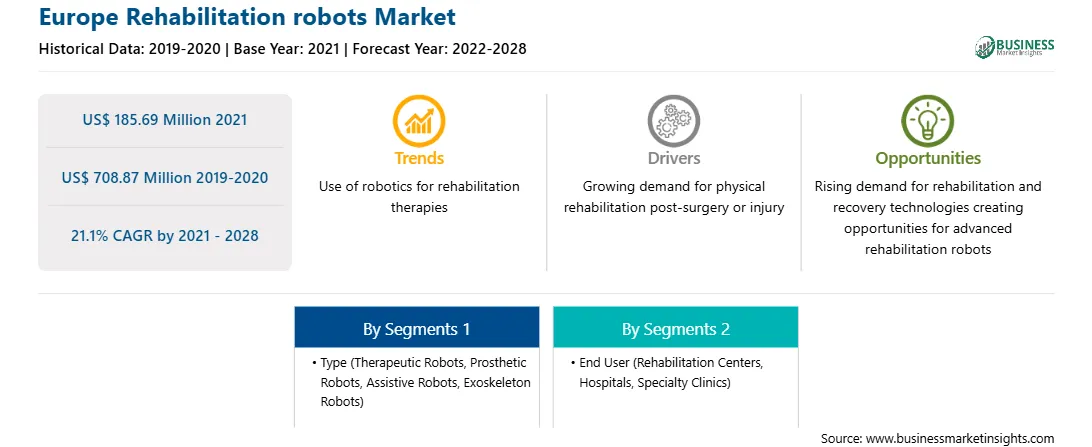
The Europe rehabilitation robots market size is expected to reach US$675.8 million by 2033 from US$376.7 million in 2025. The market is estimated to record a CAGR of 7.9% from 2026 to 2033.

Executive Summary and Europe Rehabilitation Robots Market Analysis:

The Europe Rehabilitation Robots Market represents one of the most technologically advanced segments within the global medical robotics landscape, supported by strong healthcare infrastructure, extensive research capabilities, and increasing focus on patient-centric rehabilitation solutions. Market analysis indicates that healthcare providers across Europe are progressively integrating robotic systems into rehabilitation pathways to enhance therapy precision, reduce clinician workload, and improve functional recovery outcomes. Rehabilitation robots are widely utilized for neurological rehabilitation, orthopedic therapy, and post-surgical mobility restoration, particularly for patients recovering from stroke, spinal cord injuries, and age-related mobility impairments. The region’s healthcare institutions are emphasizing data-driven therapy approaches, where robotics enables consistent repetition of therapeutic movements, real-time performance monitoring, and objective outcome measurement. The competitive landscape includes a mix of global robotics manufacturers, specialized European technology developers, and research-driven start-ups collaborating with hospitals and universities to accelerate innovation. Several European research institutions are actively engaged in the development of advanced exoskeletons, AI-assisted therapy systems, and sensor-integrated rehabilitation devices designed to personalize treatment plans. Early adoption is typically concentrated in tertiary hospitals, rehabilitation centers, and academic medical facilities where clinicians have access to training resources and infrastructure capable of supporting complex robotic systems. Regulatory frameworks within Europe also support the safe integration of medical robotics through structured approval processes and compliance standards that ensure clinical efficacy and patient safety. Although high capital investment and training requirements remain barriers in certain healthcare environments, the region benefits from strong funding mechanisms, innovation grants, and collaborative research programs. Overall, the European market demonstrates a balanced ecosystem that combines technological innovation, academic research, and clinical expertise, enabling rehabilitation robotics to evolve from experimental applications to essential tools within modern therapeutic care.

Europe Rehabilitation Robots Market - Strategic Insights:

global-market-strategic-framework
Get more information on this report

Europe Rehabilitation Robots Market Segmentation Analysis:

Key segments that contributed to the derivation of the Europe rehabilitation robots market analysis are product, application, and end user.

  • By product, the rehabilitation robots market is segmented into exoskeletons / wearable robots, upper limb rehabilitation robots, lower limb rehabilitation robots, and other products. The exoskeletons / wearable robots segment dominated the market in 2025.
  • In terms of application, the rehabilitation robots market is categorized into laparoscopy, neurology, orthopedics, gynecology, urology, cardiology and other applications. The laparoscopy segment dominated the market in 2025.
  • Based on end user, the market is classified into hospitals, ambulatory surgical centers and other end users. The hospitals segment dominated the market in 2025.

Europe Rehabilitation Robots Market Drivers and Opportunities:

Digital healthcare adoption enhances therapy delivery

The Europe rehabilitation robots market is expanding as digital healthcare adoption continues to reshape therapy delivery across the region. Healthcare providers are increasingly integrating rehabilitation robots with digital health platforms to improve patient monitoring, therapy planning, and outcome tracking. These digital systems allow clinicians to analyze patient movement data generated during robotic therapy sessions and use that information to refine treatment plans. As hospitals and rehabilitation centers move toward connected healthcare ecosystems, robotics is becoming an important tool for delivering structured and data-supported rehabilitation programs. This shift is helping providers enhance therapy efficiency while ensuring patients receive consistent and measurable treatment progress. In Western Europe, countries such as Germany, France, and the United Kingdom are at the forefront of integrating digital technologies with rehabilitation robotics. Healthcare institutions in these countries are adopting digital therapy management platforms that enable clinicians to monitor rehabilitation progress and adjust therapy programs in real time. Rehabilitation robots linked to digital systems provide therapists with detailed feedback on patient performance, enabling more personalized treatment approaches. This integration also supports multidisciplinary collaboration among healthcare professionals, as therapy data can be shared between neurologists, physiotherapists, and rehabilitation specialists. Northern and Southern European healthcare systems are also strengthening their digital health capabilities to support robotic rehabilitation solutions. Countries including Sweden, Denmark, Italy, and Spain are investing in telehealth infrastructure and electronic health platforms that allow therapy data to be securely stored and reviewed by clinicians. Rehabilitation robots integrated with digital monitoring tools make it possible for patients to continue therapy after hospital discharge while clinicians track their progress remotely. As digital healthcare becomes a standard part of medical practice across Europe, the use of rehabilitation robots within connected care environments is expected to grow steadily, improving both therapy accessibility and patient recovery outcomes.

Wearable robotics and smart garment adoption

Wearable robotics and smart rehabilitation garments are emerging as important innovations within the Europe rehabilitation robots market. These technologies include lightweight robotic exoskeletons, sensor-embedded clothing, and assistive wearable devices designed to support movement and monitor physical performance during therapy. Unlike large stationary rehabilitation systems, wearable devices allow patients to perform exercises while maintaining a more natural range of motion. Sensors embedded in wearable robotics collect detailed data on posture, muscle activity, and joint movement, enabling clinicians to evaluate rehabilitation progress more accurately and tailor therapy programs to individual patient needs. Countries such as Germany, the Netherlands, and Switzerland are exploring wearable robotics as part of modern rehabilitation programs aimed at improving patient mobility and independence. Rehabilitation centers in these countries are incorporating robotic suits and exoskeleton devices into therapy sessions to assist patients recovering from neurological injuries and mobility impairments. These wearable systems enable patients to practice walking, balance training, and upper-limb movements in a controlled and supportive environment. The ability of wearable robots to provide adjustable levels of assistance helps therapists gradually increase patient effort as recovery progresses. Across Southern and Western Europe, the adoption of smart garments and wearable rehabilitation technologies is also gaining momentum. Countries such as Italy, France, and Spain are evaluating wearable robotics that allow patients to continue therapy outside clinical environments. These systems can support home-based rehabilitation by guiding exercises and transmitting performance data to healthcare providers. The combination of mobility support and real-time monitoring encourages patients to remain actively engaged in their rehabilitation journey. As healthcare systems in Europe continue to prioritize patient-centered care and long-term recovery solutions, wearable robotics and smart garments are expected to play an increasingly significant role in expanding the reach and effectiveness of rehabilitation therapy.

Europe Rehabilitation Robots Market Size and Share Analysis:

The Europe rehabilitation robots market demonstrates steady growth, with size and share analysis highlighting evolving trends and competitive dynamics among key players. The report examines subsegments categorized within product, application, and end user, offering insights into their contribution to overall market performance.

By product, the exoskeletons / wearable robots segment dominated the market in 2025, driven by the increasing prevalence of stroke, spinal cord injuries, and age-related mobility disorders in Europe, which boosts demand for robotic gait-training and mobility-assistance technologies in rehabilitation programs.

In terms of application, the laparoscopy subsegment dominated the market in 2025, driven by the growing preference for minimally invasive robotic-assisted procedures in Europe that improve surgical precision, reduce patient trauma, and shorten recovery times.

Based on end user, the hospitals subsegment dominated the market in 2025, driven by their strong infrastructure, availability of skilled rehabilitation professionals, and higher investments in advanced robotic technologies to treat large volumes of neurological and orthopedic patients.

Europe Rehabilitation Robots Market Report Highlights:

Report Attribute Details
Market size in 2025 US$ 376.7 Million
Market Size by 2033 US$ 675.8 Million
CAGR (2026 - 2033) 7.9%
Historical Data 2022-2024
Forecast period 2026-2033
Segments Covered By Product
  • Exoskeletons / Wearable Robots
  • Upper Limb Rehabilitation Robots
  • Lower Limb Rehabilitation Robots
  • Other Products
By Application
  • Laparoscopy
  • Neurology
  • Orthopedics
  • Gynecology
  • Urology
  • Cardiology
  • Other Applications
By End User
  • Hospitals
  • Ambulatory Surgical Centers
  • Other End Users
Regions and Countries Covered
Europe Belgium, Austria, Finland, Denmark, Greece, Poland, Romania, Russia, Ukraine, Czech Republic, Slovakia, Bulgaria, Italy, Luxembourg, Germany, Switzerland, France, Netherlands, Norway, Portugal, Spain, Sweden, United Kingdom
Market leaders and key company profiles
  • Ekso Bionics Holdings Inc
  • Rex Bionics Ltd.
  • CYBERDYNE INC.
  • Hocoma AG
  • Tyromotion GmbH
  • AlterG Inc
  • Rehab-Robotics Company Limited
  • Rewalk Robotic Rehab LLP
  • Motek Medical B.V.
  • Fourier
Get more information on this report

Europe Rehabilitation Robots Market Report Coverage and Deliverables:

The "Europe Rehabilitation Robots Market Size and Forecast (2022–2033)" report provides a detailed analysis of the market covering below areas:

  • Europe Rehabilitation Robots Market size and forecast at regional and country levels for all segments covered under the scope
  • Europe Rehabilitation Robots Market trends, as well as drivers, restraints, and opportunities
  • Europe Rehabilitation Robots Market analysis covering key trends, regional framework, major players, regulations, and recent developments
  • Industry landscape and competition analysis covering market concentration, heat map analysis, prominent players, and recent developments for the Europe Rehabilitation Robots Market
  • Detailed company profiles, including SWOT analysis

Europe Rehabilitation Robots Market Geographic Insights:

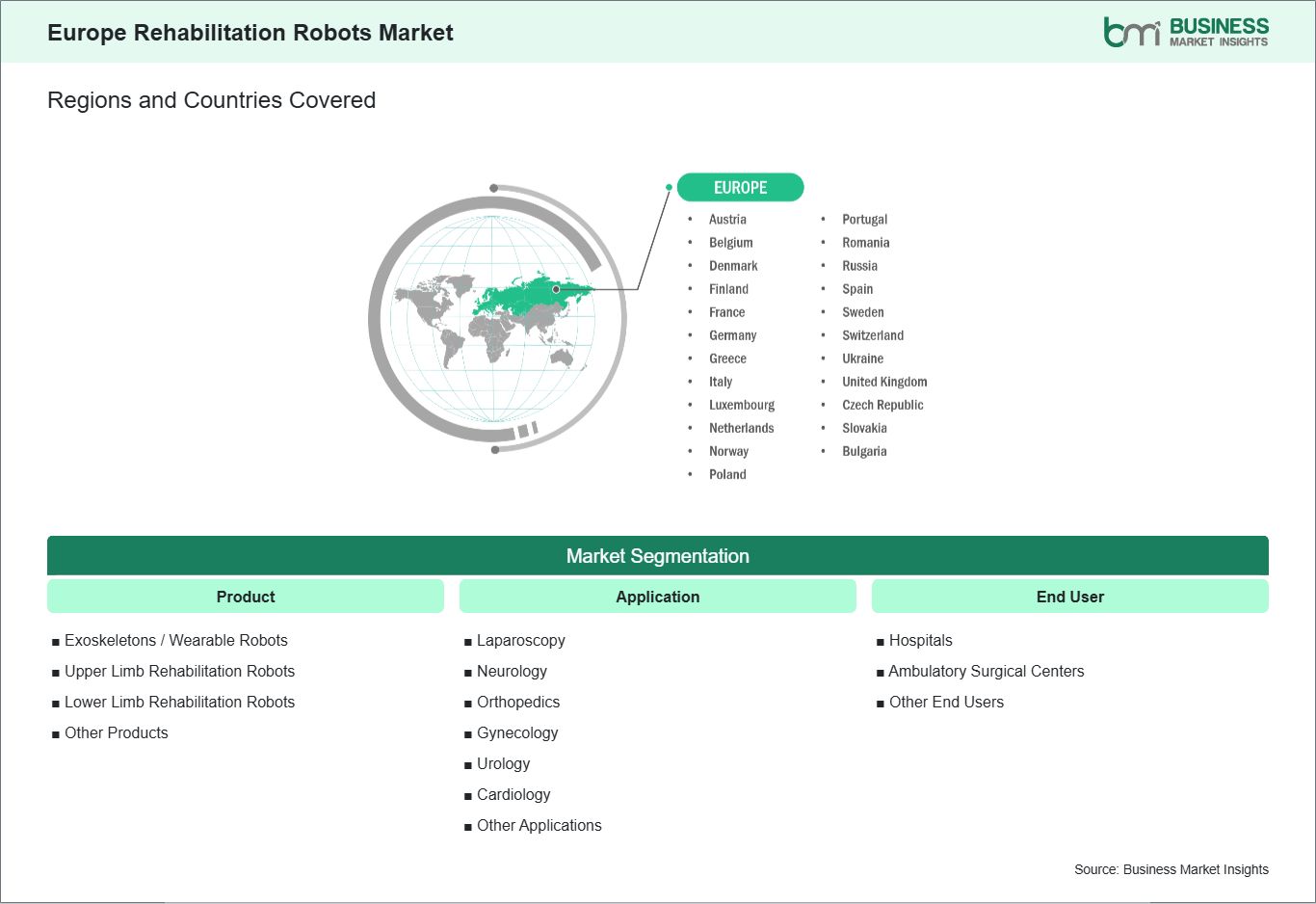
The geographical scope of the Europe Rehabilitation Robots Market report is divided into Belgium, Austria, Finland, Denmark, Greece, Poland, Romania, Russia, Ukraine, the Czech Republic, Slovakia, Bulgaria, Italy, Luxembourg, Germany, Switzerland, France, the Netherlands, Norway, Portugal, Spain, Sweden, and the UK. Germany held the largest share in 2025.

The Europe Rehabilitation Robots Market demonstrates a highly diversified regional landscape shaped by varying levels of healthcare infrastructure, research capability, and technology adoption. Among these countries, Germany emerges as the dominant market, driven by its advanced medical technology sector, strong hospital infrastructure, and extensive investment in healthcare innovation. German rehabilitation centers and tertiary hospitals are at the forefront of adopting robotics-assisted therapy, particularly for neurological rehabilitation, stroke recovery, and orthopedic rehabilitation programs. The country benefits from strong collaboration between medical technology companies, academic research institutions, and clinical facilities, enabling rapid development and validation of advanced robotic rehabilitation systems. Additionally, Germany’s structured reimbursement frameworks and strong clinician training programs support widespread adoption, positioning the country as a central hub for innovation and commercialization in the European rehabilitation robotics ecosystem. Several Western and Northern European countries demonstrate strong adoption patterns due to mature healthcare systems and high investment in medical technology. France, the Netherlands, Switzerland, Sweden, Denmark, Finland, Norway, Austria, and Belgium are actively integrating robotics into multidisciplinary rehabilitation programs across hospitals and specialized therapy centers. These countries emphasize research-driven deployment, advanced digital health integration, and the use of robotics to enhance patient recovery outcomes and optimize clinical efficiency. Many of these markets benefit from supportive government policies, strong research collaborations, and high patient awareness of advanced rehabilitation technologies. Southern European markets such as Italy, Spain, Portugal, and Greece are experiencing increasing adoption, primarily within urban hospitals and specialized rehabilitation centers. Healthcare modernization initiatives and growing focus on improving long-term recovery outcomes are encouraging providers to explore robotics-assisted therapy solutions. Meanwhile, Poland, Romania, the Czech Republic, Slovakia, Bulgaria, Ukraine, and Russia represent emerging segments within the European market. Adoption in these countries is largely driven by pilot programs, academic research collaborations, and selective deployments in major hospitals. While infrastructure limitations and budget constraints may influence adoption pace, increasing awareness of robotics-assisted rehabilitation and gradual healthcare investment are supporting market expansion. Collectively, these countries create a dynamic European rehabilitation robotics ecosystem. While adoption maturity varies across the region, Germany maintains a clear leadership position in technological capability, clinical implementation, and industry collaboration, while the remaining nations contribute to the region’s long-term growth potential through expanding healthcare infrastructure, research initiatives, and targeted technology investments.

global-market-geography
Get more information on this report

Europe Rehabilitation Robots Market Research Report Guidance:

  • The report includes qualitative and quantitative data in the Europe Rehabilitation Robots Market across product, application, end user and geography.
  • The report starts with the key takeaways (chapter 2), highlighting key trends and outlook of the Europe Rehabilitation Robots Market.
  • Chapter 3 focuses on the research methodology of the study.
  • Chapter 4 includes ecosystem analysis.
  • Chapter 5 highlights the major industry dynamics in the Europe Rehabilitation Robots Market, including factors that are driving the market, prevailing deterrents, potential opportunities, as well as future trends. Impact analysis of these drivers and restraints is also covered in this section.
  • Chapter 6 discusses the Europe Rehabilitation Robots Market scenario, in terms of historical market revenues, and forecast till the year 2033.
  • Chapters 7 to 10 cover Europe Rehabilitation Robots Market segments by product, application, end user, and geography across Belgium, Austria, Finland, Denmark, Greece, Poland, Romania, Russia, Ukraine, the Czech Republic, Slovakia, Bulgaria, Italy, Luxembourg, Germany, Switzerland, France, the Netherlands, Norway, Portugal, Spain, Sweden, and the UK. They cover the market revenue, forecast, and factors driving the market.
  • Chapter 11 describes the competitive analysis along with the heat map analysis for the key players operating in the market.
  • Chapter 12 describes the industry landscape analysis. It provides detailed descriptions of business activities such as market initiatives, new developments, mergers, and joint ventures globally, along with a competitive landscape.
  • Chapter 13 provides detailed profiles of the major companies operating in the Europe Rehabilitation Robots Market. Companies have been profiled on the basis of their key facts, business descriptions, products, financial overview, SWOT analysis, and key developments.
  • Chapter 14, i.e., the appendix, is inclusive of a brief overview of the company, a list of abbreviations, and a disclaimer.

Europe Rehabilitation Robots Market News and Key Development:

The Europe Rehabilitation Robots Market is evaluated by gathering qualitative and quantitative data post primary and secondary research, which includes important corporate publications, association data, and databases. A few of the key developments in the Europe rehabilitation robots market are:

  • In January 2024, Ekso Bionics announced the launch of a new upper-limb rehabilitation robot designed to improve therapy for stroke survivors. The robotic system assists clinicians with repetitive arm and shoulder movements during neuro-rehabilitation programs. It integrates adaptive control software and data-driven therapy tracking to improve patient recovery outcomes. The launch strengthened the company’s rehabilitation robotics portfolio and supported deployment across European rehabilitation clinics and hospitals.
  • In September 2025, Lifeward announced that its ReWalk 7 personal exoskeleton received CE Mark certification for the European Union. The approval allows commercialization and clinical use of the robotic exoskeleton across EU rehabilitation centers. The wearable system enables individuals with spinal cord injuries to stand and walk during therapy sessions. This regulatory milestone supports broader adoption of robotic gait rehabilitation technology throughout Europe.

Key Sources Referred:

World Health Organization (WHO)Organisation for Economic Cooperation and Development (OECD)The World Bank GroupWorldometerThe LancetInternational Bar AssociationInternational Trade Administration
The List of Companies - Europe Rehabilitation Robots Market
  • Ekso Bionics Holdings Inc
  • Rex Bionics Ltd.
  • CYBERDYNE INC.
  • Hocoma AG
  • Tyromotion GmbH
  • AlterG Inc
  • Rehab-Robotics Company Limited
  • Rewalk Robotic Rehab LLP
  • Motek Medical B.V.
  • Fourier
Frequently Asked Questions
How big is the Europe Rehabilitation Robots Market?

The Europe Rehabilitation Robots Market is valued at US$ 376.7 Million in 2025, it is projected to reach US$ 675.8 Million by 2033.

What is the CAGR for Europe Rehabilitation Robots Market by (2026 - 2033)?

As per our report Europe Rehabilitation Robots Market, the market size is valued at US$ 376.7 Million in 2025, projecting it to reach US$ 675.8 Million by 2033. This translates to a CAGR of approximately  7.9% during the forecast period.

What segments are covered in this report?

The Europe Rehabilitation Robots Market report typically cover these key segments-

  • Product (Exoskeletons / Wearable Robots, Upper Limb Rehabilitation Robots, Lower Limb Rehabilitation Robots, Other Products)
  • Application (Laparoscopy, Neurology, Orthopedics, Gynecology, Urology, Cardiology, Other Applications)
  • End User (Hospitals, Ambulatory Surgical Centers, Other End Users)

What is the historic period, base year, and forecast period taken for Europe Rehabilitation Robots Market?

The historic period, base year, and forecast period can vary slightly depending on the specific market research report. However, for the Europe Rehabilitation Robots Market report:

  • Historic Period : 2022-2024
  • Base Year : 2025
  • Forecast Period : 2026-2033
  • Who are the major players in Europe Rehabilitation Robots Market?

    The Europe Rehabilitation Robots Market is populated by several key players, each contributing to its growth and innovation. Some of the major players include:

  • Ekso Bionics Holdings Inc
  • Rex Bionics Ltd.
  • CYBERDYNE INC.
  • Hocoma AG
  • Tyromotion GmbH
  • AlterG Inc
  • Rehab-Robotics Company Limited
  • Rewalk Robotic Rehab LLP
  • Motek Medical B.V.
  • Fourier
  • Who should buy this report?

    The Europe Rehabilitation Robots Market report is valuable for diverse stakeholders, including:

    • Investors: Provides insights for investment decisions pertaining to market growth, companies, or industry insights. Helps assess market attractiveness and potential returns.
    • Industry Players: Offers competitive intelligence, market sizing, and trend analysis to inform strategic planning, product development, and sales strategies.
    • Suppliers and Manufacturers: Helps understand market demand for components, materials, and services related to concerned industry.
    • Researchers and Consultants: Provides data and analysis for academic research, consulting projects, and market studies.
    • Financial Institutions: Helps assess risks and opportunities associated with financing or investing in the concerned market.

    Essentially, anyone involved in or considering involvement in the Europe Rehabilitation Robots Market value chain can benefit from the information contained in a comprehensive market report.

    Available Report Formats

    pdf-format excel-format pptx-format
    Buy Now
    Sales Assistance
    +1 646 791 7070 (US & UK)
    Customization Form

    Please tell us your area of interest
    (Market Segments/ Regions and Countries/ Companies)