Market Summary
Executive Summary and Market Analysis
The North America rehabilitation robots market is one of the most mature and technologically advanced globally, driven by high healthcare expenditure, robust research infrastructure, and widespread adoption of digital health technologies. Hospitals, rehabilitation centers, and outpatient clinics in the United States and Canada are increasingly incorporating robotics-assisted therapy to improve patient outcomes in post-stroke, neurological, orthopedic, and geriatric rehabilitation. Market analysis indicates that adoption is influenced by the availability of highly skilled clinicians, advanced hospital infrastructure, and strong collaboration between medical device manufacturers and research institutions. Rehabilitation robots, including exoskeletons, robotic gait trainers, and sensor-integrated therapy platforms, are being deployed to deliver repetitive, precise, and data-driven therapy sessions that enhance functional recovery and reduce hospital stay durations. The market is further shaped by technological integration, such as AI-driven therapy personalization, real-time patient monitoring, and connectivity with electronic health records to enable outcome tracking and therapy optimization. Competitive dynamics are defined by partnerships between global robotics manufacturers, universities, and hospitals, which facilitate clinical validation, regulatory approvals, and localized support services. While the market demonstrates high penetration in urban and specialized healthcare facilities, challenges such as reimbursement variability, high capital investment, and the need for continuous workforce training remain considerations for smaller or rural providers. Overall, the North America Rehabilitation Robots Market represents a mature, innovation-driven ecosystem where technology, research, and clinical expertise converge, positioning robotics-assisted rehabilitation as a standard component of patient care and a key driver of efficiency and functional recovery.
Segment Analysis
North America Rehabilitation Robots Market Segmentation
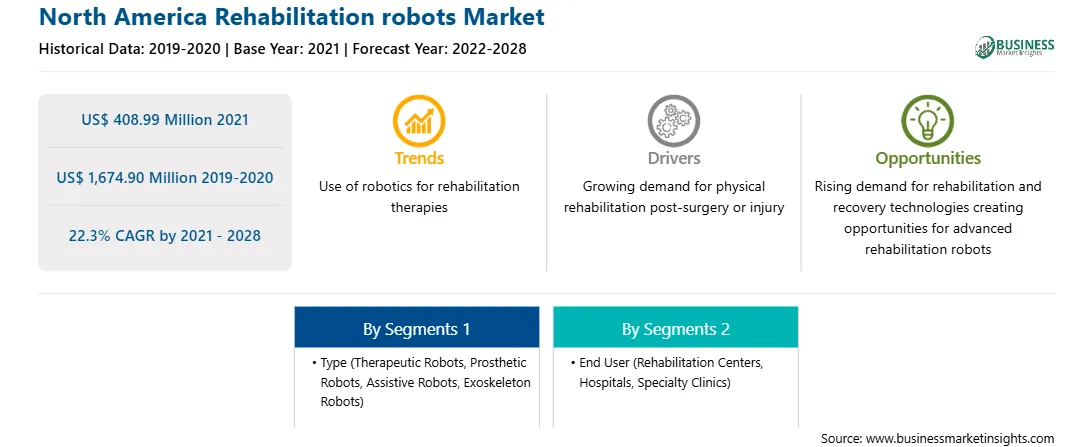
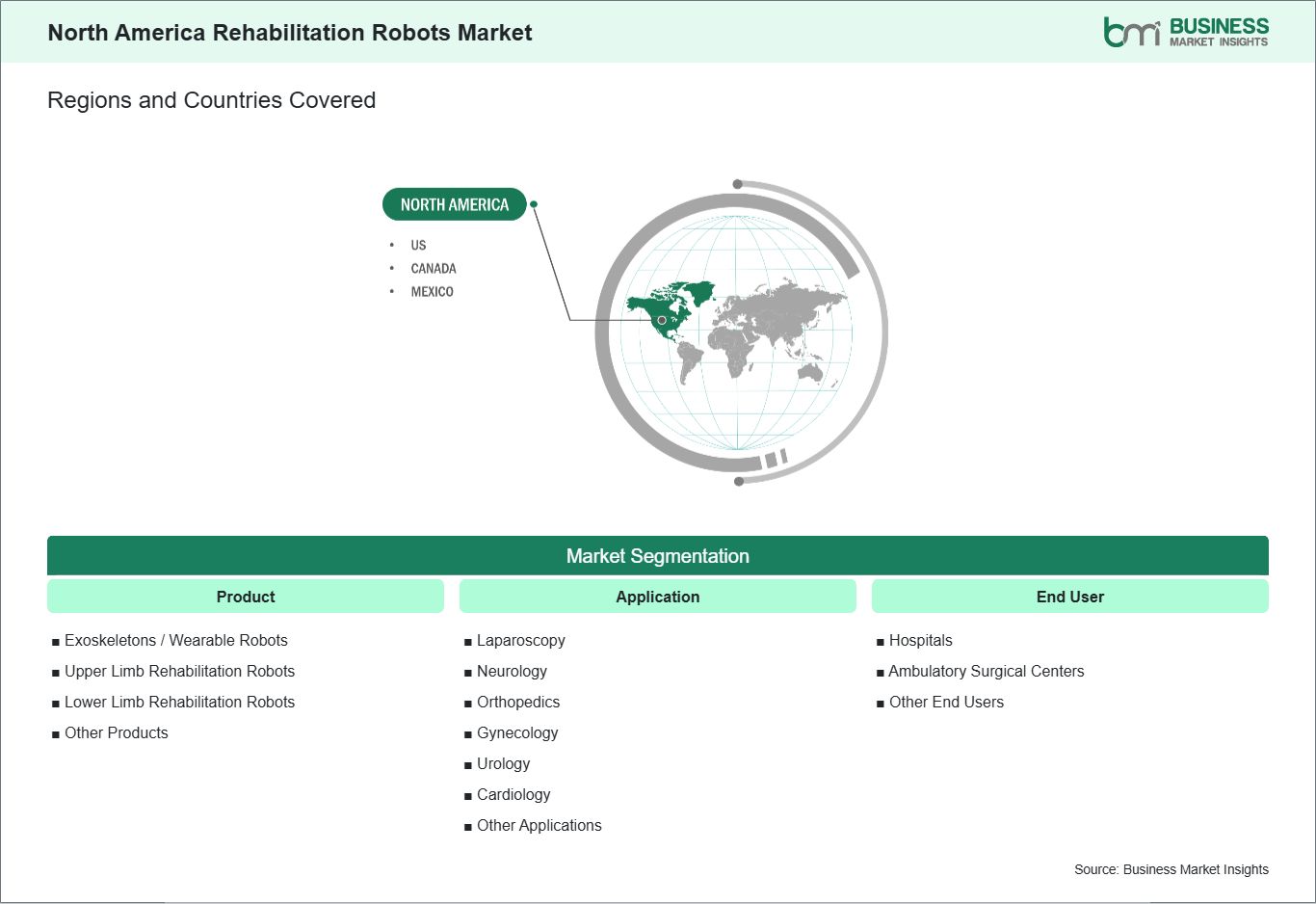
Key segments that contributed to the derivation of the North America rehabilitation robots market analysis are product, application, and end user.
- By product, the rehabilitation robots market is segmented into exoskeletons / wearable robots, upper limb rehabilitation robots, lower limb rehabilitation robots, and other products. The exoskeletons / wearable robots segment dominated the market in 2025.
- In terms of application, the rehabilitation robots market is categorized into laparoscopy, neurology, orthopedics, gynecology, urology, cardiology and other applications. The laparoscopy segment dominated the market in 2025.
- Based on end user, the market is classified into hospitals, ambulatory surgical centers and other end users. The hospitals segment dominated the market in 2025.
Market Forces
North America Rehabilitation Robots Market Drivers and Opportunities
Standardized therapy protocols improve treatment consistency
The North America rehabilitation robots market is being strongly influenced by the adoption of standardized therapy protocols, which improve treatment consistency across hospitals and rehabilitation centers. Standardized protocols ensure that robotic therapy sessions are delivered in a structured and repeatable manner, reducing variability in patient care. Rehabilitation robots can be programmed to follow precise exercise sequences, monitor patient performance, and maintain consistent therapy intensity, which allows clinicians to provide reliable, high-quality rehabilitation outcomes. This standardization supports better recovery trajectories, as patients receive uniform therapy regardless of the facility or clinician administering treatment. In the United States, rehabilitation centers are increasingly implementing standardized protocols for robotic-assisted therapy to enhance patient outcomes for post-stroke, orthopedic, and neurological recovery. Hospitals leverage robotic systems to ensure that exercises are administered consistently, while tracking performance data for each patient. This structured approach allows therapists to compare outcomes across patient populations, optimize therapy plans, and make evidence-based decisions about progression. By minimizing variability, standardized robotic protocols improve both clinical efficiency and patient confidence in therapy programs. In Canada, hospitals and outpatient rehabilitation centers are also emphasizing protocol-driven robotic therapy programs. Standardized exercises facilitated by rehabilitation robots enable therapists to maintain consistency even in high-volume clinics or across multiple locations. This approach supports uniform recovery expectations and reduces errors associated with manual exercise delivery. Clinics can integrate data collected from robotic systems into electronic health records, further strengthening the ability to monitor, evaluate, and adjust treatment plans. Across North America, standardized therapy protocols enabled by rehabilitation robots are fostering consistent, reliable, and high-quality rehabilitation care for diverse patient populations.
Hybrid human-robot rehabilitation therapy models
Hybrid human-robot rehabilitation therapy models are emerging as a key trend in the North America market, combining the strengths of robotic assistance with the expertise of human therapists. These models allow robots to handle repetitive, precise movements while clinicians focus on personalized assessment, adaptive decision-making, and patient motivation. This collaboration enhances therapy efficiency, reduces therapist fatigue, and ensures that patients receive individualized attention alongside structured robotic exercises. Hybrid approaches are particularly valuable for complex rehabilitation cases, where nuanced clinical judgment is critical to recovery. In the United States, hybrid therapy models are increasingly adopted in hospitals and specialized rehabilitation centers for post-stroke and orthopedic patients. Rehabilitation robots perform repetitive training tasks such as gait exercises or upper-limb movement sequences, while therapists monitor patient performance, adjust difficulty levels, and provide hands-on support when needed. This combination allows therapy sessions to be both efficient and highly adaptive, offering patients the benefits of consistent robotic motion alongside human expertise in motivation and corrective intervention. In Canada, hybrid rehabilitation models are also gaining traction, particularly in outpatient and community-based therapy programs. Robotic devices support repetitive and data-driven exercises, while clinicians guide patients through functional tasks and provide real-time corrections. This integrated approach ensures that therapy is personalized while maintaining the consistency and intensity offered by robotics. Across North America, hybrid human-robot rehabilitation models are shaping a more effective and patient-centered therapy environment, leveraging robotics to optimize recovery outcomes while retaining the critical human elements of care.
Size and Share Analysis
North America Rehabilitation Robots Market Size and Share Analysis
The North America rehabilitation robots market demonstrates steady growth, with size and share analysis highlighting evolving trends and competitive dynamics among key players. The report examines subsegments categorized within product, application, and end user, offering insights into their contribution to overall market performance.
By product, the exoskeletons / wearable robots segment dominated the market in 2025, driven by high clinical adoption for gait and mobility rehabilitation, supported by advanced R&D, strong reimbursement frameworks, and a large patient base with neurological and orthopedic conditions.
In terms of application, the laparoscopy subsegment dominated the market in 2025, driven by widespread use of robotic‑assisted minimally invasive surgical procedures that offer enhanced precision, reduced patient trauma, and shorter recovery times across North American healthcare facilities.
Based on end user, the hospitals subsegment dominated the market in 2025, driven by substantial investments in cutting‑edge rehabilitation and surgical robotics, coupled with well‑established healthcare infrastructure and high procedural volumes in major hospital systems.
Report Coverage
North America Rehabilitation Robots Market Report Coverage and Deliverables
The "North America Rehabilitation Robots Market Size and Forecast (2022–2033)" report provides a detailed analysis of the market covering below areas:
- North America Rehabilitation Robots Market size and forecast at regional and country levels for all segments covered under the scope
- North America Rehabilitation Robots Market trends, as well as drivers, restraints, and opportunities
- North America Rehabilitation Robots Market analysis covering key trends, regional framework, major players, regulations, and recent developments
- Industry landscape and competition analysis covering market concentration, heat map analysis, prominent players, and recent developments for the North America Rehabilitation Robots Market
- Detailed company profiles, including SWOT analysis
Geographic Insights
North America Rehabilitation Robots Market Geographic Insights
The geographical scope of the North America Rehabilitation Robots Market report is divided into US, Canada, and Mexico. The US held the largest share in 2025.
The North America Rehabilitation Robots Market exhibits strong regional adoption, with the United States emerging as the dominant market due to its advanced healthcare infrastructure, high healthcare expenditure, and early integration of robotics-assisted rehabilitation in hospitals, specialized rehabilitation centers, and academic medical institutions. U.S. healthcare providers leverage AI-enabled therapy devices, sensor-integrated exoskeletons, and robotic platforms to optimize outcomes in neurological, orthopedic, and post-surgical rehabilitation programs. These systems enable precise, repetitive therapy, real-time performance tracking, and personalized treatment protocols, significantly improving patient functional recovery and hospital efficiency. The U.S. market benefits from strong public and private investment in healthcare innovation, extensive clinical research collaborations, and structured training programs for clinicians, which accelerate adoption and support widespread implementation across urban and specialized hospitals. Canada represents a mature secondary market with steady adoption, primarily in tertiary hospitals and rehabilitation clinics. Canadian facilities are increasingly implementing robotics-assisted therapy for post-stroke, neurological, and musculoskeletal rehabilitation. Integration with digital health platforms, tele-rehabilitation, and AI-driven therapy personalization is emphasized to enhance patient outcomes and improve access to therapy in geographically dispersed regions. Government-backed healthcare initiatives and academic collaborations support pilot programs, clinical validation studies, and workforce training, making Canada a strong contributor to the regional growth of rehabilitation robotics. Mexico is an emerging market with adoption concentrated in major urban hospitals and private rehabilitation centers. Robotics-assisted therapy in Mexico is primarily deployed for neurological and post-surgical rehabilitation, with early-stage programs focused on validating clinical outcomes, optimizing cost-effectiveness, and training clinicians in robotic systems. Partnerships with international robotics providers and academic institutions facilitate technology transfer, localized support, and pilot project implementation, enabling gradual market expansion. Collectively, these three countries form a heterogeneous North American rehabilitation robotics landscape. The United States leads in scale, technological sophistication, and clinical adoption, while Canada provides research-driven growth and structured integration, and Mexico represents emerging potential through pilot programs and early urban adoption. The region is positioned for continued growth as hospitals, clinics, and research institutions increasingly prioritize robotics-assisted rehabilitation to improve patient outcomes, operational efficiency, and healthcare innovation.
Industry Activity
Recent Developments
The North America Rehabilitation Robots Market is evaluated by gathering qualitative and quantitative data post primary and secondary research, which includes important corporate publications, association data, and databases. A few of the key developments in the North America rehabilitation robots market are:
- In April 2025, Lifeward Ltd. officially launched the ReWalk 7 Personal Exoskeleton for sale across the U.S. market, offering advanced gait assistance for individuals with spinal cord injury. The new generation device includes enhanced features such as cloud connectivity and customizable walking speeds to support both clinical therapy and everyday mobility. This nationwide launch follows formal FDA clearance in March 2025, expanding commercial access beyond specialized rehab clinics. ReWalk 7 marks a major product introduction in North America’s rehabilitation robotics landscape.
- In March 2025, the U.S. Food and Drug Administration (FDA) approved Wandercraft’s Atalante X robotic exoskeleton for rehabilitation use in people with multiple sclerosis and broader spinal cord injury levels, expanding indications within the U.S. healthcare system. This approval builds on earlier clearance for spinal cord and stroke rehabilitation and enhances patient eligibility for robotic gait therapy. Wandercraft’s exoskeletons are now positioned for wider clinical deployment across North American rehabilitation centers. The approval signals continued advancement of next‑generation exoskeleton technology in the region.
Trust & Transparency
Research Methodology
The market analysis combines proprietary research with secondary data from government agencies, company disclosures, regulatory filings, industry databases and expert interviews. Market estimates are validated through data triangulation, cross-market benchmarking and analyst
review.
View Full Research Methodology
Key Sources Referred:
World Health Organization (WHO)Organisation for Economic Cooperation and Development (OECD)The World Bank GroupWorldometerThe LancetInternational Bar AssociationInternational Trade Administration