Asia Pacific Rehabilitation Robots Market Outlook (2022-2033)

Historic Data: 2022-2024   |   Base Year: 2025   |   Forecast Period: 2026-2033
Report Content: Market Scope, Market Segmentation, Market Dynamics, and Competitive Analysis

Report Coverage:
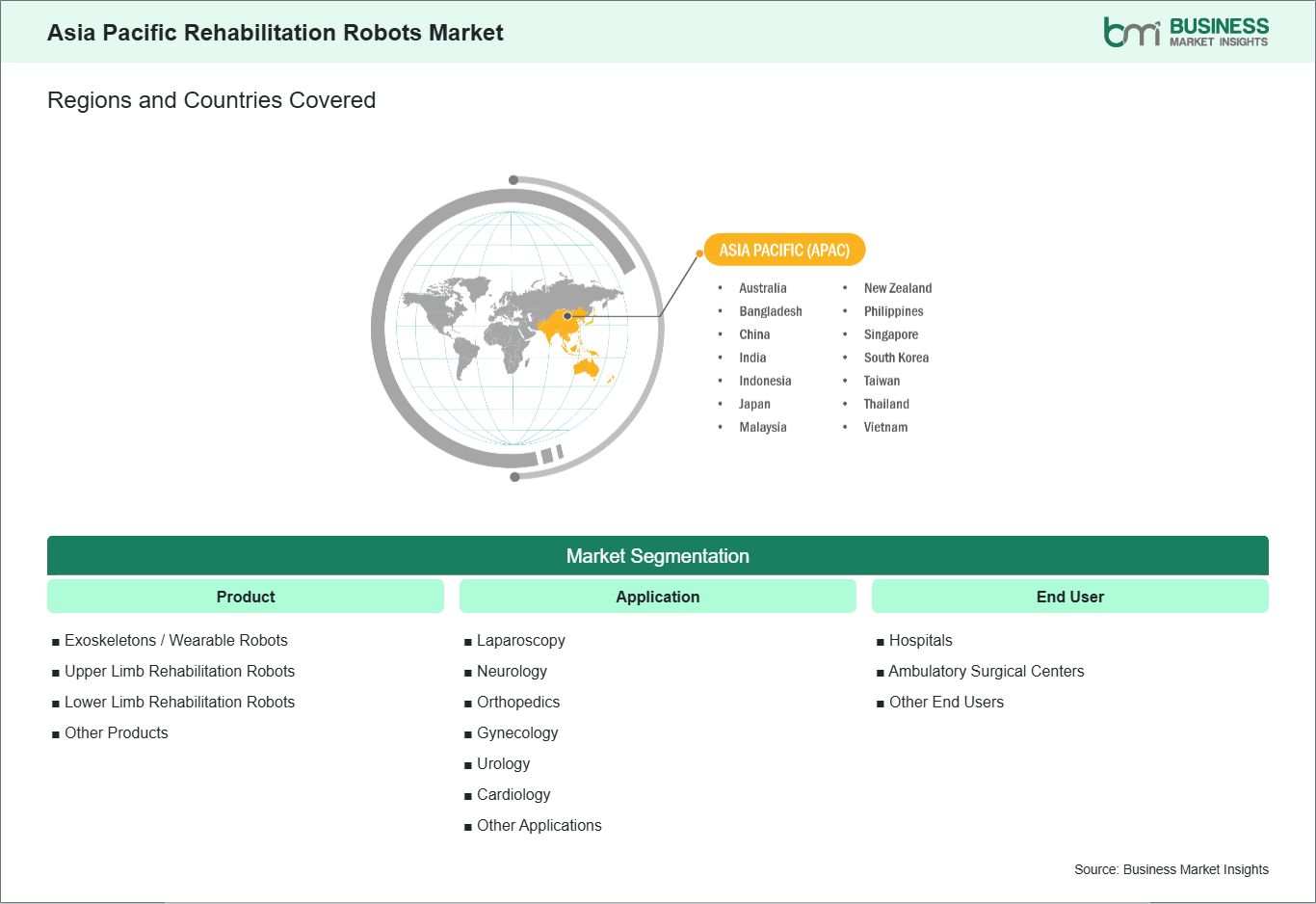
  • Product (Exoskeletons / Wearable Robots, Upper Limb Rehabilitation Robots, Lower Limb Rehabilitation Robots, Other Products)
  • Application (Laparoscopy, Neurology, Orthopedics, Gynecology, Urology, Cardiology, Other Applications)
  • End User (Hospitals, Ambulatory Surgical Centers, Other End Users)

No. of Pages: 150
Report Code: BMIPUB00034950
Category: Life Sciences
Asia Pacific Rehabilitation Robots Market

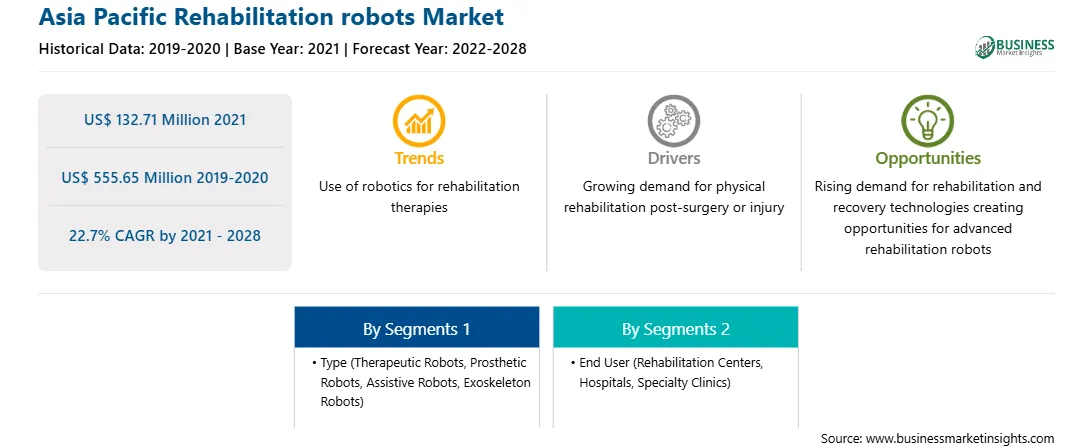
The Asia Pacific rehabilitation robots market size is expected to reach US$627.5 million by 2033 from US$258.8 million in 2025. The market is estimated to record a CAGR of 12.0% from 2026 to 2033.

Executive Summary and Asia Pacific Rehabilitation Robots Market Analysis:

The Asia Pacific rehabilitation robots market is experiencing a transformative phase driven by shifting healthcare priorities, demographic change, and rising focus on quality patient outcomes. Across the region, rehabilitation robotics is gaining traction as a strategic solution to address the increasing burden of neurological disorders, musculoskeletal conditions, and age‑related functional decline. A comprehensive market analysis indicates that stakeholders including public and private healthcare providers, technology integrators, and clinical research institutions are actively exploring automation to augment conventional therapy and extend care capacity. Key drivers include rapid urbanization, expansion of advanced medical facilities, and the integration of digital health technologies such as artificial intelligence, sensor analytics, and cloud‑based performance tracking. Unlike traditional rehabilitative approaches, robotics delivers repeatable, data‑driven therapy programs that can be tailored to specific patient needs, enhancing clinical effectiveness while optimizing therapist productivity. Competitive dynamics in the region reflect a mix of global robotics manufacturers and regional players forming strategic alliances to localize product offerings, establish robust after‑sales service networks, and build clinician training ecosystems. Distinct adoption patterns have emerged: mature markets such as Japan, South Korea, and Australia are advancing toward sophisticated devices spanning exoskeletons and AI‑enabled systems, while emerging economies like India, China, and Southeast Asian countries are prioritizing cost‑effective and scalable solutions. Challenges identified in the analysis include clinician upskilling, infrastructure readiness, regulatory synchronization, and reimbursement policy development. Nevertheless, the broader healthcare transformation agenda focused on patient experience, operational efficiency, and evidence‑based care is increasingly positioning rehabilitation robotics as a mainstream clinical asset rather than a niche innovation. As providers seek measurable outcomes and long‑term recovery pathways for patients, the Asia Pacific Rehabilitation Robots Market is poised for accelerated integration into standard therapeutic workflows, driving opportunities for innovation and regional expertise.

Asia Pacific Rehabilitation Robots Market - Strategic Insights:

global-market-strategic-framework
Get more information on this report

Asia Pacific Rehabilitation Robots Market Segmentation Analysis:

Key segments that contributed to the derivation of the Asia Pacific rehabilitation robots market analysis are product, application, and end user.

  • By product, the rehabilitation robots market is segmented into exoskeletons / wearable robots, upper limb rehabilitation robots, lower limb rehabilitation robots, and other products. The exoskeletons / wearable robots segment dominated the market in 2025.
  • In terms of application, the rehabilitation robots market is categorized into laparoscopy, neurology, orthopedics, gynecology, urology, cardiology and other applications. The laparoscopy segment dominated the market in 2025.
  • Based on end user, the market is classified into hospitals, ambulatory surgical centers and other end users. The hospitals segment dominated the market in 2025.

Asia Pacific Rehabilitation Robots Market Drivers and Opportunities:

Growth in chronic musculoskeletal diseases

The Asia Pacific rehabilitation robots market is being significantly influenced by the growing prevalence of chronic musculoskeletal diseases across the region. Conditions such as back pain, joint degeneration, and repetitive strain injuries are increasingly common as lifestyles become more sedentary and populations age. These chronic conditions often require long‑term therapy to help patients regain mobility, reduce pain, and restore functional independence. Rehabilitation robots provide a structured approach to repetitive movement therapy, delivering consistent assistance that supports recovery while reducing the physical burden on therapists and patients. In East Asian countries like Japan, South Korea, and China, healthcare providers are recognizing the value of robotic systems for addressing musculoskeletal rehabilitation needs. Urban hospitals and rehabilitation centers are exploring robotic exoskeletons, gait trainers, and limb support devices to support treatment plans for patients recovering from chronic joint injuries or surgical interventions. These technologies help clinicians standardize therapy sessions, ensure repeatability of motion exercises, and monitor patient progress in ways that traditional methods cannot easily achieve. As a result, rehabilitation robots are becoming part of mainstream therapy pathways that emphasize efficiency and effectiveness. Southeast Asian markets such as Singapore, Malaysia, and Thailand are also responding to the rise in musculoskeletal conditions by introducing rehabilitation robots into clinical care. With increasing patient demand for advanced therapy options, private and public health systems in the region are evaluating how robotic solutions can enhance the quality of rehabilitation services. The appeal of these systems lies in their ability to offer scalable therapy that supports large patient populations with varying degrees of mobility impairment. As awareness of chronic musculoskeletal disease management grows across the Asia Pacific region, rehabilitation robots are positioned to play a key role in elevating care standards and expanding access to quality rehabilitation services.

Personalized data-driven rehabilitation treatment programs

The shift toward personalized, data‑driven rehabilitation treatment programs is another major factor propelling the Asia Pacific rehabilitation robots market forward. Rehabilitation robots generate detailed records of patient movement patterns, effort levels, and therapy performance metrics. This wealth of data allows therapists to tailor treatment plans to the individual needs of each patient, adjusting exercise intensity, movement range, and therapy duration based on measurable progress. This personalized approach contrasts with generic therapy methods, enabling more efficient recovery pathways and better long‑term outcomes. In countries like Japan and South Korea, where digital healthcare innovation is a strategic priority, rehabilitation providers are integrating robotic systems with digital platforms that support advanced data analytics. Clinicians can access trend reports from robotic sessions, identify plateaus in recovery, and refine treatment strategies with precision. This focus on data‑informed care aligns with broader regional efforts to embrace digital health and evidence‑based medicine. Patients benefit from rehabilitation programs that evolve with their progress, making therapy more responsive and meaningful. In rapidly developing healthcare markets such as China, India, and Australia, personalized rehabilitation is gaining attention as a way to address diverse patient needs across urban and semi‑urban populations. Rehabilitation robots are equipped with interfaces that track progress over time and enable remote review by therapists, making treatment more adaptable to changing patient requirements. This data‑centric approach helps clinicians and patients set realistic goals, monitor improvement, and anticipate challenges before they become setbacks. As health systems across the Asia Pacific region emphasize the use of outcomes data to drive treatment decisions, personalized, data‑driven rehabilitation programs supported by robotic technologies are becoming a core component of modern rehabilitative care.

Asia Pacific Rehabilitation Robots Market Size and Share Analysis:

The Asia Pacific rehabilitation robots market demonstrates steady growth, with size and share analysis highlighting evolving trends and competitive dynamics among key players. The report examines subsegments categorized within product, application, and end user, offering insights into their contribution to overall market performance.

By product, the exoskeletons / wearable robots segment dominated the market in 2025, driven by the rising demand for advanced mobility support and functional recovery solutions for patients with neurological and physical impairments.

In terms of application, the laparoscopy subsegment dominated the market in 2025, driven by the increased preference for minimally invasive, robotic‑aided therapeutic interventions that enhance patient recovery and reduce treatment‑related complications.

Based on end user, the hospitals subsegment dominated the market in 2025, driven by the concentration of healthcare expenditure, advanced clinical infrastructure, and high patient footfall requiring comprehensive rehabilitation services.

Asia Pacific Rehabilitation Robots Market Report Highlights:

Report Attribute Details
Market size in 2025 US$ 627.5 Million
Market Size by 2033 US$ 627.5 Million
CAGR (2026 - 2033) 12.0%
Historical Data 2022-2024
Forecast period 2026-2033
Segments Covered By Product
  • Exoskeletons / Wearable Robots
  • Upper Limb Rehabilitation Robots
  • Lower Limb Rehabilitation Robots
  • Other Products
By Application
  • Laparoscopy
  • Neurology
  • Orthopedics
  • Gynecology
  • Urology
  • Cardiology
  • Other Applications
By End User
  • Hospitals
  • Ambulatory Surgical Centers
  • Other End Users
Regions and Countries Covered
Asia Pacific China, India, Japan, Australia, Bangladesh, Indonesia, Malaysia, New Zealand, Philippines, Singapore, South Korea, Taiwan, Thailand, Vietnam
Market leaders and key company profiles
  • Ekso Bionics Holdings Inc
  • Rex Bionics Ltd.
  • CYBERDYNE INC.
  • Hocoma AG
  • Tyromotion GmbH
  • AlterG Inc
  • Rehab-Robotics Company Limited
  • Rewalk Robotic Rehab LLP
  • Motek Medical B.V.
  • Fourier
Get more information on this report

Asia Pacific Rehabilitation Robots Market Report Coverage and Deliverables:

The "Asia Pacific Rehabilitation Robots Market Size and Forecast (2022–2033)" report provides a detailed analysis of the market covering below areas:

  • Asia Pacific Rehabilitation Robots Market size and forecast at regional and country levels for all segments covered under the scope
  • Asia Pacific Rehabilitation Robots Market trends, as well as drivers, restraints, and opportunities
  • Asia Pacific Rehabilitation Robots Market analysis covering key trends, regional framework, major players, regulations, and recent developments
  • Industry landscape and competition analysis covering market concentration, heat map analysis, prominent players, and recent developments for the Asia Pacific Rehabilitation Robots Market
  • Detailed company profiles, including SWOT analysis

Asia Pacific Rehabilitation Robots Market Geographic Insights:

The geographical scope of the Asia Pacific Rehabilitation Robots Market report is divided into China, India, Japan, Australia, Bangladesh, Indonesia, Malaysia, New Zealand, Philippines, Singapore, South Korea, Taiwan, Thailand, and Vietnam. China held the largest share in 2025.

The Asia Pacific Rehabilitation Robots Market demonstrates substantial diversity across its constituent countries, with China emerging as the dominant market due to its large population, rapid expansion of healthcare infrastructure, and government-led initiatives aimed at modernizing rehabilitation services. China’s healthcare system is increasingly integrating robotics across urban tertiary hospitals, specialized rehabilitation centers, and research institutions, particularly for post-stroke, neurological, and musculoskeletal rehabilitation. Strategic partnerships between international robotics vendors and local manufacturers have enabled pilot programs, clinician training, and technology localization, allowing Chinese providers to scale deployment across high-demand urban and semi-urban regions. Policy initiatives promoting smart hospitals, AI-enabled medical devices, and tele-rehabilitation frameworks further reinforce China’s market dominance, making it both a commercial and clinical focal point for the region. The sheer volume of potential patients combined with government support positions China as the central hub for regional growth and innovation. India is an emerging market with growing adoption in private hospitals and multi-specialty rehabilitation centers. Early-stage pilot projects, academic research collaborations, and technology partnerships are the primary drivers, with emphasis on cost-effective robotic solutions suitable for large patient volumes. Japan remains a mature market with advanced clinical integration, leveraging high-precision robotics for geriatric care and neurological rehabilitation, supported by strong R&D infrastructure and favorable reimbursement policies. South Korea has similarly advanced adoption, focusing on gait training, upper-limb rehabilitation, and AI-enhanced robotic systems within major hospital networks. Australia and New Zealand exhibit steady growth, emphasizing multidisciplinary care integration, evidence-based rehabilitation programs, and research-driven adoption of robotics in public and private health institutions. In Southeast Asia, Singapore and Malaysia are leading markets with high private healthcare demand, early adoption of robotic solutions, and strategic partnerships with global technology providers. Thailand, Indonesia, Vietnam, and the Philippines are at earlier stages of adoption, with pilot projects concentrated in urban centers and teaching hospitals. Efforts in Bangladesh and Taiwan focus primarily on academic research initiatives and proof-of-concept deployments. Across these countries, common growth drivers include aging populations, increasing prevalence of chronic and neurological conditions, rising healthcare spending, and policy initiatives supporting technology adoption. However, market maturity, infrastructure readiness, and clinician expertise vary widely, highlighting the need for tailored strategies. Collectively, these nations form a heterogeneous Asia Pacific landscape, with China at the forefront in scale, demand, and strategic importance, while the other countries represent high-potential markets for incremental growth and regional expansion.

global-market-geography
Get more information on this report

Asia Pacific Rehabilitation Robots Market Research Report Guidance:

  • The report includes qualitative and quantitative data in the Asia Pacific Rehabilitation Robots Market across product, application, end user and geography.
  • The report starts with the key takeaways (chapter 2), highlighting key trends and outlook of the Asia Pacific Rehabilitation Robots Market.
  • Chapter 3 focuses on the research methodology of the study.
  • Chapter 4 includes ecosystem analysis.
  • Chapter 5 highlights the major industry dynamics in the Asia Pacific Rehabilitation Robots Market, including factors that are driving the market, prevailing deterrents, potential opportunities, as well as future trends. Impact analysis of these drivers and restraints is also covered in this section.
  • Chapter 6 discusses the Asia Pacific Rehabilitation Robots Market scenario, in terms of historical market revenues, and forecast till the year 2033.
  • Chapters 7 to 10 cover Asia Pacific Rehabilitation Robots Market segments by product, application, end user, and geography across China, India, Japan, Australia, Bangladesh, Indonesia, Malaysia, New Zealand, Philippines, Singapore, South Korea, Taiwan, Thailand, and Vietnam. They cover the market revenue, forecast, and factors driving the market.
  • Chapter 11 describes the competitive analysis along with the heat map analysis for the key players operating in the market.
  • Chapter 12 describes the industry landscape analysis. It provides detailed descriptions of business activities such as market initiatives, new developments, mergers, and joint ventures globally, along with a competitive landscape.
  • Chapter 13 provides detailed profiles of the major companies operating in the Asia Pacific Rehabilitation Robots Market. Companies have been profiled on the basis of their key facts, business descriptions, products, financial overview, SWOT analysis, and key developments.
  • Chapter 14, i.e., the appendix, is inclusive of a brief overview of the company, a list of abbreviations, and a disclaimer.

Asia Pacific Rehabilitation Robots Market News and Key Development:

The Asia Pacific Rehabilitation Robots Market is evaluated by gathering qualitative and quantitative data post primary and secondary research, which includes important corporate publications, association data, and databases. A few of the key developments in the Asia Pacific rehabilitation robots market are:

  • In January 2025, Genrobotics launched India’s first robotic‑assisted paediatric gait trainer, the G‑Gaiter Paediatric, in Thiruvananthapuram to help children with mobility challenges from conditions like cerebral palsy and spinal injuries. The device uses advanced robotics with VR‑integrated, interactive therapy to make rehabilitation more engaging for young patients. Kerala Health Minister Veena George inaugurated the launch and announced installation at Sree Avittam Thirunal Hospital, expanding clinical rehab tech in public health. This marks a major product deployment of robotic gait training technology in India’s paediatric rehabilitation space.
  • In October 2025, the advanced G‑Gaiter robotic gait trainer was launched at HCAH Rehabilitation Centre in Hyderabad during the inauguration of its Center for Advance Robotics & Recovery, coinciding with World Stroke Day. The deployment introduced AI‑assisted gait rehabilitation into structured therapy programs for stroke and mobility impairment patients. Genrobotics systems are being adopted across leading rehab institutions, reflecting expanding clinical use of robotic therapy in India. This expansion supports broader integration of robotics and AI in physical medicine and rehabilitation.

Key Sources Referred:

World Health Organization (WHO)Organisation for Economic Cooperation and Development (OECD)The World Bank GroupWorldometerThe LancetInternational Bar AssociationInternational Trade Administration
The List of Companies - Asia Pacific Rehabilitation Robots Market
  • Ekso Bionics Holdings Inc
  • Rex Bionics Ltd.
  • CYBERDYNE INC.
  • Hocoma AG
  • Tyromotion GmbH
  • AlterG Inc
  • Rehab-Robotics Company Limited
  • Rewalk Robotic Rehab LLP
  • Motek Medical B.V.
  • Fourier
Frequently Asked Questions
How big is the Asia Pacific Rehabilitation Robots Market?

The Asia Pacific Rehabilitation Robots Market is valued at US$ 627.5 Million in 2025, it is projected to reach US$ 627.5 Million by 2033.

What is the CAGR for Asia Pacific Rehabilitation Robots Market by (2026 - 2033)?

As per our report Asia Pacific Rehabilitation Robots Market, the market size is valued at US$ 627.5 Million in 2025, projecting it to reach US$ 627.5 Million by 2033. This translates to a CAGR of approximately  12.0% during the forecast period.

What segments are covered in this report?

The Asia Pacific Rehabilitation Robots Market report typically cover these key segments-

  • Product (Exoskeletons / Wearable Robots, Upper Limb Rehabilitation Robots, Lower Limb Rehabilitation Robots, Other Products)
  • Application (Laparoscopy, Neurology, Orthopedics, Gynecology, Urology, Cardiology, Other Applications)
  • End User (Hospitals, Ambulatory Surgical Centers, Other End Users)

What is the historic period, base year, and forecast period taken for Asia Pacific Rehabilitation Robots Market?

The historic period, base year, and forecast period can vary slightly depending on the specific market research report. However, for the Asia Pacific Rehabilitation Robots Market report:

  • Historic Period : 2022-2024
  • Base Year : 2025
  • Forecast Period : 2026-2033
  • Who are the major players in Asia Pacific Rehabilitation Robots Market?

    The Asia Pacific Rehabilitation Robots Market is populated by several key players, each contributing to its growth and innovation. Some of the major players include:

  • Ekso Bionics Holdings Inc
  • Rex Bionics Ltd.
  • CYBERDYNE INC.
  • Hocoma AG
  • Tyromotion GmbH
  • AlterG Inc
  • Rehab-Robotics Company Limited
  • Rewalk Robotic Rehab LLP
  • Motek Medical B.V.
  • Fourier
  • Who should buy this report?

    The Asia Pacific Rehabilitation Robots Market report is valuable for diverse stakeholders, including:

    • Investors: Provides insights for investment decisions pertaining to market growth, companies, or industry insights. Helps assess market attractiveness and potential returns.
    • Industry Players: Offers competitive intelligence, market sizing, and trend analysis to inform strategic planning, product development, and sales strategies.
    • Suppliers and Manufacturers: Helps understand market demand for components, materials, and services related to concerned industry.
    • Researchers and Consultants: Provides data and analysis for academic research, consulting projects, and market studies.
    • Financial Institutions: Helps assess risks and opportunities associated with financing or investing in the concerned market.

    Essentially, anyone involved in or considering involvement in the Asia Pacific Rehabilitation Robots Market value chain can benefit from the information contained in a comprehensive market report.

    Available Report Formats

    pdf-format excel-format pptx-format
    Buy Now
    Sales Assistance
    +1 646 791 7070 (US & UK)
    Customization Form

    Please tell us your area of interest
    (Market Segments/ Regions and Countries/ Companies)