Market Summary
Executive Summary and Market Analysis
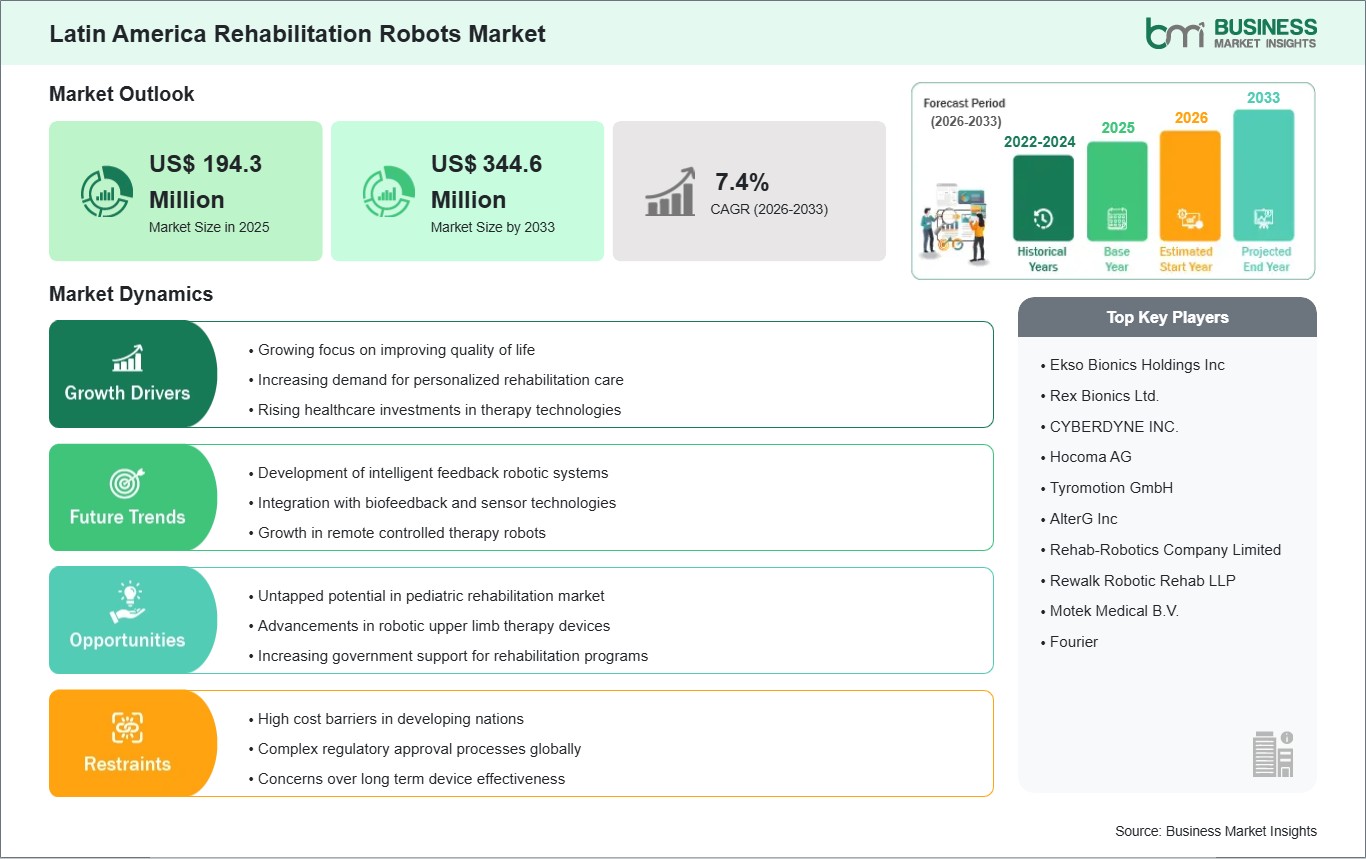
The Latin America Rehabilitation Robots Market is undergoing a period of strategic transformation as healthcare providers increasingly recognize the potential of robotics to enhance rehabilitation services, particularly in post-stroke, neurological, and musculoskeletal therapy. Market analysis indicates that rising incidence of chronic diseases, traffic-related injuries, and age-related mobility impairments are fueling demand for advanced rehabilitation technologies across the region. Hospitals and specialized rehabilitation centers are exploring robotic systems to deliver precision therapy with high repeatability, objective performance tracking, and personalized patient programs. The market is characterized by a mix of international robotics manufacturers entering high-potential Latin American countries and regional technology players tailoring cost-effective solutions for diverse clinical settings. Adoption trends show that urban tertiary hospitals and private clinics are the initial deployment hubs, while smaller facilities gradually evaluate pilot programs. Technological integration is also a key focus, with robotics increasingly combined with digital monitoring platforms, wearable sensors, and AI-assisted feedback systems to optimize therapeutic outcomes and improve patient engagement. Despite the opportunities, adoption is moderated by challenges including high capital expenditure, limited reimbursement frameworks, and the need for clinician training to effectively operate robotic systems. Competitive dynamics highlight strategic collaborations between hospitals, universities, and global technology providers, which support local adaptation, clinical validation, and training initiatives. Moreover, governments in countries such as Brazil, Mexico, and Argentina are promoting healthcare modernization programs that indirectly encourage the adoption of robotics-assisted rehabilitation. Overall, the Latin America market is evolving from experimental deployments to structured integration within clinical workflows, signaling the gradual establishment of robotics-assisted rehabilitation as a mainstream component of healthcare delivery in the region.
Segment Analysis
Latin America Rehabilitation Robots Market Segmentation
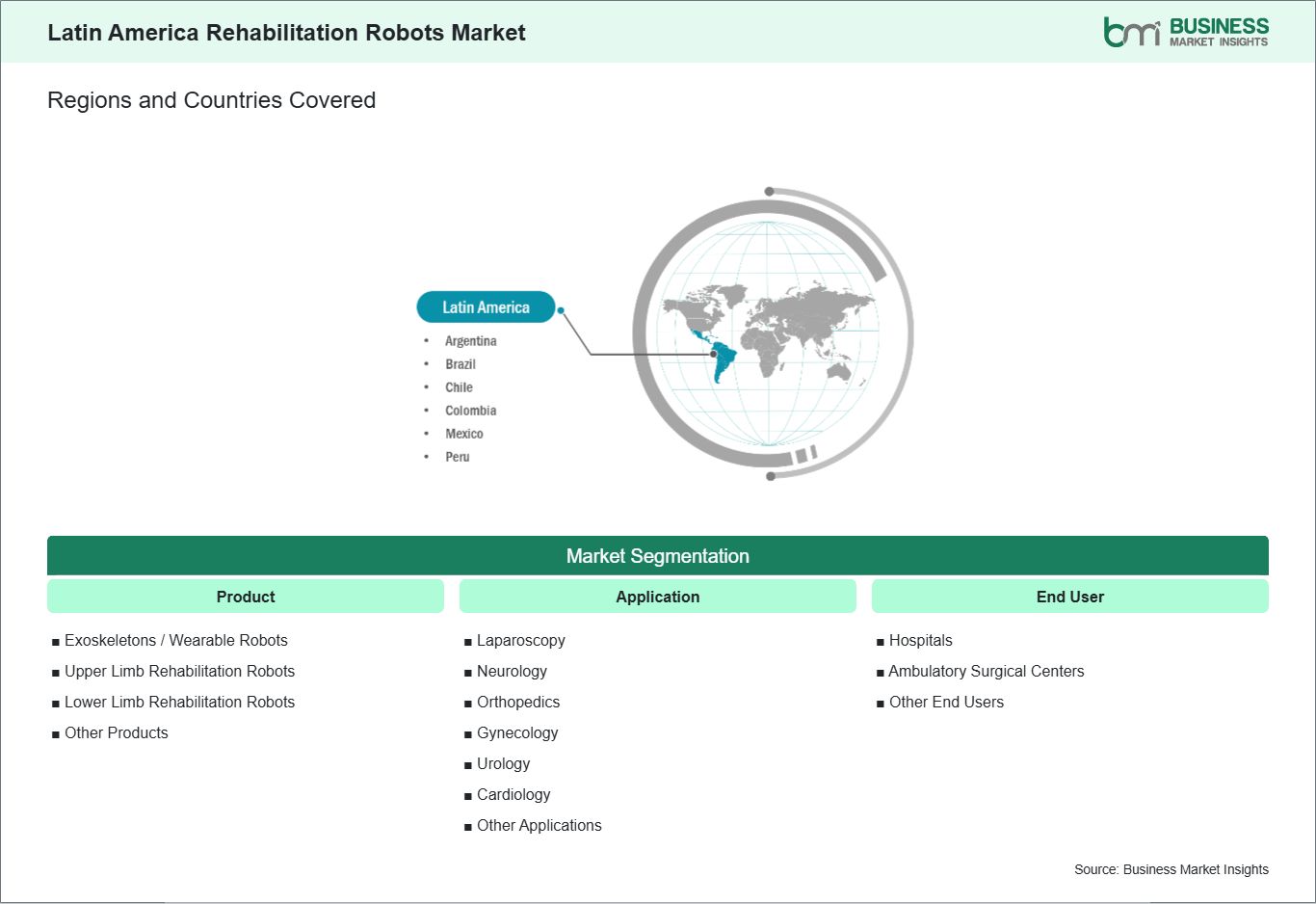
Key segments that contributed to the derivation of the Latin America rehabilitation robots market analysis are product, application, and end user.
- By product, the rehabilitation robots market is segmented into exoskeletons / wearable robots, upper limb rehabilitation robots, lower limb rehabilitation robots, and other products. The exoskeletons / wearable robots segment dominated the market in 2025.
- In terms of application, the rehabilitation robots market is categorized into laparoscopy, neurology, orthopedics, gynecology, urology, cardiology and other applications. The laparoscopy segment dominated the market in 2025.
- Based on end user, the market is classified into hospitals, ambulatory surgical centers and other end users. The hospitals segment dominated the market in 2025.
Market Forces
Latin America Rehabilitation Robots Market Drivers and Opportunities
Increasing healthcare expenditure drives technology adoption
The Latin America rehabilitation robots market is being strongly influenced by the region’s increasing healthcare expenditure, which is enabling greater adoption of advanced rehabilitation technologies. Governments and private healthcare providers are investing in modern healthcare infrastructure to improve patient care and outcomes. Rehabilitation robots offer an opportunity to enhance therapy delivery for patients recovering from neurological injuries, orthopedic procedures, and musculoskeletal conditions. These systems provide consistent, precise, and repeatable therapy movements, allowing clinicians to deliver high-quality rehabilitation while addressing resource constraints in hospitals and clinics. In countries such as Brazil and Mexico, rising healthcare budgets are encouraging hospitals to incorporate robotic therapy systems into rehabilitation programs. These investments are aligned with broader healthcare modernization efforts aimed at improving access to quality rehabilitation services across urban and semi-urban centers. Rehabilitation robots are valued for their ability to extend therapist capacity, reduce recovery times, and support standardized treatment protocols, which helps hospitals improve overall efficiency while delivering better patient outcomes. As funding for healthcare continues to grow, these technologies are increasingly being recognized as essential tools in modern rehabilitation care. Other Latin American countries, including Argentina, Colombia, and Chile, are also expanding healthcare expenditure to support the integration of advanced technologies in rehabilitation centers. Investment in robotic rehabilitation allows healthcare providers to address the growing patient demand for effective post-surgical and neurological recovery solutions. By adopting robotic systems, hospitals can offer more intensive therapy programs without overburdening clinical staff. The combination of increased funding, patient demand, and the drive to modernize healthcare infrastructure is creating a favorable environment for the growth of rehabilitation robots throughout Latin America.
Healthcare-technology partnerships accelerate innovation
Healthcare-technology partnerships are playing a pivotal role in driving innovation within the Latin America rehabilitation robots market. Collaborations between hospitals, technology developers, and research institutions are fostering the development and deployment of advanced robotic solutions tailored to regional healthcare needs. These partnerships allow healthcare providers to access cutting-edge robotics while giving technology companies insight into practical therapy requirements, enabling devices to be adapted for patient populations with diverse rehabilitation needs and varying levels of mobility impairment. In Brazil and Mexico, joint initiatives between universities, medical centers, and robotics developers are accelerating the introduction of new rehabilitation technologies. Hospitals are working closely with technology companies to pilot robotic systems and evaluate their effectiveness in clinical settings. These partnerships support knowledge exchange and encourage the creation of rehabilitation robots that can deliver more personalized therapy, monitor patient progress in real time, and adapt to individual recovery trajectories. The collaborative approach also helps to overcome barriers related to technology acceptance and integration into existing clinical workflows. Other countries in the region, such as Colombia, Chile, and Peru, are increasingly engaging in public-private partnerships to advance rehabilitation robotics innovation. By combining government support, hospital expertise, and technology provider capabilities, these initiatives facilitate faster adoption of robotic therapy solutions across both urban and regional healthcare facilities. The partnerships also promote research and development efforts, enabling the customization of devices for specific patient demographics and therapy requirements. Across Latin America, healthcare-technology collaborations are emerging as a key driver of innovation, accelerating the development, implementation, and scaling of rehabilitation robotic systems to meet growing patient needs.
Size and Share Analysis
Latin America Rehabilitation Robots Market Size and Share Analysis
The Latin America rehabilitation robots market demonstrates steady growth, with size and share analysis highlighting evolving trends and competitive dynamics among key players. The report examines subsegments categorized within product, application, and end user, offering insights into their contribution to overall market performance.
By product, the exoskeletons / wearable robots segment dominated the market in 2025, driven by increasing incidence of neurological and orthopedic conditions (e.g., stroke and spinal injuries) and a growing focus on advanced mobility rehabilitation solutions in the region.
In terms of application, the laparoscopy subsegment dominated the market in 2025, driven by rising adoption of minimally invasive robotic surgical procedures due to benefits like greater precision, reduced patient recovery time, and growing investment in surgical robotics infrastructure.
Based on end user, the hospitals subsegment dominated the market in 2025, driven by expanding healthcare capacity, increased capital expenditure on advanced rehabilitation technologies, and high patient volumes requiring robot‑assisted therapy in major public and private hospitals.
Report Coverage
Latin America Rehabilitation Robots Market Report Coverage and Deliverables
The "Latin America Rehabilitation Robots Market Size and Forecast (2022–2033)" report provides a detailed analysis of the market covering below areas:
- Latin America Rehabilitation Robots Market size and forecast at regional and country levels for all segments covered under the scope
- Latin America Rehabilitation Robots Market trends, as well as drivers, restraints, and opportunities
- Latin America Rehabilitation Robots Market analysis covering key trends, regional framework, major players, regulations, and recent developments
- Industry landscape and competition analysis covering market concentration, heat map analysis, prominent players, and recent developments for the Latin America Rehabilitation Robots Market
- Detailed company profiles, including SWOT analysis
Geographic Insights
Latin America Rehabilitation Robots Market Geographic Insights
The geographical scope of the Latin America Rehabilitation Robots Market report is divided into Mexico, Brazil, Argentina, Peru, Chile, and Colombia. Brazil held the largest share in 2025.
The Latin America Rehabilitation Robots Market exhibits significant variation across countries, with Brazil emerging as the dominant market due to its large population, advanced private and public healthcare infrastructure, and strong government support for healthcare modernization initiatives. Brazilian hospitals and specialized rehabilitation centers are early adopters of robotics-assisted therapy, focusing on neurological rehabilitation, post-stroke recovery, and musculoskeletal rehabilitation programs. Adoption is further strengthened by partnerships between global robotics providers and local medical institutions, facilitating clinician training, technology transfer, and localized support services. Advanced digital integration, including AI-enabled therapy protocols and sensor-based monitoring systems, allows hospitals in Brazil to deliver personalized rehabilitation programs and generate objective outcomes data, positioning the country as the regional leader in both clinical implementation and market scale. Mexico represents a key emerging market with growing adoption in urban hospitals and tertiary care centers. Hospitals and rehabilitation clinics are increasingly piloting robotics-assisted therapy for stroke and orthopedic rehabilitation, supported by academic collaborations and technology partnerships with international manufacturers. Early adoption in Mexico focuses on demonstrating cost-effectiveness, building clinical evidence, and training clinicians to operate robotic systems efficiently. Argentina is witnessing steady growth in urban rehabilitation centers and private hospitals, where robotics is being deployed to enhance patient throughput, improve recovery outcomes, and optimize therapy efficiency. Academic and research collaborations play a key role in supporting clinical validation and adoption. Chile, Colombia, and Peru are smaller but rapidly developing markets. Adoption in these countries is primarily concentrated in major hospitals and rehabilitation centers within metropolitan areas, with pilot programs exploring post-stroke and neurological rehabilitation applications. Investments are often supported by government initiatives, private healthcare networks, and partnerships with regional or international technology providers. While infrastructure and budget constraints remain challenges, growing awareness of the clinical benefits of robotics-assisted rehabilitation is fostering interest and incremental adoption. Collectively, these six countries form a heterogeneous Latin American market. Brazil clearly leads in technological sophistication, adoption scale, and clinical integration, while Mexico, Argentina, Chile, Colombia, and Peru provide significant growth potential through targeted investments, pilot programs, and strategic collaborations. Regional expansion is expected to be driven by increasing healthcare modernization, rising demand for advanced rehabilitation services, and growing interest in technology-enabled therapy solutions.
Industry Activity
Recent Developments
The Latin America Rehabilitation Robots Market is evaluated by gathering qualitative and quantitative data post primary and secondary research, which includes important corporate publications, association data, and databases. A few of the key developments in the Latin America rehabilitation robots market are:
- In April 2024, Chilean researchers at the University of Chile unveiled ExoRecovery, a locally developed robotic exoskeleton aimed at post‑stroke motor rehabilitation for the upper limb. The project focuses on a novel tendon‑based robotic structure tailored to assist patients with neurofunctional deficits following cerebrovascular accidents. It represents a key locally engineered product launch in the Latin American rehabilitation robotics ecosystem. Clinical testing and iterative development are ongoing to support future commercialization and broader regional use.
- In September 2025, rehabilitation clinics in Colombia began pilot use of commercial wearable lower‑limb exoskeleton systems in structured gait therapy programs, marking an expansion of clinical application beyond traditional physical therapy devices. These systems support mobility‑impaired patients during repetitive gait training, helping therapists intensify and customize regimens. While not yet tied to formal national regulatory approvals, these pilots effectively function as early clinical use expansion in Latin America. Their adoption is increasing awareness and evidence for future approval processes.
Trust & Transparency
Research Methodology
The market analysis combines proprietary research with secondary data from government agencies, company disclosures, regulatory filings, industry databases and expert interviews. Market estimates are validated through data triangulation, cross-market benchmarking and analyst
review.
View Full Research Methodology
Key Sources Referred:
World Health Organization (WHO)Organisation for Economic Cooperation and Development (OECD)The World Bank GroupWorldometerThe LancetInternational Bar AssociationInternational Trade Administration