Market Summary
Executive Summary and Market Analysis
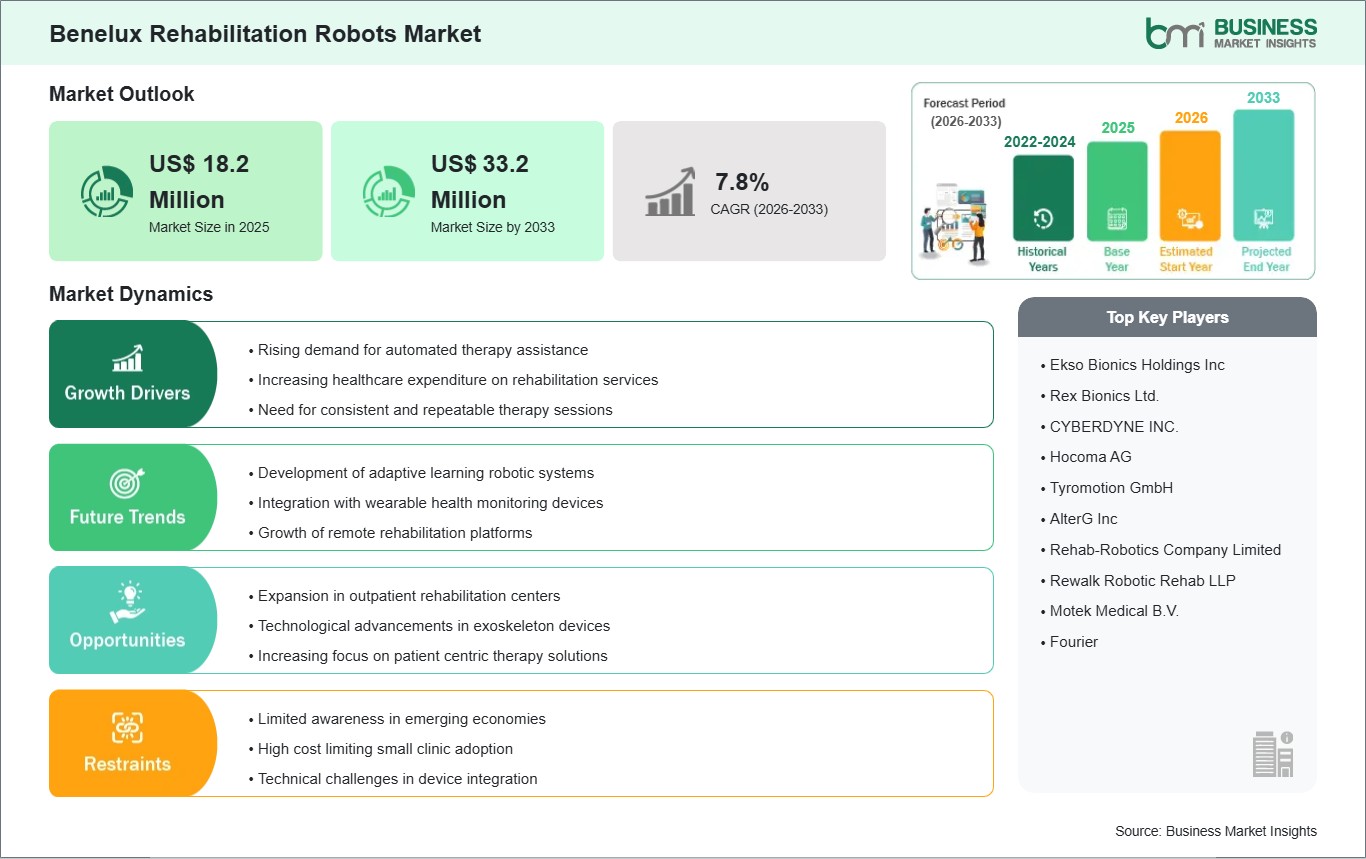
The Benelux rehabilitation robots market is evolving rapidly, driven by increasing healthcare automation, an aging population, and rising demand for technologically advanced rehabilitation solutions across Belgium, the Netherlands, and Luxembourg. This market segment reflects a sophisticated healthcare ecosystem that emphasizes patient-centric care, evidence-based outcomes, and integration of advanced technologies within existing clinical pathways. Rehabilitation robotics in the Benelux region encompasses devices designed for post-stroke recovery, musculoskeletal therapy, neurorehabilitation, and mobility restoration, offering hospitals and rehabilitation centers an opportunity to enhance therapy efficiency and reduce clinician workload. Market analysis indicates a competitive landscape where both global and regional robotics providers are establishing strategic partnerships with hospitals, research institutes, and technology integrators to accelerate adoption. The integration of robotics with digital monitoring platforms allows clinicians to track patient performance objectively, adjust therapy protocols in real-time, and improve long-term functional outcomes. Early adoption is primarily seen in urban tertiary hospitals and specialized rehabilitation centers, which also serve as testing grounds for new devices and clinical validation studies. While cost and training requirements remain barriers to broader adoption, the market benefits from strong government support, reimbursement frameworks that encourage innovation, and high patient awareness of advanced therapeutic options. Key trends in the analysis include the growing incorporation of artificial intelligence, machine learning algorithms, and sensor-based feedback systems, which enhance personalization and data-driven rehabilitation. Additionally, collaborative research between universities and hospitals is shaping product development, ensuring that solutions meet local clinical standards and patient needs. Overall, the Benelux market demonstrates a well-structured environment that balances clinical rigor, technological advancement, and strategic commercialization, positioning rehabilitation robotics as an essential component of modern healthcare delivery.
Segment Analysis
Benelux Rehabilitation Robots Market Segmentation
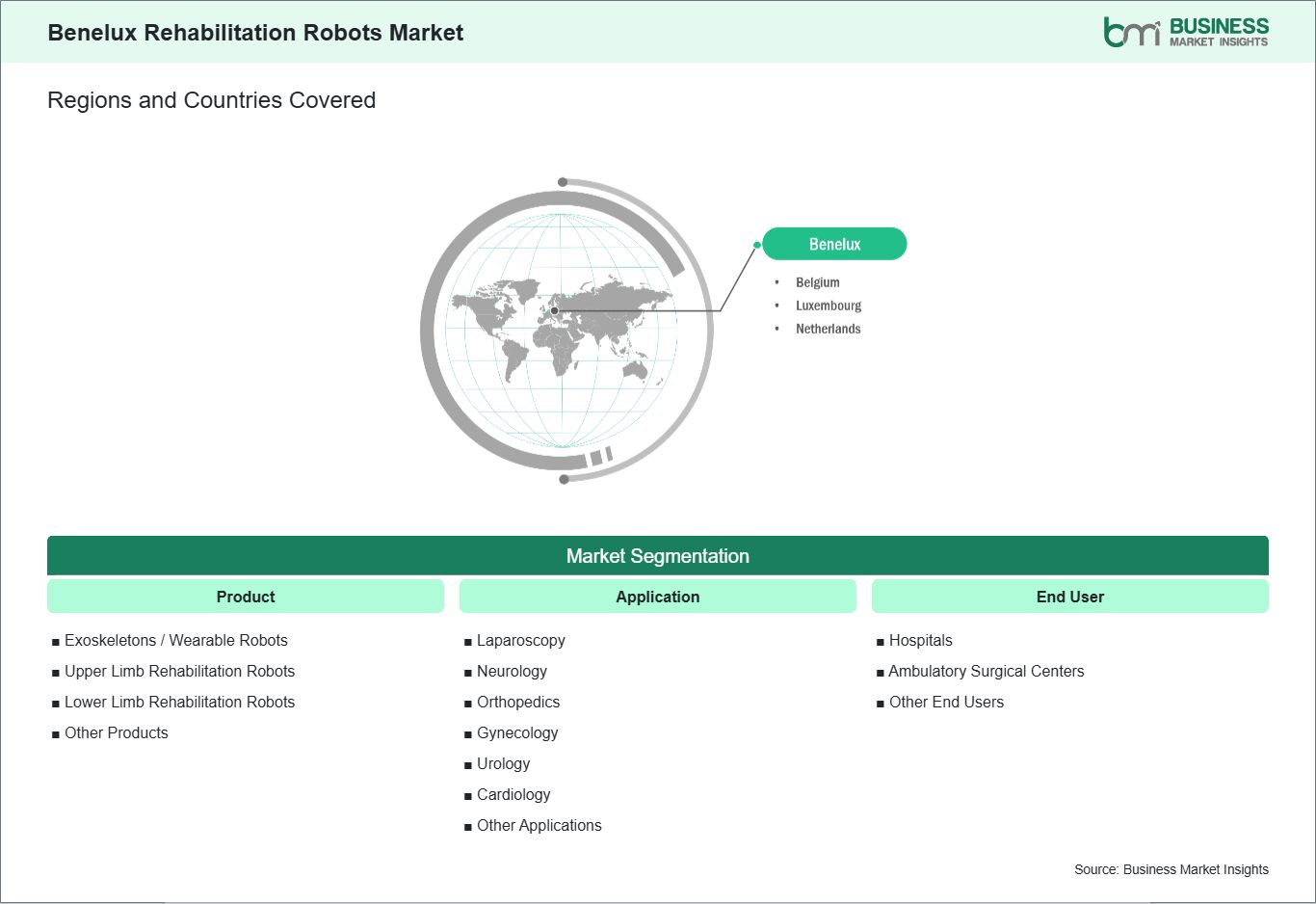
Key segments that contributed to the derivation of the Benelux rehabilitation robots market analysis are product, application, and end user.
- By product, the rehabilitation robots market is segmented into exoskeletons / wearable robots, upper limb rehabilitation robots, lower limb rehabilitation robots, and other products. The exoskeletons / wearable robots segment dominated the market in 2025.
- In terms of application, the rehabilitation robots market is categorized into laparoscopy, neurology, orthopedics, gynecology, urology, cardiology and other applications. The laparoscopy segment dominated the market in 2025.
- Based on end user, the market is classified into hospitals, ambulatory surgical centers and other end users. The hospitals segment dominated the market in 2025.
Market Forces
Benelux Rehabilitation Robots Market Drivers and Opportunities
Advancements in AI and sensor technology
The Benelux rehabilitation robots market is being strongly influenced by rapid advancements in artificial intelligence (AI) and sensor technology. Rehabilitation robots equipped with sophisticated AI algorithms can interpret movement patterns in real time, adapt assistance levels dynamically, and provide immediate corrective feedback to patients. These systems use advanced sensors to monitor limb position, force exertion, and patient responsiveness, enabling therapy that is both responsive and tailored to each individual’s capabilities. The integration of AI enhances the robot’s ability to learn from user performance over time, resulting in more effective therapy sessions and faster progress toward mobility goals. In the Netherlands, healthcare providers and rehabilitation centers are particularly active in exploring AI‑enhanced robotic systems to support physical therapy programs. Dutch therapists value the precision and repeatability that these systems bring to rehabilitation, especially for patients recovering from complex musculoskeletal injuries or neurological events. The combination of real‑time data capture and AI‑driven adaptation helps clinicians make informed decisions about therapy progression, fostering more collaborative care between human therapists and robotic systems. This technological maturity is making rehabilitation robots increasingly accepted as integral tools in modern therapy practices. Belgian rehabilitation facilities are also leveraging sensor‑based robotics to improve patient engagement and outcomes. Therapists in Belgium appreciate how AI‑driven robotics can reduce manual workload while increasing consistency in therapeutic exercises. The ability of these systems to detect subtle changes in movement quality and adjust therapy accordingly supports more nuanced care for patients with varied rehabilitation needs. In Luxembourg, smaller markets are gradually adopting similar technologies, with an emphasis on solutions that can be integrated smoothly into existing clinical workflows. Across the Benelux region, AI and sensor innovations are accelerating the evolution of rehabilitation robotics, making therapy more precise, adaptive, and effective for a wide range of patients.
Integration with brain-computer interface systems
The integration of rehabilitation robots with brain‑computer interface (BCI) systems is emerging as a key trend in the Benelux rehabilitation robots market, unlocking new opportunities for neurorehabilitation. BCI technology enables direct communication between a patient’s neural signals and robotic devices, allowing robotic systems to interpret user intent even when physical movement is limited. This integration holds particular promise for patients with severe motor impairments due to spinal injuries, stroke, or neurological conditions, as it creates pathways for initiating movement through thought‑driven commands. Rehabilitation robots paired with BCI systems can support more meaningful engagement in therapy by aligning robotic assistance with the patient’s own neural activity. In the Netherlands, clinical research institutions and technology developers are collaborating to pilot BCI‑integrated rehabilitation solutions. Dutch neurologists and therapists are interested in exploring how these systems can enhance traditional therapy, especially for patients whose voluntary movement is restricted. By combining robotics with brain‑computer pathways, clinicians can design therapies that facilitate motor learning and neural reorganization in a way that was previously difficult to achieve. The potential to bridge cognitive intent with physical movement expands the scope of rehabilitation robotics beyond mechanics into neurological recovery. Belgium and Luxembourg are also showing growing interest in BCI‑enabled rehabilitation platforms. Belgian research initiatives are focused on refining BCI interfaces to improve signal accuracy and user comfort, recognizing that seamless integration with robotic systems is essential for clinical adoption. Luxembourg’s healthcare innovators are assessing how combined BCI and robotic rehabilitation systems can be incorporated into patient care plans that span inpatient and outpatient settings. Across the Benelux market, the integration of brain‑computer interfaces with rehabilitation robots is shaping a future where therapy is more intuitive, patient‑aligned, and capable of addressing complex neurological needs.
Size and Share Analysis
Benelux Rehabilitation Robots Market Size and Share Analysis
The Benelux rehabilitation robots market demonstrates steady growth, with size and share analysis highlighting evolving trends and competitive dynamics among key players. The report examines subsegments categorized within product, application, and end user, offering insights into their contribution to overall market performance.
By product, the exoskeletons / wearable robots segment dominated the market in 2025, driven by strong clinical demand for robotic mobility assistance that enhances rehabilitation outcomes for patients with neurological and musculoskeletal impairments.
In terms of application, the laparoscopy subsegment dominated the market in 2025, driven by the preference for minimally invasive, robot‑assisted therapeutic approaches that improve recovery efficiency and reduce procedural trauma.
Based on end user, the hospitals subsegment dominated the market in 2025, driven by well‑established healthcare infrastructure and high adoption of advanced rehabilitation technologies to support complex patient rehabilitation needs.
Report Coverage
Benelux Rehabilitation Robots Market Report Coverage and Deliverables
The "Benelux Rehabilitation Robots Market Size and Forecast (2022–2033)" report provides a detailed analysis of the market covering below areas:
- Benelux Rehabilitation Robots Market size and forecast at regional and country levels for all segments covered under the scope
- Benelux Rehabilitation Robots Market trends, as well as drivers, restraints, and opportunities
- Benelux Rehabilitation Robots Market analysis covering key trends, regional framework, major players, regulations, and recent developments
- Industry landscape and competition analysis covering market concentration, heat map analysis, prominent players, and recent developments for the Benelux Rehabilitation Robots Market
- Detailed company profiles, including SWOT analysis
Geographic Insights
Benelux Rehabilitation Robots Market Geographic Insights
The geographical scope of the Benelux Rehabilitation Robots Market report is divided into Belgium, the Netherlands, and Luxembourg. The Netherlands held the largest share in 2025.
The Benelux Rehabilitation Robots Market exhibits a differentiated landscape across its three constituent countries, with the Netherlands emerging as the dominant market due to its advanced healthcare infrastructure, early adoption of innovative technologies, and strong integration of rehabilitation robotics into multidisciplinary care programs. Dutch hospitals and specialized rehabilitation centers are leading in clinical implementation, leveraging robotics for post-stroke recovery, musculoskeletal therapy, and neurorehabilitation. Adoption is supported by structured government initiatives, reimbursement frameworks, and research collaborations between universities, hospitals, and technology providers. The Netherlands also emphasizes data-driven treatment approaches, with robotics integrated alongside digital monitoring platforms and AI-assisted analytics to enhance therapy personalization, track patient progress, and optimize clinical outcomes. The combination of advanced infrastructure, strong policy support, and high clinician expertise positions the Netherlands as a strategic hub for both clinical deployment and commercial expansion in the Benelux region. Belgium represents a growing market with increasing adoption in urban hospitals and tertiary care facilities. Belgian providers are leveraging rehabilitation robots to improve patient throughput, therapy efficiency, and post-operative outcomes, particularly in neurological and orthopedic rehabilitation programs. Strategic collaborations between hospitals and technology vendors facilitate clinician training, clinical validation, and pilot deployments, supporting broader adoption across public and private institutions. While the market in Belgium is less extensive than in the Netherlands, strong academic engagement and regional partnerships are helping to accelerate growth. Luxembourg, although smaller in scale, is witnessing emerging interest in rehabilitation robotics, primarily through tertiary hospitals and pilot programs focused on post-stroke and neurological rehabilitation. Adoption in Luxembourg is supported by government incentives, demonstration projects, and partnerships with regional suppliers, enabling knowledge transfer and clinician capacity building despite the country’s limited population. The focus is on testing cost-effective and clinically validated solutions that can improve patient outcomes while informing future larger-scale deployments. Collectively, these three countries form a cohesive Benelux market where the Netherlands leads in scale, technological sophistication, and adoption maturity, while Belgium and Luxembourg provide growth opportunities through targeted hospital deployments, pilot programs, and strategic collaborations. The region benefits from a strong focus on evidence-based care, innovation in rehabilitation technology, and a collaborative approach to integrating robotics into patient-centered therapy.
Industry Activity
Recent Developments
The Benelux Rehabilitation Robots Market is evaluated by gathering qualitative and quantitative data post primary and secondary research, which includes important corporate publications, association data, and databases. A few of the key developments in the Benelux rehabilitation robots market are:
- In December 2024, Syrebo formed a partnership with Quality Production (a Belgium‑based custom orthopaedic aids manufacturer), integrating Syrebo’s Hand Rehabilitation Robot into QP’s medical device portfolio. This collaboration boosts Syrebo’s presence in Europe and enhances access to robotic hand rehab solutions through established Benelux distribution channels. The agreement covers products for clinical and home therapy use, combining robotic tech with orthopedic expertise. It is expected to broaden availability of advanced rehabilitation robotics across Belgium and neighbouring Benelux markets.
- In December 2024, yrebo’s Hand Rehabilitation Robot received patents in the United States, Europe, and Japan and continued expansion into European distribution networks an important validation step for regulatory acceptance and clinical use across the region, including Benelux. European patent recognition supports compliance and trust among medical professionals and rehabilitative clinics. This intellectual property milestone enhances eligibility for certification and healthcare procurement across EU countries. It positions Syrebo’s technology for wider adoption in specialist rehab facilities in Belgium and the Netherlands.
Trust & Transparency
Research Methodology
The market analysis combines proprietary research with secondary data from government agencies, company disclosures, regulatory filings, industry databases and expert interviews. Market estimates are validated through data triangulation, cross-market benchmarking and analyst
review.
View Full Research Methodology
Key Sources Referred:
World Health Organization (WHO)Organisation for Economic Cooperation and Development (OECD)The World Bank GroupWorldometerThe LancetInternational Bar AssociationInternational Trade Administration