Market Summary
Executive Summary and Market Analysis
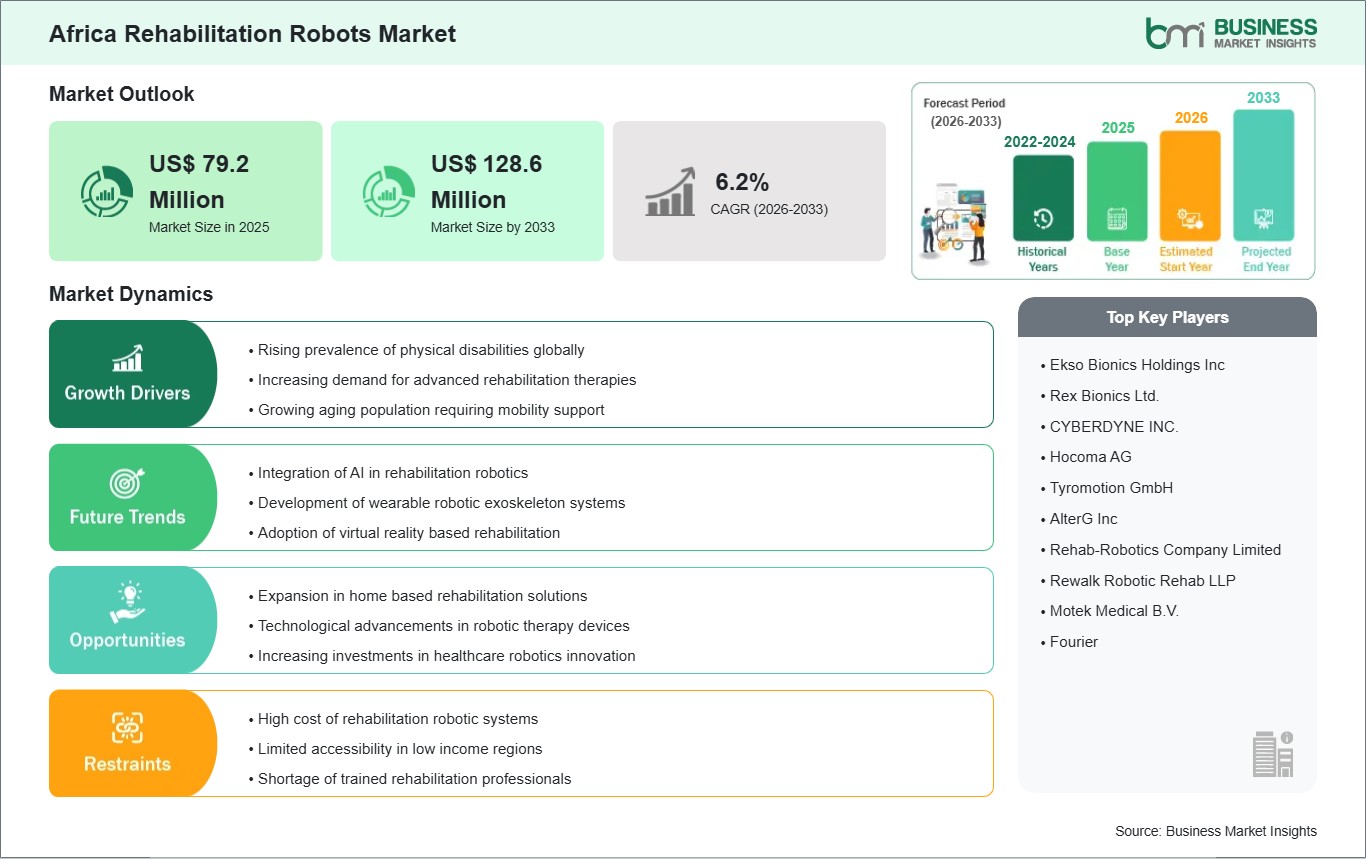
Key healthcare providers across the region recognize the benefits of robotics in addressing physical therapy, neurological recovery, and mobility restoration for patients affected by stroke, spinal cord injuries, and other debilitating conditions. While conventional rehabilitation methods remain prevalent, the shift toward robotics is underpinned by strong clinical evidence highlighting improved patient engagement, customizable therapy protocols, and objective performance tracking. Public hospitals, private rehabilitation centers, research institutions, and NGOs are collaborating to integrate robotics into existing care pathways. Investors and technology partners are seeking to capitalize on Africa's rapidly expanding healthcare consumption patterns, particularly in urban centers where infrastructure can support advanced devices. Competitive dynamics reflect early‑stage participation from global robotics manufacturers and regional integrators focusing on localized service models, training programs, and multi‑lingual user interfaces tailored to clinicians and patients. Key challenges identified include the need for clinician upskilling, regulatory standardization, and cost optimization to ensure sustainable adoption. Governments and private enterprises acknowledge robotics as a catalyst for elevating rehabilitation quality, optimizing therapist workloads, and enhancing long‑term patient outcomes. Stakeholders are prioritizing strategic alliances, pilot deployments, and data‑driven validation studies to strengthen market positioning and accelerate technology diffusion across the continent.
Segment Analysis
Africa Rehabilitation Robots Market Segmentation
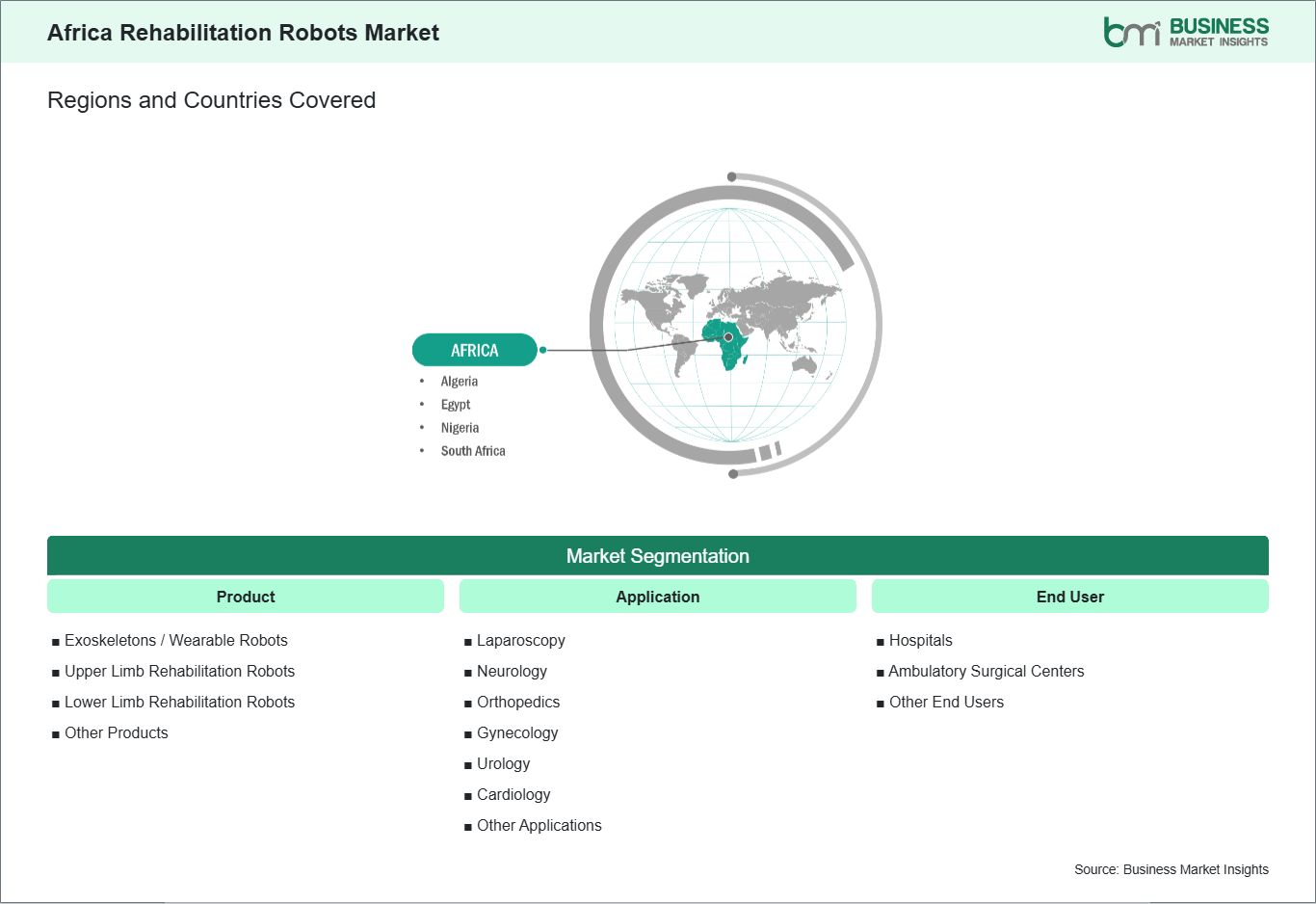
Key segments that contributed to the derivation of the Africa rehabilitation robots market analysis are product, application, and end user.
- By product, the rehabilitation robots market is segmented into exoskeletons / wearable robots, upper limb rehabilitation robots, lower limb rehabilitation robots, and other products. The exoskeletons / wearable robots segment dominated the market in 2025.
- In terms of application, the rehabilitation robots market is categorized into laparoscopy, neurology, orthopedics, gynecology, urology, cardiology, and other applications. The laparoscopy segment dominated the market in 2025.
- Based on end user, the market is classified into hospitals, ambulatory surgical centers, and others. The hospitals segment dominated the market in 2025.
Market Forces
Africa Rehabilitation Robots Market Drivers and Opportunities
Rising Prevalence of Neurological Disorders
With demographic shifts and growing awareness of health conditions such as stroke, traumatic injuries, and neurodegenerative diseases, there is a corresponding need for rehabilitation solutions. Traditional rehabilitation relies on manual therapy and limited clinical resources, making consistent and intensive treatment difficult to deliver. Rehabilitation robots can support repetitive therapeutic movements, precision guidance, and structured therapy sessions, helping patients work toward improved mobility and functional recovery. In African countries, healthcare systems are evolving to address communicable and non‑communicable diseases, and neurological disorders are part of this emerging focus. Rehabilitation robots offer clinicians the ability to standardize therapy efforts, reduce human fatigue, and track patient progress with objective feedback. In settings where there is a shortage of trained rehabilitation specialists, robotic systems can supplement clinical efforts and improve therapy delivery. Hospitals and rehabilitation centers are beginning to explore these technologies as part of programs aimed at modernizing care and enhancing patient outcomes. Adoption of rehabilitation robots reflects a growing commitment to long‑term patient support and quality of life improvement. As awareness of neurological conditions grows among health administrators and communities, there is increased interest in solutions that extend beyond basic care. Rehabilitation robots are a part of a strategy to strengthen post‑acute care frameworks, allowing healthcare providers to offer structured, repeatable therapy that supports patients throughout their recovery journey. This trend highlights a shift in regional health priorities toward embracing advanced technology as a means to bridge gaps in traditional rehabilitation services.
Home-based rehabilitation Solutions for Patients
For patients with limited access to specialized clinics, performing rehabilitation exercises at home offers a means to continue therapy consistently without frequent travel or dependence on facility‑based care. Rehabilitation robots for home use provide structured exercise guidance, intuitive interfaces, and remote monitoring capabilities, enabling patients to engage in therapy independently while maintaining a connection with their healthcare providers. This shift toward decentralized care is helping to address access challenges that have long affected rehabilitation outcomes in the region. In urban and peri‑urban areas, the adoption of home‑based rehabilitation technologies is gaining traction as part of efforts to enhance patient autonomy and reduce the burden on clinic‑based services. Patients benefit from the flexibility to integrate therapy into their daily routines, while caregivers and clinicians can monitor progress and adjust therapy plans remotely. This model supports continuity of care that extends beyond the confines of traditional rehabilitation centers, fostering greater patient engagement and adherence to prescribed therapy regimens. The convenience of home rehabilitation solutions is valuable for individuals with mobility limitations or those living at a distance from specialized care facilities. Governments and private healthcare providers are exploring ways to incorporate these solutions into community health strategies, recognizing that home‑based care can reduce pressure on hospitals and improve long‑term outcomes for patients with neurological conditions. As awareness and acceptance of rehabilitation robots increase, home‑based solutions are positioned to play a key role in the evolution of rehabilitative care across the region, enabling more inclusive access to therapy and supporting patients throughout their recovery journey.
Size and Share Analysis
Africa Rehabilitation Robots Market Size and Share Analysis
The Africa rehabilitation robots market demonstrates steady growth, with size and share analysis highlighting evolving trends and competitive dynamics among key players. The report examines subsegments categorized within product, application, and end user, offering insights into their contribution to overall market performance.
By product, the exoskeletons / wearable robots segment dominated the market in 2025, driven by strong clinical adoption of wearable mobility assistance solutions that improve gait training and motor function recovery for neurological and spinal injury patients.
In terms of application, the laparoscopy subsegment dominated the market in 2025, driven by the increasing emphasis on advanced, less invasive therapeutic interventions that enhance recovery outcomes. However, laparoscopy is a surgical rather than a rehabilitation application.
Based on end user, the hospitals subsegment dominated the market in 2025, driven by the concentration of advanced healthcare infrastructure, availability of specialized rehabilitation professionals, and greater procurement of robotic rehabilitation technologies in hospital settings.
Report Coverage
Africa Rehabilitation Robots Market Report Coverage and Deliverables
The "Africa Rehabilitation Robots Market Size and Forecast (2022–2033)" report provides a detailed analysis of the market covering below areas:
- Africa Rehabilitation Robots Market size and forecast at regional and country levels for all segments covered under the scope
- Africa Rehabilitation Robots Market trends, as well as drivers, restraints, and opportunities
- Africa Rehabilitation Robots Market analysis covering key trends, regional framework, major players, regulations, and recent developments
- Industry landscape and competition analysis covering market concentration, heat map analysis, prominent players, and recent developments for the Africa Rehabilitation Robots Market
- Detailed company profiles, including SWOT analysis
Geographic Insights
Africa Rehabilitation Robots Market Geographic Insights
The geographical scope of the Africa Rehabilitation Robots Market report is divided into Egypt, South Africa, Nigeria, and Algeria. Nigeria held the largest share in 2025.
Nigeria's market leadership is driven by its large population, rising incidence of chronic and neurological conditions, and accelerated investments in modern healthcare infrastructure. Advanced rehabilitation robotics are adopted in private and corporate hospitals to enhance post-stroke, musculoskeletal, and neurorehabilitation outcomes. Strategic partnerships with international robotics manufacturers have led to demonstration centers, clinician training programs, and expanded service networks, positioning Nigeria as a central hub for commercial and clinical growth. The scale of patient demand and increasing government focus on healthcare modernization make Nigeria the primary market in the region, attracting global and regional technology innovators. South Africa presents a mature ecosystem, supported by established specialist rehabilitation centers and higher per-capita healthcare expenditure. Global robotics vendors and local distributors prioritize South Africa for new solution launches due to its structured clinical research networks and robust private-sector adoption. Multi-disciplinary integration of rehabilitation robotics with conventional therapy, combined with data-driven performance tracking, underscores the country's advanced approach. Investment in clinician education, training programs, and post-sales support ensures sustainable deployment, making South Africa a key reference market for regional technology introduction. In Egypt, private healthcare facilities are piloting low- and high-tech robotics solutions to enhance patient outcomes and operational efficiency. Partnerships between local healthcare groups and international suppliers are expanding solution availability, while emerging regulatory frameworks provide clarity for procurement and investment decisions. The market in Egypt is driven by rising awareness of technological interventions in rehabilitation and growing interest from private hospitals seeking to differentiate their services. In Algeria, adoption is concentrated in select tertiary hospitals and specialist rehabilitation centers. Early deployments focus on clinician training, proof-of-concept studies, and demonstrating both clinical and economic value. Market maturation is expected as healthcare infrastructure expands and regional vendors implement localized support, service, and maintenance networks.
Industry Activity
Recent Developments
The Africa Rehabilitation Robots Market is evaluated by gathering qualitative and quantitative data post primary and secondary research, which includes important corporate publications, association data, and databases. A few of the key developments in the Africa rehabilitation robots market are:
- In February 2026, Egypt's Ministry of Health announced the start of robotic systems integration in public healthcare, beginning with surgical robots at Nasser Institute Hospital in Cairo, as part of efforts to modernize medical services. While focused on surgery, this step reflects growing infrastructure that could support broader adoption of rehabilitation robotics in major hospitals.
- In March 2025, Lifeward Ltd. received 510(k) clearance from the U.S. Food and Drug Administration (FDA) for its ReWalk 7 Personal Exoskeleton, a wearable robotic device that enables individuals with spinal cord injury (SCI) to stand and walk again, marking a major regulatory milestone for the next‑generation product.
Trust & Transparency
Research Methodology
The market analysis combines proprietary research with secondary data from government agencies, company disclosures, regulatory filings, industry databases and expert interviews. Market estimates are validated through data triangulation, cross-market benchmarking and analyst
review.
View Full Research Methodology
Key Sources Referred:
World Health Organization (WHO)Organisation for Economic Cooperation and Development (OECD)The World Bank GroupWorldometerThe LancetInternational Bar AssociationInternational Trade Administration