Market Summary
Executive Summary and Market Analysis
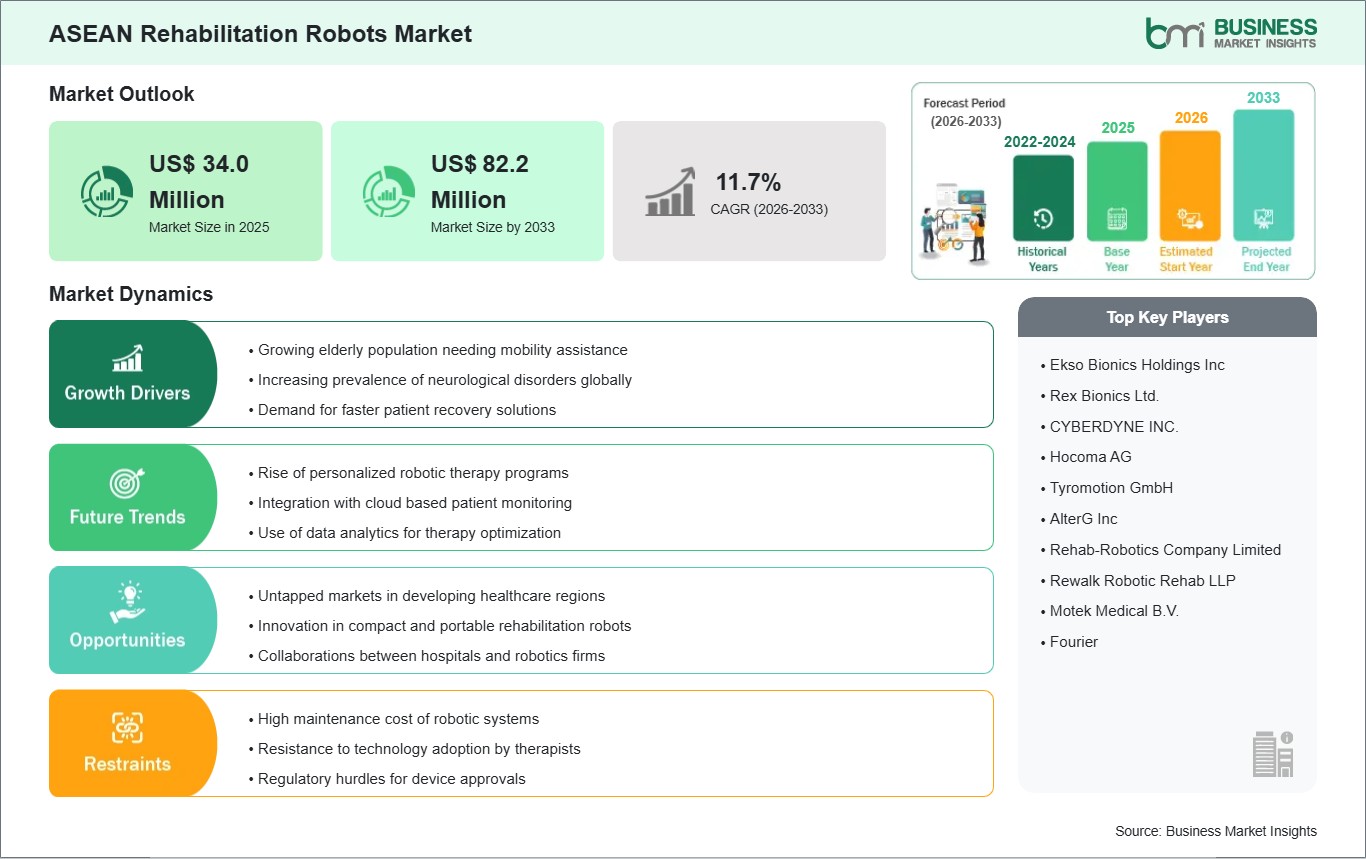
The ASEAN rehabilitation robots market is gaining traction as healthcare systems across Southeast Asia transition toward advanced therapeutic technologies to meet rising rehabilitation demand driven by aging populations, increased incidence of neurological disorders, and expanding post‑surgical care needs. This sector is characterized by a multiplicity of stakeholders, including regional healthcare providers, technology integrators, rehabilitation specialists, and international robotics developers seeking entry into emerging markets beyond developed economies. A comprehensive market analysis underscores a shift from traditional rehabilitation methods toward solutions that offer repeatable, data‑driven therapy, improved patient engagement, and scalability across care segments. Key markets such as Singapore, Malaysia, and Thailand serve as early adoption hubs, supported by robust healthcare infrastructure and favorable policy frameworks that encourage digital health innovation. However, adoption patterns vary significantly within the region, with countries like Indonesia and Vietnam presently focused on pilot programs and academic research collaborations to validate therapeutic efficacy locally. Comparative analysis shows that public‑sector initiatives aimed at chronic disease management and disability inclusion are increasingly influencing procurement decisions, while private hospitals and specialty centers are leveraging rehabilitation robots as differentiators in patient care portfolios. Competitive dynamics highlight strategic alliances between ASEAN distributors and global vendors aimed at bolstering after‑sales service networks, clinician training ecosystems, and localized support capabilities. Both low‑ and high‑tech solutions are being strategically positioned to address diverse clinical needs and budgetary constraints, from basic upper‑limb assistance devices to sophisticated gait‑training exoskeletons. Despite challenges including infrastructure gaps in rural areas, the need for clinician competencies, and reimbursement ambiguities the overall market landscape points to a gradual maturation, with enhanced focus on evidence‑based outcomes, value‑based procurement, and integrated rehabilitation workflows. As ASEAN healthcare systems continue to evolve, rehabilitation robotics is being viewed less as a niche innovation and more as a strategic enabler of quality care, operational efficiency, and long‑term patient recovery pathways.
Segment Analysis
ASEAN Rehabilitation Robots Market Segmentation
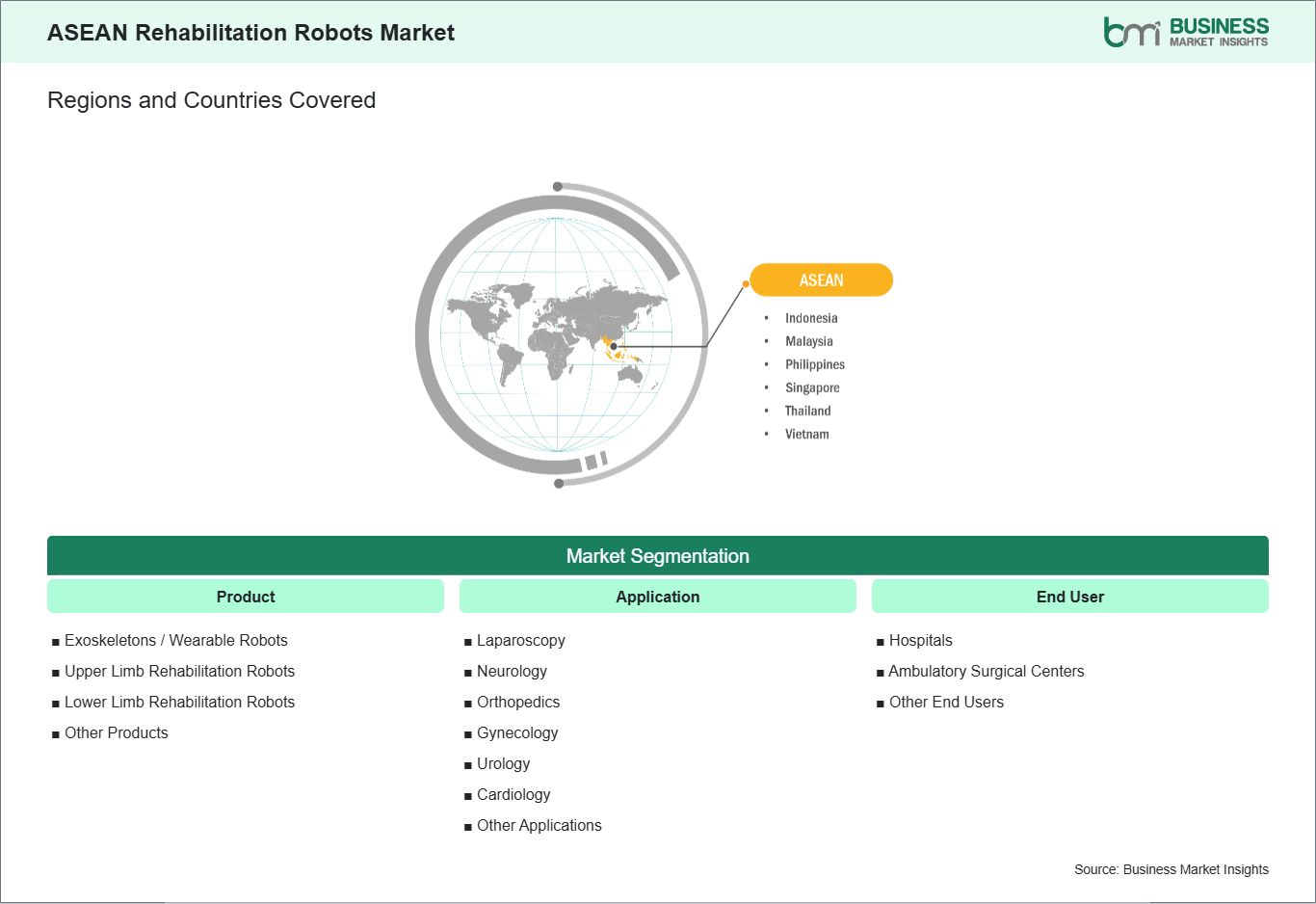
Key segments that contributed to the derivation of the ASEAN rehabilitation robots market analysis are product, application, and end user.
- By product, the rehabilitation robots market is segmented into exoskeletons / wearable robots, upper limb rehabilitation robots, lower limb rehabilitation robots, and other products. The exoskeletons / wearable robots segment dominated the market in 2025.
- In terms of application, the rehabilitation robots market is categorized into laparoscopy, neurology, orthopedics, gynecology, urology, cardiology and other applications. The laparoscopy segment dominated the market in 2025.
- Based on end user, the market is classified into hospitals, ambulatory surgical centers and other end users. The hospitals segment dominated the market in 2025.
Market Forces
ASEAN Rehabilitation Robots Market Drivers and Opportunities
Aging population increases mobility support needs
The ASEAN rehabilitation robots market is being influenced by the region’s steadily aging population, which is increasing demand for solutions that support mobility and functional independence. Countries across Southeast Asia are experiencing demographic shifts as life expectancy improves and birth rates decline. This change has expanded the segment of older adults who require medical support for age‑related conditions such as joint stiffness, muscle weakness, and mobility impairments. Rehabilitation robots, including exoskeletons and assisted movement devices, are gaining attention as tools that can help older patients maintain balance, enhance gait training, and participate in structured physical therapy at an earlier stage in their recovery. In markets such as Singapore and Malaysia, healthcare providers are beginning to recognize rehabilitation robots as valuable complements to existing therapy services. Hospitals and rehabilitation centers in urban areas are piloting robotic systems to support post‑surgical rehabilitation, fall recovery programs, and age‑related mobility maintenance. These technologies allow clinicians to deliver repeatable, guided exercise regimens that help older patients rebuild strength and coordination safely. The perception of rehabilitation robots is evolving from a specialized clinical resource to a mainstream support option that addresses long‑term mobility needs associated with an aging demographic. Meanwhile, in countries such as Thailand, Indonesia, and Vietnam, the growing elderly population is encouraging private healthcare providers and therapy centers to consider accessible, technology‑assisted care pathways. With older adults increasingly seeking options that help them retain independence, rehabilitation robots are becoming part of the conversation around sustainable aging support. These systems enable consistent therapeutic movements and real‑time feedback, which can reduce reliance on caregiver physical support and free up clinician time. As the region continues to prioritize healthy aging strategies, rehabilitation robots are positioned to play a central role in mobility support and functional rehabilitation for older adults across ASEAN.
Tele-monitoring expands remote therapy services
The adoption of tele‑monitoring solutions is expanding remote therapy services within the ASEAN rehabilitation robots market, enhancing how patient progress is managed outside traditional clinical environments. Rehabilitation robots embedded with connected sensors and remote tracking capabilities allow therapists to monitor patient performance virtually, adjusting treatment plans without requiring frequent in‑person visits. This shift supports broader healthcare goals of increasing access, reducing travel burden, and enabling continuity of care for patients who might otherwise face geographic or mobility‑related barriers to consistent therapy. In countries such as the Philippines and Singapore, tele‑monitoring has encouraged the integration of rehabilitation robots with digital health platforms. Clinicians can access performance data, therapy adherence reports, and progress metrics in real time, allowing them to tailor remote sessions and offer timely guidance. This capability enhances patient engagement and enables more personalized treatment trajectories. It also helps healthcare professionals identify plateaus or regressions sooner, making therapy more adaptive and responsive to individual recovery patterns. In Malaysia, Thailand, and Indonesia, tele‑monitoring solutions are facilitating partnerships between urban centers and community clinics. Rehabilitation robots that incorporate remote connectivity allow patients to work through prescribed exercises at home while therapists receive continuous updates on movement quality and frequency. This model is particularly valuable where travel to rehabilitation facilities can be time‑consuming or costly. By enabling remote oversight, tele‑monitoring enhances the effectiveness of rehabilitation robotics and supports a more inclusive approach to care that bridges distance and resource constraints. As tele‑health infrastructure strengthens across ASEAN, remote therapy enabled by rehabilitation robots is poised to become a mainstream component of rehabilitative care delivery in the region..
Size and Share Analysis
ASEAN Rehabilitation Robots Market Size and Share Analysis
The ASEAN rehabilitation robots market demonstrates steady growth, with size and share analysis highlighting evolving trends and competitive dynamics among key players. The report examines subsegments categorized within product, application, and end user, offering insights into their contribution to overall market performance.
By product, the exoskeletons / wearable robots segment dominated the market in 2025, driven by the growing need for patient mobility support and personalized rehabilitation that enables faster recovery for neurological and musculoskeletal conditions.
In terms of application, the laparoscopy subsegment dominated the market in 2025, driven by increasing adoption of minimally invasive techniques and robotic-assisted procedures that reduce patient trauma and accelerate functional recovery in therapy and rehabilitation.
Based on end user, the hospitals subsegment dominated the market in 2025, driven by their higher capacity for advanced rehabilitation infrastructure, skilled personnel, and large patient volumes requiring robotic-assisted therapy solutions.
Report Coverage
ASEAN Rehabilitation Robots Market Report Coverage and Deliverables
The "ASEAN Rehabilitation Robots Market Size and Forecast (2022–2033)" report provides a detailed analysis of the market covering below areas:
- ASEAN Rehabilitation Robots Market size and forecast at regional and country levels for all segments covered under the scope
- ASEAN Rehabilitation Robots Market trends, as well as drivers, restraints, and opportunities
- ASEAN Rehabilitation Robots Market analysis covering key trends, regional framework, major players, regulations, and recent developments
- Industry landscape and competition analysis covering market concentration, heat map analysis, prominent players, and recent developments for the ASEAN Rehabilitation Robots Market
- Detailed company profiles, including SWOT analysis
Geographic Insights
ASEAN Rehabilitation Robots Market Geographic Insights
The geographical scope of the ASEAN Rehabilitation Robots Market report is divided into Indonesia, Malaysia, the Philippines, Singapore, Thailand, and Vietnam. Indonesia held the largest share in 2025.
The ASEAN Rehabilitation Robots Market demonstrates significant country-level diversity, with Indonesia emerging as the dominant market among the six key nations due to its large population base, rising prevalence of neurological and musculoskeletal conditions, and growing investments in healthcare infrastructure modernization. Indonesia’s rehabilitation ecosystem is rapidly evolving, with private hospitals, tertiary care centers, and specialized rehabilitation clinics increasingly adopting robotics to enhance post-stroke recovery, mobility therapy, and long-term rehabilitation outcomes. Strategic collaborations with international robotics manufacturers have led to pilot programs, clinician training initiatives, and the development of service networks to ensure sustainable deployment across urban and semi-urban centers. The sheer scale of demand in Indonesia, combined with government efforts to improve access to advanced healthcare technologies, positions the country as a critical hub for regional market growth and commercial expansion. Malaysia represents a growing market with adoption focused on tertiary hospitals and private rehabilitation centers. The country’s healthcare modernization initiatives and partnerships with global robotics vendors have facilitated integration of advanced therapeutic devices, particularly in post-surgical and stroke rehabilitation. Malaysia’s strategic focus on evidence-based clinical outcomes, coupled with government support for technology adoption, makes it an attractive secondary market for robotics manufacturers seeking regional penetration. The Philippines is experiencing emerging adoption, primarily driven by private healthcare networks and academic hospitals conducting pilot projects to assess clinical efficacy. Growing clinician awareness and increasing patient demand for advanced rehabilitation solutions are key drivers, though broader deployment is constrained by infrastructure gaps and budgetary limitations. Singapore serves as a highly developed but smaller-scale market, emphasizing research, validation, and high-precision rehabilitation robotics in specialized care centers. Its mature regulatory environment and strong institutional support provide a reference model for regional adoption strategies. Thailand is characterized by integration of robotics within urban private hospitals and multi-disciplinary rehabilitation programs, supported by gradual policy evolution to facilitate technology approval. Vietnam, still in the early adoption stage, is exploring partnerships and pilot programs to build local competencies, often prioritizing cost-effective solutions suitable for broader healthcare accessibility. Collectively, these six countries reflect a nuanced ASEAN landscape, with Indonesia leading in scale, demand, and market potential, while the others offer high growth opportunities supported by strategic investments, emerging policies, and increasing awareness of robotics-enabled rehabilitation.
Industry Activity
Recent Developments
The ASEAN Rehabilitation Robots Market is evaluated by gathering qualitative and quantitative data post primary and secondary research, which includes important corporate publications, association data, and databases. A few of the key developments in the ASEAN rehabilitation robots market are:
- In January 2026, Angel Robotics officially launched its Angel Legs M20 wearable rehabilitation robot at Al‑Sultan Abdullah Hospital under Universiti Teknologi MARA (UiTM) in Malaysia, showcasing a gait‑assistance solution for patients with lower‑limb weakness and neurological disorders. The device had already received approval from the Malaysian medical device authority, enabling its introduction into clinical practice. The launch event was attended by key healthcare leaders, demonstrating real‑world therapy applications and partnerships. Angel Robotics plans to expand the robot’s presence into Indonesia, Singapore, Thailand, and Vietnam as part of its ASEAN rollout strategy.
- In April 2025, Robotimize Group and Human in Motion Robotics Asia Inc. signed a strategic partnership to enhance distribution, regulatory approval support, and commercialisation of wearable humanoid exoskeletons across Singapore, Malaysia, and Indonesia. The alliance gives Robotimize exclusive regional rights for product marketing and after‑sales service in key ASEAN markets. The collaboration is designed to accelerate access to advanced exoskeletal rehabilitation technology in Southeast Asian clinics and hospitals. Both companies stressed commitments to clinician training and market readiness to support real clinical use.
Trust & Transparency
Research Methodology
The market analysis combines proprietary research with secondary data from government agencies, company disclosures, regulatory filings, industry databases and expert interviews. Market estimates are validated through data triangulation, cross-market benchmarking and analyst
review.
View Full Research Methodology
Key Sources Referred:
World Health Organization (WHO)Organisation for Economic Cooperation and Development (OECD)The World Bank GroupWorldometerThe LancetInternational Bar AssociationInternational Trade Administration