Market Summary
Executive Summary and Market Analysis
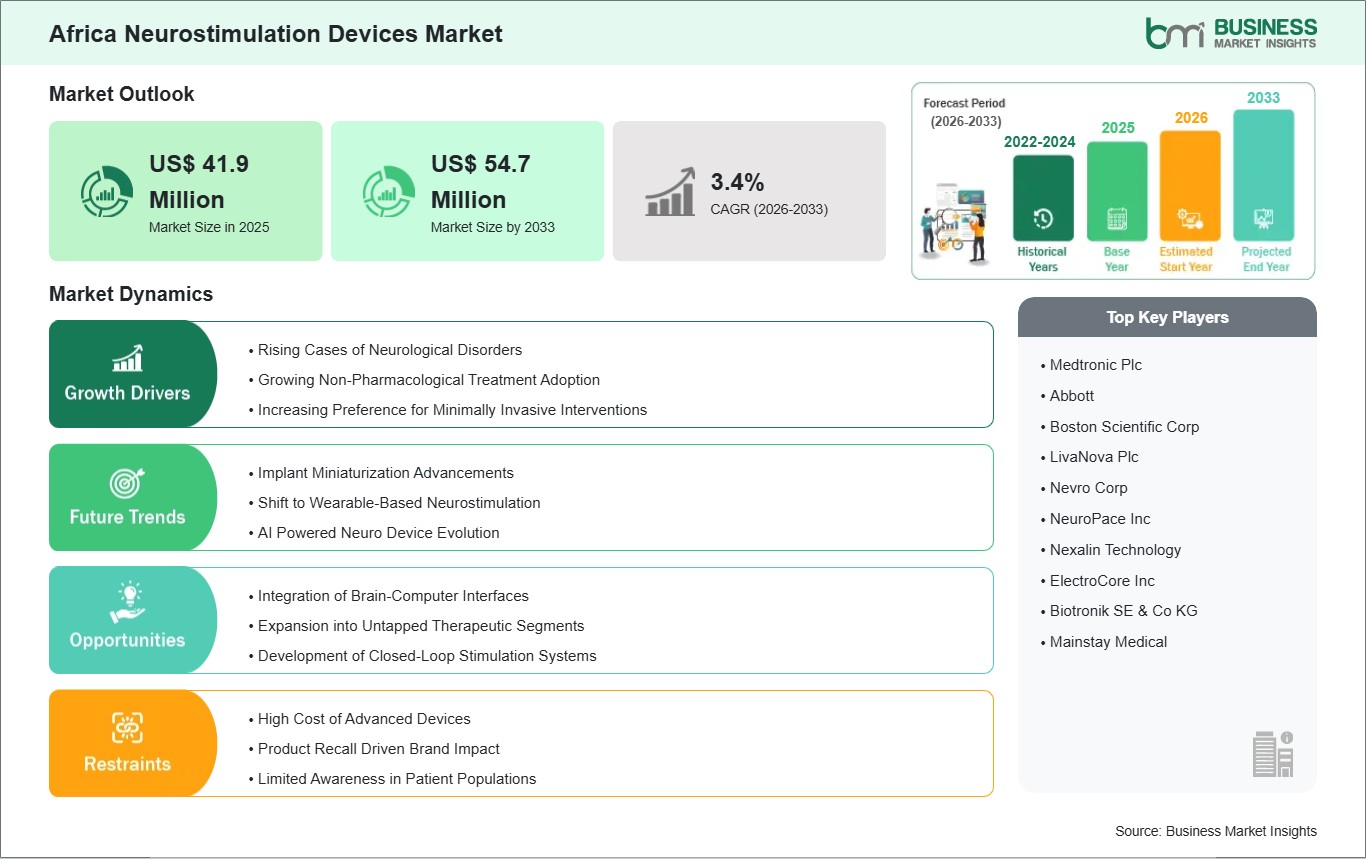
Neurological disorders such as Parkinson's disease, epilepsy, chronic pain conditions, and treatment-resistant depression increase while diagnostic capabilities and specialist care services show ongoing progress. Urban tertiary hospitals see increased adoption of treatment methods because healthcare professionals and patients recognize these methods as less invasive alternatives to traditional treatment methods. Private healthcare organizations continue to enhance their facilities and implement new treatment technologies. Structural and economic constraints create barriers to growth. The population faces restricted access because high device and procedure costs combine with insufficient reimbursement systems, which create financial barriers. Local manufacturing capabilities remain limited, which creates supply chain vulnerabilities and drives up operational expenses because organizations depend on imported technologies. There is a lack of qualified neurospecialists, and advanced medical services do not reach rural communities. The market will develop throughout the region because healthcare investment shows gradual growth, and more people want to access specialized neurological care.
Segment Analysis
Africa Neurostimulation Devices Market Segmentation
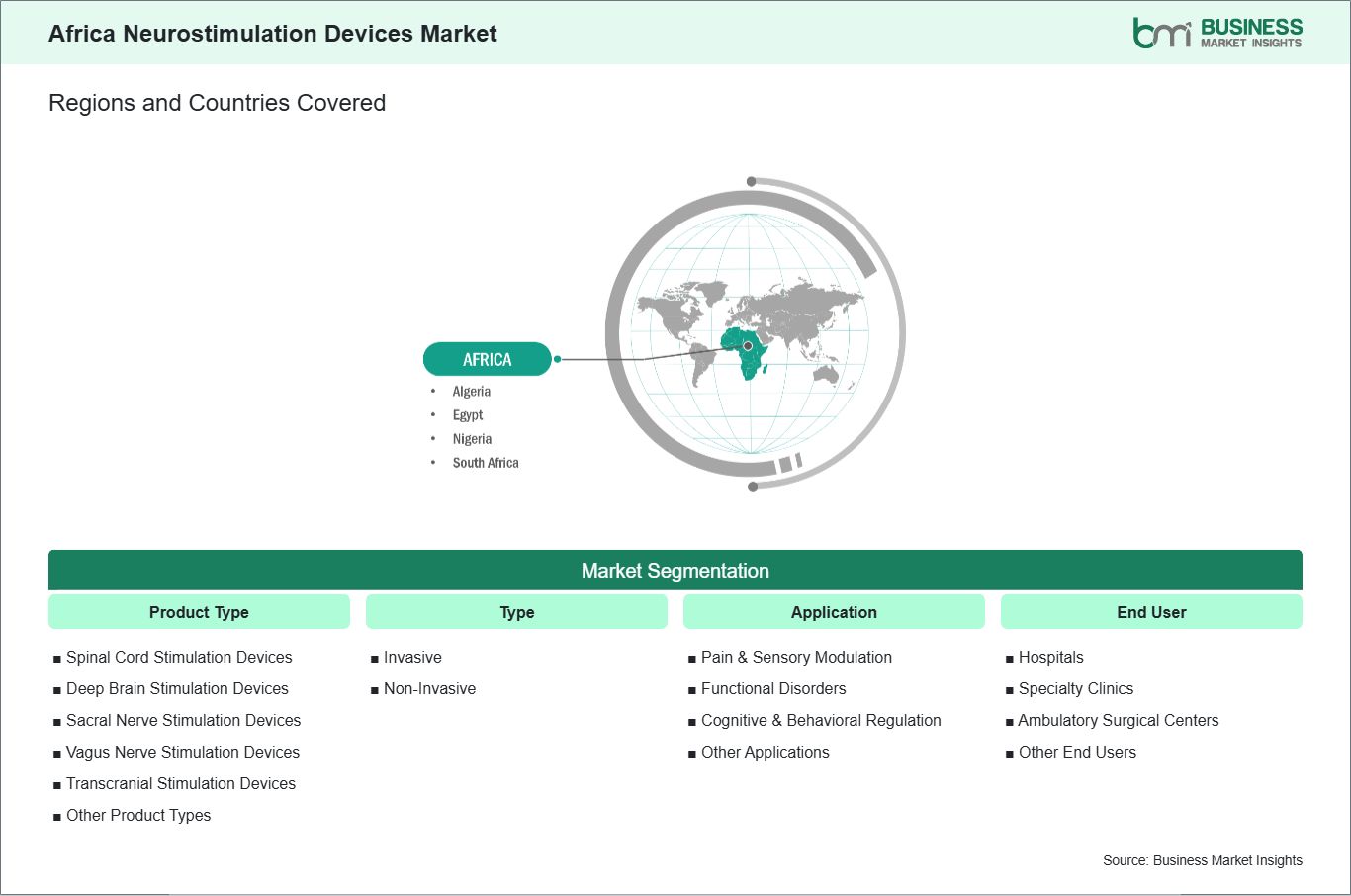
Key segments that contributed to the derivation of the Africa neurostimulation devices market analysis are product type, type, application, and end user.
- By product type, the neurostimulation devices market is segmented into spinal cord stimulation devices, deep brain stimulation devices, sacral nerve stimulation devices, vagus nerve stimulation devices, transcranial stimulation devices, and other product types. The spinal cord stimulation devices segment dominated the market in 2025.
- Based on type, the neurostimulation devices market is categorized into invasive and non-invasive. The invasive segment dominated the market in 2025.
- On the basis of application, the neurostimulation devices market is categorized into pain and sensory modulation, functional disorders, cognitive and behavioral regulation, and other applications. The pain and sensory modulation segment dominated the market in 2025.
- In terms of end user, the neurostimulation devices market is categorized into hospitals, specialty clinics, ambulatory surgical centers, and other end users. The hospitals segment dominated the market in 2025.
Market Forces
Africa Neurostimulation Devices Market Drivers and Opportunities
Rising Cases of Neurological Disorders
The combination of population aging and urban development has resulted in increased rates of stroke, epilepsy, and neurodegenerative disorders. Neurological disorders account for a significant portion of disability-adjusted life years in Africa because the disease burden has increased while existing diagnostic methods remain ineffective. The current trend requires hospitals to implement new treatment methods that use cutting-edge neurostimulation systems.
Epilepsy represents one of the most common neurological conditions in Africa, with a disproportionately high burden compared to global averages. In rural areas, people cannot access proper medication, while hospitals lack sufficient medical facilities. Rising stroke rates occur because more people develop hypertension and adopt dangerous lifestyle choices that increase their risk. Patients suffering from these conditions need neuromodulation devices to help them manage their symptoms while they recover from their disabilities.
Infectious diseases such as HIV and meningitis cause neurological problems, which increase the number of patients needing expert medical treatment. The development of healthcare systems, together with increased knowledge about neurological disorders, will lead to more accurate diagnosis of these conditions. Neurostimulation devices will see higher adoption rates because more patients will need treatment in urban areas where specialized neurological facilities exist.
Integration of Brain-Computer Interfaces
The integration of brain-computer interface (BCI) technologies is supported by advancements in digital health and neuroscience research. Although adoption remains in its early stages, academic institutions and innovation hubs across the region are beginning to explore the application of BCIs in neurorehabilitation and assistive technologies. These systems offer potential benefits in restoring communication and motor function among patients with severe neurological impairments.
African countries are witnessing increased collaboration between local research centers and international technology developers to pilot noninvasive BCI solutions. These initiatives are focused on rehabilitation for stroke survivors and individuals with spinal cord injuries. The growing penetration of mobile health technologies is enabling the integration of BCIs with remote monitoring platforms, making it feasible to deliver therapy in settings with limited access to specialized healthcare facilities.
The evolving innovation ecosystem in Africa, supported by public-private partnerships and global funding programs, is encouraging experimentation with scalable neurotechnology solutions. Efforts are being made to design cost-effective and adaptable BCI systems suitable for resource-constrained environments. As regulatory frameworks mature and technical expertise expands, the integration of BCIs with neurostimulation devices is expected to enhance clinical outcomes and strengthen the region's position in the global neurotechnology landscape.
Size and Share Analysis
Africa Neurostimulation Devices Market Size and Share Analysis
The Africa neurostimulation devices market is experiencing steady growth, with market size and share analysis reflecting evolving treatment preferences and competitive dynamics among key players. The report evaluates important subsegments categorized within product type, type, application, and end user, highlighting their respective contributions to market performance.
By product type, the spinal cord stimulation devices subsegment dominated the market in 2025, driven by its widespread adoption for chronic pain management and strong clinical efficacy.
Based on type, the invasive subsegment dominated the market in 2025, driven by higher precision, long-term effectiveness, and increasing preference for implantable solutions in severe neurological conditions.
On the basis of application, the pain and sensory modulation subsegment dominated the market in 2025, driven by the rising prevalence of chronic pain disorders and growing demand for non-opioid treatment alternatives.
In terms of end user, the hospitals subsegment dominated the market in 2025, driven by advanced healthcare infrastructure, availability of skilled professionals, and higher volume of neurostimulation procedures.
Report Coverage
Africa Neurostimulation Devices Market Report Coverage and Deliverables
The "Africa Neurostimulation Devices Market Size and Forecast (2022-2033)" report provides a detailed analysis of the market covering below areas:
- Market size and forecast at regional and country levels for all market segments covered under the scope
- Market trends, as well as drivers, restraints, and opportunities
- Market analysis covering key trends, regional framework, major players, regulations, and recent developments
- Market concentration, heat map analysis, prominent players, and recent developments for the Market
- Detailed company profiles, including SWOT analysis
Geographic Insights
Africa Neurostimulation Devices Market Geographic Insights
The geographical scope of the Africa Neurostimulation Devices Market report is divided into Nigeria, Egypt, South Africa, and Algeria. South Africa held the largest share in 2025.
South Africa experiences improved treatment results because patients can access innovative medical technologies. Private healthcare providers have established more treatment centers for neurostimulation therapy, which treats chronic pain, Parkinson's disease, and epilepsy. The large population of Nigeria creates a promising market opportunity because the country faces rising rates of neurological disorders. However, the market has limited growth because patients cannot reach specialized treatment facilities, high treatment costs, and the distribution of healthcare resources is weak. In Egypt, healthcare reforms, along with hospital infrastructure expansion and increased public knowledge of modern medical treatments in urban regions, are improving. Algeria's public healthcare spending has increased, and the country is focusing on upgrading its medical facilities. The demand in these countries is driven by rising disease rates, better diagnostic tools, and improved access to medical services. South Africa leads the market because it has better technology usage, more medical procedures, and its healthcare network.
Industry Activity
Recent Developments
The Africa Neurostimulation Devices Market is evaluated by gathering qualitative and quantitative data post primary and secondary research, which includes important corporate publications, association data, and databases. A few of the key developments in the Africa neurostimulation devices market are:
- In October 2025, Boston Scientific announced the acquisition of full ownership of Nalu Medical for approximately US$ 533 million, expanding its neuromodulation portfolio with peripheral nerve stimulation (PNS) technology for chronic pain management.
- In March 2024, Medtronic plc disclosed market activity for its deep brain stimulation (DBS) devices in South Africa, indicating ongoing commercialization and adoption of neurostimulation therapies at the country level within Africa.
Trust & Transparency
Research Methodology
The market analysis combines proprietary research with secondary data from government agencies, company disclosures, regulatory filings, industry databases and expert interviews. Market estimates are validated through data triangulation, cross-market benchmarking and analyst
review.
View Full Research Methodology
Key Sources Referred:
U.S. Food and Drug Administration (FDA)European Medicines Agency (EMA)National Institutes of Health (NIH)World Health Organization (WHO)International Neuromodulation SocietyNorth American Neuromodulation SocietyAmerican Academy of NeurologyEuropean Academy of NeurologyCongress of Neurological SurgeonsCompany WebsitesCompany Annual ReportsCompany Investor Presentations