Market Summary
Executive Summary and Market Analysis
The Middle East and Africa neurostimulation devices market shows an emerging market state, which displays different adoption rates between countries but benefits from a developing clinical and technological system. The region experiences growth because of increasing neurological disorder cases, which include Parkinson's disease, epilepsy and chronic pain conditions, together with rising awareness about neuromodulation as a permanent treatment solution. Gulf countries in the Middle East experience fast healthcare system development because their governments invest in modern medical technologies and specialized treatment facilities, which create conditions that support neurostimulation device use. Some African countries demonstrate gradual economic growth, which progresses at a slow pace, because they receive better tertiary medical services and establish international partnerships. The increasing demand for non-invasive procedures together with non-medication treatments, operates as a main driver because these methods serve as solutions when standard treatments fail to work or generate negative effects. Advanced neuromodulation procedures see higher adoption rates because private healthcare organizations expand their services, and medical tourism increases in major Middle Eastern cities. The market experiences several important limitations. The high expenses associated with devices and medical procedures create a major obstacle to market entry, especially in African nations that have sensitive price markets and insufficient reimbursement systems. The public health system suffers from two major problems, which include a lack of qualified neurologists and neurosurgeons, and a shortage of knowledge about medical practice in distant and low-income regions. The market reflects a dual structure, with relatively advanced uptake in parts of the Middle East and more gradual, infrastructure-dependent growth across Africa.
Segment Analysis
Middle East and Africa Neurostimulation Devices Market Segmentation
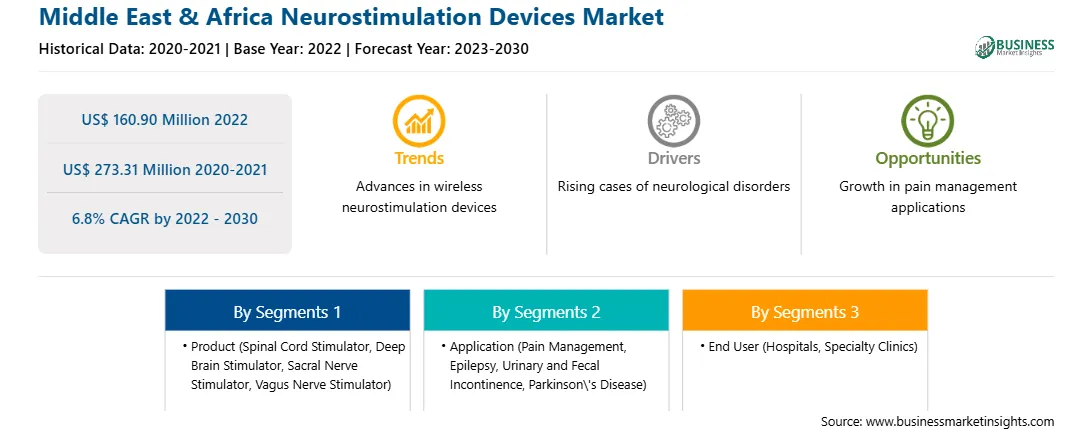
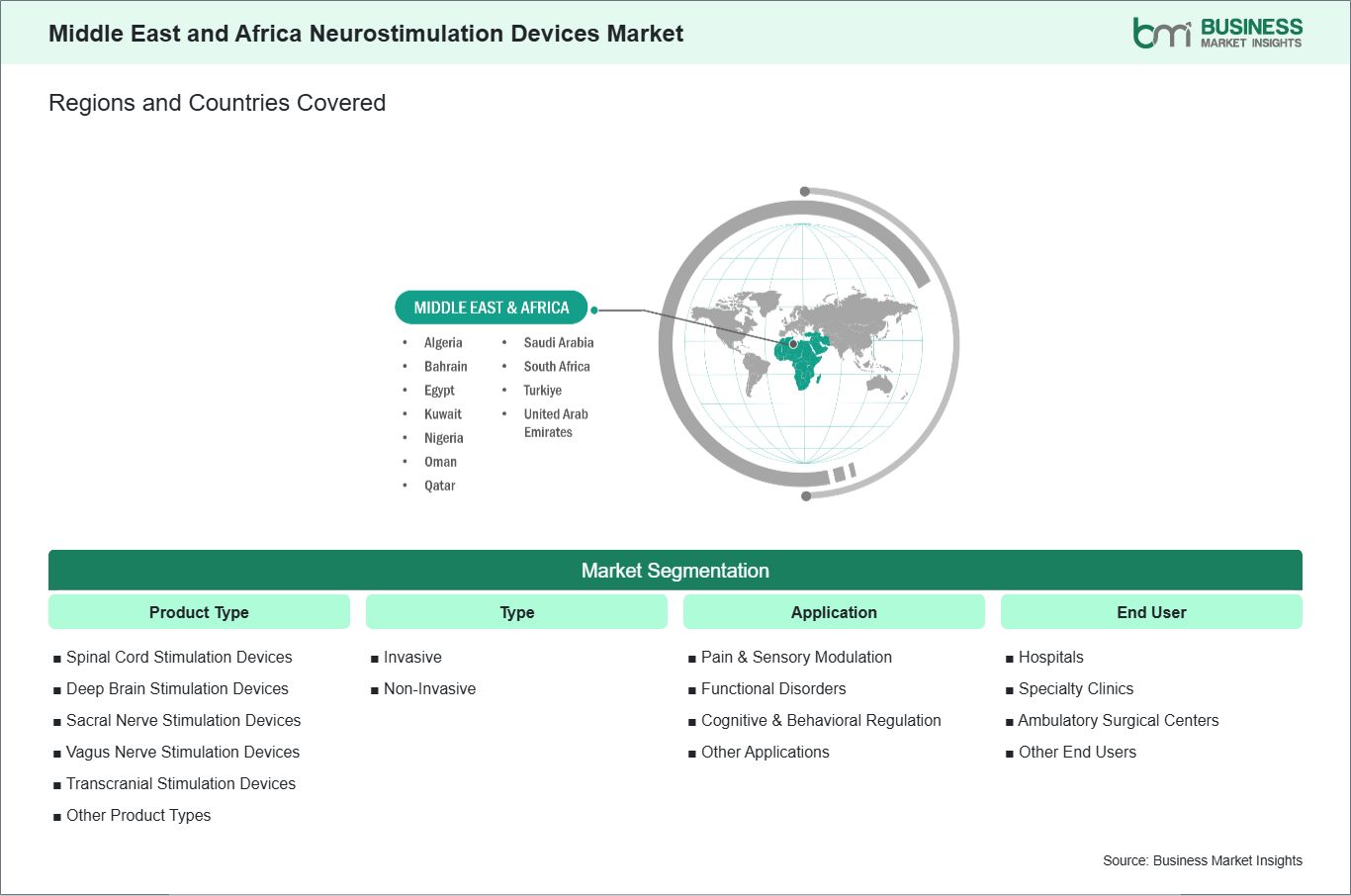
Key segments that contributed to the derivation of the Middle East and Africa neurostimulation devices market analysis are product type, type, application, and end user.
- By product type, the neurostimulation devices market is segmented into spinal cord stimulation devices, deep brain stimulation devices, sacral nerve stimulation devices, vagus nerve stimulation devices, transcranial stimulation devices, and other product types. The spinal cord stimulation devices segment dominated the market in 2025.
- Based on type, the neurostimulation devices market is categorized into invasive and non-invasive. The invasive segment dominated the market in 2025.
- On the basis of application, the neurostimulation devices market is categorized into pain and sensory modulation, functional disorders, cognitive and behavioral regulation, and other applications. The pain and sensory modulation segment dominated the market in 2025.
- In terms of end user, the neurostimulation devices market is categorized into hospitals, specialty clinics, ambulatory surgical centers, and other end users. The hospitals segment dominated the market in 2025.
Market Forces
Middle East and Africa Neurostimulation Devices Market Drivers and Opportunities
Increasing Neurological Disorder Prevalence
The Middle East and Africa neurostimulation devices market is experiencing notable growth because of the increasing occurrence of epilepsy, Parkinson's disease and post-stroke complications. The Gulf Cooperation Council (GCC) countries show rising case numbers because better diagnostic methods now reveal more cases, while African regions see decreasing underdiagnosis rates because healthcare services are becoming more available.
The combination of these two factors results in more patients being diagnosed with medical conditions, which increases the requirement for neurostimulation treatments that doctors use to manage chronic diseases. People develop more diseases because their lifestyle choices change and their population numbers grow. Urban centers such as Dubai, Riyadh and Johannesburg experience increased chronic migraine and depression rates because people follow new dietary patterns and their stress levels increase.
The growing elderly population in Saudi Arabia and the UAE requires advanced treatment methods because they face higher risks of developing neurodegenerative diseases. Regional healthcare systems are beginning to focus on neurological treatment through funding from governmental and non-governmental sources. Governments are building more specialized neurology centers and rehabilitation facilities, which will make treatment more accessible to patients. International collaborations and funding programs in Africa create new opportunities to enhance the neurological care system. These advancements enable healthcare providers to use neurostimulation devices because they want effective yet less hazardous medical solutions.
BCI Enabled Neurotechnology Growth
Brain-computer interface (BCI)-enabled neurotechnology is emerging as a promising area within the Middle East and Africa neurostimulation devices market. These technologies enable direct communication between neural signals and external devices, supporting applications in neurorehabilitation, assistive communication, and motor function restoration. The growing interest in integrating digital health tools with neurological care is encouraging healthcare providers to explore BCI-based solutions, particularly for patients with severe mobility or communication impairments.
Innovation ecosystems in countries such as Israel and the United Arab Emirates are playing a key role in advancing BCI-related research and development. Academic institutions, startups, and healthcare providers are collaborating to develop solutions that combine neurostimulation with artificial intelligence and robotics. These integrated systems are being tested in stroke recovery and spinal cord injury rehabilitation, where they show potential to improve patient outcomes through personalized therapy and real-time feedback mechanisms.
Despite its potential, the adoption of BCI-enabled neurotechnology in the region faces certain constraints, including high implementation costs and limited availability of specialized expertise. Infrastructure disparities between urban and rural areas also impact deployment. However, increasing investment in digital transformation and healthcare innovation, along with supportive government initiatives, is expected to gradually overcome these barriers and drive broader adoption in the coming years.
Size and Share Analysis
Middle East and Africa Neurostimulation Devices Market Size and Share Analysis
The Middle East and Africa neurostimulation devices market is experiencing steady growth, with market size and share analysis reflecting evolving treatment preferences and competitive dynamics among key players. The report evaluates important subsegments categorized within product type, type, application, and end user, highlighting their respective contributions to market performance.
By product type, the spinal cord stimulation devices subsegment dominated the market in 2025, driven by its widespread adoption for chronic pain management and strong clinical efficacy.
Based on type, the invasive subsegment dominated the market in 2025, driven by higher precision, long-term effectiveness, and increasing preference for implantable solutions in severe neurological conditions.
On the basis of application, the pain and sensory modulation subsegment dominated the market in 2025, driven by the rising prevalence of chronic pain disorders and growing demand for non-opioid treatment alternatives.
In terms of end user, the hospitals subsegment dominated the market in 2025, driven by advanced healthcare infrastructure, availability of skilled professionals, and higher volume of neurostimulation procedures.
Report Coverage
Middle East and Africa Neurostimulation Devices Market Report Coverage and Deliverables
The "Middle East and Africa Neurostimulation Devices Market Size and Forecast (2022-2033)" report provides a detailed analysis of the market covering below areas:
- Market size and forecast at regional and country levels for all market segments covered under the scope
- Market trends, as well as drivers, restraints, and opportunities
- Market analysis covering key trends, regional framework, major players, regulations, and recent developments
- Market concentration, heat map analysis, prominent players, and recent developments for the Market
- Detailed company profiles, including SWOT analysis
Geographic Insights
Middle East and Africa Neurostimulation Devices Market Geographic Insights
The geographical scope of the Middle East and Africa Neurostimulation Devices Market report is divided into Turkiye, the UAE, Saudi Arabia, Bahrain, Oman, Egypt, South Africa and Africa, Algeria, Nigeria, Kuwait, and Qatar. Turkiye held the largest share in 2025.
The neurostimulation devices market in the Middle East and Africa is expanding slowly because of three main factors, which include the rising number of neurological disorders, the growing awareness about modern pain treatment methods and the developing medical systems in essential African nations. Turkiye stands out as the dominant market due to its well-established hospital networks and growing adoption of advanced neuromodulation procedures, and its role as a regional referral hub supported by medical tourism. The UAE and Saudi Arabia serve as vital expansion markets in the Gulf region because of their substantial government investment in healthcare facilities, their developing specialized medical services and their commitment to implementing cutting-edge healthcare technologies. The Saudi Arabian healthcare system benefits from extensive healthcare transformation programs, while the UAE system uses its private healthcare industry together with global partnerships. The Gulf region countries, such as Qatar, Kuwait, Bahrain and Oman, are establishing better access to specialized neurology and pain management services, which enables them to grow their services steadily at this time. South Africa leads the African market because it has better infrastructure and medical operations than other countries, while Egypt has become a major market because of its large population and improving healthcare access. Algeria and Nigeria present long-term opportunities that face growth challenges because of their restricted access to specialized medical services and high treatment costs. The entire African region has not been fully developed yet, which creates opportunities for future international development as medical systems undergo improvements.
Industry Activity
Recent Developments
The Middle East and Africa Neurostimulation Devices Market is evaluated by gathering qualitative and quantitative data post primary and secondary research, which includes important corporate publications, association data, and databases. A few of the key developments in the Middle East and Africa neurostimulation devices market are:
- In February 2025, Nyxoah announced the commercial launch of its Genio neurostimulation therapy in the Middle East, marking the first successful implantation at Saudi German Hospital in Dubai, UAE, expanding access to its bilateral hypoglossal nerve stimulation treatment for obstructive sleep apnea patients in the region.
- In September 2024, Abbott announced the successful first implantation of its Esprit™ BTK resorbable scaffold in the UAE at Al Qassimi Hospital, marking the first use of this advanced vascular intervention technology in the Middle East and Africa region and strengthening Abbott's interventional and neuromodulation-adjacent presence in MEA healthcare systems.
Trust & Transparency
Research Methodology
The market analysis combines proprietary research with secondary data from government agencies, company disclosures, regulatory filings, industry databases and expert interviews. Market estimates are validated through data triangulation, cross-market benchmarking and analyst
review.
View Full Research Methodology
Key Sources Referred:
U.S. Food and Drug Administration (FDA)European Medicines Agency (EMA)National Institutes of Health (NIH)World Health Organization (WHO)International Neuromodulation SocietyNorth American Neuromodulation SocietyAmerican Academy of NeurologyEuropean Academy of NeurologyCongress of Neurological SurgeonsCompany WebsitesCompany Annual ReportsCompany Investor Presentations