Market Summary
Executive Summary and Global Market Analysis
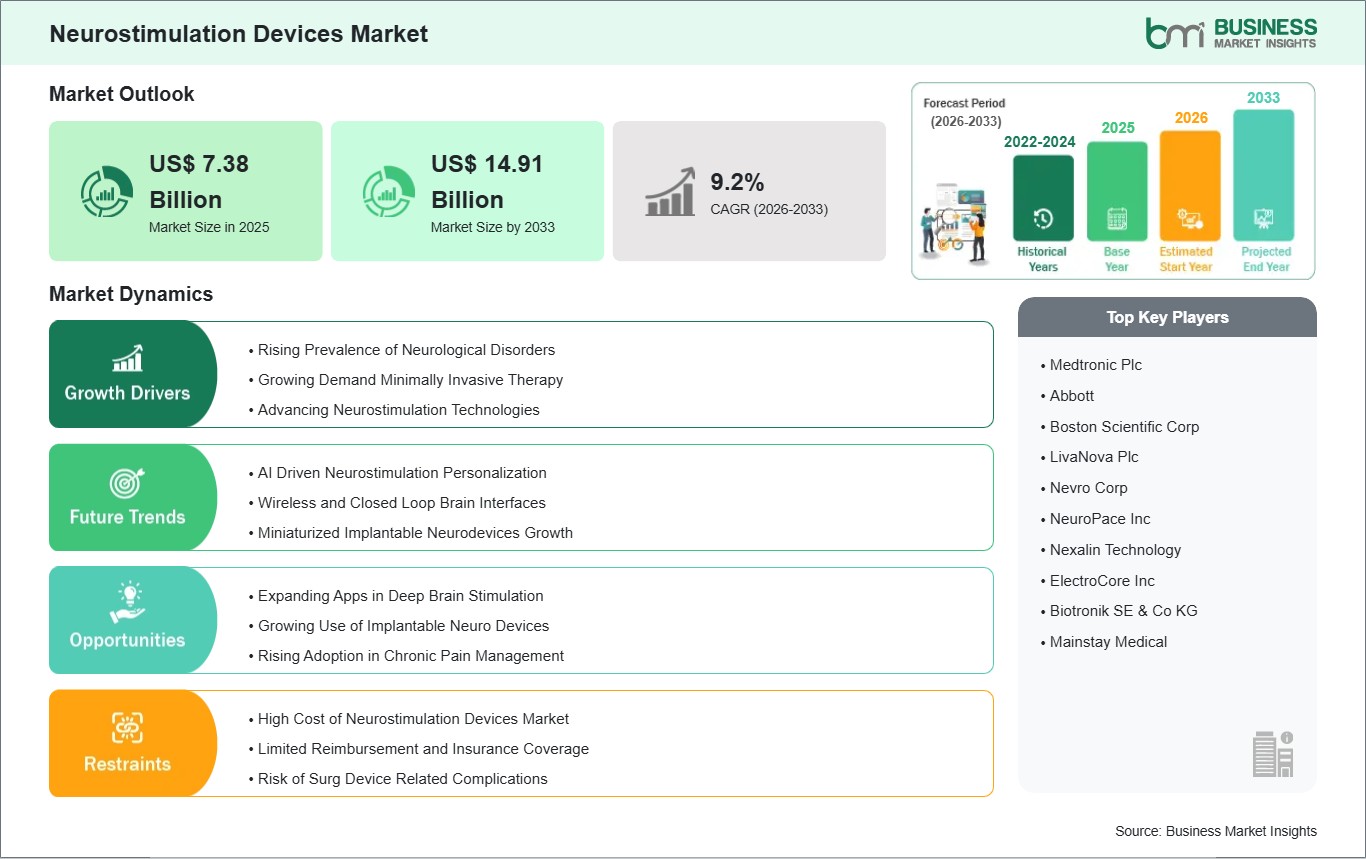
The medical field has begun to adopt neurostimulation therapies, which use specific electrical stimulation methods to treat nervous system disorders, as an alternative treatment to replace or supplement standard medication methods. Patients and their doctors choose this option because of the medication limitations, which include side effects, the development of tolerance, and the risk of long-term dependency. There is an increasing rate of neurological disorders, which include Parkinson's disease, epilepsy, and treatment-resistant depression, together with chronic pain. Older people have a higher likelihood of developing degenerative and nerve-related medical conditions. Clinicians prefer treatment methods that cause minimal physical harm and reversible effects, which makes neurostimulation devices attractive for patients and healthcare professionals. New technologies for device miniaturization, better battery life, and more accurate targeting methods and programmable stimulation systems have improved therapy results and patient treatment adherence. The engineering of advanced systems, which can perform either adaptive or closed-loop stimulation functions, enables the medical devices to treat a range of neurological and psychiatric disorders. The high initial expenses of neurostimulation devices, together with their surgical implantation costs, create major obstacles that affect healthcare systems that need to control their expenses. Limited reimbursement policies in specific areas restrict patient treatment options. The need for surgical implantation across multiple device types creates clinical dangers that require specialized knowledge that not all healthcare facilities can provide. The market has potential for continued worldwide expansion despite ongoing cost and accessibility issues because innovation and healthcare systems are becoming more advanced.
Segment Analysis
Neurostimulation Devices Market Segmentation
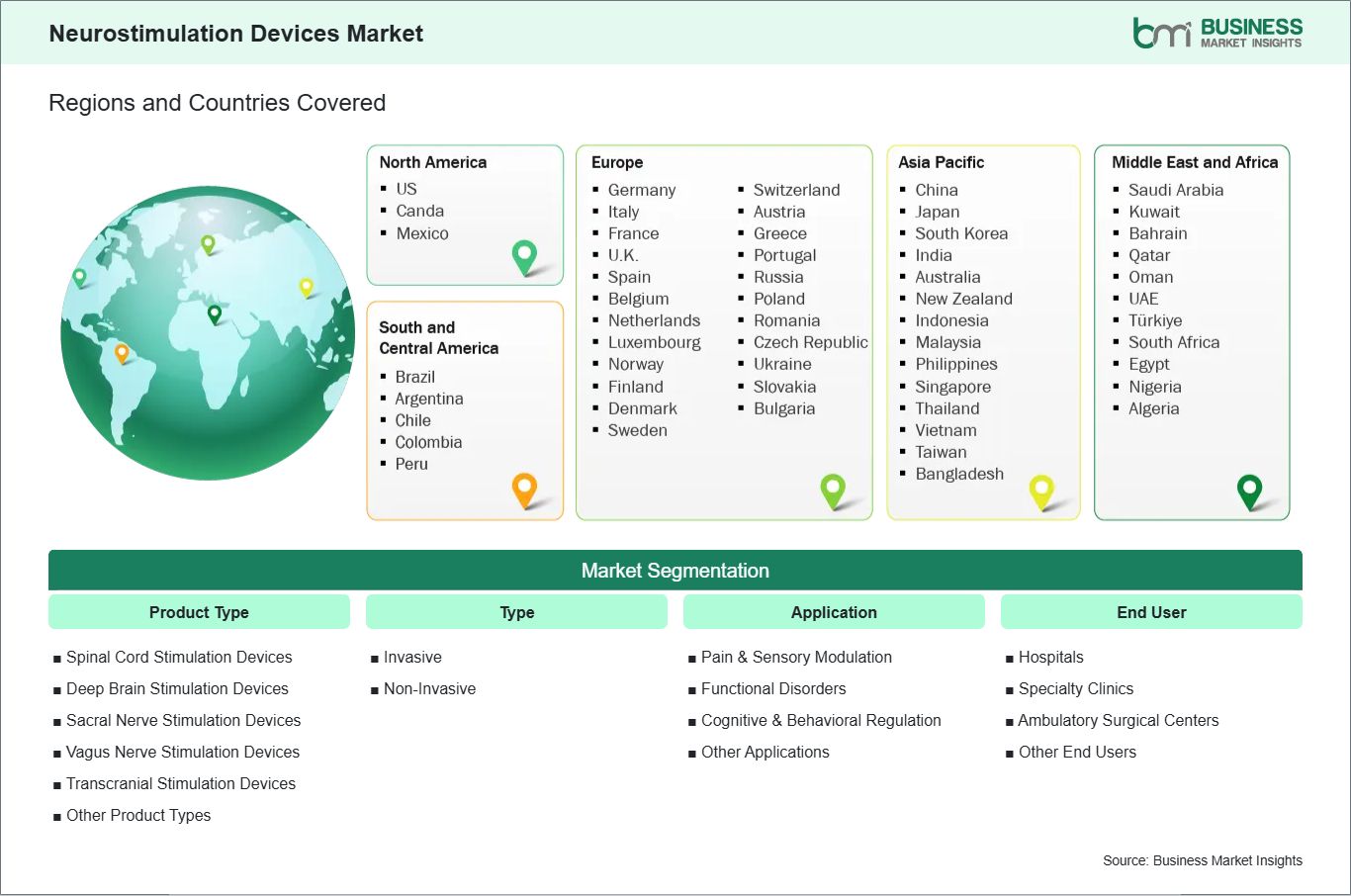
Key segments that contributed to the derivation of the neurostimulation devices market analysis are product type, type, application, and end user.
- By product type, the neurostimulation devices market is segmented into spinal cord stimulation devices, deep brain stimulation devices, sacral nerve stimulation devices, vagus nerve stimulation devices, transcranial stimulation devices, and other product types. The spinal cord stimulation devices segment dominated the market in 2025.
- Based on type, the neurostimulation devices market is categorized into invasive and non-invasive. The invasive segment dominated the market in 2025.
- On the basis of application, the neurostimulation devices market is categorized into pain and sensory modulation, functional disorders, cognitive and behavioral regulation, and other applications. The pain and sensory modulation segment dominated the market in 2025.
- In terms of end user, the neurostimulation devices market is categorized into hospitals, specialty clinics, ambulatory surgical centers, and other end users. The hospitals segment dominated the market in 2025.
Market Forces
Neurostimulation Devices Market Drivers and Opportunities
Rising Prevalence of Neurological Disorders
Parkinson-like movement disorders, chronic migraines, epilepsy, and treatment-resistant depression have increased in frequency. Urbanized areas experience a more rapid increase in neurodegenerative diseases because of their aging population, high stress levels, sleep difficulties, and lack of physical activity.
More people are choosing to use minimally invasive neuromodulation therapies. Doctors now prefer to use implantable devices and external stimulation systems instead of prescribing medications to patients who do not respond to standard treatment methods. The enhanced surgical methods and advanced device programming capabilities enable doctors to achieve better patient results while increasing their trust in the medical system. The medical system demands advanced treatment options because patients now have a better understanding of them than ever before. The use of neurostimulation devices receives additional support from healthcare system improvements and the implementation of digital monitoring systems.
Expanding Apps in Deep Brain Stimulation
Deep brain stimulation is witnessing an expanding application scope beyond movement disorder management, becoming a key opportunity area in the global neurostimulation devices market. Used for severe neurological conditions, it is now explored for psychiatric disorders, chronic pain syndromes, and cognitive dysfunction cases. This clinical acceptance is driven by improved understanding of brain signaling pathways and the ability to modulate specific neural circuits with higher precision.
Technological advancements are enhancing the effectiveness and safety of deep brain stimulation systems. Modern devices are incorporating adaptive feedback mechanisms that allow real-time adjustment of stimulation parameters based on patient response. It improves therapeutic accuracy while reducing side effects. Minimally invasive implantation techniques and better imaging guidance are making procedures safer and more accessible across specialized hospitals. Growing healthcare investments and increasing neurosurgical expertise are supporting the adoption of deep brain stimulation therapies, particularly in complex neurological and treatment-resistant cases.
Size and Share Analysis
Neurostimulation Devices Market Size and Share Analysis
The neurostimulation devices market demonstrates steady growth, with size and share analysis highlighting evolving trends and competitive dynamics among key players. The report examines subsegments categorized within product type, type, application and end user, offering insights into their contribution to overall market performance.
By product type, the spinal cord stimulation devices subsegment dominated the market in 2025, driven by its widespread adoption for chronic pain management and strong clinical efficacy.
Based on type, the invasive subsegment dominated the market in 2025, driven by higher precision, long-term effectiveness, and increasing preference for implantable solutions in severe neurological conditions.
On the basis of application, the pain and sensory modulation subsegment dominated the market in 2025, driven by the rising prevalence of chronic pain disorders and growing demand for non-opioid treatment alternatives.
In terms of end user, the hospitals subsegment dominated the market in 2025, driven by advanced healthcare infrastructure, availability of skilled professionals, and higher volume of neurostimulation procedures.
Report Coverage
Neurostimulation Devices Market Report Coverage and Deliverables
The "Neurostimulation Devices Market Size and Forecast (2022-2033)" report provides a detailed analysis of the market covering below areas:
- Market size and forecast at global, regional, and country levels for all the key market segments covered under the scope
- Market trends, as well as drivers, restraints, and opportunities
- Market analysis covering key trends, global and regional framework, major players, regulations, and recent developments
- Market concentration, heat map analysis, prominent players, and recent developments for the Market
- Detailed company profiles, including SWOT analysis
Geographic Insights
Neurostimulation Devices Market Geographic Insights
The geographical scope of the Neurostimulation Devices Market report is divided into North America, Asia Pacific, Europe, the Middle East and Africa, and South and Central America. North America held the largest share in 2025.
North America has established reimbursement systems, and hospitals and outpatient centers use state-of-the-art neuromodulation treatments. Europe experiences steady growth because of its aging demographic, rising rates of chronic neurological diseases, and its extensive healthcare system accessibility. Western Europe shows high adoption rates because its healthcare professionals use clinical knowledge and regulatory frameworks to distribute products, yet reimbursement systems and cost containment practices affect market development. APAC experiences the highest growth rate because of its advancing healthcare systems, growing middle-class population, and increasing public knowledge about treatment methods. The region sees greater financial support for medical technology development while its healthcare facilities adopt less invasive medical techniques, which establishes the region as a key driver of expansion despite ongoing challenges with market access and affordability. The MEA is developing through healthcare investments, which create new treatment centers and efforts to treat neurological disorders. Advanced therapies remain inaccessible to patients due to existing healthcare infrastructure limitations. South and Central America shows moderate growth because healthcare access improves, demand for pain management solutions increases, and physicians become more knowledgeable about neuromodulation techniques. Economic fluctuations and healthcare resource distribution problems affect its rate of adoption. Emerging markets, especially APAC, will drive future growth as their health facilities improve, public knowledge increases, and medical research funding rises.
Industry Activity
Recent Developments
The Neurostimulation Devices Market is evaluated by gathering qualitative and quantitative data post primary and secondary research, which includes important corporate publications, association data, and databases. A few of the key developments in the neurostimulation devices market are:
- In August 2023, Medtronic announced CE Mark approval for its Inceptiv closed-loop spinal cord stimulator for chronic pain treatment. The device uses real-time sensing of spinal cord signals to automatically adjust stimulation, representing a shift toward adaptive neurostimulation therapy.
- In August 2023, Abbott announced that it received U.S. FDA approval for its next-generation Proclaim Plus spinal cord stimulation system featuring FlexBurst360 therapy for chronic pain management. This upgraded system expands programming flexibility to cover multiple pain regions and allows therapy adjustments as patient needs evolve.
Trust & Transparency
Research Methodology
The market analysis combines proprietary research with secondary data from government agencies, company disclosures, regulatory filings, industry databases and expert interviews. Market estimates are validated through data triangulation, cross-market benchmarking and analyst
review.
View Full Research Methodology
Key Sources Referred:
U.S. Food and Drug Administration (FDA) European Medicines Agency (EMA) National Institutes of Health (NIH) World Health Organization (WHO) International Neuromodulation Society North American Neuromodulation Society American Academy of Neurology European Academy of Neurology Congress of Neurological Surgeons Company Websites Company Annual Reports Company Investor Presentations