Market Summary
Executive Summary and Market Analysis
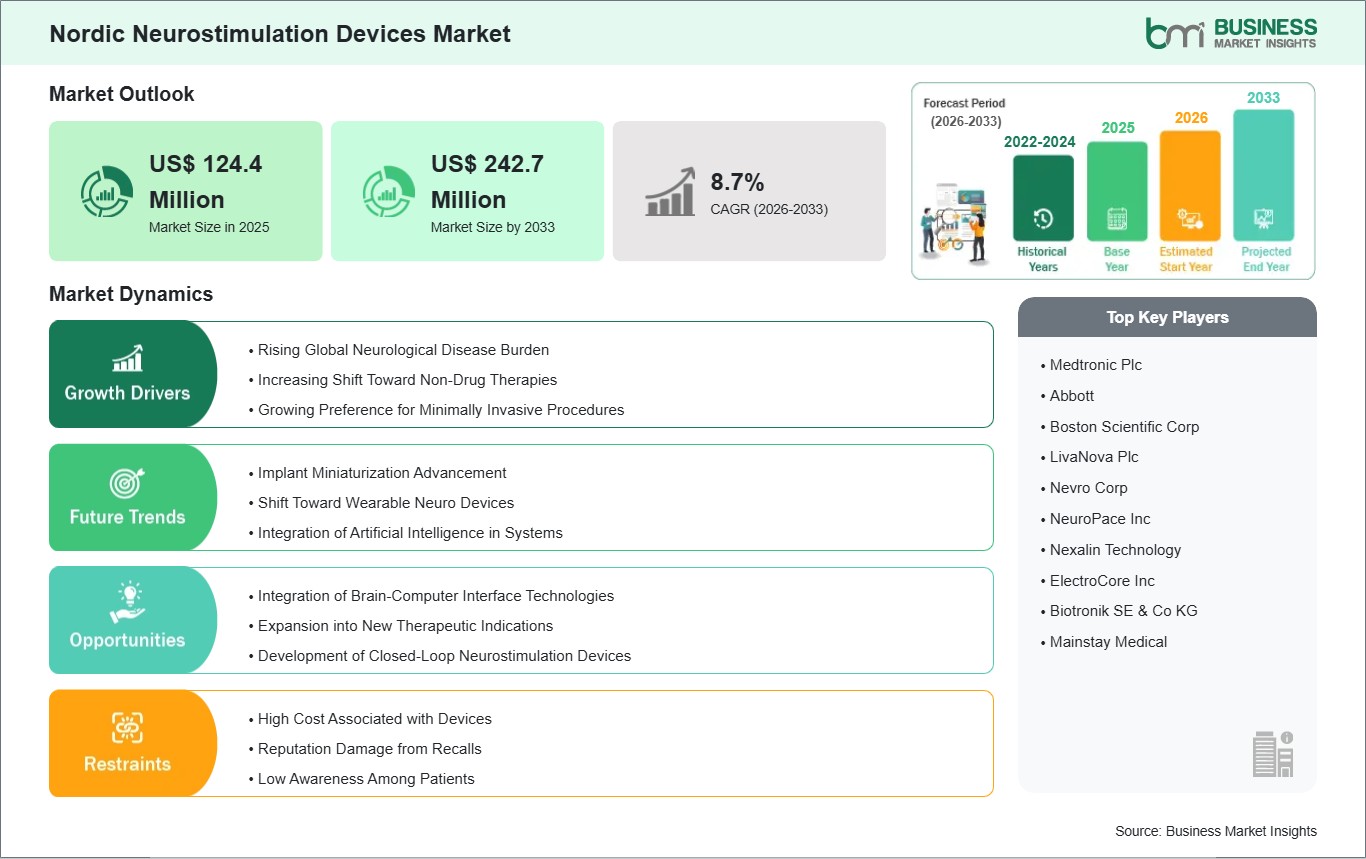
The Nordic neurostimulation devices market proves to be an advanced sector that drives innovation within the European neuromodulation market. The region displays strong public healthcare systems, which enable early medical technology adoption and complete digital clinical workflow integration. The market uses neurostimulation devices to treat chronic pain and movement disorders, which include Parkinson's disease, epilepsy and treatment-resistant depression, according to the existing neurological care system. The Nordic region experiences growth because its healthcare system prioritizes non-invasive and minimally invasive treatments, which match national healthcare goals of decreasing hospital usage and enhancing outpatient services. The adoption of neurostimulation technologies increases through their connection to digital health systems, which include electronic referral networks and remote patient monitoring systems. The rising demand for advanced neuromodulation therapies in the region results from the increasing number of senior citizens who require treatment for age-related neurological and pain disorders. The high volume of clinical research activities, together with the hospital-university-medtech company partnerships, which support early access to next-generation neurostimulation technologies, drives the market forward by enabling the development of closed-loop systems and adaptive stimulation platforms. The Nordic countries serve as both testing grounds and early adoption sites for new neuromodulation technologies. However, certain limitations exist that restrict market development. The region attracts less commercial development because its limited population capacity prevents businesses from pursuing extensive growth projects, which larger European markets allow. The introduction of advanced implantable devices faces delays because health technology assessment procedures and reimbursement systems require extensive evaluation. The Nordic region retains its strategic value because it leads in innovation, and its neurostimulation therapies achieve substantial clinical acceptance.
Segment Analysis
Nordic Neurostimulation Devices Market Segmentation
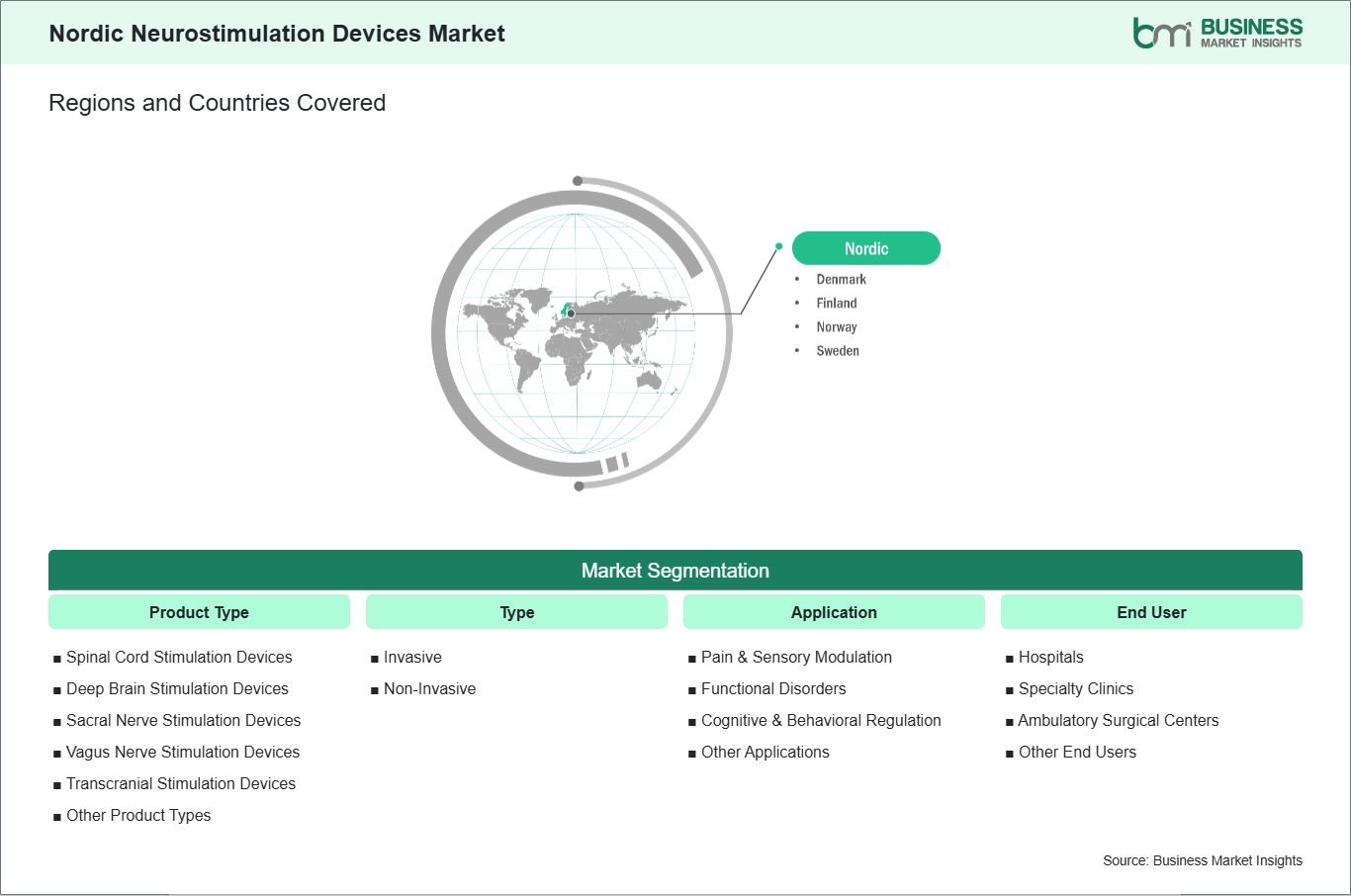
Key segments that contributed to the derivation of the Nordic neurostimulation devices market analysis are product type, type, application, and end user.
- By product type, the neurostimulation devices market is segmented into spinal cord stimulation devices, deep brain stimulation devices, sacral nerve stimulation devices, vagus nerve stimulation devices, transcranial stimulation devices, and other product types. The spinal cord stimulation devices segment dominated the market in 2025.
- Based on type, the neurostimulation devices market is categorized into invasive and non-invasive. The invasive segment dominated the market in 2025.
- On the basis of application, the neurostimulation devices market is categorized into pain and sensory modulation, functional disorders, cognitive and behavioral regulation, and other applications. The pain and sensory modulation segment dominated the market in 2025.
- In terms of end user, the neurostimulation devices market is categorized into hospitals, specialty clinics, ambulatory surgical centers, and other end users. The hospitals segment dominated the market in 2025.
Market Forces
Nordic Neurostimulation Devices Market Drivers and Opportunities
Rising Global Neurological Disease Burden
The Nordic neurostimulation devices market experiences development because of increasing neurological disorder cases, which include Parkinson's disease, epilepsy, chronic pain conditions and treatment-resistant depression. The rising elderly population in Sweden, Norway, Denmark and Finland creates a need for advanced neuromodulation therapies because traditional pharmacological treatments fail to provide enduring relief for patients.
Chronic pain disorders drive neurostimulation usage throughout the Nordic region, especially in Finland and Sweden, which experience severe quality of life challenges from musculoskeletal and neuropathic disorders. Hospitals increasingly use spinal cord stimulation and peripheral nerve stimulation as treatment alternatives when standard therapies fail to provide sufficient results at their clinical practice facilities.
Public healthcare systems in the Nordic countries support neurostimulation adoption through their establishment of structured reimbursement systems and their creation of integrated neurology treatment networks. Norwegian and Danish hospitals are increasingly recognizing neurostimulation as a cost-efficient solution for managing refractory neurological disorders, which helps to establish its clinical acceptance across specialist centers in the region.
Integration of Brain-Computer Interface Technologies
Nordic countries are emerging as early adopters of brain-computer interface (BCI) technologies, particularly in rehabilitation and assistive care applications. Finnish and Swedish research institutions develop EEG-based systems that convert neural signals into usable commands to assist spinal injury and motor neuron disease patients. The project supports regional digital health innovation and personalized medicine development, which currently serves as a regional health innovation priority.
Danish and Norwegian hospitals and rehabilitation centers adopt non-invasive BCI platforms, which they combine with neurostimulation devices to enhance stroke recovery results and motor function restoration outcomes. The hybrid systems use real-time brain signal processing to enable precise therapy delivery through adaptive stimulation methods. University hospitals use pilot programs to show how patient engagement improvements lead to better recovery results.
Government funding supports research activities, while government partnerships with MedTech companies drive BCI neurostimulation system development. Nordic innovation hubs develop wearable devices that work with cloud-based systems to enable remote patient monitoring and therapy modifications. The region develops into a major testing location for advanced neurostimulation systems through its integration of neuroscience research with digital system development.
Size and Share Analysis
Nordic Neurostimulation Devices Market Size and Share Analysis
The Nordic neurostimulation devices market is experiencing steady growth, with market size and share analysis reflecting evolving treatment preferences and competitive dynamics among key players. The report evaluates important subsegments categorized within product type, type, application, and end user, highlighting their respective contributions to market performance.
By product type, the spinal cord stimulation devices subsegment dominated the market in 2025, driven by its widespread adoption for chronic pain management and strong clinical efficacy.
Based on type, the invasive subsegment dominated the market in 2025, driven by higher precision, long-term effectiveness, and increasing preference for implantable solutions in severe neurological conditions.
On the basis of application, the pain and sensory modulation subsegment dominated the market in 2025, driven by the rising prevalence of chronic pain disorders and growing demand for non-opioid treatment alternatives.
In terms of end user, the hospitals subsegment dominated the market in 2025, driven by advanced healthcare infrastructure, availability of skilled professionals, and higher volume of neurostimulation procedures.
Report Coverage
Nordic Neurostimulation Devices Market Report Coverage and Deliverables
The "Nordic Neurostimulation Devices Market Size and Forecast (2022-2033)" report provides a detailed analysis of the market covering below areas:
- Market size and forecast at regional and country levels for all market segments covered under the scope
- Market trends, as well as drivers, restraints, and opportunities
- Market analysis covering key trends, regional framework, major players, regulations, and recent developments
- Market concentration, heat map analysis, prominent players, and recent developments for the Market
- Detailed company profiles, including SWOT analysis
Geographic Insights
Nordic Neurostimulation Devices Market Geographic Insights
The geographical scope of the Nordic Neurostimulation Devices Market report is divided into Sweden, Denmark, Norway, Finland. Sweden held the largest share in 2025.
The Nordic neurostimulation devices market shows steady growth across Sweden, Denmark, Norway, and Finland, driven by rising neurological disorder prevalence, strong public healthcare systems, and increasing adoption of minimally invasive neuromodulation therapies. Sweden serves as the main regional center because it possesses advanced neurology infrastructure, it adopted transcranial magnetic stimulation (TMS) and spinal cord stimulation technologies before other countries, and its public healthcare system integrates digital health pathways. The country achieves better clinical trial results because it provides better reimbursement systems and has more neurosurgery facilities than its adjacent nations, which strengthen its Nordic neurostimulation market position. Denmark shows strong market development because its hospital system functions well, while its medical system handles chronic pain and psychiatric conditions through neuromodulation treatments. Norway's market is expanding gradually because people spend more on healthcare, and doctors use implantable devices to treat Parkinson's disease and pain disorders. Although Finland experiences increased demand for non-invasive neurostimulation solutions, which help treat mental health issues and rehabilitation, digital health systems and centralized healthcare procurement drive their development. Sweden maintains its position as the leading Nordic nation because all Nordic countries provide universal healthcare, and people accept new technologies, but Sweden has more advanced clinical systems, better technology development and greater neuromodulation expertise.
Industry Activity
Recent Developments
The Nordic Neurostimulation Devices Market is evaluated by gathering qualitative and quantitative data post primary and secondary research, which includes important corporate publications, association data, and databases. A few of the key developments in the Nordic neurostimulation devices market are:
- In July 2024, Sensio (Norway), announced that Nordic Capital had agreed to acquire a majority stake in the company to accelerate its international expansion and further develop its smart monitoring and healthcare technology platform used across Nordic elderly care systems.
- In June 2024, Nexstim Plc, announced that it signed a Letter of Intent with Sinaptica Therapeutics to collaborate on developing a precision neuromodulation system based on Nexstim's NBS platform for Alzheimer's disease treatment, expanding its technology into new CNS therapeutic areas.
Trust & Transparency
Research Methodology
The market analysis combines proprietary research with secondary data from government agencies, company disclosures, regulatory filings, industry databases and expert interviews. Market estimates are validated through data triangulation, cross-market benchmarking and analyst
review.
View Full Research Methodology
Key Sources Referred:
U.S. Food and Drug Administration (FDA)European Medicines Agency (EMA)National Institutes of Health (NIH)World Health Organization (WHO)International Neuromodulation SocietyNorth American Neuromodulation SocietyAmerican Academy of NeurologyEuropean Academy of NeurologyCongress of Neurological SurgeonsCompany WebsitesCompany Annual ReportsCompany Investor Presentations