Market Summary
Executive Summary and Market Analysis
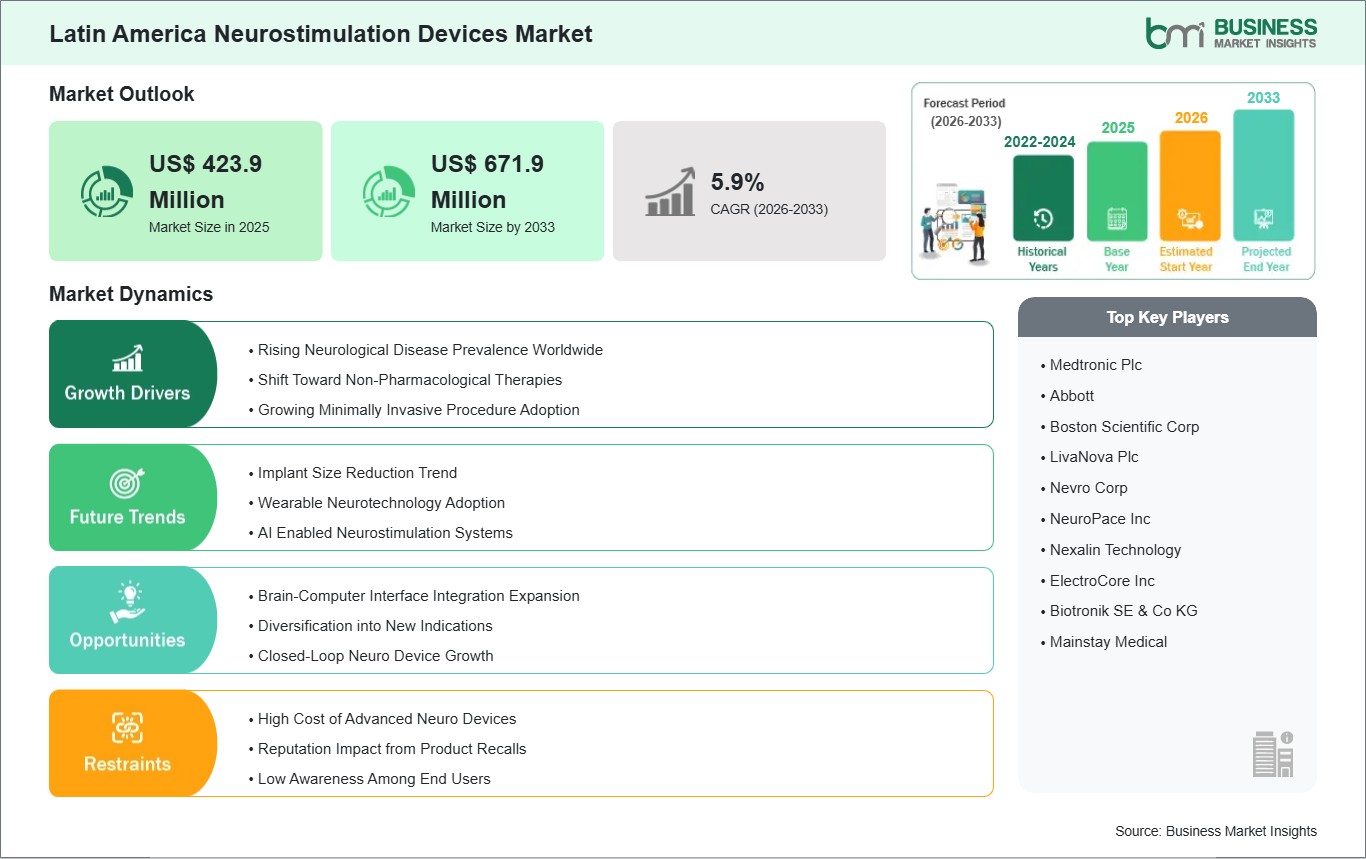
The Latin America neurostimulation devices market is emerging as a steadily expanding segment within the broader neurology medical devices landscape, driven by a rising burden of neurological and chronic pain disorders and gradual improvements in specialized neurocare infrastructure. The region experiences continuous demand for advanced neuromodulation therapies because of increasing cases of Parkinson's disease, epilepsy, neuropathic pain and depression across its major economies, which include Brazil, Mexico, Argentina and Colombia. Neurostimulation solutions are experiencing wider clinical acceptance because clinicians and patients now better understand the benefits of device-based and minimally invasive treatment options. Modernization efforts in healthcare systems drive regional growth as hospitals and specialty neurology centers start using technologies like spinal cord stimulation, deep brain stimulation and sacral nerve stimulation. The expansion of private healthcare facilities, together with increased global medical device company involvement, leads to better access for patients who need sophisticated medical procedures. The urban population benefits from improved healthcare access because both healthcare spending and insurance coverage are increasing in these regions. The market remains constrained by structural obstacles that prevent it from achieving rapid market growth. Public healthcare systems struggle with budget constraints, which make it impossible for them to handle the high expenses associated with treatment and medical equipment. The distribution of advanced neurosurgical skills and specialized medical facilities concentrates in urban areas, which creates barriers that prevent rural and semi-urban populations from accessing these essential services. The regional market expansion faces obstacles because countries have different regulatory requirements and reimbursement procedures. The existing restrictions on business operations will not affect the company's ability to achieve sustainable development because technological progress and healthcare funding will continue to grow throughout the market.
Segment Analysis
Latin America Neurostimulation Devices Market Segmentation
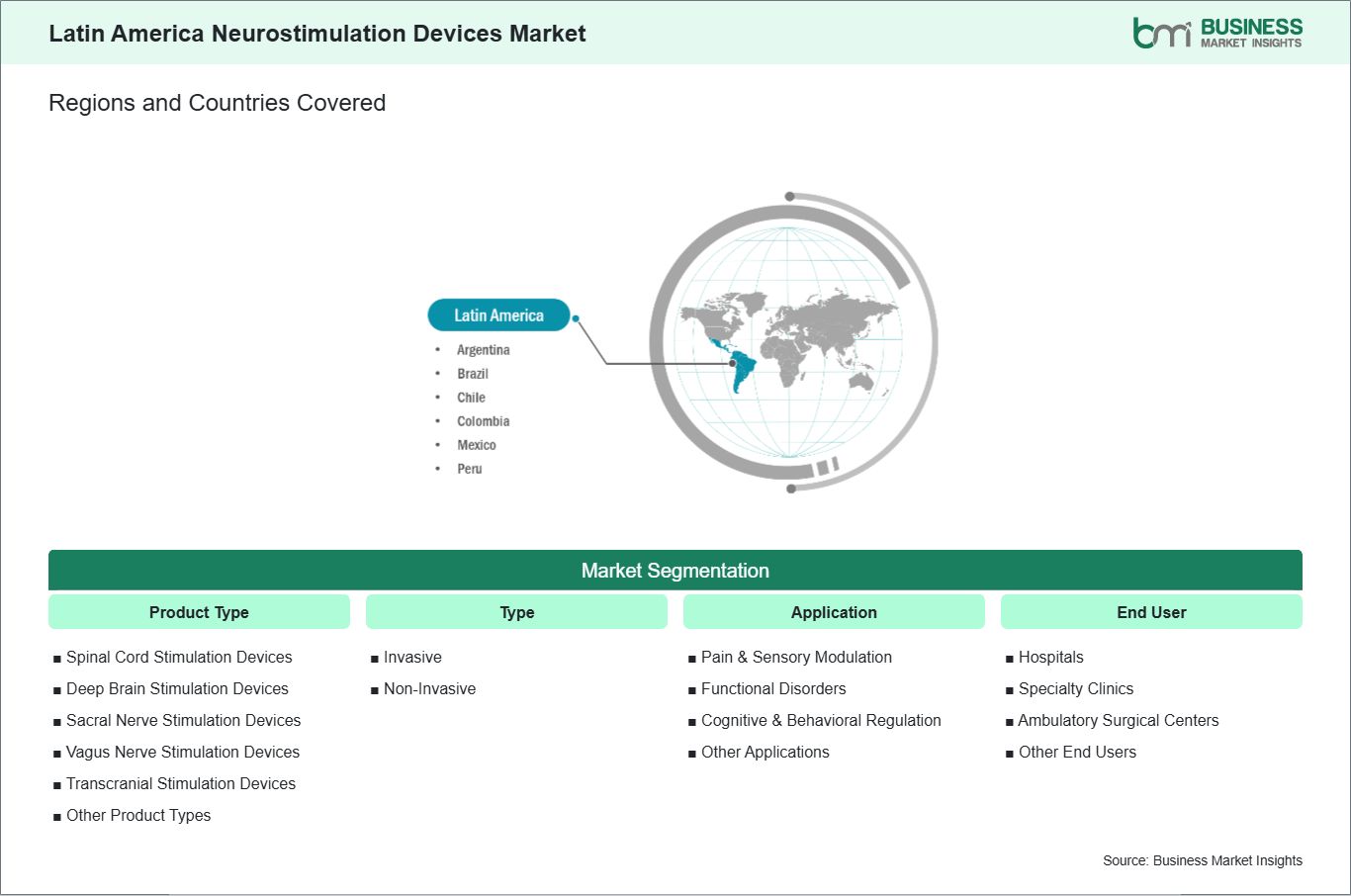
Key segments that contributed to the derivation of the Latin America neurostimulation devices market analysis are product type, type, application, and end user.
- By product type, the neurostimulation devices market is segmented into spinal cord stimulation devices, deep brain stimulation devices, sacral nerve stimulation devices, vagus nerve stimulation devices, transcranial stimulation devices, and other product types. The spinal cord stimulation devices segment dominated the market in 2025.
- Based on type, the neurostimulation devices market is categorized into invasive and non-invasive. The invasive segment dominated the market in 2025.
- On the basis of application, the neurostimulation devices market is categorized into pain and sensory modulation, functional disorders, cognitive and behavioral regulation, and other applications. The pain and sensory modulation segment dominated the market in 2025.
- In terms of end user, the neurostimulation devices market is categorized into hospitals, specialty clinics, ambulatory surgical centers, and other end users. The hospitals segment dominated the market in 2025.
Market Forces
Latin America Neurostimulation Devices Market Drivers and Opportunities
Rising Neurological Disease Prevalence Worldwide
The increasing prevalence of neurological disorders throughout Latin America results from three main factors, which include an aging population, better diagnostic methods, and people becoming more vulnerable to lifestyle-related health problems that include stress and metabolic disorders. The ongoing need for advanced neurostimulation therapies arises from epilepsy and Parkinson's disease, and chronic neuropathic pain, which creates a continuous demand for these treatments in urban healthcare facilities that serve patients with these conditions.
The Latin American healthcare system has made progress in developing its healthcare facilities, but these improvements have not yet eliminated the need for specialized neurological care in rural and remote areas. The combination of low neurologist availability and slow diagnosis processes results in patients requiring implantable and non-invasive neurostimulation devices, which have become essential for their long-term symptom control needs, according to private clinics.
Healthcare providers throughout Latin America now use neurostimulation methods as standard treatment options for patients who demonstrate resistance to drugs. Multidisciplinary treatment strategies, which unify the fields of neurology and psychiatry and rehabilitation medicine, have gained acceptance in hospitals, while patients in urban areas increasingly adopt device-based therapies, which result in better clinical outcomes and enhanced long-term care services across the entire region.
Brain-Computer Interface Integration Expansion
Brain computer interface technologies are emerging across Latin America as experimental yet promising tools in neurorehabilitation and assistive communication applications Leading hospitals and research universities are exploring their use in restoring motor function and improving patient interaction after neurological injury and disease while early adoption remains concentrated in urban medical centers and specialized clinics growing
Collaboration between healthcare providers engineering teams and academic institutions is accelerating the development of brain-computer interface solutions tailored to regional healthcare needs Artificial intelligence is increasingly being integrated to interpret neural signals more effectively improving system responsiveness and enhancing rehabilitation outcomes for patients with severe mobility impairments across Latin America and neurological conditions overall care
Despite progress challenges remain including high equipment costs limited specialized training and uneven healthcare infrastructure across countries in Latin America However growing investment in digital health and rehabilitation services is expected to expand access to brain-computer interfaces particularly as device portability improves and clinical acceptance increases in future care models supporting broader adoption regionwide progressively.
Size and Share Analysis
Latin America Neurostimulation Devices Market Size and Share Analysis
The Latin America neurostimulation devices market is experiencing steady growth, with market size and share analysis reflecting evolving treatment preferences and competitive dynamics among key players. The report evaluates important subsegments categorized within product type, type, application, and end user, highlighting their respective contributions to market performance.
By product type, the spinal cord stimulation devices subsegment dominated the market in 2025, driven by its widespread adoption for chronic pain management and strong clinical efficacy.
Based on type, the invasive subsegment dominated the market in 2025, driven by higher precision, long-term effectiveness, and increasing preference for implantable solutions in severe neurological conditions.
On the basis of application, the pain and sensory modulation subsegment dominated the market in 2025, driven by the rising prevalence of chronic pain disorders and growing demand for non-opioid treatment alternatives.
In terms of end user, the hospitals subsegment dominated the market in 2025, driven by advanced healthcare infrastructure, availability of skilled professionals, and higher volume of neurostimulation procedures.
Report Coverage
Latin America Neurostimulation Devices Market Report Coverage and Deliverables
The "Latin America Neurostimulation Devices Market Size and Forecast (2022-2033)" report provides a detailed analysis of the market covering below areas:
- Market size and forecast at regional and country levels for all market segments covered under the scope
- Market trends, as well as drivers, restraints, and opportunities
- Market analysis covering key trends, regional framework, major players, regulations, and recent developments
- Market concentration, heat map analysis, prominent players, and recent developments for the Market
- Detailed company profiles, including SWOT analysis
Geographic Insights
Latin America Neurostimulation Devices Market Geographic Insights
The geographical scope of the Latin America Neurostimulation Devices Market report is divided into Mexico, Brazil, Argentina, Peru, Chile, Colombia. Brazil held the largest share in 2025.
The Latin America neurostimulation devices market shows steady expansion, which results from three main factors. First, the burden of neurological disorders increases , second, the healthcare infrastructure develops , and third, advanced neuromodulation therapies receive wider implementation. Brazil has established itself as the main regional center because its healthcare system enables better patient treatment. Brazil leads demand for spinal cord stimulation, deep brain stimulation, and vagus nerve stimulation devices, supported by both public (SUS) and private healthcare investments and a high prevalence of chronic pain, epilepsy, and depression, making it the key revenue generator in the region. The second most important market after Brazil is Mexico, which benefits from healthcare modernization and rising cases of Parkinson's disease and epilepsy, together with improved access to minimally invasive neuromodulation procedures. Argentina shows moderate adoption of neurostimulation therapies, which is now increasing because more people understand these treatments and the country has an older population, while more specialist care facilities open. The healthcare system in Peru has limited reach, but it is improving through urban hospital growth, which creates a path for medical devices to be more widely used. Chile has higher device usage because its smaller population uses advanced healthcare systems, and hospitals started using neuromodulation devices. The demand for healthcare services in Colombia is rising because of three factors, which include healthcare reforms, expanded neurology services and better public awareness about drug-resistant epilepsy treatments. Brazil establishes itself as the primary growth driver for Latin America neurostimulation because of its vast resources, advanced medical facilities, and superior speed of medical device adoption compared to its competitors. Other nations in the region demonstrate a gradual increase in demand, which collectively adds to their market share.
Industry Activity
Recent Developments
The Latin America Neurostimulation Devices Market is evaluated by gathering qualitative and quantitative data post primary and secondary research, which includes important corporate publications, association data, and databases. A few of the key developments in the Latin America neurostimulation devices market are:
- In April 2025, Nexalin Technology, announced that its Gen-2 Deep Intracranial Frequency Stimulation (DIFS) neurostimulation device received IRB approval in Brazil and initiated a clinical trial at the Instituto de Psiquiatria do Hospital das Clinicas da Faculdade de Medicina da Universidade de Sao Paulo to evaluate treatment for anxiety disorders and chronic insomnia.
- In November 2025, Abbott announced that it had received ANVISA approval in Brazil for its Liberta RC Deep Brain Stimulation (DBS) system, a neurostimulation device designed to treat movement disorders such as Parkinson's disease, enabling its availability in the Brazilian market.
Trust & Transparency
Research Methodology
The market analysis combines proprietary research with secondary data from government agencies, company disclosures, regulatory filings, industry databases and expert interviews. Market estimates are validated through data triangulation, cross-market benchmarking and analyst
review.
View Full Research Methodology
Key Sources Referred:
U.S. Food and Drug Administration (FDA)European Medicines Agency (EMA)National Institutes of Health (NIH)World Health Organization (WHO)International Neuromodulation SocietyNorth American Neuromodulation SocietyAmerican Academy of NeurologyEuropean Academy of NeurologyCongress of Neurological SurgeonsCompany WebsitesCompany Annual ReportsCompany Investor Presentations