Market Summary
Executive Summary and Market Analysis
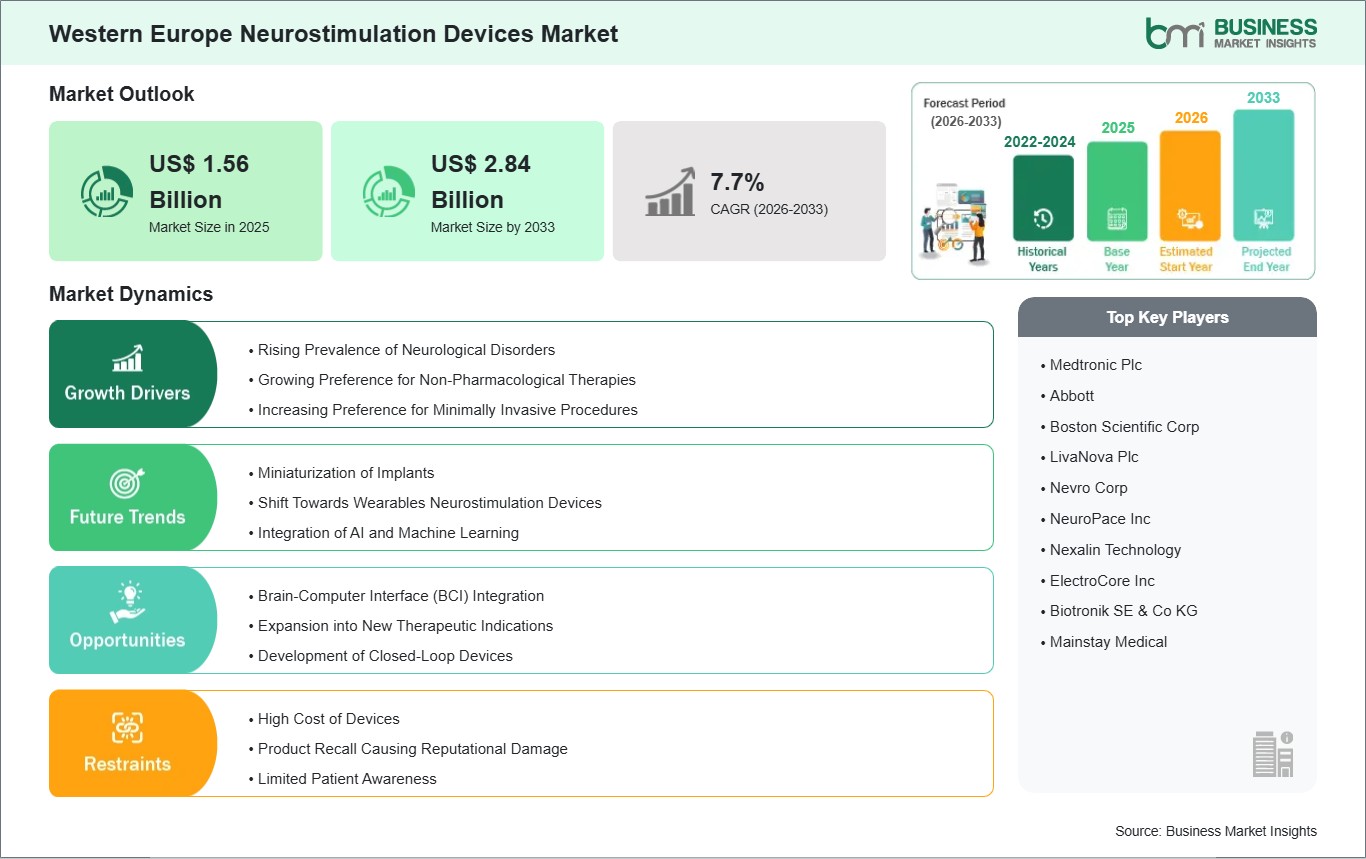
In Western Europe, a high prevalence of chronic neurological disorders such as Parkinson's disease, epilepsy, depression, and treatment-resistant chronic pain continues to sustain demand for implantable and noninvasive neurostimulation therapies. The healthcare ecosystem in Germany, France, and the UK provides support for the implementation of advanced treatments, which include spinal cord stimulation, deep brain stimulation, and transcranial magnetic stimulation. The need for minimally invasive and technology-based treatment solutions drives Western Europe to increase its economic development. Hospitals and neurology centers are adopting closed-loop and digitally connected neurostimulation systems that allow for personalized treatment and remote patient monitoring. Supportive regulatory environments and health technology assessment processes enable better and quicker adoption of new medical devices, which offer solutions to difficult therapeutic challenges in chronic pain management and movement disorders. High device and implantation costs continue to limit accessibility, particularly within smaller healthcare systems and budget-constrained public health programs. The European Union Medical Device Regulation establishes strict regulatory requirements that cause product approval delays, preventing the timely launch of advanced technological solutions. The region maintains its strategic importance for neurostimulation device manufacturers because of two factors, which combine to create high treatment penetration rates, a robust research ecosystem, and a constant need for advanced neurological care solutions.
Segment Analysis
Western Europe Neurostimulation Devices Market Segmentation
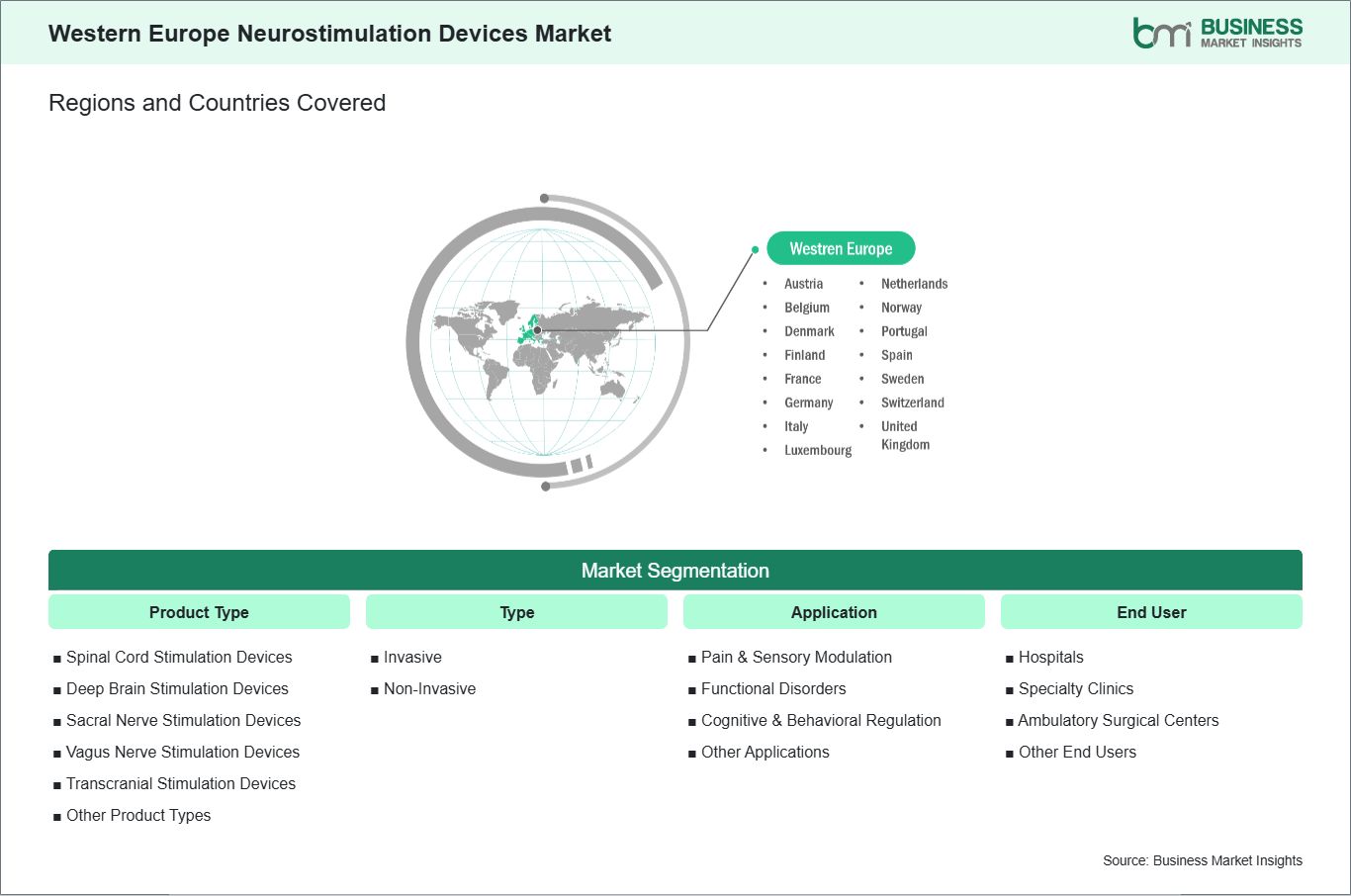
Key segments that contributed to the derivation of the Western Europe neurostimulation devices market analysis are product type, type, application, and end user.
- By product type, the neurostimulation devices market is segmented into spinal cord stimulation devices, deep brain stimulation devices, sacral nerve stimulation devices, vagus nerve stimulation devices, transcranial stimulation devices, and other product types. The spinal cord stimulation devices segment dominated the market in 2025.
- Based on type, the neurostimulation devices market is categorized into invasive and non-invasive. The invasive segment dominated the market in 2025.
- On the basis of application, the neurostimulation devices market is categorized into pain and sensory modulation, functional disorders, cognitive and behavioral regulation, and other applications. The pain and sensory modulation segment dominated the market in 2025.
- In terms of end user, the neurostimulation devices market is categorized into hospitals, specialty clinics, ambulatory surgical centers, and other end users. The hospitals segment dominated the market in 2025.
Market Forces
Western Europe Neurostimulation Devices Market Drivers and Opportunities
Rising Prevalence of Neurological Disorders
The increasing neurological disorder rates affect the elderly population in Germany, France, and the UK. There is a continuous need for novel neuromodulation solutions because more patients receive Parkinson's disease, epilepsy, and chronic neuropathic pain diagnoses.
Due to chronic pain management, Western European doctors search for medical solutions that do not require long-term medication use. Hospitals throughout the UK and France use implantable neurostimulation systems for patients suffering from failed back surgery syndrome and other chronic pain conditions, which helps establish wider acceptance of device-based medical treatments.
The growing elderly population in Western Europe increases the need for neurodegenerative disease treatment because more people reach ages that heighten their risk for these conditions. Strong healthcare infrastructure and early diagnostic systems allow healthcare professionals to start neurostimulation treatments earlier, which results in continuous market growth for public and private healthcare systems.
Brain-Computer Interface (BCI) Integration
Germany, Switzerland, and the Netherlands are developing hybrid platforms that use real-time brain signal analysis to provide targeted stimulation for more accurate neurological treatments and better patient results.
Healthcare systems in the UK and France investigate closed-loop neurostimulation systems, which use BCI inputs to treat epilepsy and depression and motor impairment that occurs after stroke. The adaptive systems enable clinicians to modify stimulation parameters based on neural feedback, which helps them deliver more precise treatments and develop customized neurological treatment methods for medical facilities that provide specialized care.
Digital health initiatives, which the European Union supports along with strong academic-medical partnerships, create an environment that drives fast progress in BCI-based neurostimulation system development. The development of wearable EEG technology, together with cloud-based neural analytics systems, enables ongoing patient monitoring and therapy adjustments, which establish Western Europe as a primary center for developing neurotechnology used in clinical settings and rehabilitation programs. The new developments will improve the adoption of clinical practices that operate throughout the main neurological treatment networks.
Size and Share Analysis
Western Europe Neurostimulation Devices Market Size and Share Analysis
The Western Europe neurostimulation devices market is experiencing steady growth, with market size and share analysis reflecting evolving treatment preferences and competitive dynamics among key players. The report evaluates important subsegments categorized within product type, type, application, and end user, highlighting their respective contributions to market performance.
By product type, the spinal cord stimulation devices subsegment dominated the market in 2025, driven by its widespread adoption for chronic pain management and strong clinical efficacy.
Based on type, the invasive subsegment dominated the market in 2025, driven by higher precision, long-term effectiveness, and increasing preference for implantable solutions in severe neurological conditions.
On the basis of application, the pain and sensory modulation subsegment dominated the market in 2025, driven by the rising prevalence of chronic pain disorders and growing demand for non-opioid treatment alternatives.
In terms of end user, the hospitals subsegment dominated the market in 2025, driven by advanced healthcare infrastructure, availability of skilled professionals, and higher volume of neurostimulation procedures.
Report Coverage
Western Europe Neurostimulation Devices Market Report Coverage and Deliverables
The "Western Europe Neurostimulation Devices Market Size and Forecast (2022-2033)" report provides a detailed analysis of the market covering below areas:
- Market size and forecast at regional and country levels for all market segments covered under the scope
- Market trends, as well as drivers, restraints, and opportunities
- Market analysis covering key trends, regional framework, major players, regulations, and recent developments
- Market concentration, heat map analysis, prominent players, and recent developments for the Market
- Detailed company profiles, including SWOT analysis
Geographic Insights
Western Europe Neurostimulation Devices Market Geographic Insights
The geographical scope of the Western Europe Neurostimulation Devices Market report is divided into Belgium, the Netherlands, Luxembourg, Germany, France, Italy, Spain, Switzerland, Sweden, Austria, the UK, Denmark, Portugal, Norway, and Finland. Germany held the largest share in 2025.
Germany has comprehensive neurosurgery facilities and handles numerous medical procedures, operates multiple hospitals while using deep brain stimulation and spinal cord stimulation, and develops closed-loop systems as its main treatment techniques. France operates through institutional adoption backed by centralized healthcare that enables hospitals to maintain constant usage of their primary hospital networks. The UK shows steady uptake under NHS pathways, although procurement cycles and budget approvals can moderate the growth pace. The demand in Italy and Spain is increasing because more people reach retirement age and more people develop chronic pain and movement disorders, although different areas have different treatment options. The Netherlands, Belgium, and Luxembourg constitute advanced markets, which enable people to use neuromodulation technologies. Switzerland maintains its status as a high-end market that emphasizes new product development through its early access to cutting-edge medical treatments. Sweden, Denmark, Finland, and Norway use digital health solutions and noninvasive stimulation methods. Austria and Portugal are expanding because better access to neurological treatment is becoming available.
Industry Activity
Recent Developments
The Western Europe Neurostimulation Devices Market is evaluated by gathering qualitative and quantitative data post primary and secondary research, which includes important corporate publications, association data, and databases. A few of the key developments in the Western Europe neurostimulation devices market are:
- In December 2024, Nyxoah announced the commercial launch of its Genio neurostimulation therapy in England, with the first patients implanted at University College London Hospitals, marking the system's official rollout in the UK under NHS-supported access pathways.
- In November 2024, Nevro Corp. announced that its HFX iQ spinal cord stimulation system received CE Mark certification in Europe, allowing the company to commercially market the AI-enabled neurostimulation device across European markets.
Trust & Transparency
Research Methodology
The market analysis combines proprietary research with secondary data from government agencies, company disclosures, regulatory filings, industry databases and expert interviews. Market estimates are validated through data triangulation, cross-market benchmarking and analyst
review.
View Full Research Methodology
Key Sources Referred:
U.S. Food and Drug Administration (FDA)European Medicines Agency (EMA)National Institutes of Health (NIH)World Health Organization (WHO)International Neuromodulation SocietyNorth American Neuromodulation SocietyAmerican Academy of NeurologyEuropean Academy of NeurologyCongress of Neurological SurgeonsCompany WebsitesCompany Annual ReportsCompany Investor Presentations