Market Summary
Executive Summary and Market Analysis
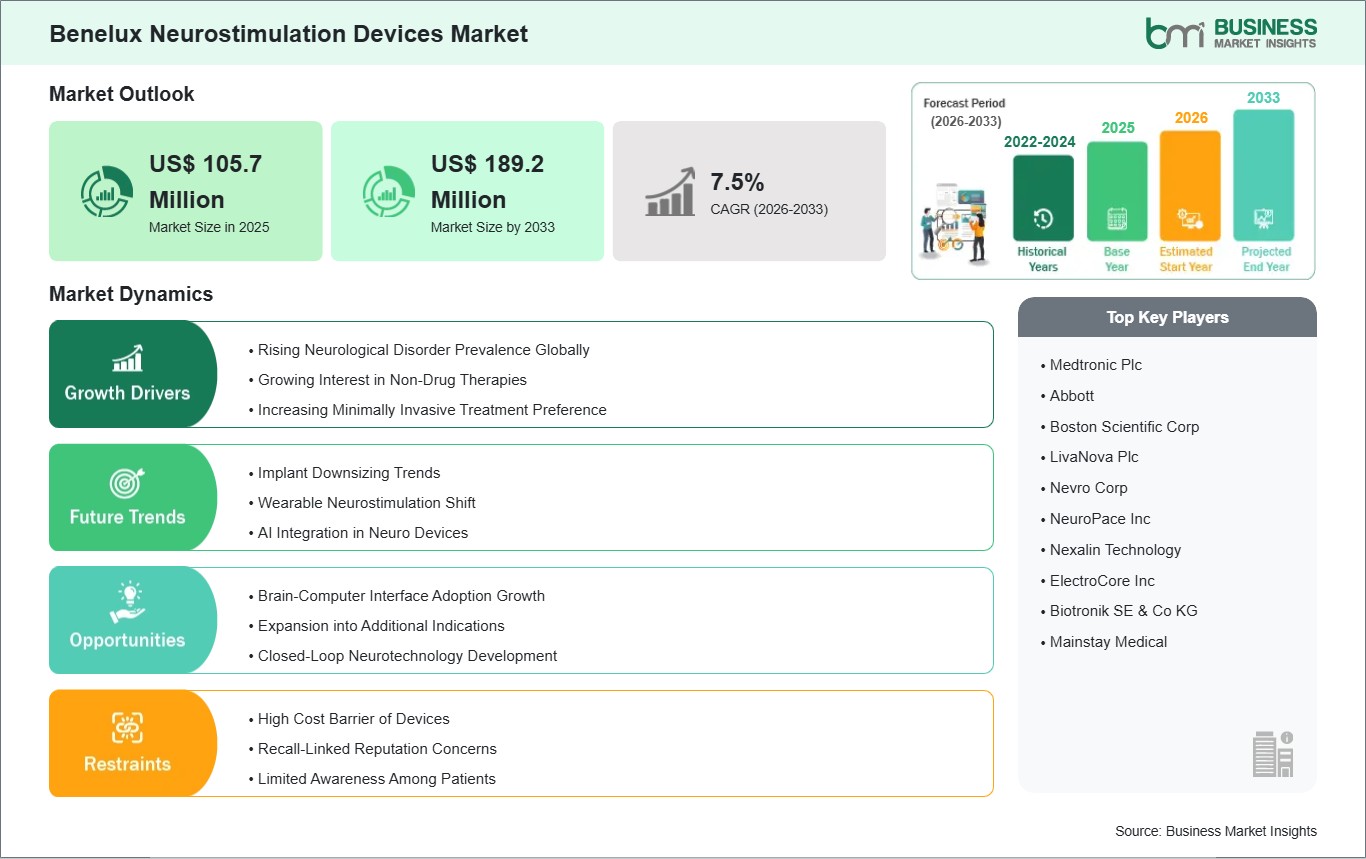
Belgium, the Netherlands, and Luxembourg together make up the Benelux region, which functions as an advanced area for research and development within the European market for neurostimulation devices. The market shows strong implementation of high-level neuromodulation techniques, which medical professionals use to treat neurological disorders, relieve pain and handle psychiatric conditions because of the well-developed healthcare systems that have implemented new technology. The area shows increasing demand for neurostimulation devices because medical professionals now use these devices to treat chronic neurological diseases, which include Parkinson's disease, epilepsy and treatment-resistant depression. The Benelux market experiences significant growth because advanced neurosurgical facilities exist throughout the region, especially in the Netherlands and Belgium, which enables medical teams to implement both surgical and nonsurgical neurostimulation procedures. The combination of favorable reimbursement systems in specific healthcare environments, together with the increasing focus on decreasing long-lasting reliance on medications, has resulted in higher device market acceptance. The area benefits from strong partnerships between academic research institutions and medical technology companies, which speed up both clinical validation processes and new treatment development. The market faces obstacles because medical procedures require extensive specialized knowledge, which restricts access to those who work at major urban healthcare facilities. The process of obtaining regulatory approval according to European Union medical device regulations requires more procedures, resulting in extended product development timeframes. Despite these challenges, the Benelux region continues to position itself as a high-value, early-adoption market where innovation in neurostimulation technologies is steadily translating into expanded clinical use and improved patient outcomes across neurological care pathways.
Segment Analysis
Benelux Neurostimulation Devices Market Segmentation
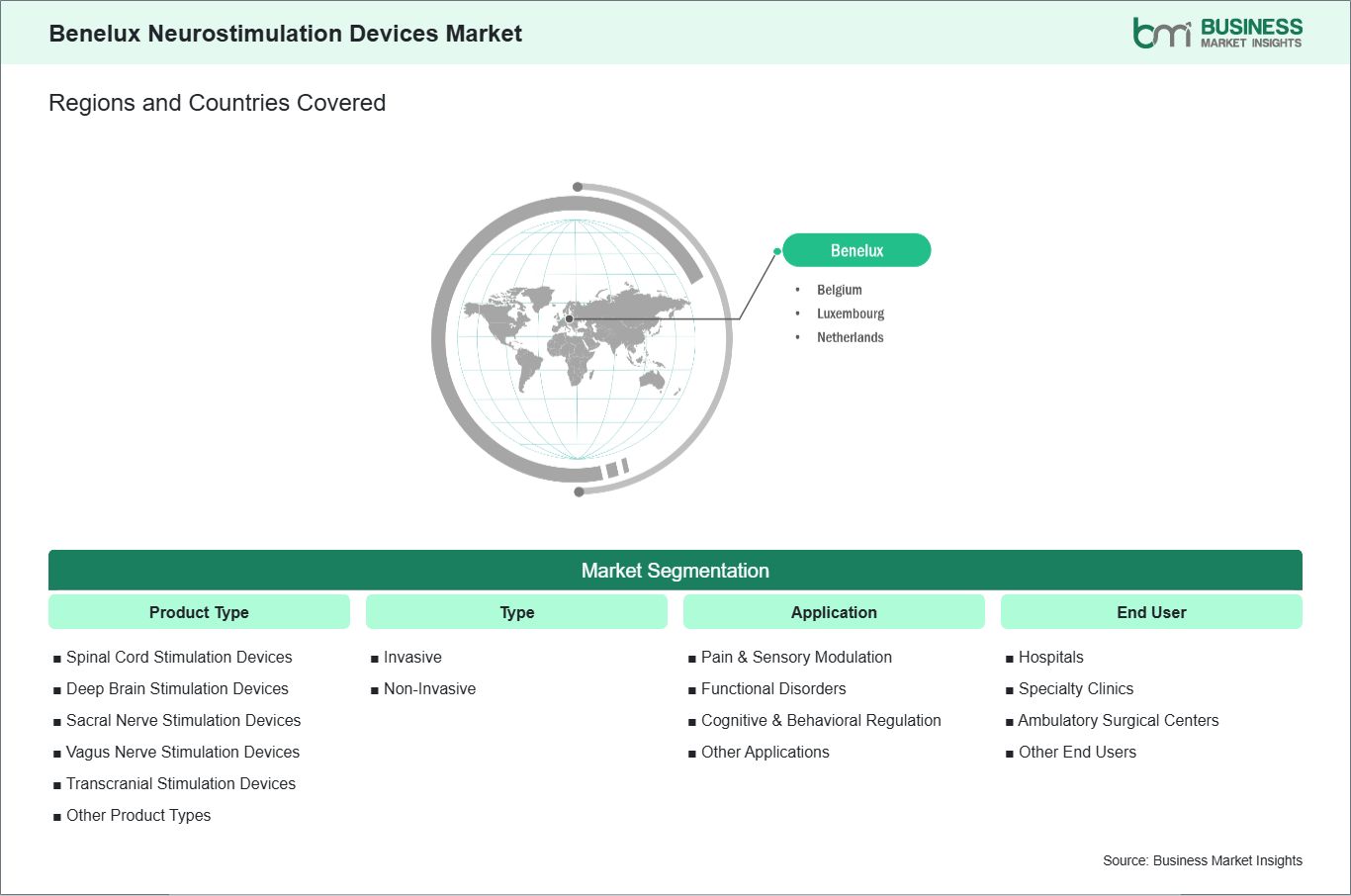
Key segments that contributed to the derivation of the Benelux neurostimulation devices market analysis are product type, type, application, and end user.
- By product type, the neurostimulation devices market is segmented into spinal cord stimulation devices, deep brain stimulation devices, sacral nerve stimulation devices, vagus nerve stimulation devices, transcranial stimulation devices, and other product types. The spinal cord stimulation devices segment dominated the market in 2025.
- Based on type, the neurostimulation devices market is categorized into invasive and non-invasive. The invasive segment dominated the market in 2025.
- On the basis of application, the neurostimulation devices market is categorized into pain and sensory modulation, functional disorders, cognitive and behavioral regulation, and other applications. The pain and sensory modulation segment dominated the market in 2025.
- In terms of end user, the neurostimulation devices market is categorized into hospitals, specialty clinics, ambulatory surgical centers, and other end users. The hospitals segment dominated the market in 2025.
Market Forces
Benelux Neurostimulation Devices Market Drivers and Opportunities
Rising Neurological Disorder Prevalence Globally
The Benelux neurostimulation devices market is experiencing steady growth driven by the increasing prevalence of neurological disorders worldwide. Clinical improvements in diagnostic methods have led to more frequent diagnoses of conditions, which include Parkinson's disease, epilepsy, chronic pain syndromes and treatment-resistant depression. This trend is directly influencing demand for advanced neurostimulation therapies across Belgium, the Netherlands, and Luxembourg.
The Benelux region demonstrates demographic aging as its primary factor, which leads to increased neurological disease rates in urban areas that maintain advanced healthcare systems and extended life spans. The elderly population growth results in increased cases of neurodegenerative disorders, which include Alzheimer's disease and Parkinson's disease. This creates sustained demand for implantable and non-invasive neurostimulation solutions in hospital networks and specialized neurology clinics.
Advanced healthcare infrastructure and supportive reimbursement frameworks in Benelux countries further enable the adoption of neurostimulation technologies. Major hospitals implement integrated care pathways, which provide early treatment for chronic neurological conditions. Cross-border collaboration within the EU also facilitates faster diffusion of innovative neurostimulation procedures across the region.
Brain-Computer Interface Adoption Growth
The Benelux neurostimulation market shows increasing adoption of brain-computer interfaces because research institutions and medical technology developers work on neural signal processing and assistive communication systems. The region develops BCI-enabled therapeutic applications from its strong academic foundation in neuroscience and engineering.
The rehabilitation centers in Belgium and the Netherlands have started using non-invasive brain-computer interface systems to help stroke patients recover their motor functions. The combination of EEG-based platforms with adaptive software algorithms enables clinicians to monitor neural activity while creating customized therapy programs that enhance rehabilitation results.
Commercial interest in BCI technologies is expanding in the region, with startups collaborating with hospitals to develop assistive devices for patients with severe motor impairments. Applications include communication aids for individuals with paralysis and cognitive training tools. However, regulatory scrutiny and high development costs continue to slow widespread commercialization across Benelux markets over the medium term regionally.
Size and Share Analysis
Benelux Neurostimulation Devices Market Size and Share Analysis
The Benelux neurostimulation devices market is experiencing steady growth, with market size and share analysis reflecting evolving treatment preferences and competitive dynamics among key players. The report evaluates important subsegments categorized within product type, type, application, and end user, highlighting their respective contributions to market performance.
By product type, the spinal cord stimulation devices subsegment dominated the market in 2025, driven by its widespread adoption for chronic pain management and strong clinical efficacy.
Based on type, the invasive subsegment dominated the market in 2025, driven by higher precision, long-term effectiveness, and increasing preference for implantable solutions in severe neurological conditions.
On the basis of application, the pain and sensory modulation subsegment dominated the market in 2025, driven by the rising prevalence of chronic pain disorders and growing demand for non-opioid treatment alternatives.
In terms of end user, the hospitals subsegment dominated the market in 2025, driven by advanced healthcare infrastructure, availability of skilled professionals, and higher volume of neurostimulation procedures.
Report Coverage
Benelux Neurostimulation Devices Market Report Coverage and Deliverables
The "Benelux Neurostimulation Devices Market Size and Forecast (2022-2033)" report provides a detailed analysis of the market covering below areas:
- Market size and forecast at regional and country levels for all market segments covered under the scope
- Market trends, as well as drivers, restraints, and opportunities
- Market analysis covering key trends, regional framework, major players, regulations, and recent developments
- Market concentration, heat map analysis, prominent players, and recent developments for the Market
- Detailed company profiles, including SWOT analysis
Geographic Insights
Benelux Neurostimulation Devices Market Geographic Insights
The geographical scope of the Benelux Neurostimulation Devices Market report is divided into Belgium, Netherlands, Luxembourg. Netherlands held the largest share in 2025.
The Benelux neurostimulation devices market demonstrates a relatively advanced and innovation-oriented healthcare environment, with demand shaped by rising neurological disorders, chronic pain prevalence, and increasing acceptance of device-based neuromodulation therapies across clinical settings. The Netherlands operates as the principal market within the region because its healthcare infrastructure supports medical services through digital health technologies and advanced neuromodulation techniques, which hospitals, both public and private, have started to use. The country maintains a comprehensive network of specialized centers for both neurology and neurosurgery, which enables medical professionals to adopt spinal cord stimulation, deep brain stimulation, and peripheral nerve stimulation technologies at an accelerated pace because they already understand these techniques. Belgium represents a mature but comparatively slower-growing market, where adoption is steady due to established neurological care pathways and strong hospital infrastructure, though procurement and adoption cycles tend to be more centralized and cost-sensitive. The domestic market in Luxembourg operates as a niche sector that generates high profits because its patients receive neurostimulation treatment through healthcare systems in Belgium and Germany, while their home country lacks sufficient treatment facilities. The aging population, growing movement disorder and neuropathic pain cases, and increasing availability of outpatient neuromodulation treatments combine to drive overall growth in Benelux. The market expansion faces limitations because of expensive devices, European Union regulatory compliance needs, and the requirement for specialized medical knowledge, which establishes the Netherlands as the top regional innovation hub.
Industry Activity
Recent Developments
The Benelux Neurostimulation Devices Market is evaluated by gathering qualitative and quantitative data post primary and secondary research, which includes important corporate publications, association data, and databases. A few of the key developments in the Benelux neurostimulation devices market are:
- In December 2025, Nyxoah, announced that it completed the first commercial Genio implants in the Netherlands, marking the official market expansion of its hypoglossal nerve stimulation therapy in the Benelux region.
- In December 2024, ONWARD Medical (Netherlands), announced FDA authorization for its ARC-EX system, a non-invasive spinal cord stimulation device, and confirmed initial commercial sales in the United States with planned European expansion.
Trust & Transparency
Research Methodology
The market analysis combines proprietary research with secondary data from government agencies, company disclosures, regulatory filings, industry databases and expert interviews. Market estimates are validated through data triangulation, cross-market benchmarking and analyst
review.
View Full Research Methodology
Key Sources Referred:
U.S. Food and Drug Administration (FDA)European Medicines Agency (EMA)National Institutes of Health (NIH)World Health Organization (WHO)International Neuromodulation SocietyNorth American Neuromodulation SocietyAmerican Academy of NeurologyEuropean Academy of NeurologyCongress of Neurological SurgeonsCompany WebsitesCompany Annual ReportsCompany Investor Presentations