Market Summary
Executive Summary and Market Analysis
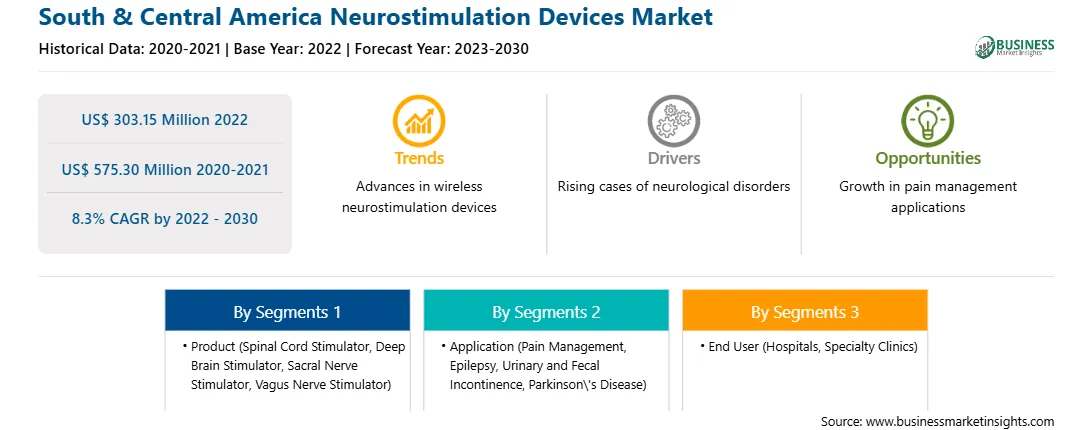
The South and Central America neurostimulation devices market has developed into an expanding section of the regional neurology and advanced medical devices market because doctors treat increasing cases of chronic neurological disorders and pain-related conditions. The clinical use of spinal cord stimulators, deep brain stimulators and other implantable neuromodulation systems is increasing across Brazil, Argentina and the Andean region as healthcare providers start to use advanced technology for treating chronic pain, Parkinson's disease, epilepsy and urinary dysfunction. The healthcare sector in this area experiences growth through its ongoing development of medical facilities, which particularly enhance access to specialized neurosurgery and advanced surgical equipment in urban private hospital networks. Clinicians now understand non-pharmacological and minimally invasive treatment methods, which help to boost demand for neurostimulation therapies. The growing elderly population creates a requirement for extended neurological treatment options, which drives market growth throughout the years. The market growth is restricted because of existing structural issues in the healthcare system. The primary obstacle exists because there are not enough properly trained neurosurgeons and pain management specialists who possess the skills to perform complex neurostimulation procedures. Unequal access to advanced medical technologies between urban and rural healthcare systems continues to limit widespread adoption of those technologies. The high costs associated with devices and procedures create barriers to market entry, which particularly affects public healthcare systems in multiple countries throughout the region. The South and Central America neurostimulation devices market currently exists in a transitional growth stage, which results from enhanced clinical abilities and increased public understanding of diseases, but which still faces problems with infrastructure development and product affordability.
Segment Analysis
South and Central America Neurostimulation Devices Market Segmentation
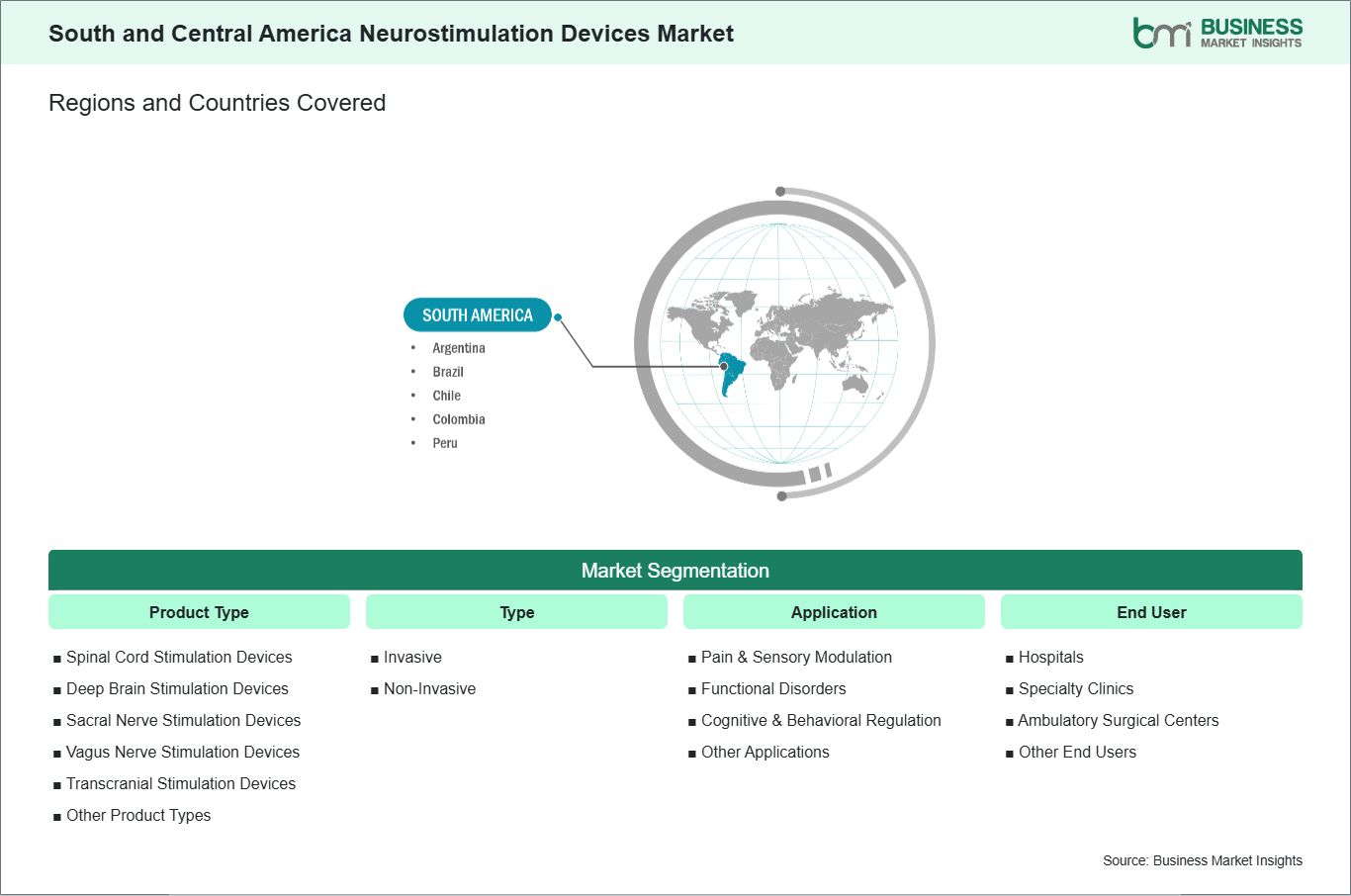
Key segments that contributed to the derivation of the South and Central America neurostimulation devices market analysis are product type, type, application, and end user.
- By product type, the neurostimulation devices market is segmented into spinal cord stimulation devices, deep brain stimulation devices, sacral nerve stimulation devices, vagus nerve stimulation devices, transcranial stimulation devices, and other product types. The spinal cord stimulation devices segment dominated the market in 2025.
- Based on type, the neurostimulation devices market is categorized into invasive and non-invasive. The invasive segment dominated the market in 2025.
- On the basis of application, the neurostimulation devices market is categorized into pain and sensory modulation, functional disorders, cognitive and behavioral regulation, and other applications. The pain and sensory modulation segment dominated the market in 2025.
- In terms of end user, the neurostimulation devices market is categorized into hospitals, specialty clinics, ambulatory surgical centers, and other end users. The hospitals segment dominated the market in 2025.
Market Forces
South and Central America Neurostimulation Devices Market Drivers and Opportunities
Increasing Incidence of Neurological Disorders
The South and Central America neurostimulation devices market experiences continuous expansion because neurological disorders show increasing occurrence rates in the region. Brazil, Argentina, and Colombia show growing rates of Parkinson's disease, epilepsy, and neuropathic pain throughout their territories. The current trend develops through three factors: older populations, better diagnostic capabilities, and increased public understanding of neurological disorders in cities.
Urban hospitals in Chile and Peru report increasing rates of stroke-induced disabilities, together with chronic pain disorders. The combination of sedentary behavior, diabetes and insufficient early medical support in rural regions leads to the development of nerve-related health issues. The need for advanced medical solutions increases, which includes spinal cord stimulation and deep brain stimulation technologies.
The collaboration between governments and private healthcare organizations leads to the establishment of dedicated neurology services, which enhance neurostimulation therapy access in major cities, including São Paulo and Buenos Aires. The region continues to experience unmet clinical needs because urban areas have better access to specialized neurological treatment compared to rural regions.
BCI Technology Integration in Neuro Devices
Brain-computer interface integration is gradually emerging in South and Central America as part of next-generation neurostimulation development. Research institutions in Brazil and Argentina are experimenting with non-invasive BCI systems to support stroke rehabilitation and motor recovery. These early-stage initiatives aim to improve communication between neural activity and external therapeutic devices.
Clinical pilots are exploring hybrid systems that combine neurostimulation implants with real-time brain signal feedback. In Colombia and Chile, hospitals are testing adaptive stimulation approaches for epilepsy and spinal cord injuries, where device output adjusts based on neural responses, improving treatment precision and patient outcomes in controlled clinical environments in urban medical centers.
Despite limited infrastructure, regional collaboration with global technology firms is accelerating knowledge transfer and prototype development. Wearable BCI devices and non-invasive stimulation tools are being introduced in specialized clinics in Brazil, signaling gradual but meaningful progress toward integrating digital neurotherapies into mainstream neurological care across the region.
Size and Share Analysis
South and Central America Neurostimulation Devices Market Size and Share Analysis
The South and Central America neurostimulation devices market is experiencing steady growth, with market size and share analysis reflecting evolving treatment preferences and competitive dynamics among key players. The report evaluates important subsegments categorized within product type, type, application, and end user, highlighting their respective contributions to market performance.
By product type, the spinal cord stimulation devices subsegment dominated the market in 2025, driven by its widespread adoption for chronic pain management and strong clinical efficacy.
Based on type, the invasive subsegment dominated the market in 2025, driven by higher precision, long-term effectiveness, and increasing preference for implantable solutions in severe neurological conditions.
On the basis of application, the pain and sensory modulation subsegment dominated the market in 2025, driven by the rising prevalence of chronic pain disorders and growing demand for non-opioid treatment alternatives.
In terms of end user, the hospitals subsegment dominated the market in 2025, driven by advanced healthcare infrastructure, availability of skilled professionals, and higher volume of neurostimulation procedures.
Report Coverage
South and Central America Neurostimulation Devices Market Report Coverage and Deliverables
The "South and Central America Neurostimulation Devices Market Size and Forecast (2022-2033)" report provides a detailed analysis of the market covering below areas:
- Market size and forecast at regional and country levels for all market segments covered under the scope
- Market trends, as well as drivers, restraints, and opportunities
- Market analysis covering key trends, regional framework, major players, regulations, and recent developments
- Market concentration, heat map analysis, prominent players, and recent developments for the Market
- Detailed company profiles, including SWOT analysis
Geographic Insights
South and Central America Neurostimulation Devices Market Geographic Insights
The geographical scope of the South and Central America Neurostimulation Devices Market report is divided into Brazil, Argentina, Chile, Colombia, Peru. Brazil held the largest share in 2025.
The South and Central America neurostimulation devices market is evolving at a moderate pace, shaped by growing awareness of neurological disorders, gradual expansion of specialized neurology care, and increasing willingness among patients and providers to adopt advanced therapeutic options. Brazil stands as the dominant market in the region due to its comparatively larger healthcare infrastructure, higher concentration of neurology specialists, and stronger access to tertiary care hospitals capable of performing complex neurostimulation procedures such as deep-brain and spinal cord stimulation. The private sector in Brazil enables faster adoption of expensive implantable devices through its increased engagement in the healthcare industry. Argentina represents the second most developed market, supported by a well-established medical community, though adoption is tempered by budget constraints within the public healthcare system. The healthcare system in Chile achieves consistent growth because it utilizes effective delivery methods and spends more money on healthcare per person, which allows cities to quickly adopt new neuromodulation treatments. The healthcare system in Colombia is developing at a slow pace because there are better medical facilities available now, which allows more people to get diagnosed with chronic pain and neurological disorders, while the medical system fails to deliver equal treatment to both urban and rural areas. The demand for neurological services in Peru exists mainly in urban areas that possess specialized services, but the country faces obstacles in infrastructure development and service costs that limit its growth.
Industry Activity
Recent Developments
The South and Central America Neurostimulation Devices Market is evaluated by gathering qualitative and quantitative data post primary and secondary research, which includes important corporate publications, association data, and databases. A few of the key developments in the South and Central America neurostimulation devices market are:
- In June 2024, Nexalin announced that its Gen-2 neurostimulation device received regulatory approval from ANVISA (Brazil), enabling commercial sales in Brazil's large mental health treatment market. This is one of the most direct South America-specific neurostimulation regulatory milestones, expanding access to non-invasive brain stimulation technologies.
- In September 2023, Boston Scientific announced an agreement to acquire Relievant Medsystems, strengthening its chronic pain and neuromodulation portfolio, particularly in minimally invasive pain therapies. This expansion supports the company's broader neurotechnology presence.
Trust & Transparency
Research Methodology
The market analysis combines proprietary research with secondary data from government agencies, company disclosures, regulatory filings, industry databases and expert interviews. Market estimates are validated through data triangulation, cross-market benchmarking and analyst
review.
View Full Research Methodology
Key Sources Referred:
U.S. Food and Drug Administration (FDA)European Medicines Agency (EMA)National Institutes of Health (NIH)World Health Organization (WHO)International Neuromodulation SocietyNorth American Neuromodulation SocietyAmerican Academy of NeurologyEuropean Academy of NeurologyCongress of Neurological SurgeonsCompany WebsitesCompany Annual ReportsCompany Investor Presentations