Market Summary
Executive Summary and Market Analysis
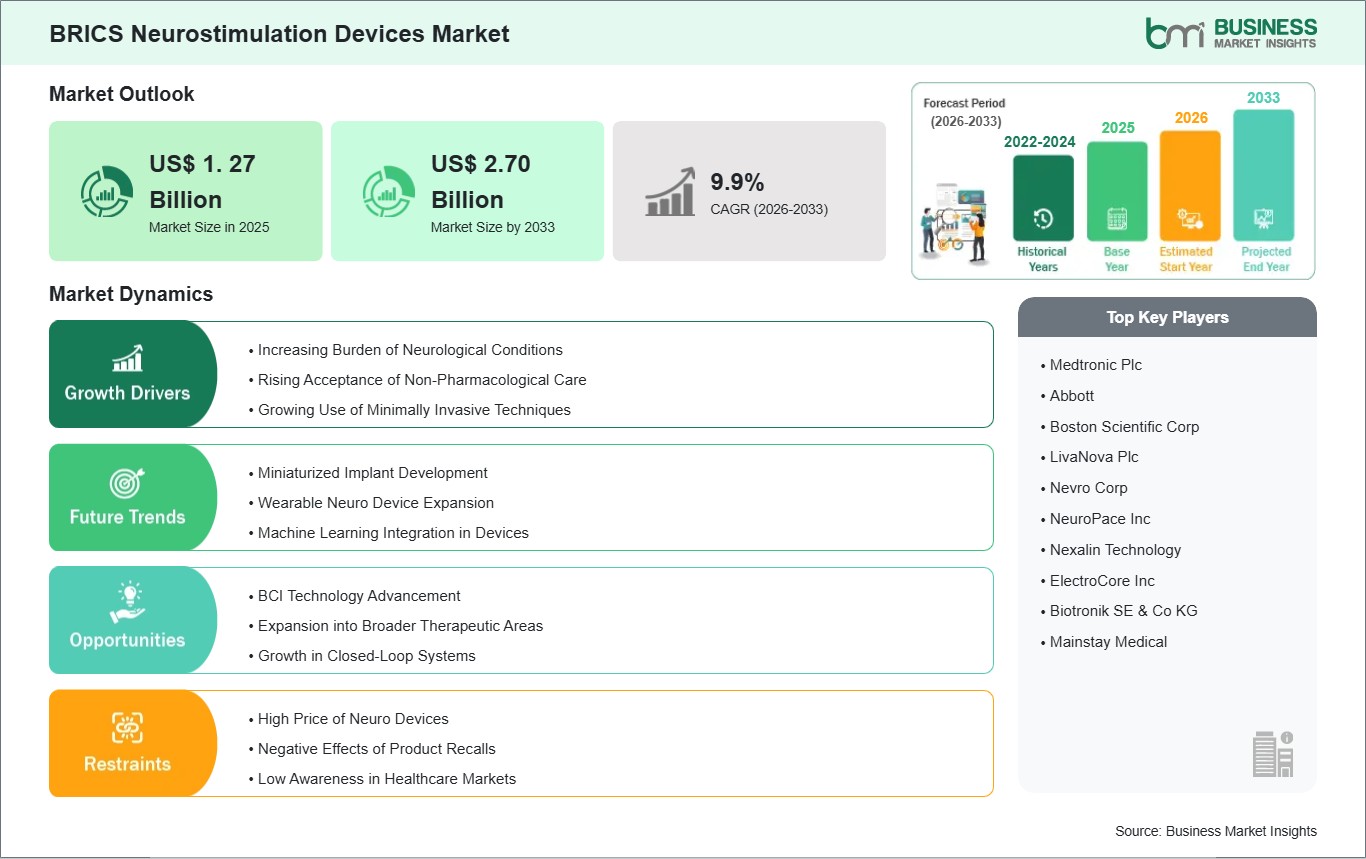
The BRICS neurostimulation devices market experiences constant growth because emerging economies face increasing neurological and chronic pain conditions, while neurosurgical infrastructure and advanced medical technology access proceed to improve. Countries such as China, India and Brazil show rising acceptance of both implantable and non-implantable neurostimulation therapies because clinicians and patients increasingly understand the benefits of these minimally invasive treatment options. The region's extensive aging population, together with rising rates of epilepsy, Parkinson's disease, depression and neuropathic pain conditions, drives market expansion through increased demand. The BRICS region experiences significant market growth because healthcare systems continue to modernize throughout urban areas, where hospitals obtain cutting-edge neuromodulation technologies. Medical insurance coverage expansion, together with the gradual addition of advanced neurological treatments to reimbursement options, enables hospitals to provide better care to patients. Local governments back their investments in neurological care facilities, which lead to higher adoption rates of spinal cord stimulators, deep brain stimulators and vagus nerve stimulation systems throughout tertiary care hospitals. The market encounters major constraints because of expensive devices and procedures, low public understanding in semi-urban and rural regions and the shortage of specialized neurosurgical resources. The regulatory demands in certain BRICS nations create slower device approval processes, which result in delayed access to advanced medical technologies. Despite these challenges, the long-term outlook remains positive, supported by rising healthcare investments and increasing preference for non-pharmacological, device-based therapies across the region.
Segment Analysis
BRICS Neurostimulation Devices Market Segmentation
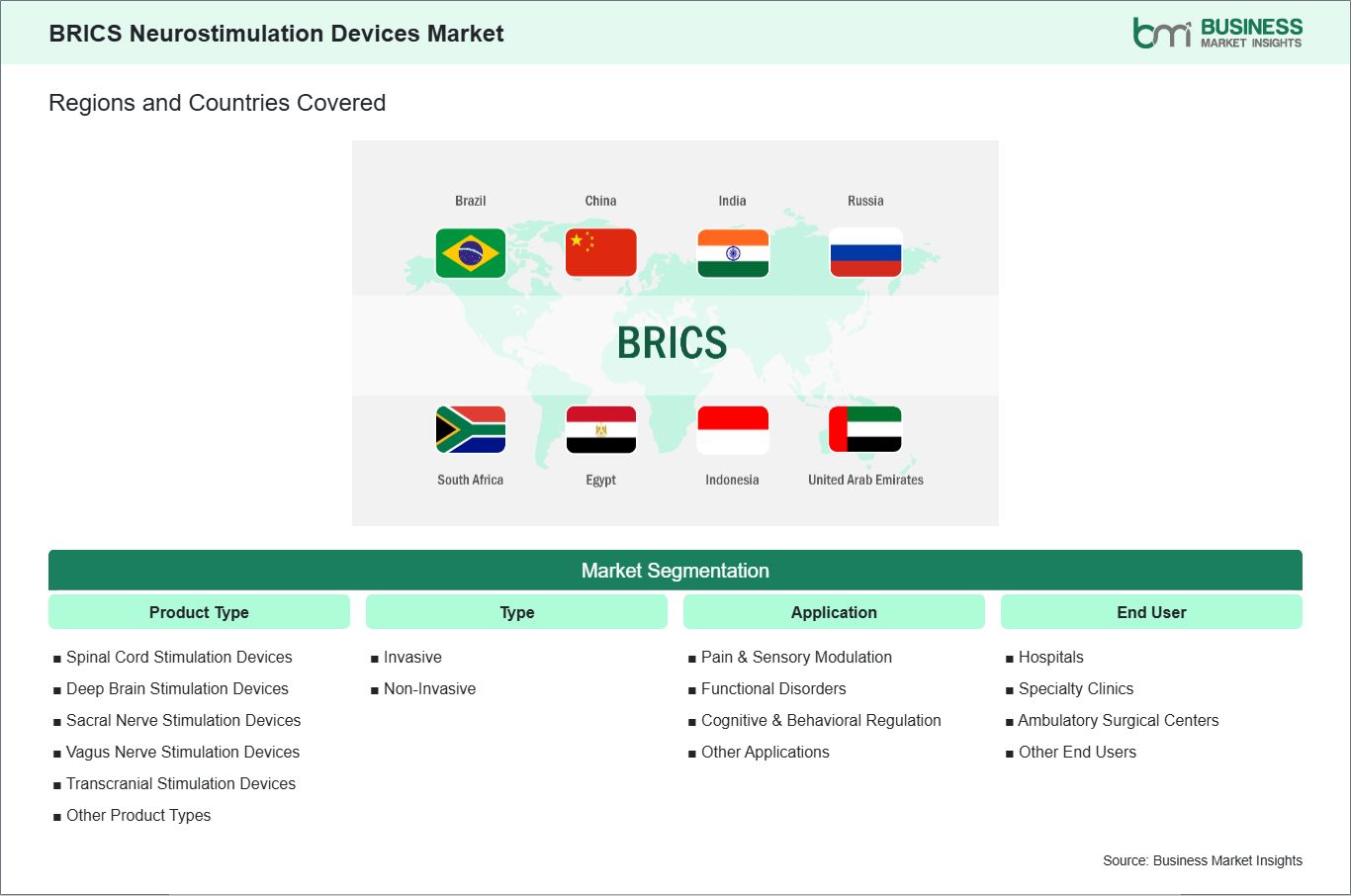
Key segments that contributed to the derivation of the BRICS neurostimulation devices market analysis are product type, type, application, and end user.
- By product type, the neurostimulation devices market is segmented into spinal cord stimulation devices, deep brain stimulation devices, sacral nerve stimulation devices, vagus nerve stimulation devices, transcranial stimulation devices, and other product types. The spinal cord stimulation devices segment dominated the market in 2025.
- Based on type, the neurostimulation devices market is categorized into invasive and non-invasive. The invasive segment dominated the market in 2025.
- On the basis of application, the neurostimulation devices market is categorized into pain and sensory modulation, functional disorders, cognitive and behavioral regulation, and other applications. The pain and sensory modulation segment dominated the market in 2025.
- In terms of end user, the neurostimulation devices market is categorized into hospitals, specialty clinics, ambulatory surgical centers, and other end users. The hospitals segment dominated the market in 2025.
Market Forces
BRICS Neurostimulation Devices Market Drivers and Opportunities
Increasing Burden of Neurological Conditions
The BRICS region is experiencing a growing burden of neurological disorders driven by three main factors, which include urbanization, aging populations and changing lifestyles. The urban centers that have high population density, limited healthcare access and inadequate preventive care resources are seeing an increase in epilepsy and Parkinsonian syndromes and chronic neuropathic pain cases. The trend shows its strongest effects in China and India.
Brazil, Russia and South Africa are facing an increase in neurological disease occurrence, which medical research shows is associated with diabetes, hypertension and workplace anxiety. The medical conditions are driving up the need for neurostimulation treatments, which are used to manage pain and treat movement disorders at tertiary hospitals and specialized neurological treatment facilities.
Higher public understanding of neurological disorders, combined with better diagnostic tools, now enables BRICS nations to identify neurological conditions at their initial stages. The government sector is developing neurology facilities, while private hospitals are creating new advanced medical treatment services. This combination is increasing patient eligibility for neurostimulation devices, which supports broader adoption across both public and private healthcare systems. The improvements to rural access are helping to eliminate treatment gaps at a gradual pace.
BCI Technology Advancement
Neurotechnology research and digital healthcare innovation in BRICS countries enable fast progress of brain-computer interface development through growing investment in these fields. Rehabilitation centers and university hospitals are testing these systems to help patients with severe neurological impairments regain motor control and enhance their ability to communicate. China is leading early-stage clinical integration efforts in this area.
India is advancing low-cost BCI development through collaborations between academic institutions and healthcare startups, focusing on non-invasive solutions for paralysis and speech recovery. The initiatives build up access to neurostimulation technologies that healthcare facilities with budget restrictions need, especially between urban medical centers and new private neurocare facilities. The domestic RandD funding boosts research progress in this area.
Russia and Brazil are investing in neuroengineering programs aimed at developing closed-loop brain interfaces for rehabilitation and cognitive restoration. The research efforts are progressing into initial clinical testing for stroke recovery and neuropsychiatric treatment, which medical research partnerships and hospital innovation centers are backing. Regional partnerships are strengthening technology translation efforts.
Size and Share Analysis
BRICS Neurostimulation Devices Market Size and Share Analysis
The BRICS neurostimulation devices market is experiencing steady growth, with market size and share analysis reflecting evolving treatment preferences and competitive dynamics among key players. The report evaluates important subsegments categorized within product type, type, application, and end user, highlighting their respective contributions to market performance.
By product type, the spinal cord stimulation devices subsegment dominated the market in 2025, driven by its widespread adoption for chronic pain management and strong clinical efficacy.
Based on type, the invasive subsegment dominated the market in 2025, driven by higher precision, long-term effectiveness, and increasing preference for implantable solutions in severe neurological conditions.
On the basis of application, the pain and sensory modulation subsegment dominated the market in 2025, driven by the rising prevalence of chronic pain disorders and growing demand for non-opioid treatment alternatives.
In terms of end user, the hospitals subsegment dominated the market in 2025, driven by advanced healthcare infrastructure, availability of skilled professionals, and higher volume of neurostimulation procedures.
Report Coverage
BRICS Neurostimulation Devices Market Report Coverage and Deliverables
The "BRICS Neurostimulation Devices Market Size and Forecast (2022-2033)" report provides a detailed analysis of the market covering below areas:
- Market size and forecast at regional and country levels for all market segments covered under the scope
- Market trends, as well as drivers, restraints, and opportunities
- Market analysis covering key trends, regional framework, major players, regulations, and recent developments
- Market concentration, heat map analysis, prominent players, and recent developments for the Market
- Detailed company profiles, including SWOT analysis
Geographic Insights
BRICS Neurostimulation Devices Market Geographic Insights
The geographical scope of the BRICS Neurostimulation Devices Market report is divided into Russia, Brazil, South Africa, India, China, Egypt, Indonesia, Saudi Arabia, and the UAE. China held the largest share in 2025.
The BRICS neurostimulation devices market shows uneven but expanding regional adoption across member and partner economies, with China emerging as the dominant hub because its extensive patient base, powerful medical device manufacturing capabilities and fast-paced implementation of cutting-edge neuromodulation treatments for brain disorders establish the country as the primary source of revenue and innovative progress for the entire group. India functions as a high-growth market because its neurological disease rate increases while its neurosurgical facilities develop. Brazil exhibits consistent market development through public-private healthcare system growth and higher adoption rates of spinal cord and pain management stimulators. Russia has a moderate market demand but suffers from high levels of import dependency and insufficient reimbursement options. South Africa represents the most developed African BRICS-linked market, with gradual adoption in tertiary hospitals for epilepsy and chronic pain treatment. China maintains its dominant position among new BRICS+ economies because Indonesian, Saudi Arabian, UAE and Egyptian regions adopt neurostimulation technologies through government funding for specialized medical centers and healthcare system improvements. Indonesia has low but encouraging development because its neurology services are being built out more extensively. Saudi Arabia and the UAE dominate the Middle East market because they spend more on healthcare and adopt new technologies faster than other countries in their private hospitals. Egypt is developing distinct cost-sensitive patterns for its primary neurological medical services. China leads demand in the Asia-Pacific region, while Latin America, the Middle East, and Africa provide small growth, which establishes China as the main manufacturing and clinical adoption and research center for BRICS neurostimulation devices.
Industry Activity
Recent Developments
The BRICS Neurostimulation Devices Market is evaluated by gathering qualitative and quantitative data post primary and secondary research, which includes important corporate publications, association data, and databases. A few of the key developments in the BRICS neurostimulation devices market are:
- In June 2024, Nexalin Technology, Inc., announced that it received regulatory approval from the Brazilian Health Regulatory Agency (ANVISA) to market its Gen-2 neurostimulation device in Brazil. The approval enables commercialization of its 15 mA neurostimulation system in the Brazilian market, marking a key expansion into South America and strengthening its presence in emerging BRICS-aligned healthcare markets focused on mental health treatment technologies.
- In March 2026, Borui Kang Medical Technology (Shanghai) announced regulatory approval in China for its brain-computer interface (BCI) medical device for commercialization. The system is designed to help patients with paralysis regain hand function, representing a major advancement in neurostimulation-adjacent neurotechnology and marking China's leadership in next-generation neural interface medical devices.
Trust & Transparency
Research Methodology
The market analysis combines proprietary research with secondary data from government agencies, company disclosures, regulatory filings, industry databases and expert interviews. Market estimates are validated through data triangulation, cross-market benchmarking and analyst
review.
View Full Research Methodology
Key Sources Referred:
U.S. Food and Drug Administration (FDA)European Medicines Agency (EMA)National Institutes of Health (NIH)World Health Organization (WHO)International Neuromodulation SocietyNorth American Neuromodulation SocietyAmerican Academy of NeurologyEuropean Academy of NeurologyCongress of Neurological SurgeonsCompany WebsitesCompany Annual ReportsCompany Investor Presentations