Market Summary
Executive Summary and Market Analysis
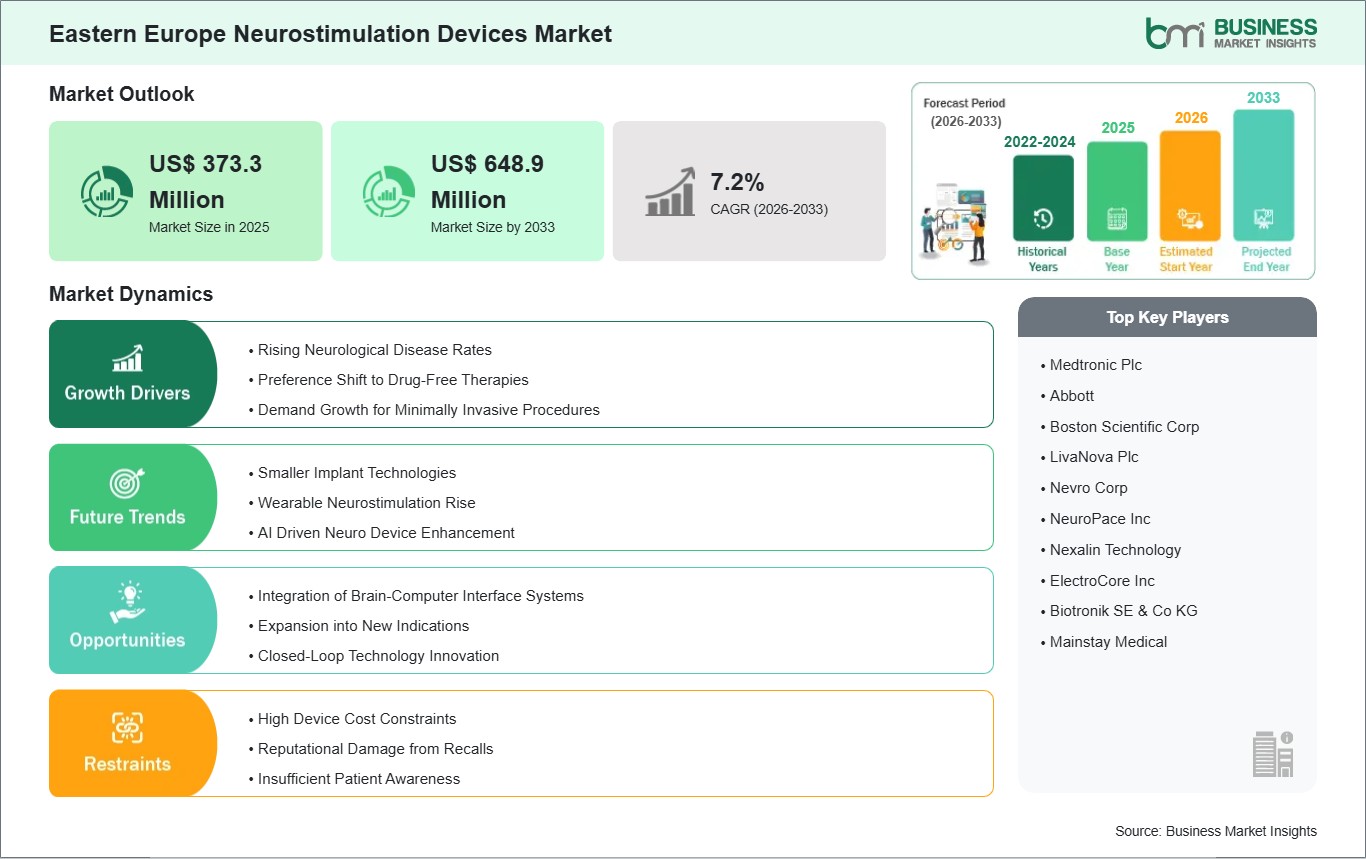
The Eastern Europe neurostimulation devices market is developing into an important growth area for European neuromodulation markets because people in the region are starting to recognize neurological disorders and chronic pain conditions. The healthcare systems of Poland, the Czech Republic, Hungary, Romania, and Russia now face rising patient numbers who need advanced medical technologies to treat Parkinson's disease, epilepsy and refractory chronic pain. The increasing patient load at hospitals and specialty neurology centers drives them to implement implantable and external neurostimulation systems, which they can use because the healthcare infrastructure is becoming better, although it still remains inconsistent. The region experiences its primary growth force from healthcare facility modernization, which enables hospitals to follow Western European treatment methods that allow patients to access newer neuromodulation treatments. The demand for non-drug medical device-based therapies is rising because doctors and patients are becoming more knowledgeable about these treatment options, which is particularly true in urban medical centers. Medical tourism and cross-border patient movement within Europe also indirectly support adoption in more developed Eastern European markets. The market includes multiple important restrictions that continue to affect its development. Public healthcare systems face two main issues that prevent them from covering expenses for high-cost implantable devices. The healthcare system faces two major challenges, which create treatment gaps because there are not enough specialized neurosurgeons, and advanced neurology centers exist only in metropolitan regions. The different regulatory requirements that exist in each country create market entry challenges that prevent manufacturers from entering new markets. While Eastern Europe remains a cost-sensitive and infrastructure-diverse region, it presents strong long-term potential for neurostimulation device manufacturers due to rising neurological disease prevalence, gradual healthcare upgrades, and increasing openness to advanced neuromodulation therapies.
Segment Analysis
Eastern Europe Neurostimulation Devices Market Segmentation
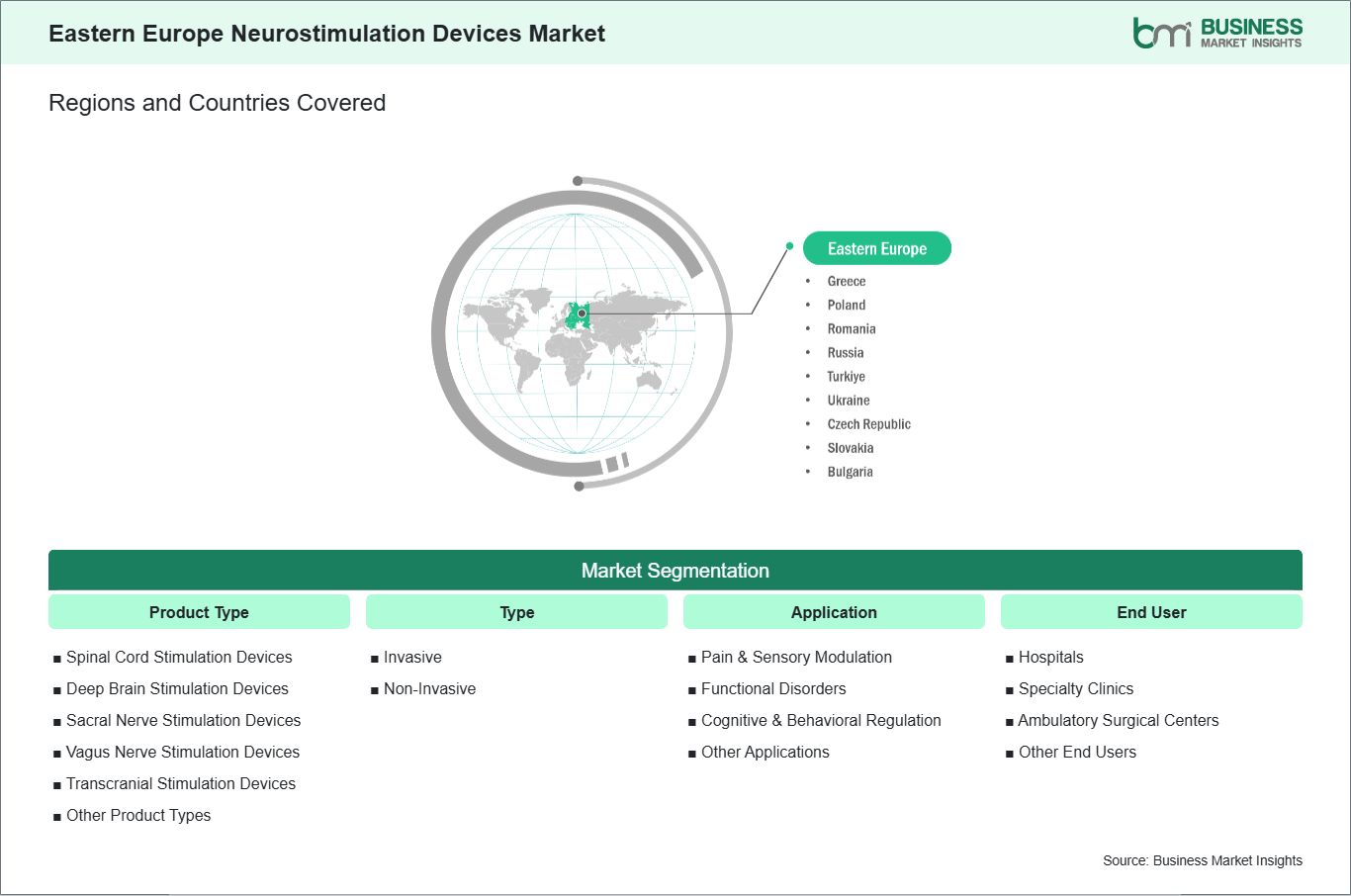
Key segments that contributed to the derivation of the Eastern Europe neurostimulation devices market analysis are product type, type, application, and end user.
- By product type, the neurostimulation devices market is segmented into spinal cord stimulation devices, deep brain stimulation devices, sacral nerve stimulation devices, vagus nerve stimulation devices, transcranial stimulation devices, and other product types. The spinal cord stimulation devices segment dominated the market in 2025.
- Based on type, the neurostimulation devices market is categorized into invasive and non-invasive. The invasive segment dominated the market in 2025.
- On the basis of application, the neurostimulation devices market is categorized into pain and sensory modulation, functional disorders, cognitive and behavioral regulation, and other applications. The pain and sensory modulation segment dominated the market in 2025.
- In terms of end user, the neurostimulation devices market is categorized into hospitals, specialty clinics, ambulatory surgical centers, and other end users. The hospitals segment dominated the market in 2025.
Market Forces
Eastern Europe Neurostimulation Devices Market Drivers and Opportunities
Rising Neurological Disease Rates
The Eastern European neurostimulation devices market is experiencing strong growth because patients with neurological disorders keep increasing throughout Poland, Romania, Hungary, and the Czech Republic. Eastern Europe has the highest stroke rates in Europe because Central and Eastern EU nations show stroke mortality rates that are 1.5 to 2 times higher than Western European countries. The demand for neurostimulation-based rehabilitation therapies increased because these therapies help patients who experience stroke-related disabilities.
The medical field now uses spinal cord stimulation devices to treat chronic pain disorders, which doctors link to occupational strain and post-surgical complications. The Western European countries of Eastern Europe face rising neurological disease rates because over 20% of their citizens are aged 65 and older. The situation gets worse because people in rural areas cannot access early treatment, which makes them depend on advanced neuromodulation therapies.
The Polish and Romanian government healthcare modernization programs establish neuro care services through their device adoption initiatives, which help expand service accessibility. The region still faces treatment access problems because reimbursement systems create inconsistent payment structures, which affect different areas.
Integration of Brain-Computer Interface Systems
The integration of Brain-Computer Interface (BCI) systems is emerging as a transformative trend in the Eastern European neurostimulation devices market, particularly in advanced clinical centers in Poland, Czech Republic, and Estonia. Research institutions are increasingly collaborating with EU-funded neuroscience programs to develop non-invasive BCI platforms for stroke rehabilitation and motor recovery in spinal cord injury patients. These systems are being combined with transcranial magnetic stimulation and adaptive neurostimulation devices to improve neuroplasticity outcomes in post-stroke patients, a major neurological burden in the region.
Eastern Europe is also witnessing pilot deployments of EEG-based BCIs in rehabilitation hospitals, enabling patients with severe paralysis to control assistive devices or communicate through neural signals. Although adoption is still in early stages, increasing participation in European Horizon research initiatives is accelerating technology transfer from Western Europe.
Furthermore, rising investments in digital healthcare infrastructure in countries like Poland and Lithuania are supporting integration of AI-driven signal decoding with neurostimulation platforms. However, high device costs and limited specialist training continue to slow large-scale clinical deployment across public healthcare systems.
Size and Share Analysis
Eastern Europe Neurostimulation Devices Market Size and Share Analysis
The Eastern Europe neurostimulation devices market is experiencing steady growth, with market size and share analysis reflecting evolving treatment preferences and competitive dynamics among key players. The report evaluates important subsegments categorized within product type, type, application, and end user, highlighting their respective contributions to market performance.
By product type, the spinal cord stimulation devices subsegment dominated the market in 2025, driven by its widespread adoption for chronic pain management and strong clinical efficacy.
Based on type, the invasive subsegment dominated the market in 2025, driven by higher precision, long-term effectiveness, and increasing preference for implantable solutions in severe neurological conditions.
On the basis of application, the pain and sensory modulation subsegment dominated the market in 2025, driven by the rising prevalence of chronic pain disorders and growing demand for non-opioid treatment alternatives.
In terms of end user, the hospitals subsegment dominated the market in 2025, driven by advanced healthcare infrastructure, availability of skilled professionals, and higher volume of neurostimulation procedures.
Report Coverage
Eastern Europe Neurostimulation Devices Market Report Coverage and Deliverables
The "Eastern Europe Neurostimulation Devices Market Size and Forecast (2022-2033)" report provides a detailed analysis of the market covering below areas:
- Market size and forecast at regional and country levels for all market segments covered under the scope
- Market trends, as well as drivers, restraints, and opportunities
- Market analysis covering key trends, regional framework, major players, regulations, and recent developments
- Market concentration, heat map analysis, prominent players, and recent developments for the Market
- Detailed company profiles, including SWOT analysis
Geographic Insights
Eastern Europe Neurostimulation Devices Market Geographic Insights
The geographical scope of the Eastern Europe Neurostimulation Devices Market report is divided into Russia, Poland, Romania, Czech Republic, Greece, Ukraine, Slovakia, Bulgaria. Russia held the largest share in 2025.
The Eastern European market for neurostimulation devices shows different growth patterns, which continue to develop throughout Russia, Poland, Romania Czech Republic, Greece, Ukraine, Slovakia and Bulgaria because people need more medical services to treat neurological disorders and chronic pain and healthcare facilities for neurosurgery show continuous development. The Russian market stands as the leading market in this region because its extensive patient base and developed neurology centers, and its higher use of spinal cord and deep brain stimulation technologies generate demand for these medical services throughout its urban hospital systems and rehabilitation centers, which form the main revenue source for the entire Eastern European market. Poland functions as the most developed market in the European Union because it demonstrates higher operational standards, better reimbursement models and increasing adoption of neurostimulation devices, which require less invasive surgical procedures. The European Union healthcare funding, together with private healthcare expansion and increasing knowledge about neuromodulation methods for pain and Parkinson's disease treatment, are driving growth in Romania and the Czech Republic. Ukraine exhibits limited demand capacity yet shows high demand potential because infrastructure constraints cannot meet the substantial clinical needs, especially for trauma and neurological rehabilitation services. The markets in Slovakia and Bulgaria have smaller sizes, which show ongoing development through hospital upgrades and medical tourism from Central Europe, which brings visitors to their countries. Greece demonstrates moderate technology adoption because its private healthcare market has reached advanced development stages, while non-invasive neurostimulation technology usage is increasing. The region displays a dual-speed system, which functions with Russian control over majority operations, while Polish and Czech Republic systems demonstrate superior technological advancement, and other nations achieve gradual progress through their healthcare systems, which increasingly align with Western European standards and their patients who gain access to modern neuromodulation treatment methods.
Industry Activity
Recent Developments
The Eastern Europe Neurostimulation Devices Market is evaluated by gathering qualitative and quantitative data post primary and secondary research, which includes important corporate publications, association data, and databases. A few of the key developments in the Eastern Europe neurostimulation devices market are:
- In December 2023, Medtronic, announced that it received CE Mark approval for its Percept RC rechargeable deep brain stimulation (DBS) neurostimulator with BrainSense technology, enabling commercial availability across European markets including Western Europe and other CE-regulated regions.
- In July 2024, Mainstay Medical, announced that it received regulatory approvals across the European Union and the United Kingdom for updated MRI labeling of its ReActiv8 restorative neurostimulation system, enhancing imaging access for implanted patients in European markets.
Trust & Transparency
Research Methodology
The market analysis combines proprietary research with secondary data from government agencies, company disclosures, regulatory filings, industry databases and expert interviews. Market estimates are validated through data triangulation, cross-market benchmarking and analyst
review.
View Full Research Methodology
Key Sources Referred:
U.S. Food and Drug Administration (FDA)European Medicines Agency (EMA)National Institutes of Health (NIH)World Health Organization (WHO)International Neuromodulation SocietyNorth American Neuromodulation SocietyAmerican Academy of NeurologyEuropean Academy of NeurologyCongress of Neurological SurgeonsCompany WebsitesCompany Annual ReportsCompany Investor Presentations