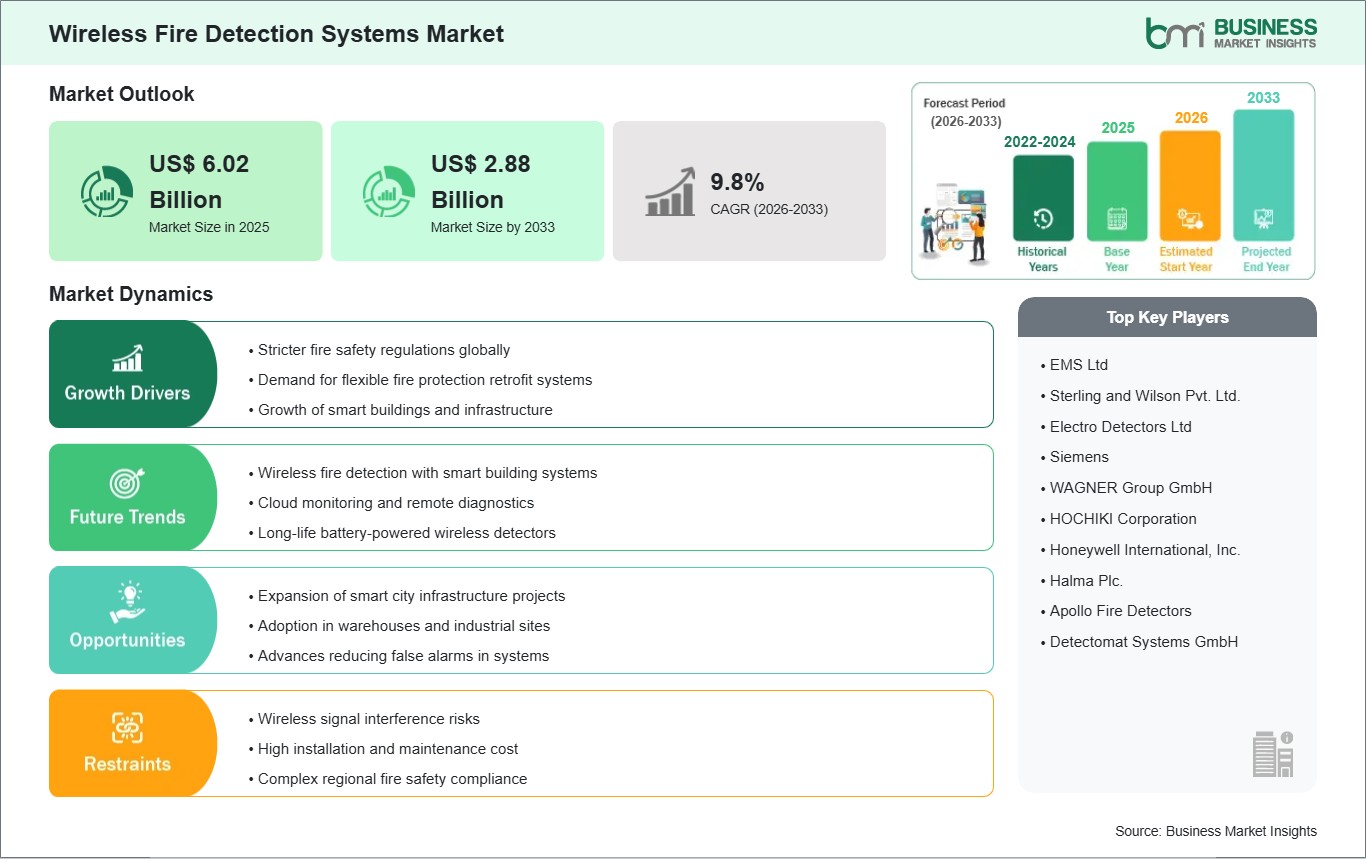
Market Summary
Executive Summary and Global Market Analysis
A Wireless Fire Detection System is an advanced safety network that utilizes radio frequency (RF) signals, often via secure mesh or proprietary protocols, to interconnect smoke detectors, heat sensors, and manual call points with a central control panel. These systems deliver substantial economic value by significantly reducing installation time, offering “zero-disruption” solutions for occupied buildings, and providing scalable protection that can grow alongside a facility. Market expansion is primarily attributed to rising demand for smart building retrofits, the increasing integration of IoT and cloud-based monitoring, and the ongoing enforcement of rigorous fire safety codes. The adoption of multi-sensor technology, which combines smoke, heat, and carbon monoxide detection into a single wireless unit, is further enhancing the reliability and responsiveness of modern networks. These advancements enable facility managers to respond to hazards more quickly and with greater precision, improving overall safety outcomes.
However, several challenges may limit market expansion. Higher initial hardware costs can be a deterrent for budget-sensitive residential or small-scale projects. Technical hurdles such as signal interference from high-frequency industrial equipment or thick metallic structures can complicate deployment in complex environments. Additionally, the need for regular battery maintenance in large-scale networks can create logistical and operational challenges over time.
Despite these hurdles, the market presents significant opportunities. There is growing demand for heritage site protection, where non-invasive wireless solutions are ideal, as well as for AI-driven false alarm reduction. The increasing deployment of temporary fire protection for construction projects, combined with advancements in long-range mesh networks, further supports the continued growth and evolution of the wireless fire detection industry.
Segment Analysis
Wireless Fire Detection Systems Market Segmentation
Key segments that contributed to the derivation of the Wireless Fire Detection Systems market analysis are product, system type, installation type, and vertical.
- By Product, the market is segmented into Sensors/Detectors, Smoke Detectors, Call Points, Fire Alarm Panels and Devices, Input/Output Modules.
- By System Type, the market is divided into Fully Wireless Systems and Hybrid Systems.
- By Installation Type,the market is categorized into New Installation and Retrofit Installation.
- By Vertical,the market is segmented into Residential, Commercial, Government, and Manufacturing.
Market Forces
Wireless Fire Detection Systems Market Drivers and Opportunities
Advancing Retrofit Flexibility and Smart Building Integration
A key driver for the Wireless Fire Detection Systems Market is the growing demand for flexible, non-invasive safety solutions in complex architectural settings and aging infrastructure. Wireless systems are increasingly favored in heritage buildings, high-end hotels, and occupied commercial spaces where traditional hardwiring is either impractical or cost-prohibitive. By eliminating extensive conduit runs and cabling, wireless architectures enable faster deployment with minimal disruption to ongoing operations. This trend is further strengthened by the global move toward smart buildings, where wireless fire detectors serve as integral IoT nodes. These systems integrate seamlessly into centralized building management platforms, offering real-time monitoring of air quality, temperature, and fire hazards. At the same time, stringent global fire safety regulations and mandates for addressable systems, which can pinpoint the exact location of a hazard, have made wireless fire detection a strategic necessity in modern urban infrastructure.
AI-Enhanced False Alarm Reduction and Mesh Network Reliability
A major opportunity lies in incorporating Artificial Intelligence and Machine Learning into wireless sensor networks to reduce nuisance or false alarms. Advanced signal processing allows detectors to distinguish real fire events from non-hazardous triggers such as cooking smoke or dust, lowering operational costs associated with emergency responses and unnecessary evacuations. Another key growth area is the adoption of self-healing mesh network topologies. These networks ensure uninterrupted communication among devices, even if one node fails or a signal path is blocked, which is particularly valuable for large-scale industrial sites and multi-occupancy residential complexes. Additionally, the rise of electric vehicles and battery storage solutions presents new demand for specialized wireless detectors that can identify unique thermal risks associated with lithium-ion technology. Manufacturers focusing on extended battery life and cloud-based remote monitoring models are well-positioned to capture high-value opportunities in the evolving fire protection landscape.
Size and Share Analysis
Wireless Fire Detection Systems Market Size and Share Analysis
The Wireless Fire Detection Systems market demonstrates steady growth, with size and share analysis revealing evolving trends and competitive positioning among key players. The report further examines subsegments categorized within product, system type, installation type, and vertical, offering insights into their contribution to overall market performance.
Based on product segment, Sensors and Detectors subsegments hold a strong position in the market, serving as a key standard for early-stage fire hazard detection. These devices are especially critical in the Manufacturing sector, where they offer multi-criteria sensing, including smoke, heat, and carbon monoxide, allowing operators to distinguish between routine industrial emissions and actual fire incidents. Another notable trend is the rising prominence of Fire Alarm Panels and Devices, as operators increasingly adopt centralized, wireless hubs capable of managing multiple field devices. These panels are becoming essential in the Government sector, where they help protect heritage buildings where extensive physical cabling is restricted. By providing a data-driven approach, these systems support the preservation of architectural integrity while ensuring compliance with modern fire safety standards.
Report Coverage
Wireless Fire Detection Systems Market Report Coverage and Deliverables
The "Wireless Fire Detection Systems Market Size and Forecast (2022 - 2033)" report provides a detailed analysis of the market covering below areas:
- Wireless Fire Detection Systems market size and forecast at global, regional, and country levels for all the key market segments covered under the scope
- Wireless Fire Detection Systems market trends, as well as market dynamics such as drivers, restraints, and key opportunities
- Wireless Fire Detection Systems market analysis covering key market trends, global and regional framework, major players, regulations, and recent market developments
- Industry landscape and competition analysis covering market concentration, heat map analysis, prominent players, and recent developments for the Wireless Fire Detection Systems market
- Detailed company profiles, including SWOT analysis
Geographic Insights
Wireless Fire Detection Systems Market Geographic Insights
The geographical scope of the Wireless Fire Detection Systems market report is divided into five regions: North America, Asia Pacific, Europe, Middle East & Africa, and South & Central America.
The Asia-Pacific Wireless Fire Detection Systems Market is divided into China, Japan, South Korea, India, Australia, and other parts of the region. This region is among the fastest-growing markets worldwide, driven largely by rapid urbanization and the extensive development of smart city initiatives in China and India. These countries are increasingly adopting wireless fire detection technologies to overcome the challenges associated with traditional wired systems in densely populated urban areas. In addition, Australia’s stringent building regulations and early adoption of hybrid fire detection solutions contribute significantly to market growth.
Market expansion is also supported by a growing shift toward IoT-enabled smart sensors, as both commercial and residential users seek to reduce false alarms through AI-based analytics. The adoption of advanced connectivity solutions, including 5G and mesh networking protocols, along with the rising popularity of long-lifespan, battery-powered detectors, positions the Asia-Pacific region as a key hub for innovation and future growth in the Wireless Fire Detection Systems industry.
Industry Activity
Recent Developments
The Wireless Fire Detection Systems market is evaluated by gathering qualitative and quantitative data post primary and secondary research, which includes important corporate publications, association data, and databases. A few of the key developments in the Wireless Fire Detection Systems market are:
- In January 2026, Pye-Barker Fire & Safety acquired EVCO Integrated Solutions, a provider of fire alarms, access control, and security systems in Washington State. This acquisition strengthens Pye-Barker’s life safety services in the Northwest and expands its capabilities to offer more comprehensive fire detection solutions, potentially including wireless fire detection technologies, supporting regional market growth.
- In August 2025, Ajax Systems launched its EN54 Line, a fully wireless fire detection and alarm system for commercial and municipal sites. The system offers fast installation, scalable deployment, and integration with intrusion and video systems, enhancing fire safety and operational efficiency. This launch underscores growing innovation and adoption in the wireless fire detection market.
Trust & Transparency
Research Methodology
The market analysis combines proprietary research with secondary data from government agencies, company disclosures, regulatory filings, industry databases and expert interviews. Market estimates are validated through data triangulation, cross-market benchmarking and analyst
review.
View Full Research Methodology
Key Sources Referred:
World Bank - Global Trade Indicators World Trade Organization (WTO) International Monetary Fund (IMF) International Trade Administration (ITA) Company website Company annual reports Company investor presentations