
Wireless Gas Detection System Market Outlook: Size, Share, Trends, Growth Analysis, Competitive Landscape & Forecast, 2026-2033

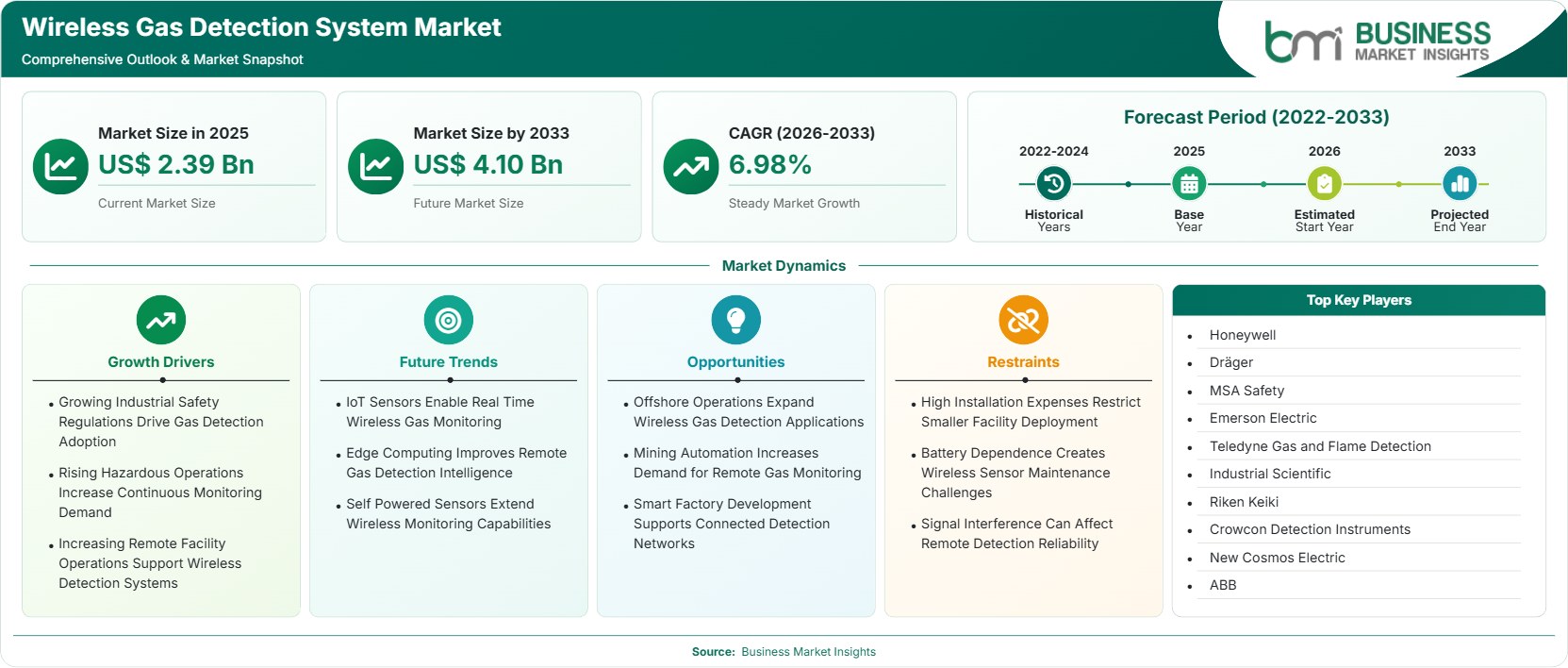
The Wireless Gas Detection System Market size was valued at US$ 2.39 billion in 2025 and is projected to reach US$ 4.10 billion by 2033, growing at a CAGR of 6.98% during 2026–2033. Increasing industrial safety regulations, hazardous operation monitoring requirements, remote facility expansion, and demand for connected safety solutions are creating growth opportunities for wireless gas detection providers.

Report Coverage
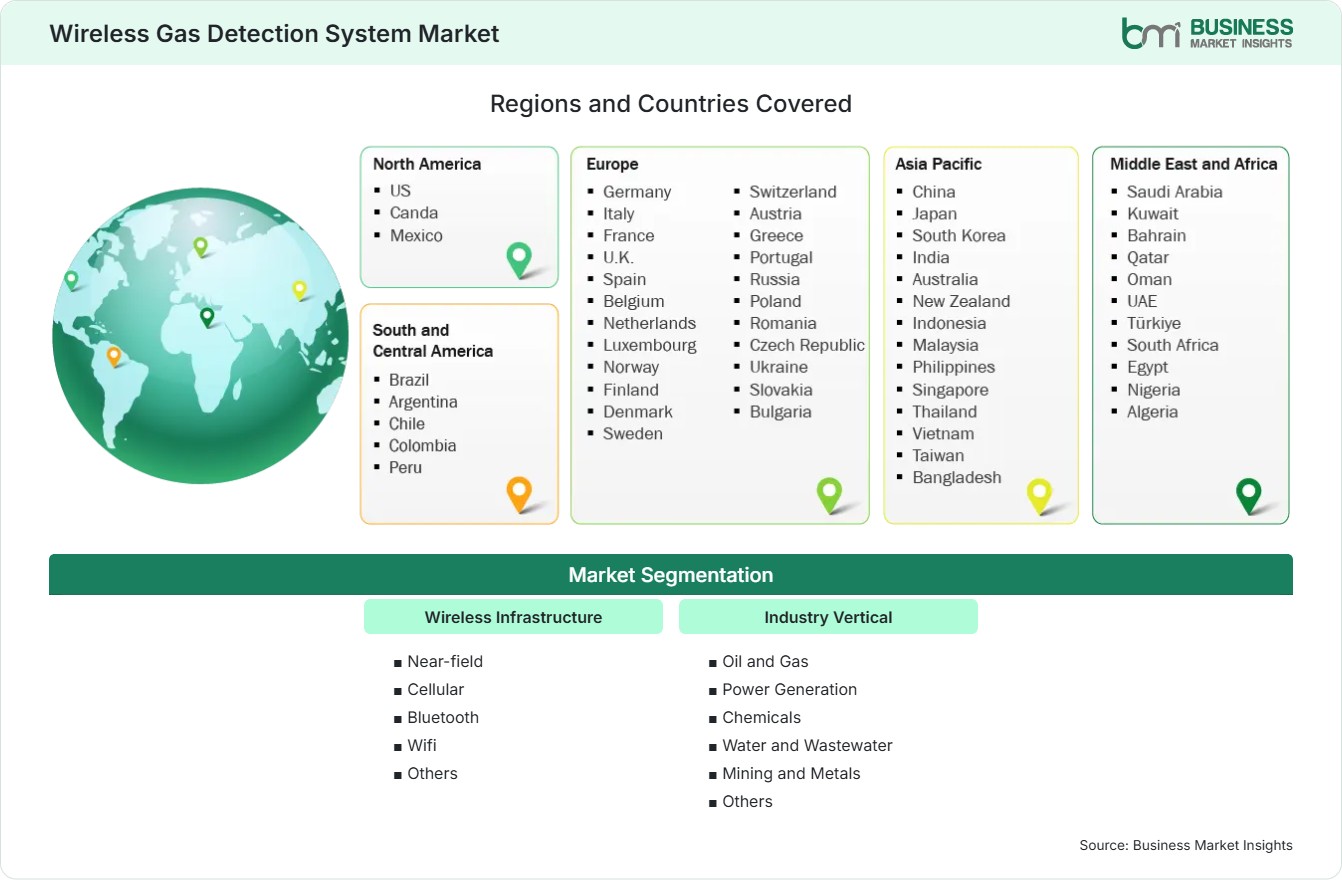
  • Wireless Infrastructure: Near-field, Cellular, Bluetooth, Wifi, Others
  • Industry Vertical: Oil and Gas, Power Generation, Chemicals, Water and Wastewater, Mining and Metals, Others
US$ 2.39 Bn Market size in 2025
US$ 4.10 Bn Market Size by 2033
6.98% CAGR, 2026 - 2033
2026-2033 Forecast Period

AI Overview

Wireless Gas Detection System Market Summary

  • North America Region: North America holds a leading position with a share ranging between 35%–38% in 2025 and is projected to grow at a CAGR of 6.6%–7.2% through 2033. Strict workplace safety standards, industrial automation, and adoption of connected monitoring technologies support regional growth. The U.S. Wireless Gas Detection System Market benefits from energy sector investments, industrial safety compliance, and smart facility development, supporting a CAGR of 6.8%–7.4%.
  • Fastest Growing Region: Asia Pacific represents the fastest-growing region with a share of 28%–31% in 2025 and is expected to expand at a CAGR of 7.5%–8.1%. Industrial expansion, infrastructure development, and increasing safety technology adoption are accelerating demand.
  • Leading Segment: Cellular wireless infrastructure represents the leading segment with a share of 32%–35% in 2025 and is projected to grow at a CAGR of 7.0%–7.6%. Wide-area connectivity, remote monitoring capability, and industrial deployment flexibility support segment adoption.
  • High Growth Segment: Mining and Metals industry vertical demonstrates strong expansion with a share of 12%–15% in 2025 and a CAGR of 7.8%–8.4%. Automation initiatives and demand for worker safety monitoring are supporting segment growth.
  • Key Market Opportunity: Increasing offshore activities, mining automation, and smart factory development are creating opportunities for connected gas monitoring systems that provide real-time safety insights across industrial environments.
  • Major Market Players: Honeywell, Dräger, MSA Safety, Emerson Electric, Teledyne Gas and Flame Detection, Industrial Scientific, Riken Keiki, Crowcon Detection Instruments, New Cosmos Electric, and ABB.
Strategic Insights

Wireless Gas Detection System Market: Strategic Insights

Wireless Gas Detection System Market Strategic Framework
FREE PDF
Request your free sample
Request free sample
Stakeholder View

Key Takeaways

  • The industrial safety ecosystem is evolving through integration of wireless sensors, communication networks, analytics platforms, and safety management systems across hazardous operating environments. These integrated solutions enable faster incident detection, improved risk assessment, and more efficient safety responses by providing real-time visibility into workplace conditions.
  • Oil and gas, mining, and chemical industries represent attractive growth areas due to increasing requirements for continuous hazard monitoring and worker protection. The need to minimize operational risks and comply with stringent safety regulations is driving investments in advanced wireless monitoring technologies across these sectors.
  • Wireless technology innovation is focusing on improved sensor accuracy, longer battery life, enhanced connectivity, and integration with digital industrial platforms. Advancements in IoT, edge computing, and low-power communication technologies are further enhancing the reliability and scalability of wireless safety solutions.
  • Asia Pacific provides strong investment opportunities due to industrial expansion, infrastructure development, and increasing adoption of automated safety systems. Rapid industrialization, government safety initiatives, and modernization of manufacturing facilities are expected to accelerate demand for connected safety technologies in the region.
  • Strategic collaborations between safety technology providers and industrial operators are strengthening product development and deployment capabilities. These partnerships help companies develop industry-specific solutions, improve system interoperability, and accelerate the adoption of advanced safety monitoring platforms.
  • Growing focus on predictive safety management is encouraging organizations to adopt connected detection systems that provide real-time operational insights. By leveraging data analytics and machine learning capabilities, these systems help organizations identify potential hazards proactively and prevent workplace incidents before they occur.
Geographic Outlook

Wireless Gas Detection System Market Regional Highlights

North America Wireless Gas Detection System Market

North America accounted for approximately 35%–38% of global revenue in 2025 and is expected to expand at a CAGR of 6.6%–7.2% through 2033. The region benefits from strong industrial safety frameworks, energy sector activities, and increasing adoption of wireless monitoring technologies across hazardous facilities.

  • The United States represents the primary contributor due to industrial safety investments and advanced monitoring adoption.
  • Oil and gas operators are integrating wireless detection systems for remote and complex facilities.
  • Regulatory compliance requirements are encouraging modernization of industrial safety infrastructure.
  • Smart manufacturing initiatives are supporting connected safety technology adoption.

US Wireless Gas Detection System Market

The United States represents the largest country-level contributor within North America, supported by energy production, chemical processing, and industrial automation activities. The market is projected to grow at a CAGR of 6.8%–7.4% through 2033, driven by safety modernization and increasing demand for remote monitoring solutions.

  • Industrial facilities are adopting wireless sensors to improve hazard detection and operational flexibility.
  • Energy companies are investing in digital safety solutions for distributed assets.
  • Advanced communication technologies are improving reliability of industrial monitoring networks.

Europe Wireless Gas Detection System Market

Europe represented approximately 24%–27% of global revenue in 2025 and is projected to grow at a CAGR of 6.4%–7.0% through 2033. Germany leads regional adoption through industrial manufacturing strength, while the United Kingdom and France demonstrate increasing demand from energy and chemical industries.

  • Germany supports adoption through advanced manufacturing and industrial safety initiatives.
  • The United Kingdom is increasing wireless monitoring use across energy and process industries.
  • France is adopting connected safety solutions within chemical and industrial facilities.
  • European regulations are encouraging improved workplace hazard management systems.

Asia Pacific Wireless Gas Detection System Market

Asia Pacific accounted for approximately 28%–31% of global revenue in 2025 and is expected to register the fastest CAGR of 7.5%–8.1% through 2033. China leads regional demand, while India, Japan, and Southeast Asian countries demonstrate increasing adoption through industrial expansion and automation.

  • China is expanding wireless safety technology adoption across manufacturing and energy sectors.
  • India is witnessing demand growth through infrastructure development and industrial modernization.
  • Japan and South Korea are integrating advanced safety systems within automated facilities.
  • Regional industrial growth is increasing demand for remote monitoring technologies.

Rest of World Wireless Gas Detection System Market

Rest of World regions contribute approximately 9%–12% of Wireless Gas Detection System Market share in 2025 and are projected to grow at a CAGR of 6.9%–7.5% through 2033. Middle East and Latin American markets are adopting wireless gas detection systems through energy projects, mining operations, and industrial safety improvements.

  • Middle Eastern countries are deploying safety technologies across oil and gas facilities.
  • Latin American mining operations are increasing demand for remote monitoring systems.
  • Industrial modernization programs are supporting adoption across emerging economies.
  • International safety standards are influencing technology investments.
Global Market Geography
FREE PDF
Request your free sample
Request free sample
Segment Analysis

Wireless Gas Detection System Market Segmentation

Wireless Infrastructure

The Wireless Infrastructure segment defines connectivity approaches used for industrial gas monitoring applications. Cellular-based infrastructure represents the leading category with 32%–35% share in 2025 and a CAGR of 7.0%–7.6% through 2033. Remote facility operations, flexible deployment requirements, and demand for continuous monitoring are supporting adoption of wireless communication technologies. The Wireless Gas Detection System Market scope continues expanding as industries prioritize scalable safety networks.

  • Near-field: Supports short-range communication requirements in controlled industrial environments requiring localized monitoring and reliable sensor connectivity.
  • Cellular: Enables wide-area monitoring across remote facilities, supporting oil and gas operations, infrastructure sites, and distributed industrial assets.
  • Bluetooth: Provides low-power connectivity for localized applications requiring simple installation and efficient wireless sensor communication.
  • Wifi: Supports integration with existing industrial networks, enabling real-time data transmission and centralized monitoring capabilities.
  • Others: Includes emerging wireless technologies designed for specialized industrial environments requiring customized connectivity solutions.

Industry Vertical

The Industry Vertical segment reflects adoption across industries where hazardous gas monitoring is essential for operational safety. Oil and Gas represents the leading application area due to continuous monitoring requirements in production, processing, and storage facilities. The Wireless Gas Detection System Market trend reflects increasing demand for flexible safety technologies across hazardous industrial environments.

  • Oil and Gas: Drives adoption through offshore platforms, refineries, pipelines, and processing facilities requiring continuous gas hazard monitoring.
  • Power Generation: Uses wireless detection systems to improve safety monitoring across generation plants and operational areas.
  • Chemicals: Requires advanced gas detection solutions due to hazardous materials handling and strict workplace safety requirements.
  • Water and Wastewater: Adopts monitoring systems for detecting harmful gases in treatment facilities and infrastructure operations.
  • Mining and Metals: Increases demand through underground operations, automation initiatives, and worker safety improvement programs.
  • Others: Includes industries requiring connected safety monitoring for specialized operational environments and hazardous applications.
Market Forces

Wireless Gas Detection System Market Dynamics

Key Market Drivers

Growing Industrial Safety Regulations Drive Gas Detection Adoption

Increasing workplace safety regulations are encouraging industries to implement advanced gas monitoring solutions across hazardous environments. Regulatory requirements related to worker protection, emergency response, and operational safety are supporting adoption of wireless detection systems. These solutions provide flexible installation, continuous monitoring, and improved visibility across industrial facilities. The Wireless Gas Detection System Market trend is influenced by organizations seeking technologies that enhance compliance while reducing infrastructure limitations. Safety operators are increasingly integrating wireless sensors with centralized platforms to improve risk management and enable faster responses to potential gas hazards.

Rising Hazardous Operations Increase Continuous Monitoring Demand

Gases that can be either explosive or toxic are used in many industries, and therefore, there is a need for monitoring technologies to detect hazards before accidents occur. Wireless detection technology is increasingly being used by companies in sectors such as oil and gas, chemicals, mining, and power generation to enhance safety in their operations. This technology provides real-time data gathering in hard-to-reach areas and faster decision-making. The increasing focus on prevention-based safety is fueling demand for monitoring technologies. The technology providers are working to enhance the accuracy, communication capabilities, and battery efficiency of sensors.

Increasing Remote Facility Operations Support Wireless Detection Systems

The development of remote industries has increased the need for wireless gas detectors that simplify installation and provide better monitoring coverage. Wireless technology enables a flexible and safe solution for industrial and offshore platforms, as well as remote energy sites, without the need for complex cabling. The adoption of digitalization programs encourages the integration of detection systems into industrial platforms and analytical software. This trend is contributing to the increased adoption of wireless safety technology in geographically distributed industries.

Key Market Opportunities

Offshore Operations Expand Wireless Gas Detection Applications

Activities related to offshore oil and gas drilling are providing opportunities for wireless gas detection companies, as operators need monitoring technology. Offshore plants often face challenging conditions, making the implementation of wired gas detection systems challenging. With wireless gas detection, it is easy to place devices where needed, expand the system as needed, and monitor the site efficiently. Companies that produce rugged wireless gas detectors for harsh conditions will benefit as more money is spent on offshore safety. The emphasis on reliability and worker safety is anticipated to favor the adoption of modern wireless detection technology.

Mining Automation Increases Demand for Remote Gas Monitoring

Emerging possibilities for wireless gas detection devices in mining automation could boost demand for remote monitoring at underground and surface mining sites. The automated mining environment demands interconnected safety solutions that would help with worker safety and operation management. Wireless sensors can be used to monitor areas where installing such devices would pose a problem. With the increase in demand for digitization and automation in the mining industry, opportunities are emerging for providers of robust, maintenance-free solutions.

Smart Factory Development Supports Connected Detection Networks

The smart factory concept is fostering the development of integrated connectivity in advanced manufacturing systems by incorporating safety systems. The adoption of digital networks and automation, along with sensor technology to enhance visibility in these industrial environments, is facilitated by wireless gas detection systems. Companies designing products that integrate with industrial communication systems can capitalize on growing interest in connected factories. There are also likely to be more uses of wireless safety systems in the future due to intelligent manufacturing systems.

Market Restraints and Challenges

High Installation Expenses Restrict Smaller Facility Deployment

Factor: Wireless gas detection systems require investment in advanced sensors, communication infrastructure, and monitoring platforms. Impact: The high start-up costs will pose challenges for small manufacturing companies in adopting the system due to their limited technology budgets. It is up to organizations to assess the benefits of safety measures against the start-up costs. The manufacturers have been developing scalable systems. Nevertheless, capital investment remains an issue for organizations seeking to modernize their current safety systems.

Battery Dependence Creates Wireless Sensor Maintenance Challenges

Factor: Wireless sensors rely on battery systems that require monitoring, replacement planning, and maintenance activities. Impact: Problems arising from battery-related restrictions could threaten operational efficiency and the reliability of such systems. Manufacturers are working on making these systems more efficient and reliable. Nevertheless, some requirements related to lifecycle management remain and should be taken into account by facilities operating in difficult conditions. Maintenance processes are always necessary to keep the wireless gas detection system operational.

Company Analysis

Competitive Landscape

The competitive environment includes industrial safety technology providers, gas monitoring specialists, and automation companies developing wireless solutions for hazardous environments. The Wireless Gas Detection System Market analysis highlights company strategies focused on sensor innovation, connectivity improvements, remote monitoring capabilities, and integration with industrial safety platforms.

Company Name

Overview

Products and Services relevant to this market

Honeywell

Global technology company providing industrial safety, automation, and sensing solutions across multiple industries.

Wireless gas detection systems, connected safety platforms, industrial sensors, monitoring solutions, and hazard management technologies.

Dräger

Safety technology company specializing in gas detection, respiratory protection, and industrial safety equipment.

Wireless gas detectors, portable and fixed detection systems, safety monitoring solutions, and industrial protection technologies.

MSA Safety

Safety equipment provider focused on worker protection and hazardous environment monitoring solutions.

Wireless gas detection devices, safety sensors, monitoring systems, and industrial safety equipment.

Emerson Electric

Automation technology company delivering industrial control and safety solutions for process industries.

Wireless gas detection technologies, automation systems, monitoring solutions, and industrial communication platforms.

Teledyne Gas and Flame Detection

Gas and flame detection specialist providing safety solutions for industrial applications.

Wireless gas detectors, flame detection systems, fixed monitoring equipment, and hazardous area solutions.

Industrial Scientific

Safety technology provider focused on connected worker protection and gas monitoring solutions.

Wireless gas detection devices, cloud-based safety platforms, connected monitoring systems, and data analytics solutions.

Riken Keiki

Gas detection technology company developing industrial safety and measurement solutions.

Portable gas detectors, fixed monitoring systems, wireless detection technologies, and industrial safety instruments.

Crowcon Detection Instruments

Gas detection manufacturer serving industrial safety and environmental monitoring applications.

Wireless gas detection systems, fixed detectors, portable monitors, and hazardous gas monitoring solutions.

New Cosmos Electric

Japanese company specializing in gas sensing and safety monitoring technologies.

Gas detection equipment, industrial sensors, wireless monitoring solutions, and safety systems.

ABB

Industrial automation and electrification company providing digital solutions for process industries.

Industrial wireless solutions, gas monitoring technologies, automation platforms, and safety management systems.

Trust & Transparency

Research Methodology

The market analysis combines proprietary research with secondary data from government agencies, company disclosures, regulatory filings, industry databases and expert interviews. Market estimates are validated through data triangulation, cross-market benchmarking and analyst review.

View Full Research Methodology

Questions Answered

Frequently Asked Questions

How will industrial automation influence wireless gas detection adoption?

According to the Wireless Gas Detection System Market forecast, Industrial automation will increase demand for connected safety systems by enabling real-time monitoring, predictive safety management, and integration of gas detection data with digital industrial platforms.

What does the Wireless Gas Detection System Market report cover?

The report covers infrastructure types, industry applications, regional developments, competitive strategies, adoption factors, and future growth opportunities.

What technologies support wireless gas detection systems?

Wireless gas detection systems use communication technologies such as cellular, Bluetooth, WiFi, and other connectivity solutions to transmit sensor data for centralized monitoring.

Why are wireless gas detection systems preferred over wired systems?

Wireless systems provide flexible installation, reduced cabling requirements, easier deployment across remote locations, and improved scalability for facilities requiring continuous hazardous gas monitoring.

What industries are adopting wireless gas detection systems?

Oil and gas, chemical processing, power generation, mining, water treatment, and industrial manufacturing facilities are adopting wireless gas detection systems to improve safety monitoring and operational visibility.

Access the Full Wireless Gas Detection System Market Report

Get segment-level forecasts, regional estimates, competitive benchmarking, company profiles and downloadable Excel datasets.

Access the full Wireless Gas Detection System Market Report
350 pages PDF & Excel | 2026-08-11
Similar Research

Related Market Reports