
Greenhouse Gas Monitoring Market Outlook: Size, Share, Trends, Growth Analysis, Competitive Landscape & Forecast, 2026-2033

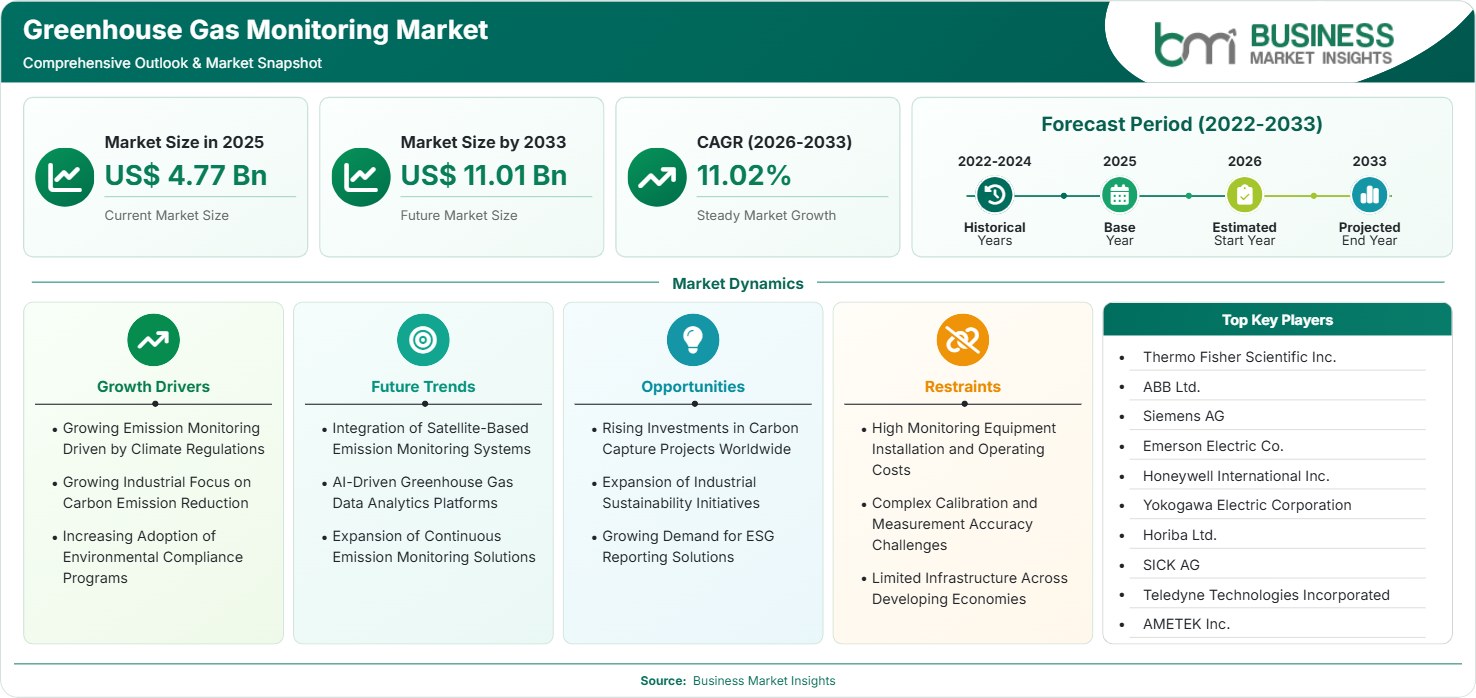
The Greenhouse Gas Monitoring Market size was valued at US$ 4.77 Billion in 2025 and is projected to reach US$ 11.01 Billion by 2033, growing at a CAGR of USD 11.02% during 2026–2033, driven by climate regulations, industrial emission controls, carbon accounting requirements, and sustainability investments.

Report Coverage
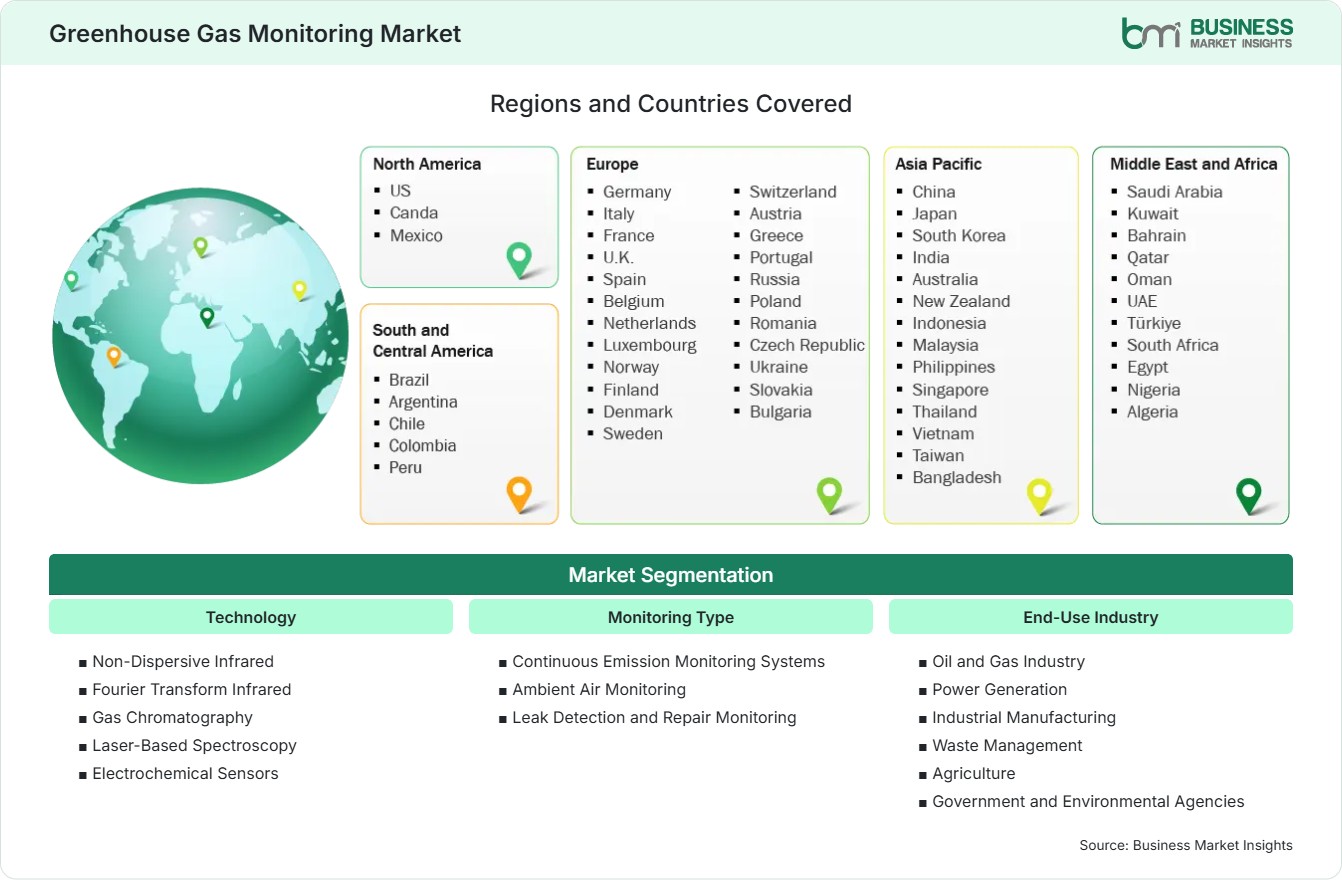
  • Technology: Non-Dispersive Infrared, Fourier Transform Infrared, Gas Chromatography, Laser-Based Spectroscopy, Electrochemical Sensors
  • Monitoring Type: Continuous Emission Monitoring Systems, Ambient Air Monitoring, Leak Detection and Repair Monitoring
  • End-Use Industry: Oil and Gas Industry, Power Generation, Industrial Manufacturing, Waste Management, Agriculture, Government and Environmental Agencies
US$ 4.77 Bn Market size in 2025
US$ 11.01 Bn Market Size by 2033
11.02% CAGR, 2026 - 2033
2026-2033 Forecast Period

01 AI Overview

Greenhouse Gas Monitoring Market Summary

  • North America Region: North America holds a market share of 34%–37% in 2025, growing with a CAGR of 10.5%–11.5% influenced by stringent emission regulations, methane monitoring initiatives, and industrial decarbonization programs. The US market analysis indicates strong adoption with a CAGR of 10.8%–11.4% between 2026–2033.
  • Fastest Growing Region: Asia Pacific holds a market share of 27%–30% in 2025, growing with a CAGR of 12.0%–13.0% due to expanding industrial activity, environmental policies, smart monitoring investments, and rising demand for real-time emission measurement solutions.
  • Leading Segment: Continuous Emission Monitoring Systems holds a market share of 38%–42% in 2025, growing with a CAGR of 11.0%–12.0% supported by regulatory compliance needs, power sector monitoring, and automated industrial emission reporting requirements.
  • High Growth Segment: Laser-Based Spectroscopy holds a market share of 18%–21% in 2025, growing with a CAGR of 12.5%–13.5% due to higher sensitivity, remote sensing capabilities, and increasing demand for accurate methane and carbon monitoring.
  • Key Market Opportunity: Increasing adoption of carbon management platforms, ESG reporting frameworks, and industrial digitalization creates opportunities for advanced monitoring systems integrating analytics, automation, and real-time environmental intelligence.
  • Major Market Players: Thermo Fisher Scientific Inc., ABB Ltd., Siemens AG, Emerson Electric Co., Honeywell International Inc., Yokogawa Electric Corporation, Horiba Ltd., SICK AG, Teledyne Technologies Incorporated, and AMETEK Inc.
02 Strategic Insights

Greenhouse Gas Monitoring Market: Strategic Insights

greenhouse-gas-monitoring-market-market-strategic-framework
FREE PDF
Request your free sample
Request free sample
03 Stakeholder View

Key Takeaways

  • The market ecosystem is shifting from standalone measurement equipment toward integrated platforms combining sensors, cloud analytics, data management, and compliance reporting capabilities. Equipment suppliers, software providers, and industrial operators are increasingly collaborating to deliver complete monitoring solutions.
  • Industrial sectors including oil and gas, power generation, and manufacturing represent major adoption opportunities because these industries face increasing pressure to quantify emissions, improve operational efficiency, and meet evolving environmental performance requirements.
  • Technology innovation is moving toward high-precision spectroscopy, satellite-linked monitoring, artificial intelligence-based anomaly detection, and automated leak identification systems that enable faster response to emission events.
  • Asia Pacific presents a strong investment opportunity due to industrial expansion, environmental policy development, and increasing deployment of monitoring infrastructure in countries modernizing energy and manufacturing sectors.
  • Strategic partnerships, technology acquisitions, and portfolio expansion activities are becoming important competitive strategies as established automation companies strengthen their environmental monitoring capabilities.
  • Environmental agencies and government institutions are becoming influential stakeholders by developing standardized monitoring frameworks that encourage transparent emissions measurement and reporting practices.
04 Geographic Outlook

Greenhouse Gas Monitoring Market Regional Highlights

North America Greenhouse Gas Monitoring Market

North America accounted for a market share of 34%–37% in 2025 and is projected to grow at a CAGR of 10.5%–11.5% during 2026–2033. The region benefits from advanced industrial infrastructure, methane reduction programs, and strong regulatory enforcement across energy and manufacturing sectors. The Greenhouse Gas Monitoring Market share remains supported by the United States and Canada through environmental compliance investments and digital monitoring adoption.

  • The United States drives regional demand through federal and state-level emission reporting frameworks, supporting adoption of advanced monitoring systems across energy, utilities, and industrial facilities.
  • Canada is expanding monitoring deployments through climate action programs, increasing demand for methane detection technologies in oil production, mining operations, and environmental assessment activities.
  • Industrial facilities are integrating automated monitoring platforms to improve compliance reporting accuracy, operational visibility, and carbon management strategies across multiple emission-intensive sectors.
  • Technology providers are focusing on cloud-connected sensors and analytics platforms to support continuous monitoring requirements and improve real-time emission management capabilities.

US Greenhouse Gas Monitoring Market

The United States represented a market share of 29%–32% in 2025 and is expected to register a CAGR of 10.8%–11.4% during 2026–2033. The country maintains a leading position due to regulatory initiatives, industrial emission reduction programs, and increasing corporate sustainability commitments. Growing demand from oil and gas, power generation, and manufacturing industries strengthens domestic adoption of advanced monitoring solutions.

  • The oil and gas industry remains a major adopter due to increasing requirements for methane leak detection and emissions transparency throughout production operations.
  • Power generation companies are deploying continuous monitoring technologies to improve regulatory compliance and optimize emission control processes across large-scale facilities.
  • Corporate sustainability commitments are encouraging businesses to invest in digital monitoring systems that provide accurate environmental performance data for reporting purposes.

Europe Greenhouse Gas Monitoring Market

Europe held a market share of 25%–28% in 2025 and is forecast to grow at a CAGR of 10.8%–11.8% from 2026–2033. The region demonstrates strong adoption due to climate legislation, industrial decarbonization targets, and environmental reporting requirements. Germany, the United Kingdom, and France represent leading markets, while countries such as Denmark and the Netherlands show faster deployment of advanced monitoring technologies.

  • European Union climate policies are encouraging industries to implement precise emission tracking systems to achieve carbon reduction objectives and improve environmental accountability.
  • Germany is investing in industrial monitoring infrastructure due to its manufacturing base and increasing focus on sustainable production practices.
  • The United Kingdom is expanding methane and carbon measurement capabilities across energy facilities through stricter environmental monitoring requirements.
  • France is adopting advanced environmental monitoring solutions across industrial sectors, supported by sustainability initiatives and national emission reduction strategies.

Asia Pacific Greenhouse Gas Monitoring Market

Asia Pacific accounted for a market share of 27%–30% in 2025 and is projected to achieve the fastest CAGR of 12.0%–13.0% during 2026–2033. Rapid industrialization, expanding energy demand, and environmental policy development are accelerating adoption. China, Japan, South Korea, and India represent key markets, with India and Southeast Asian economies showing strong growth potential due to infrastructure expansion.

  • China is increasing deployment of monitoring technologies across manufacturing and energy sectors to support national emission reduction objectives and industrial efficiency programs.
  • Japan is adopting advanced sensor-based solutions due to technological expertise and emphasis on accurate environmental measurement systems.
  • India is witnessing rising demand from power generation and industrial sectors as emission compliance requirements become more structured.
  • Southeast Asian countries are developing environmental monitoring infrastructure alongside industrial expansion and sustainability-focused investment programs.

Rest of World Greenhouse Gas Monitoring Market

South and Central America along with the Middle East and Africa represented a market share of 8%–11% in 2025, growing at a CAGR of 10.5%–12.0% during 2026–2033. Brazil, Saudi Arabia, and the United Arab Emirates are emerging markets due to energy sector modernization, environmental initiatives, and industrial monitoring investments. The Greenhouse Gas Monitoring Market growth in these regions is influenced by energy transition programs and increasing sustainability requirements.

  • Brazil is expanding environmental monitoring capabilities across agriculture, energy, and industrial sectors to improve emissions measurement and resource management.
  • Middle Eastern countries are adopting advanced monitoring technologies as oil and gas operators focus on operational efficiency and methane reduction.
  • The United Arab Emirates is investing in environmental monitoring infrastructure through sustainability programs and climate-focused industrial development initiatives.
  • African markets are gradually increasing adoption through government programs, international climate funding, and environmental management projects.
global-market-geography
FREE PDF
Request your free sample
Request free sample
05 Segment Analysis

Greenhouse Gas Monitoring Market Segmentation

Technology

Technology segmentation represents a critical component of the Greenhouse Gas Monitoring Market scope, with advanced measurement methods improving accuracy, reliability, and application flexibility. The segment accounted for 2025 adoption patterns based on industrial requirements, with growth supported by digital transformation and emission compliance needs. Technology solutions are advancing through sensor innovation, automation, and integration with analytical platforms for diverse monitoring environments.

  • Non-Dispersive Infrared (NDIR): Provides reliable gas measurement capabilities for industrial applications, supporting cost-effective monitoring solutions with established performance across carbon dioxide detection requirements.
  • Fourier Transform Infrared (FTIR): Enables multi-gas detection capabilities through advanced spectroscopy techniques, supporting complex industrial environments requiring detailed emission analysis.
  • Gas Chromatography (GC): Delivers high-precision measurement for specialized applications, particularly laboratories and industries requiring accurate composition analysis of gas samples.
  • Laser-Based Spectroscopy: Supports advanced remote sensing applications through high sensitivity, faster detection response, and improved monitoring accuracy for emission sources.
  • Electrochemical Sensors: Offers compact monitoring solutions suitable for distributed applications, portable devices, and environments requiring continuous measurement capabilities.

Monitoring Type

Monitoring Type segmentation influences adoption patterns as industries require different approaches for emission measurement, compliance reporting, and operational control. Continuous Emission Monitoring Systems maintain a leading position due to regulatory requirements and industrial usage. The segment demonstrates strong Greenhouse Gas Monitoring Market trends through increasing integration of automated systems, data analytics, and real-time reporting platforms across emission-intensive industries.

  • Continuous Emission Monitoring Systems: Supports regulatory compliance by providing uninterrupted measurement data for industrial facilities, utilities, and large-scale emission sources.
  • Ambient Air Monitoring: Enables environmental assessment through measurement of surrounding air quality, supporting government agencies and urban sustainability programs.
  • Leak Detection and Repair (LDAR) Monitoring: Helps industries identify and reduce unintended emissions through systematic inspection, detection, and maintenance procedures.

End-Use Industry

End-use industries determine demand patterns for monitoring technologies based on regulatory obligations, operational requirements, and sustainability objectives. The segment includes energy, industrial, agricultural, and governmental applications requiring accurate emission measurement. The Greenhouse Gas Monitoring Market continues expanding as organizations prioritize environmental compliance, carbon reduction strategies, and transparent reporting practices. Adoption is supported by increasing integration of automated monitoring platforms.

  • Oil and Gas Industry: Represents a major application area due to methane monitoring requirements, operational efficiency goals, and increasing pressure to reduce upstream and downstream emissions.
  • Power Generation: Utilizes monitoring systems for emission tracking, regulatory compliance, and optimization of combustion processes across thermal and renewable energy facilities.
  • Industrial Manufacturing: Adopts monitoring solutions to measure process emissions, improve sustainability performance, and support carbon reduction initiatives across production operations.
  • Waste Management: Implements emission monitoring technologies to track landfill gases, improve resource management, and support environmental protection programs.
  • Agriculture: Increasingly applies monitoring solutions for greenhouse gas measurement related to livestock, soil management, and sustainable farming practices.
  • Government and Environmental Agencies: Deploy monitoring infrastructure for environmental assessments, policy development, climate research, and national emission inventory management.
06 Market Forces

Greenhouse Gas Monitoring Market Dynamics

Key Market Drivers

Growing Emission Monitoring Driven by Climate Regulations

Growing regulations on the environment are driving the use of emission measuring technology as the government sets stringent regulations on reporting and carbon emission reductions. Growth of the Greenhouse Gas Monitoring Market is driven by regulations aimed at reducing methane, carbon dioxide, and other emissions. Methane gas reduction is still a vital issue, according to International Energy Agency, since methane is more dangerous than carbon dioxide. Regulations on the environment are pushing industries to put in place systems of continuous monitoring, detection of leaks, and reporting systems.

Growing Industrial Focus on Carbon Emission Reduction

Industrial firms have been focusing on emission reduction initiatives as a way of enhancing efficiency as well as fulfilling their commitment towards sustainability. The energy-consuming industries like oil and gas, manufacturing and electricity production have been allocating resources for the development of monitoring tools that will help in identifying the sources of emissions as well as improving efficiency. With the use of digital monitoring tools, firms will be able to gather information about their environment as well as improve decision making. Investors’ need for carbon accounting has further increased the need for measurements frameworks by firms.

Increasing Adoption of Environmental Compliance Programs

The environmental monitoring program is becoming increasingly significant as companies continue to experience more pressure to disclose emissions data accurately and to adhere to regulations. There is a continuous increase in the standards of monitoring imposed by the government and environmental organizations. Companies have started using automation tools in order to make the process easier and more reliable. The implementation of environmental monitoring programs in the developing parts of the world has generated more demand for automation tools.

Key Market Opportunities

Rising Investments in Carbon Capture Projects Worldwide

Increased investments in carbon capture and storage facilities are opening up new avenues for monitoring technology suppliers. Such facilities will need precise measurements of emissions captured, storage efficiency, and facility efficiencies. Greenhouse Gas Monitoring Market Forecasts show rising demand for monitoring technologies that will aid in the efficient operation of carbon management infrastructure. There is an increased amount of money being pumped into low carbon technologies by governments and industries alike, thus giving a chance to firms that provide such solutions.

Expansion of Industrial Sustainability Initiatives

Industrial sustainability programs are expanding as companies develop long-term strategies to reduce environmental impact and improve resource efficiency. Industrial plants, utility companies, and energy firms are investing in monitoring technology to develop decarbonization roadmaps. Through modern monitoring systems, it becomes possible to get real-time insight into emissions levels and identify potential areas of improvement. The growing trend toward using sustainability models is leading organizations to incorporate monitoring technologies within their environmental management systems.

Growing Demand for ESG Reporting Solutions

The increasing significance of ESG reporting is driving the need for accurate emissions data management services. There is an increasing need for accurate measurement services by companies due to the growing need for sustainability reporting and to satisfy the needs of investors. The use of monitoring tools combined with digital reporting platforms can help increase transparency and simplify the process of reporting. Increasingly, financial institutions and other stakeholders are taking into account the environmental performance of corporations while evaluating their business strategies.

Market Restraints and Challenges

High Monitoring Equipment Installation and Operating Costs

Factor: High equipment costs, including advanced sensors, calibration requirements, and infrastructure investments, can restrict adoption among smaller industrial operators. Impact: Limited financial capability may delay the deployment of more sophisticated systems and lower their penetration rate in the cost-conscious market segment. While bigger corporations find it easier to justify spending on new technology through compliance and efficiency gains, other smaller corporations may encounter problems with adopting the more sophisticated technology. Factors such as maintenance cost and technical support needs are additional factors to consider in the total cost of ownership.

Complex Calibration and Measurement Accuracy Challenges

Factor: Complex calibration requirements and variations in environmental conditions can affect monitoring accuracy and system reliability. Impact: Measurement errors can decrease confidence in the emissions reported and cause non-compliance problems for the industrial end users. High-end monitoring devices need proper maintenance, technical knowledge, and measurement techniques to function efficiently. Variations in the gas composition, environmental conditions, and measurement techniques lead to technical complications. Manufacturers are developing better algorithms and calibration methods to increase accuracy of their devices.

07 Company Analysis

Competitive Landscape

The Greenhouse Gas Monitoring Market analysis highlights competition among technology providers offering sensing equipment, automation platforms, analytical software, and environmental monitoring solutions. Leading companies focus on product innovation, strategic partnerships, and expanding industrial applications to strengthen market positioning.

Company Name

Overview

Products and Services relevant to this market

Thermo Fisher Scientific Inc.

Provides analytical technologies supporting environmental measurement and laboratory applications worldwide.

Gas analysis instruments, monitoring systems, analytical equipment, and environmental measurement solutions.

ABB Ltd.

Global automation company offering industrial monitoring and control technologies.

Emission monitoring systems, gas analyzers, automation platforms, and digital solutions.

Siemens AG

Provides industrial digitalization and environmental monitoring technologies.

Continuous emission monitoring systems, industrial automation, and environmental data platforms.

Emerson Electric Co.

Develops automation technologies for industrial process monitoring applications.

Gas measurement systems, emission monitoring technologies, and analytical solutions.

Honeywell International Inc.

Offers industrial safety and environmental monitoring technologies.

Gas detection systems, sensing technologies, and emission management solutions.

Yokogawa Electric Corporation

Specializes in measurement and industrial automation solutions.

Gas analyzers, environmental monitoring systems, and process measurement technologies.

Horiba Ltd.

Develops analytical instruments for environmental and industrial applications.

Gas analyzers, emission testing systems, and measurement equipment.

SICK AG

Provides sensor technologies for industrial monitoring applications.

Gas analyzers, emission monitoring systems, and optical measurement solutions.

Teledyne Technologies Incorporated

Supplies advanced sensing and instrumentation technologies.

Gas detection systems, analytical instruments, and environmental monitoring equipment.

AMETEK Inc.

Manufactures electronic instruments and measurement technologies.


10 Trust & Transparency

Research Methodology

The market analysis combines proprietary research with secondary data from government agencies, company disclosures, regulatory filings, industry databases and expert interviews. Market estimates are validated through data triangulation, cross-market benchmarking and analyst review.

View Full Research Methodology

11 Questions Answered

Frequently Asked Questions

How does the Report support business decisions?

The Greenhouse Gas Monitoring Market Report provides insights into technology adoption patterns, competitive strategies, segmentation dynamics, regional opportunities, and investment trends to support strategic planning by industry participants.

What role does regulatory compliance play in this market?

Environmental regulations requiring transparent emissions reporting are accelerating demand for monitoring systems. Organizations increasingly require accurate measurement platforms to demonstrate compliance with national and international climate policies.

How are digital technologies transforming environmental monitoring?

Artificial intelligence, cloud analytics, and connected sensor networks are improving data interpretation, predictive maintenance, and remote monitoring capabilities. These technologies enable organizations to identify emission sources faster and optimize operational efficiency.

Which industries are major users of greenhouse gas monitoring solutions?

Oil and gas, power generation, industrial manufacturing, waste management, and government environmental agencies represent key application areas due to their emission-intensive operations and regulatory obligations.

What factors are influencing adoption of greenhouse gas monitoring technologies?

Increasing regulatory pressure, corporate carbon reduction commitments, and demand for accurate emissions data are encouraging industries to deploy advanced monitoring technologies. Companies are prioritizing real-time measurement capabilities to support compliance reporting and sustainability objectives.

Access the Full Greenhouse Gas Monitoring Market Report

Get segment-level forecasts, regional estimates, competitive benchmarking, company profiles and downloadable Excel datasets.

Access the full Greenhouse Gas Monitoring Market Report
350 pages PDF & Excel | 2026-08-04