Market Summary
Executive Summary and Global Market Analysis
Machine health monitoring systems assess equipment condition through continuous or periodic measurement of mechanical, thermal, electrical, and lubrication signals. They detect abnormal operating patterns before functional disruption occurs, enabling maintenance teams to act with better timing and technical precision. This capability is increasingly embedded in industrial reliability programs where asset continuity and process stability are operational priorities.
Industrial operators are expanding deployment of monitoring platforms as unplanned downtime carries higher production, safety, and maintenance consequences. Facilities with rotating equipment, motors, pumps, and critical process assets require earlier fault visibility to avoid cascading failures. This need is reinforcing investment in diagnostic tools that support predictive maintenance, asset utilization planning, and better coordination between operations and reliability teams.
Segmentation highlights a market shaped by technique, delivery model, deployment architecture, monitoring process, and industrial end use. Vibration monitoring maintains broad relevance for rotating machinery, while thermography, oil analysis, corrosion monitoring, ultrasound emission, and motor current analysis address different failure signatures. Hardware remains foundational for sensing and acquisition, whereas software supports interpretation, alerts, and workflow integration across maintenance environments.
Technology evolution is shifting the industry from isolated measurement tools toward connected diagnostic ecosystems. Cloud deployment, edge analytics, wireless sensing, and AI-assisted interpretation are improving visibility across distributed assets without requiring constant manual inspection. These advances are widening suitability for both online condition monitoring and portable condition monitoring, particularly where maintenance teams must balance responsiveness, cost control, and equipment criticality.
Competitive activity centers on sensing accuracy, software usability, interoperability, and the ability to align diagnostics with industrial workflows. Vendors differentiate through scalable platforms, analytics depth, and support for sector-specific reliability needs rather than through instrumentation breadth alone. As customers seek measurable maintenance outcomes, the market increasingly favors solutions that combine actionable insight with straightforward deployment across mixed equipment fleets.
Segment Analysis
Machine Condition Monitoring Market Segmentation
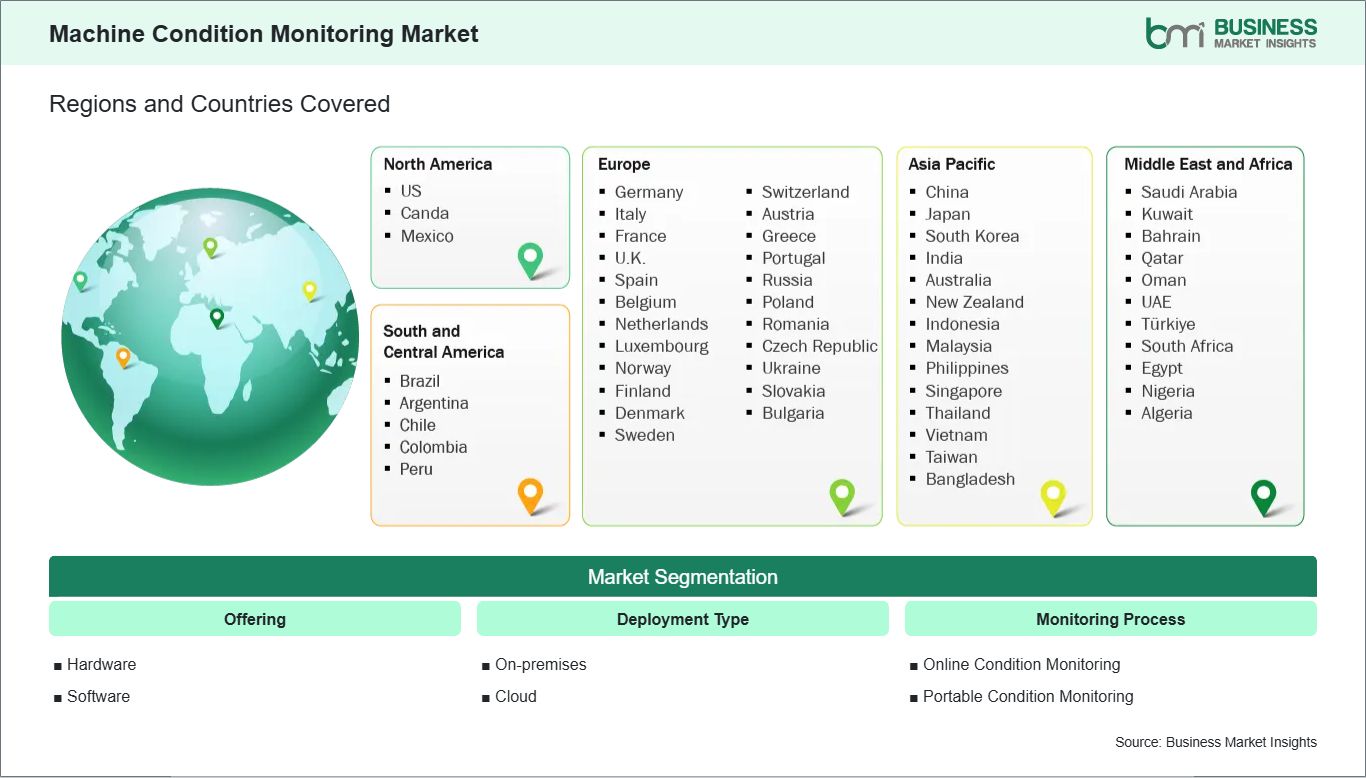
The market is segmented by monitoring technique, offering, deployment type, monitoring process, and industry verticals, reflecting distinct reliability objectives and operating environments.
By Monitoring Technique
- Vibration Monitoring: Captures imbalance and bearing wear across critical rotating equipment.
- Thermography: Reveals thermal anomalies in electrical and mechanical systems.
- Oil Analysis: Tracks lubricant condition and contamination linked to internal wear.
- Corrosion Monitoring: Measures degradation exposure in harsh process environments.
- Ultrasound Emission: Identifies leakage, friction, and discharge events at early stages.
- Motor Current Analysis: Interprets electrical signatures to detect motor-related faults.
By Offering
- Hardware: Forms the sensing and acquisition base of monitoring systems.
- Software: Converts machine signals into diagnostics, alerts, and maintenance insight.
By Deployment Type
- On-premises: Preferred where data control and site integration are prioritized.
- Cloud: Supports centralized visibility across distributed assets and facilities.
By Monitoring Process
- Online Condition Monitoring: Enables continuous oversight for mission-critical machinery.
- Portable Condition Monitoring: Fits route-based inspection across dispersed equipment bases.
By Industry Verticals
- Oil Gas: Requires asset surveillance across remote and high-risk operations.
- Power Generation: Emphasizes reliability across turbines, generators, and auxiliaries.
- Metals Mining: Monitors heavy-duty equipment under abrasive operating conditions.
- Chemicals: Favors monitoring where process continuity and safety are closely linked.
- Automotive: Supports uptime across automated and high-throughput production lines.
- Food Beverages: Reinforces equipment availability within hygiene-sensitive processing environments.
- Other Industry Verticals: Includes additional sectors with critical rotating asset needs.
Market Forces
Machine Condition Monitoring Market Drivers and Opportunities
Shift Toward Predictive Maintenance Across Asset-Intensive Operations
Industrial facilities are under pressure to reduce avoidable stoppages while managing more complex equipment fleets. This creates a clear need for earlier fault recognition, especially in assets where degradation advances before visible failure occurs. Machine health monitoring addresses that requirement by converting operating signals into maintenance intelligence, allowing teams to schedule intervention before breakdown, secondary damage, or process disruption becomes more difficult to contain.
The operational effect is stronger maintenance planning, improved equipment availability, and more disciplined resource allocation across plants and field assets. This driver carries particular relevance in oil gas, power generation, chemicals, and metals mining, where asset failure can interrupt throughput and heighten safety exposure. As maintenance strategies become more condition-based, monitoring systems are gaining a firmer role in reliability architecture and plant performance management.
Expansion of Cloud-Connected Analytics and Intelligent Diagnostic Platforms
A significant opportunity is emerging from platforms that connect sensors, analytics, and maintenance workflows across multiple sites. Cloud-based architectures, AI-assisted diagnostics, and edge-enabled processing are improving how users interpret machine behavior in real operating conditions. These innovations are especially useful in distributed facilities, where portable inspection data and online monitoring streams can be combined to create a more complete reliability view.
Future scope extends into broader software-led service models, fleet-level diagnostics, and remote decision support for maintenance organizations with limited specialist coverage. As interoperability improves, vendors can serve more industries without relying on isolated instruments alone. This direction supports market expansion by improving scalability, shortening response time, and strengthening the practical value of machine health data across complex industrial environments.
Size and Share Analysis
Machine Condition Monitoring Market Size and Share Analysis
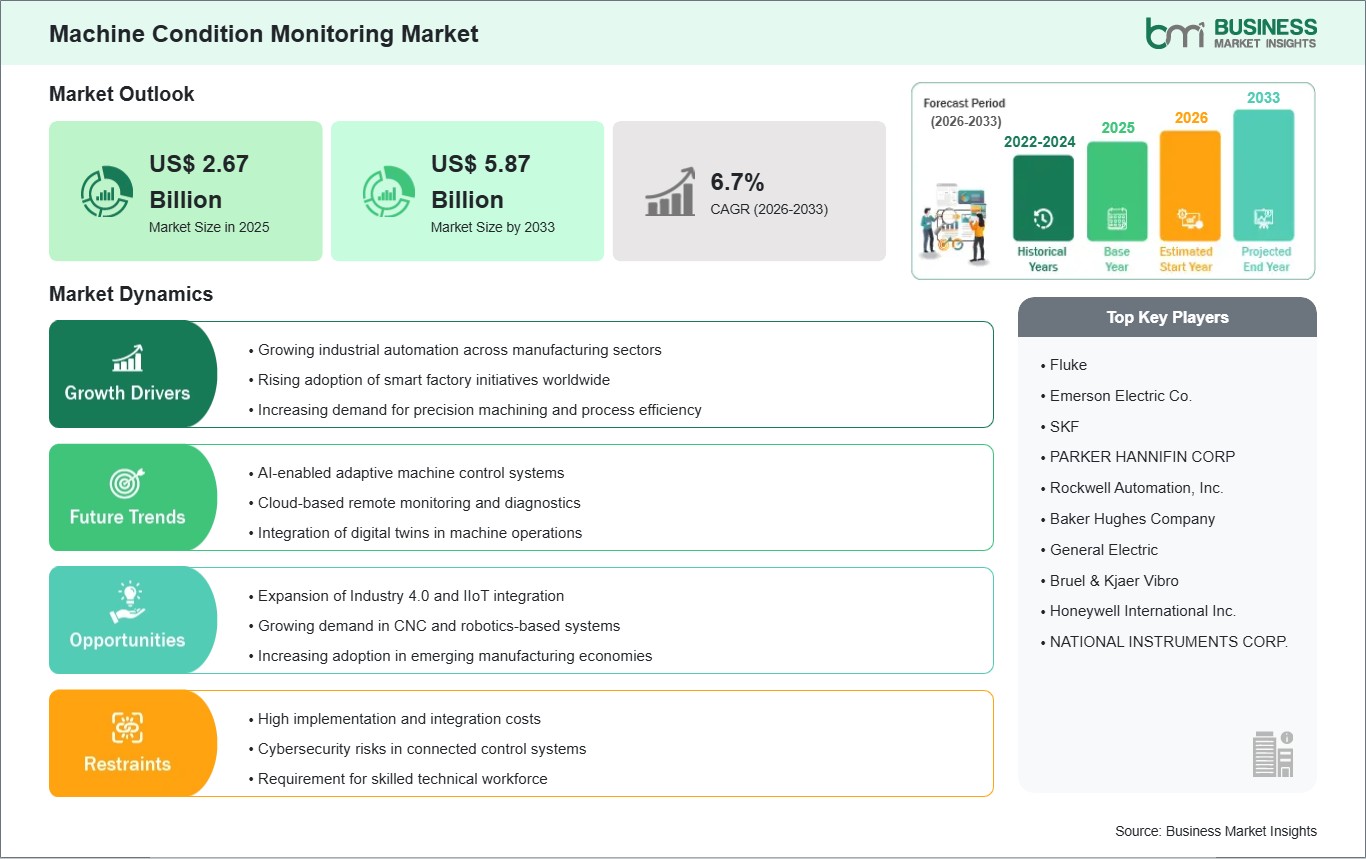
The Machine Health Monitoring market size is projected to grow from US$ 2.67 Billion in 2025 to US$ 5.87 Billion by 2033, registering a CAGR of 6.7% during 2026 - 2033. This trajectory indicates steady expansion as industrial operators prioritize earlier fault visibility, maintenance efficiency, and stronger asset reliability across production-critical environments.
Among monitoring techniques, vibration monitoring holds a central position because it aligns well with rotating machinery diagnostics across multiple industries. Hardware retains broad importance as the sensing layer, while software continues to gain relevance through analytics, alarm management, and maintenance workflow support. Deployment preferences reflect different operating priorities, with on-premises configurations favored in controlled environments and cloud models advancing where multi-site visibility matters.
From an application standpoint, online condition monitoring commands substantial attention in settings where continuous equipment oversight is necessary for process continuity. Oil gas and power generation remain prominent adopters because asset interruptions can carry wide operational consequences. Metals mining, chemicals, automotive, and food beverages also contribute meaningful demand as maintenance teams seek better control over wear patterns, performance drift, and asset availability.
Report Coverage
Machine Condition Monitoring Market Report Coverage and Deliverables
The "Machine Condition Monitoring Market Size and Forecast (2022–2033)" report provides a detailed analysis of the market covering below areas:
- Market size and forecast at global, regional, and country levels for all the key market segments covered under the scope
- Market trends, as well as market dynamics such as drivers, restraints, and key opportunities
- Market analysis covering key market trends, global and regional framework, major players, regulations, and recent market developments
- Industry landscape and competition analysis covering market concentration, heat map analysis, prominent players, and recent developments for the market
- Detailed company profiles, including SWOT analysis
Geographic Insights
Machine Condition Monitoring Market Geographic Insights
The Machine Health Monitoring market shows diverse regional adoption patterns influenced by industrial asset intensity, maintenance maturity, digital infrastructure, and sector-specific reliability priorities. Across the global market, deployment is strongest where equipment continuity, safety discipline, and production scheduling require better visibility into machine condition. Adoption also varies by facility age, automation level, and the extent to which maintenance teams can integrate diagnostic outputs into routine operational decisions.
North America maintains a strong position because reliability engineering practices are well established across energy, manufacturing, and process industries. Users in this region often prioritize platforms that combine sensing, analytics, and serviceability without creating additional operational complexity. Demand also reflects the need to modernize legacy assets with tools that support predictive maintenance while fitting established compliance, safety, and maintenance management frameworks.
Asia Pacific is expanding through industrial capacity additions, utility development, and rising automation across manufacturing and processing sectors. The region offers a broad use case landscape, from high-volume production lines to heavy-duty extraction and energy assets that require closer equipment supervision. Buyers increasingly value solutions that can scale across mixed facilities, especially when portable monitoring and online systems must coexist within the same maintenance program.
Europe remains important due to its focus on industrial efficiency, process consistency, and advanced maintenance methods across established production bases. Emerging markets in the Middle East and Africa and South and Central America are creating fresh opportunities as operators seek better equipment oversight in energy, mining, and infrastructure-linked industries. Regional momentum depends on how effectively vendors align deployment models, analytics capability, and service support with local operating conditions.
Industry Activity
Recent Developments
The Machine Health Monitoring market is evaluated by gathering qualitative and quantitative data post primary and secondary research, which includes important corporate publications, association data, and databases. A few of the key developments in the Machine Health Monitoring marketare.
- In May 2025, B&R Industrial Automation launched two IIoT applications designed to enable AI-driven machine health monitoring and optimization in packaging automation systems. The first application, IIoT Connector, enables seamless data access across edge, cloud, and hybrid environments, supporting both new and existing installations. The second application, ACOPOStrak Monitor, uses AI-based analytics to process shuttle and system data, enabling real-time performance optimization and predictive maintenance. The solution enhances visibility, improves operational efficiency, and reduces downtime by transforming machine data into actionable insights through dashboards, alerts, and remote monitoring capabilities.
- In October 2021, Honeywell launched its Real-Time Health Monitoring System (RTHMS), an edge-to-cloud patient monitoring platform designed to track vital health parameters in real time. The system integrates wearable sensors, biosensor patches, and digital dashboards to continuously capture patient data such as heart rate, ECG, respiration rate, temperature, and oxygen levels. It enables healthcare providers to remotely monitor patients both inside hospitals and at home, generate real-time alerts for abnormal conditions, and improve clinical response times while reducing manual monitoring workload. The solution is aimed at enhancing patient care efficiency, enabling early intervention, and supporting remote healthcare delivery models.
Trust & Transparency
Research Methodology
The market analysis combines proprietary research with secondary data from government agencies, company disclosures, regulatory filings, industry databases and expert interviews. Market estimates are validated through data triangulation, cross-market benchmarking and analyst
review.
View Full Research Methodology
Key Sources Referred:
World Bank – Global Trade IndicatorsWorld Trade Organization (WTO)(International Monetary Fund )IMFInternational Trade Administration (ITA)Company websiteCompany annual reportsCompany investor presentations