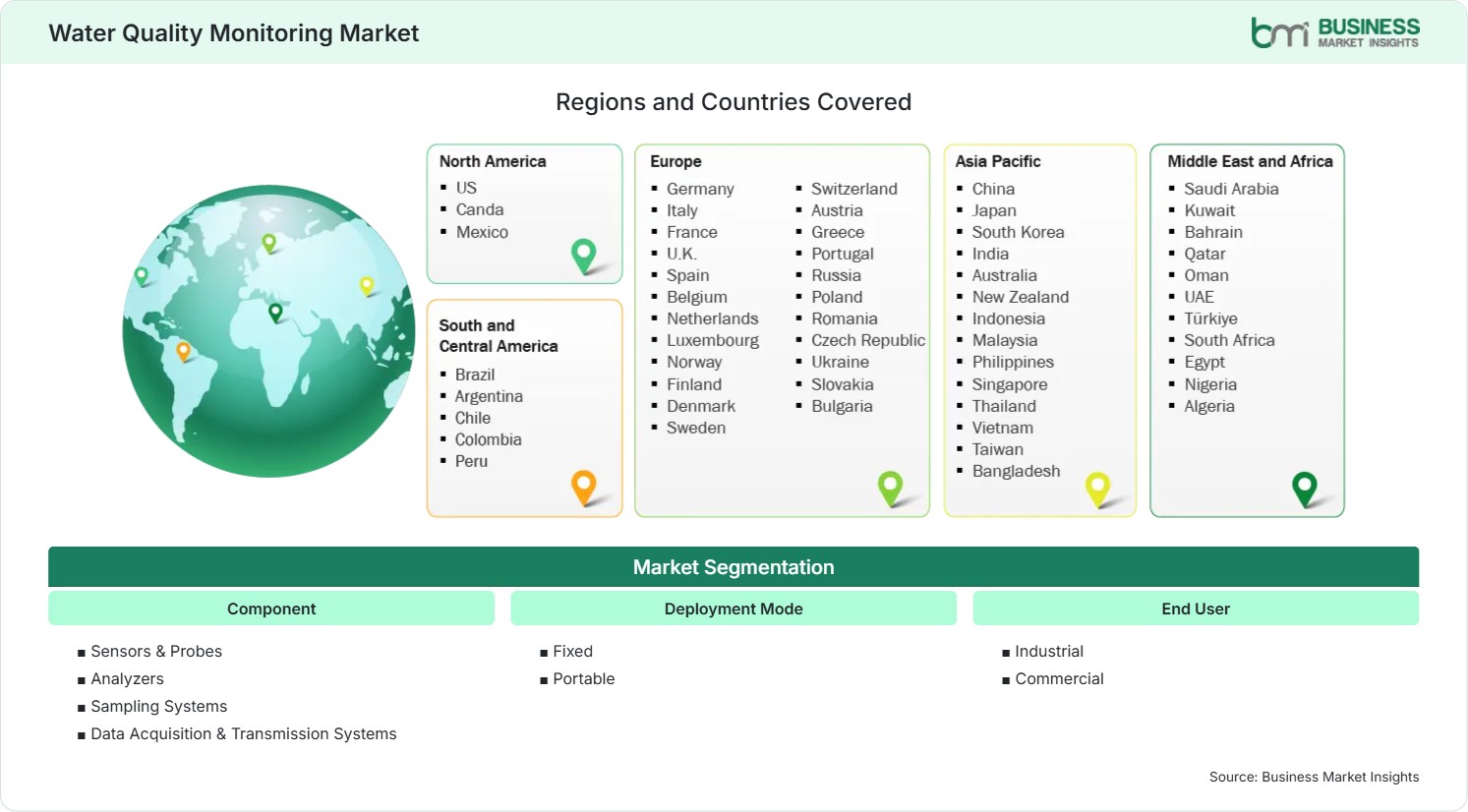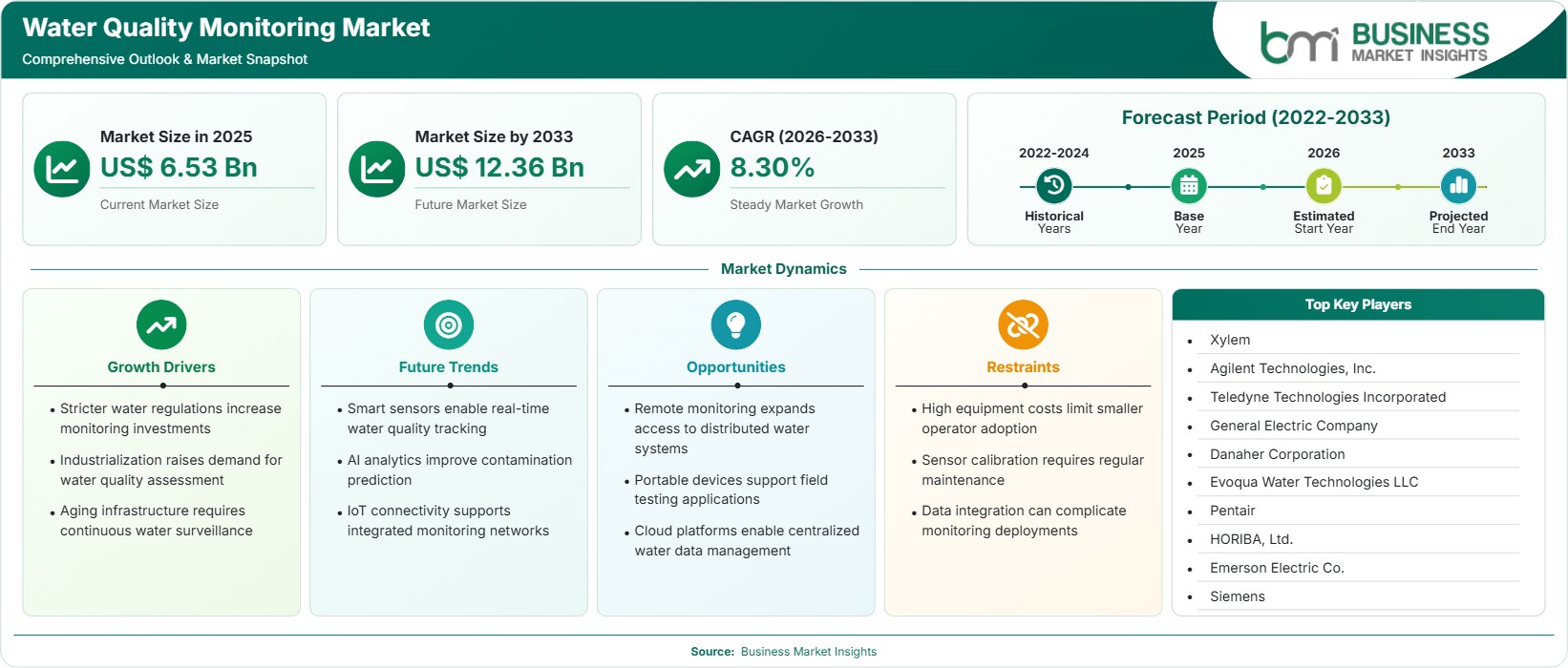
Water Quality Monitoring Market Regional Highlights
North America Water Quality Monitoring Market
North America represented 34%–37% Water Quality Monitoring Market share in 2025 and is projected to expand at a 7.6%–8.2% CAGR through 2033. Factors driving market demand include modernization of old water infrastructure, regulatory supervision, and utilization of digital technology-based monitoring systems. Water utilities keep making investments in real-time water monitoring technologies to boost operational efficiency and regulatory compliance. The industries that have adopted water monitoring systems for various applications include power plants, chemical companies, and food manufacturers.
- Regulatory compliance requirements continue encouraging utilities and industries to deploy continuous monitoring systems capable of detecting contamination events and improving response times while supporting environmental and public-health objectives.
- Smart water infrastructure investments are increasing adoption of connected sensors, advanced telemetry technologies, and cloud-enabled data platforms across municipal and industrial water networks.
- Industrial facilities are implementing automated monitoring systems to strengthen wastewater management practices, improve reporting accuracy, and maintain compliance with environmental performance targets.
- Integration of artificial intelligence and predictive analytics supports proactive maintenance strategies and enhances visibility into changing water-quality conditions across distributed assets.
- Utility operators increasingly prioritize digital transformation programs that combine sensing technologies, communication systems, and analytics platforms into unified water-management frameworks.
US Water Quality Monitoring Market
The United States accounts for approximately 79%–83% Water Quality Monitoring Market share within North America and is anticipated to grow at a 7.8%–8.4% CAGR during 2026–2033. Extensive utility infrastructure, industrial water-management requirements, and advanced technology adoption support national market leadership. Public investments in water resilience, contamination prevention, and infrastructure modernization continue stimulating deployment of sophisticated monitoring solutions across municipal, commercial, and industrial applications.
- Municipal utilities are expanding monitoring networks to improve service reliability, water safety, and operational efficiency across large distribution systems.
- Industrial operators are increasing investment in advanced monitoring technologies to address stricter discharge requirements and sustainability objectives.
- Demand for cloud-connected monitoring platforms continues rising as organizations seek centralized visibility and automated reporting capabilities.
- Research initiatives focused on emerging contaminants are encouraging adoption of higher-sensitivity analytical monitoring technologies.
Europe Water Quality Monitoring Market
Europe accounted for 27%–30% share in 2025 and is forecast to grow at a 7.9%–8.5% CAGR through 2033. Demand is supported by stringent environmental directives, wastewater treatment modernization, and investments in smart utility operations. Germany leads regional revenues due to advanced industrial monitoring requirements and municipal infrastructure upgrades, while Eastern European countries exhibit stronger growth rates as governments expand environmental compliance programs. Water utilities across the region continue integrating digital monitoring technologies to improve resource management and support long-term sustainability goals.
- Germany remains the leading regional contributor due to broad industrial adoption, advanced utility infrastructure, and strong investment in automated water-quality surveillance systems.
- Poland and Romania represent higher-growth opportunities, supported by infrastructure modernization initiatives and environmental monitoring investments.
- Utilities increasingly utilize cloud-connected monitoring systems to strengthen compliance management and improve water resource efficiency.
- Industrial operators continue deploying multi-parameter analyzers and advanced sensor platforms for operational optimization and sustainability objectives.
- Growing emphasis on circular water management promotes broader implementation of monitoring technologies throughout treatment and distribution networks.
Asia Pacific Water Quality Monitoring Market
Asia Pacific represented 24%–27% share in 2025 and is expected to record the fastest expansion at 9.4%–10.1% CAGR through 2033. Rapid urbanization, industrialization, and increasing concerns regarding freshwater quality are driving sustained investment. China remains the largest market due to extensive infrastructure development and environmental initiatives, while India demonstrates the strongest growth momentum. Governments throughout the region continue prioritizing water security, pollution control, and digital infrastructure modernization, creating favorable conditions for advanced monitoring technology deployment.
- China leads regional demand through extensive industrial activity, large-scale utility modernization projects, and environmental compliance initiatives.
- India demonstrates strong growth prospects supported by smart-city programs, water-treatment investments, and increasing deployment of digital monitoring technologies.
- Southeast Asian countries are improving water-management capabilities through adoption of portable and fixed monitoring systems.
- Industrial wastewater monitoring requirements continue increasing across manufacturing, mining, and energy sectors.
- Investments in smart infrastructure accelerate demand for connected data-acquisition platforms and real-time monitoring solutions.
Rest of World Water Quality Monitoring Market
Rest of World accounted for 9%–12% share in 2025 and is anticipated to expand at a 8.5%–9.2% CAGR through 2033. South and Central America benefit from increasing investment in water-treatment facilities and industrial compliance programs. The Middle East and Africa region is experiencing growth driven by desalination projects, water-scarcity concerns, and infrastructure modernization initiatives. Brazil remains the leading revenue contributor, while Gulf countries demonstrate significant potential due to large-scale water management investments.
- Expansion of desalination facilities is increasing demand for advanced analyzers, sensors, and continuous monitoring platforms.
- Industrial development across Latin America supports deployment of regulatory-compliance monitoring systems and wastewater-management technologies.
- Water-security strategies encourage greater investment in digital monitoring and resource-efficiency initiatives.
- Mining, energy, and manufacturing sectors remain key adopters of advanced monitoring platforms in emerging markets.
- Government-led infrastructure projects continue supporting long-term implementation of integrated water-management technologies.