
Air Quality Monitoring System Market Outlook: Size, Share, Trends, Growth Analysis, Competitive Landscape & Forecast, 2022-2033

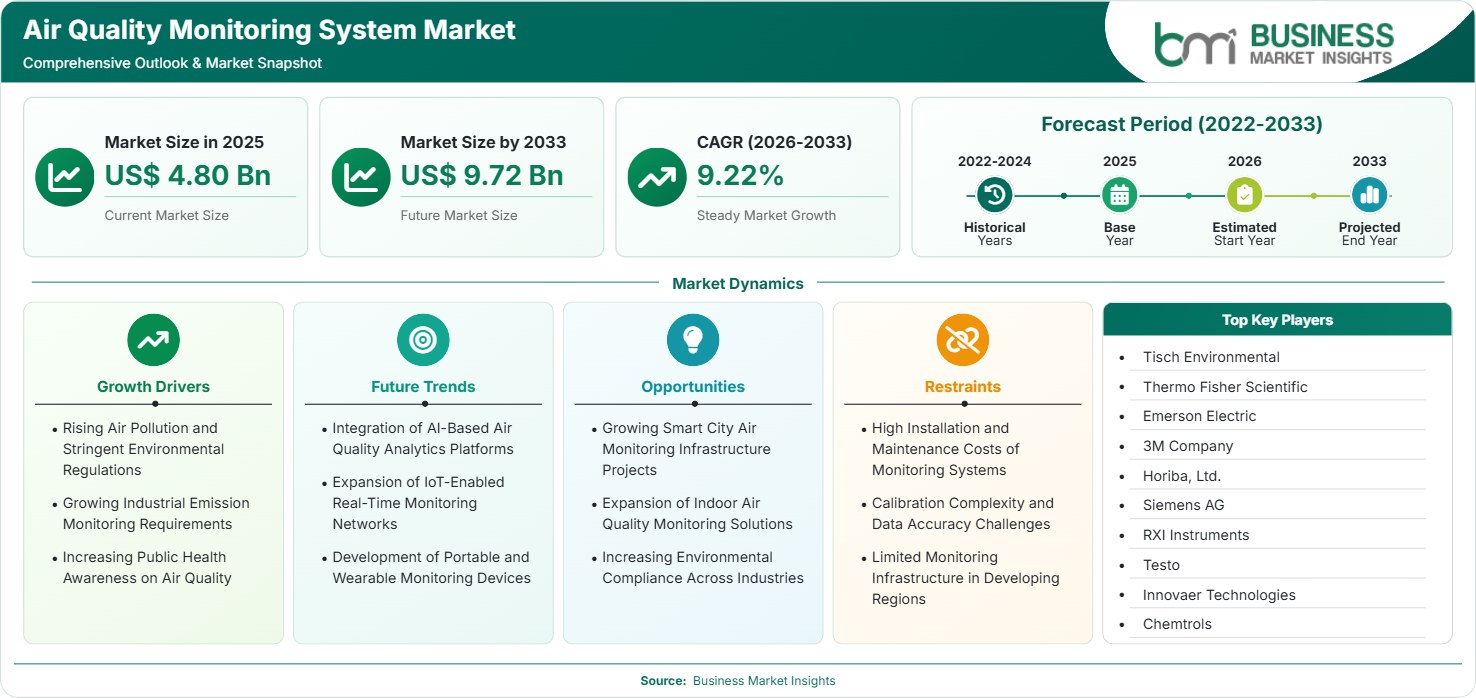
The Air Quality Monitoring System Market size was valued at US$ 4.80 Billion in 2025 and is projected to reach US$ 9.72 Billion by 2033, growing at a CAGR of 9.22% during 2026–2033. Growing pollution-control requirements, smart-city investments, industrial emissions compliance, and demand for indoor air-monitoring solutions are creating new opportunities across commercial, industrial, and public infrastructure applications.

Report Coverage
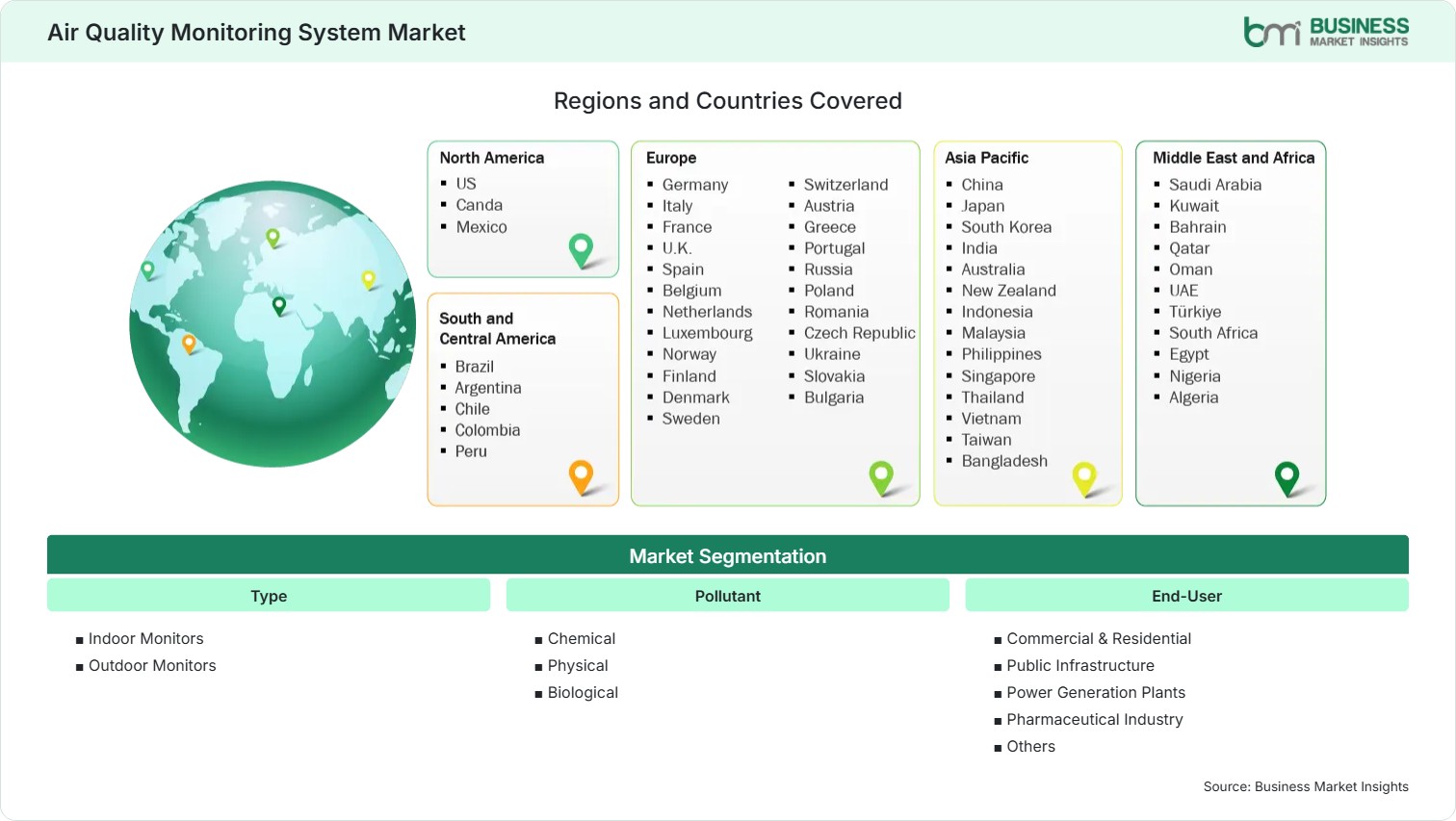
  • Type: Indoor Monitors, Outdoor Monitors
  • Pollutant: Chemical, Physical, Biological
  • End-User: Commercial & Residential, Public Infrastructure, Power Generation Plants, Pharmaceutical Industry, Others
US$ 4.80 Bn Market size in 2025
US$ 9.72 Bn Market Size by 2033
9.22% CAGR, 2026 - 2033
2026-2033 Forecast Period

01 AI Overview

Air Quality Monitoring System Market Summary

  • North America Region: North America holds an Air Quality Monitoring System market share of 34%–36% in 2025, growing at a CAGR of 8.4%–8.8% during 2026–2033, driven by environmental regulations, industrial monitoring requirements, smart infrastructure development, and the adoption of connected sensing technologies. The US market analysis indicates continued expansion with a CAGR of 8.5%–8.9% driven by emission compliance programs, industrial modernization, and demand for real-time monitoring platforms.
  • Fastest Growing Region: Asia Pacific maintains a market share of 27%–29% in 2025, expanding at a CAGR of 10.6%–11.1% during 2026–2033 due to rapid urbanization, rising pollution concerns, government clean-air initiatives, smart city projects, and increasing deployment of advanced environmental monitoring infrastructure.
  • Leading Segment: Outdoor Monitors account for a market share of 57%–60% in 2025, advancing at a CAGR of 8.8%–9.3% during 2026–2033, supported by regulatory monitoring requirements, industrial emission tracking, municipal air quality networks, and expansion of environmental surveillance programs.
  • High Growth Segment: Indoor Monitors represent a market share of 40%–43% in 2025, progressing at a CAGR of 10.2%–10.7% during 2026–2033, supported by healthy building standards, workplace safety initiatives, smart building integration, and rising awareness of indoor pollutant exposure.
  • Key Market Opportunity: Integration of IoT sensors, artificial intelligence analytics, cloud platforms, and predictive environmental monitoring solutions creates opportunities for manufacturers targeting smart cities, industrial facilities, healthcare environments, and commercial buildings.
  • Major Market Players: Tisch Environmental Technologies LLC, Thermo Fisher Scientific Inc., Emerson Electric Co., 3M Company, HORIBA, Ltd., Siemens AG, RX Instruments Ltd., Testo SE & Co. KGaA, Innovaer Technologies, and Chemtrols Industries Pvt. Ltd.
02 Strategic Insights

Air Quality Monitoring System Market: Strategic Insights

air-quality-monitoring-system-market-market-strategic-framework
FREE PDF
Request your free sample
Request free sample
03 Stakeholder View

Key Takeaways

  • The market ecosystem is evolving toward integrated solutions combining sensing hardware, analytics software, communication infrastructure, calibration services, and lifecycle support. Companies offering complete monitoring ecosystems are better positioned to capture recurring revenue opportunities across industrial and municipal applications.
  • Industrial facilities, commercial buildings, pharmaceutical environments, and public infrastructure represent high-potential application areas due to increasing compliance requirements and demand for continuous environmental visibility. Stakeholders investing in application-specific solutions can address diverse operational requirements.
  • Technology development is centered on compact sensors, wireless monitoring networks, artificial intelligence-based analytics, and cloud-enabled platforms. These innovations are improving measurement accuracy, reducing operational complexity, and enabling faster environmental decision-making.
  • Asia Pacific offers attractive expansion opportunities due to increasing urban populations, industrial growth, government pollution-control programs, and smart city investments. Countries such as China and India are creating strong demand for scalable monitoring infrastructure.
  • Strategic collaborations between instrumentation companies, automation providers, and digital technology firms are shaping competitive positioning. Partnerships focused on integrated hardware and software capabilities are helping companies expand across multiple end-user industries.
04 Geographic Outlook

Air Quality Monitoring System Market Regional Highlights

North America Air Quality Monitoring System Market

North America represented 34%–36% share in 2025 and is projected to expand at a CAGR of 8.4%–8.8% during 2026–2033. The region remains a mature market supported by regulatory compliance, industrial monitoring requirements, and advanced environmental infrastructure. The Air Quality Monitoring System Market share in North America is strengthened by demand from industrial facilities, municipalities, commercial buildings, and healthcare institutions requiring accurate real-time monitoring capabilities.

  • Regulatory frameworks continue encouraging industries to replace conventional monitoring equipment with connected systems offering automated reporting, improved compliance management, and continuous pollutant measurement capabilities.
  • Smart city initiatives are increasing deployment of distributed monitoring networks across urban areas, transportation corridors, and public infrastructure to support environmental planning and pollution control.
  • Industrial operators are adopting advanced monitoring technologies to improve emission management, operational efficiency, and sustainability reporting across manufacturing and energy sectors.
  • Growing adoption of IoT-enabled sensors and cloud analytics is improving remote monitoring capabilities while reducing maintenance requirements for large-scale environmental monitoring networks.

US Air Quality Monitoring System Market

The US is projected to hold a 24% to 26% share in 2025, and the market is projected to grow at a CAGR of 8.5% to 8.9% from 2026 to 2033. The US remains an important player in the market because of its stringent environmental laws, use of automation technology, and implementation of air quality improvement initiatives. The Air Quality Monitoring System market continues to grow across industries, offices, laboratories, and government monitoring networks requiring accurate environmental data.

  • Federal and state-level environmental requirements continue supporting demand for advanced monitoring systems capable of improving emission tracking and regulatory reporting.
  • Commercial buildings and healthcare facilities are increasing indoor monitoring adoption to improve ventilation management, occupant safety, and operational efficiency.
  • Industrial modernization initiatives are encouraging integration of monitoring platforms with automation systems for improved environmental control and process optimization.

Europe Air Quality Monitoring System Market

Europe Air Quality Monitoring System Market accounted for 25%–27% share in 2025 and is forecast to grow at a CAGR of 8.7%–9.1% during 2026–2033. The region benefits from stringent environmental policies, sustainability initiatives, and industrial emission regulations. Germany leads regional adoption with a CAGR of 8.5%–8.9%, while Poland represents a high-growth market with a CAGR of 9.8%–10.2% due to industrial modernization and environmental infrastructure investments.

  • Germany continues leading adoption through advanced manufacturing, Industry 4.0 integration, and demand for precision environmental monitoring solutions.
  • The United Kingdom is expanding urban monitoring networks through sustainability initiatives and increasing focus on public health protection.
  • France is witnessing increased adoption across pharmaceutical, commercial, and transportation applications due to environmental compliance requirements.
  • Poland is experiencing faster deployment as industries modernize facilities and adopt improved emission monitoring technologies.
  • European sustainability programs continue supporting demand for connected monitoring platforms capable of environmental data management and reporting.

Asia Pacific Air Quality Monitoring System Market

Asia Pacific captured 27%–29% share in 2025 and is expected to achieve the fastest CAGR of 10.6%–11.1% during 2026–2033. The region benefits from industrial expansion, urbanization, government clean-air programs, and smart city development. China leads the regional market with a CAGR of 10.4%–10.8%, while India shows strong growth potential with a CAGR of 11.2%–11.6%.

  • China continues expanding monitoring infrastructure through pollution control initiatives, industrial compliance programs, and large-scale smart city projects.
  • India is witnessing rising demand due to urban air pollution challenges, infrastructure development, and national environmental improvement programs.
  • Japan is adopting high-precision monitoring technologies across industrial, commercial, and transportation applications.
  • South Korea is integrating environmental monitoring with smart manufacturing and digital infrastructure initiatives.
  • Southeast Asian countries are increasing investments in pollution monitoring networks as urban populations and industrial activity expand.

Rest of World Air Quality Monitoring System Market

Rest of World represented 11%–13% share in 2025 and is anticipated to grow at a CAGR of 9.1%–9.5% during 2026–2033. South and Central America are witnessing increasing adoption due to industrial expansion and environmental regulations. The Middle East and Africa are developing monitoring infrastructure through sustainability programs, urban development projects, and industrial diversification strategies.

  • Brazil leads South American adoption with a CAGR of 9.0%–9.4%, supported by industrial activities, environmental regulations, and monitoring requirements.
  • Mexico continues expanding deployment across manufacturing zones, urban centers, and transportation networks requiring improved pollution management.
  • Saudi Arabia shows strong potential with a CAGR of 9.8%–10.2% due to smart city projects and sustainability investments.
  • The United Arab Emirates is investing in digital environmental platforms supporting sustainable urban development and infrastructure management.
  • South Africa is strengthening monitoring capabilities across mining, energy, and industrial sectors to improve environmental compliance.
global-market-geography
FREE PDF
Request your free sample
Request free sample
05 Segment Analysis

Air Quality Monitoring System Market Segmentation

Type

The type segment comprises Indoor and Outdoor Monitors. In this category, Outdoor Monitors are the leading segment owing to their widespread use across industries, environmental monitoring bodies, and cities. This segment accounts for 57% - 60% in 2025 and is projected to grow at a CAGR of 8.8%-9.3% during 2026-2034. Indoor Monitors have been seeing rising interest due to the growing emphasis on workplace safety, smart buildings, and indoor environments. The increasing adoption of connected monitoring platforms continues to shape segment expansion.

  • Indoor Monitors: Indoor monitoring solutions support commercial buildings, healthcare facilities, schools, and residential spaces by measuring pollutants, improving ventilation strategies, and enhancing occupant health through continuous environmental assessment.
  • Outdoor Monitors: Outdoor monitoring systems enable ambient air monitoring, industrial emissions tracking, municipal surveillance, and regulatory compliance through fixed and portable technologies deployed across diverse environments.

Pollutant

The Pollutant segment comprises Chemical, Physical, and Biological categories addressing different monitoring requirements across industries and public applications. Chemical monitoring remains strong due to industrial emissions control needs and regulatory requirements. Physical pollutant detection continues to expand in response to demand for particulate monitoring, while biological monitoring gains relevance in healthcare and controlled environments. The segment supports the Air Quality Monitoring System Market scope by enabling specialized solutions for diverse applications that require accurate pollutant identification, continuous measurement, and enhanced environmental management capabilities.

  • Chemical: Chemical pollutant monitoring systems detect harmful gases and volatile compounds in industrial, environmental, and commercial applications that require accurate emission measurements and compliance support.
  • Physical: Physical pollutant monitoring focuses on particulate matter detection, including PM2.5 and PM10 measurement, supporting urban air quality programs, industrial monitoring, and public health initiatives.
  • Biological: Biological monitoring solutions identify smart building solutions. Industrial users continue adopting monitoring systems for compliance and operational optimization. Pharmaceutical facilities require highly controlled environments, while public infrastructure projects increasingly deploy monitoring networks for airborne microorganisms and other biological contaminants in urban environments, supporting pharmaceutical facilities, healthcare environments, laboratories, and other controlled indoor spaces requiring contamination management.

End-User

The End-User segment includes Commercial & Residential, Public Infrastructure, Power Generation Plants, Pharmaceutical Industry, and Others. Commercial & Residential applications represent a significant demand area due to increasing awareness regarding indoor air quality and smart building solutions. Industrial users continue adopting monitoring systems for compliance and operational optimization. Pharmaceutical facilities require highly controlled environments, while public infrastructure projects increasingly deploy monitoring networks for urban environmental management. These applications continue supporting long-term market expansion across diverse sectors.

  • Commercial & Residential: Commercial and residential users are adopting monitoring solutions to improve indoor air quality, integrate with smart buildings, optimize ventilation, and manage occupant safety.
  • Public Infrastructure: Public infrastructure applications include airports, transportation hubs, government facilities, and urban monitoring networks requiring continuous environmental data collection and pollution management.
  • Power Generation Plants: Power generation plants utilize monitoring systems for emission measurement, regulatory compliance, operational efficiency improvement, and environmental performance management across energy facilities.
  • Pharmaceutical Industry: Pharmaceutical manufacturers deploy advanced monitoring technologies to maintain controlled environments, reduce contamination risks, and support quality standards during production and research activities.
06 Market Forces

Air Quality Monitoring System Market Dynamics

Key Market Drivers

Rising Air Pollution and Stringent Environmental Regulations

Rising levels of pollution and strict environmental laws and policies are fueling market growth in the market. The World Health Organization stresses that air pollution is one of the biggest health concerns worldwide. Regulations from regulatory bodies are becoming more stringent regarding pollution tracking across industries, cities, and transport. The Air Quality Monitoring System Market trend suggests that there will be a growing popularity of connected solutions offering real-time monitoring and automated reporting for pollution management.

Growing Industrial Emission Monitoring Requirements

Emission monitoring technologies are gaining momentum in investment from the industrial sector to meet regulatory requirements, enhance performance, and reduce environmental hazards. The power generation industry, manufacturing plants, chemical industries, and processing plants need accurate measurements for gases and particulates. The integration of the Air Quality Monitoring System Market with industrial automation tools is enhancing emission monitoring through real-time alarms, data management, and predictive capabilities. The adoption of emission monitoring technology is increasing among firms due to sustainability goals, operational risks, and environmental reporting requirements.

Increasing Public Health Awareness on Air Quality

Rising awareness regarding the relationship between air quality and health outcomes is increasing demand across residential, commercial, and institutional environments. Schools, hospitals, offices, and residential buildings are adopting monitoring solutions to understand indoor pollutant levels and improve ventilation management. Growing concerns regarding airborne contaminants and workplace safety are encouraging organizations to implement continuous monitoring strategies. The healthcare and facility management sectors are increasingly using environmental data to support healthier environments, reduce exposure risks, and improve overall occupant well-being.

Key Market Opportunities

Growing Smart City Air Monitoring Infrastructure Project

The expansion of smart city programs has created an opportunity to implement connected environmental monitoring systems that integrate sensors, communication technology, cloud computing capabilities, and analysis. City authorities are setting up monitoring facilities throughout the city to assess pollution levels and support urban planning to ensure sustainable goals. Countries with emerging economies have been investing in their digital infrastructure, thereby increasing the need for scalable monitoring systems. AI-based analysis and integration with geographical information systems are helping predict pollution levels and respond swiftly. These factors have increased the opportunities for suppliers of connected environmental monitoring systems in the urban and public infrastructure segments, which will drive the Air Quality Monitoring System Market Forecast.

Expansion of Indoor Air Quality Monitoring Solutions

The increasing emphasis on providing healthy indoor environmental conditions is leading to new possibilities in the indoor monitoring market across the commercial, healthcare, educational, and residential sectors. Organizations use monitoring systems to optimize the ventilation process, increase energy efficiency, and ensure workplace safety. Integration with building management systems provides automation and the ability to make decisions instantly. The growing demand for smart buildings and sustainability certifications is driving the adoption of monitoring technologies. Manufacturers that provide small sensors, wireless communication, and cloud analytics have an advantage in addressing new demands.

Increasing Environmental Compliance Across Industries

Increasing compliance regulations are prompting industries to adopt efficient monitoring systems to help them control emissions and measure sustainability performance. Environmental data is needed in industries such as manufacturing, energy, pharmaceuticals, and chemicals to comply with existing regulations and increase transparency. Increased demand for environmental, social, and governance (ESG) reporting is fueling demand for effective monitoring systems to measure environmental performance. Air Quality Monitoring System Market solutions integrating hardware, software analytics, and maintenance services would create opportunities through industrial long-term contracts. Increased environmental regulations in emerging countries would further drive adoption.

Market Restraints and Challenges

High Installation and Maintenance Costs of Monitoring Systems

Factor: High initial investment requirements associated with advanced monitoring equipment, installation infrastructure, calibration procedures, and maintenance services create financial barriers for smaller organizations. Impact: Increased deployment costs can delay adoption decisions, particularly among price-sensitive users who prioritize short-term operational budgets over long-term environmental benefits. Complex systems requiring specialized technical support may further increase ownership expenses. Although sensor costs are gradually declining, advanced monitoring platforms with networking capabilities and analytical features continue requiring significant investment. Air Quality Monitoring System Market participants are addressing this challenge through modular solutions, subscription-based services, and scalable deployment models that reduce upfront expenditure.

Calibration Complexity and Data Accuracy Challenges

Factor: Maintaining measurement accuracy requires frequent calibration, environmental adjustments, and technical expertise, especially in applications involving changing pollutant concentrations and operating conditions. Impact: Calibration inconsistencies may compromise the reliability of collected data, create compliance issues, and reduce users' trust in monitoring systems. Changes in weather conditions, such as temperature and humidity, could affect sensor performance. Manufacturers are developing self-calibration mechanisms, machine learning solutions, and remote diagnostics systems to enhance sensor performance.

07 Company Analysis

Competitive Landscape

The Air Quality Monitoring System Market analysis indicates a competitive landscape dominated by global instrumentation companies, industrial automation providers, and specialized environmental technology manufacturers. Companies are focusing on sensor innovation, digital analytics, connected platforms, and application-specific monitoring solutions to strengthen market positioning. Competitive differentiation depends on measurement accuracy, regulatory compliance capabilities, connectivity features, and lifecycle support services.

Company Name

Overview

Products and Services relevant to this market

Tisch Environmental Technologies LLC

Environmental monitoring provider specializing in air sampling equipment and measurement solutions for research and regulatory applications.

High-volume air samplers, particulate monitoring equipment, environmental sampling systems, and air quality measurement technologies.

Thermo Fisher Scientific Inc.

Global scientific technology company providing analytical instruments and environmental monitoring solutions.

Ambient air monitoring systems, gas analyzers, particulate measurement instruments, and environmental analysis platforms.

Emerson Electric Co.

Industrial automation company delivering measurement technologies and digital solutions.

Gas analysis systems, emission monitoring solutions, industrial sensors, and environmental management platforms.

3M Company

Technology company providing workplace safety, sensing, and environmental solutions.

Air monitoring instruments, exposure monitoring solutions, filtration technologies, and safety products.

HORIBA, Ltd.

Measurement technology company specializing in environmental and industrial analytical systems.

Ambient air monitoring systems, gas analyzers, particulate measurement equipment, and testing solutions.

Siemens AG

Industrial technology provider offering automation and digital infrastructure solutions.

Environmental monitoring systems, building automation integration, industrial sensors, and digital platforms.

RX Instruments Ltd.

Environmental instrumentation specialist providing air monitoring technologies.

Ambient monitoring equipment, gas measurement instruments, calibration solutions, and environmental services.

Testo SE & Co. KGaA

German measurement technology company serving industrial and commercial applications.

Portable air quality analyzers, indoor monitoring devices, and diagnostic measurement tools.

Innovaer Technologies

Technology provider focused on connected environmental monitoring solutions.

Smart air monitoring devices, sensor platforms, and environmental data solutions.

Chemtrols Industries Pvt. Ltd.

Industrial instrumentation company serving process and environmental


10 Trust & Transparency

Research Methodology

The market analysis combines proprietary research with secondary data from government agencies, company disclosures, regulatory filings, industry databases and expert interviews. Market estimates are validated through data triangulation, cross-market benchmarking and analyst review.

View Full Research Methodology

11 Questions Answered

Frequently Asked Questions

What does the Air Quality Monitoring System Market Report provide?

The report provides insights into market size, segmentation, regional developments, competitive strategies, industry trends, opportunities, challenges, and future growth outlook.

Which region offers the strongest future growth opportunity?

Asia Pacific offers significant growth potential due to rapid urbanization, industrial expansion, smart-city investments, and government initiatives to improve air quality management.

How are IoT and artificial intelligence influencing monitoring technologies?

IoT connectivity and artificial intelligence are enabling real-time data collection, predictive analytics, remote system management, automated alerts, and improved decision-making across environmental monitoring applications.

Why are indoor air quality monitoring solutions gaining importance?

Indoor monitoring solutions are gaining importance due to increased awareness of workplace health, building sustainability standards, the need to optimize ventilation, and the demand for healthier indoor environments.

What are the major applications driving adoption of air quality monitoring systems?

Industrial emissions monitoring, smart city infrastructure, indoor air quality management, pharmaceutical manufacturing, public infrastructure, and commercial building applications are major drivers of adoption due to regulatory and operational requirements.

Access the Full Air Quality Monitoring System Market Report

Get segment-level forecasts, regional estimates, competitive benchmarking, company profiles and downloadable Excel datasets.

Access the full Air Quality Monitoring System Market Report
350 pages PDF & Excel | 2026-08-03