Market Summary
Executive Summary and Global Market Analysis
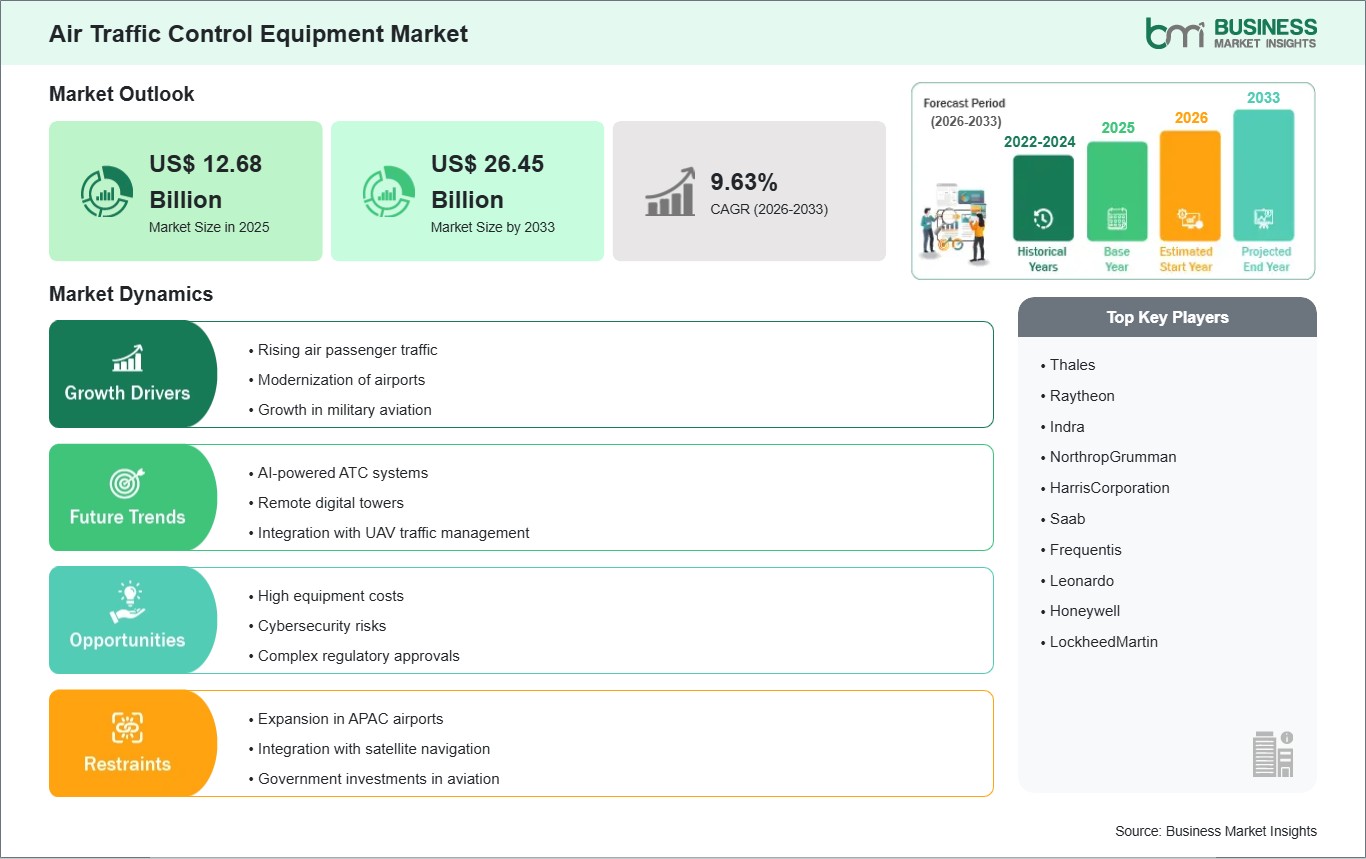
Air traffic control equipment includes advanced systems and technologies used to monitor, manage, and coordinate aircraft movement in airspace and on airport runways. These systems include radar equipment, navigation systems, communication technologies, and surveillance solutions that support safe and efficient air traffic operations. Air traffic control equipment is widely used by airports, military airbases, and aviation authorities to reduce operational risks, improve flight coordination, and manage increasing air traffic volumes. The market is growing as global aviation activities continue to expand and governments invest in modernizing airport infrastructure and air traffic management systems. The increasing use of digital communication technologies, satellite-based navigation systems, and automated surveillance platforms is supporting the modernization of air traffic control operations. Rising passenger traffic and growing demand for efficient airport management systems are also contributing to market expansion.
Several challenges could affect the growth of the market during the forecast period. The installation and maintenance of advanced air traffic control systems require significant infrastructure investment and technical expertise. Many airports and aviation authorities face difficulties in upgrading legacy systems while maintaining uninterrupted flight operations. Cybersecurity concerns associated with connected aviation systems and digital communication networks are also becoming increasingly important. In addition, complex regulatory approval processes and interoperability requirements between national and international aviation systems may delay infrastructure modernization projects in certain regions.
Despite these challenges, the market is expected to witness steady growth due to increasing investment in smart airport technologies and advanced aviation infrastructure. Opportunities are emerging from the adoption of artificial intelligence, cloud-based air traffic management systems, and satellite-enabled surveillance technologies. The growing focus on improving aviation safety, reducing flight delays, and supporting unmanned aerial vehicle integration is also creating demand for next-generation air traffic control equipment. Expanding airport construction projects and modernization programs across developing economies are expected to further support the long-term growth of the Air Traffic Control Equipment market.
Segment Analysis
Air Traffic Control Equipment Market Segmentation
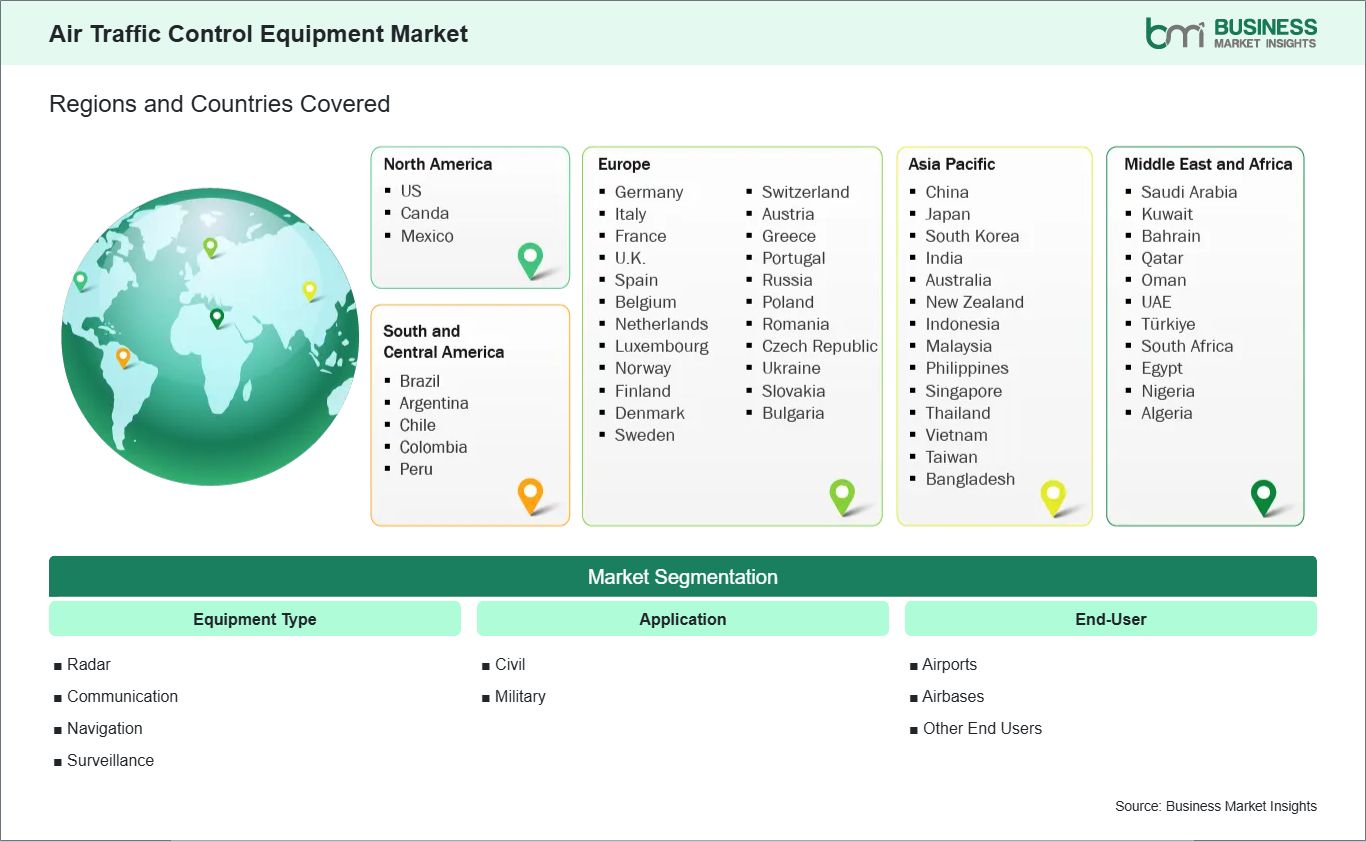
The Air Traffic Control Equipment market is segmented based on equipment type, application, and end-user. Increasing aviation activities and modernization of airport infrastructure are supporting demand across multiple operational segments.
By Equipment Type
- Radar: Radar systems are widely used for aircraft detection, tracking, and airspace monitoring to support safe aviation operations.
- Communication: Communication systems help maintain real-time coordination between pilots, air traffic controllers, and airport authorities.
- Navigation: Navigation equipment supports accurate aircraft positioning and route management during flight operations.
- Surveillance: Surveillance systems provide advanced monitoring capabilities and support efficient airspace management.
By Application
- Civil: Civil aviation accounts for a major share due to increasing passenger air traffic and airport modernization initiatives.
- Military: Military applications use advanced air traffic control systems for defense operations, airbase coordination, and mission management.
By End-User
- Airports: Airports represent a major segment due to ongoing investments in air traffic management and aviation infrastructure modernization.
- Airbases: Airbases use advanced control equipment to support defense aviation operations and secure airspace coordination.
- Other End Users: Other end users include aviation training centers and government aviation agencies.
Market Forces
Air Traffic Control Equipment Market Drivers and Opportunities
Expansion of Global Air Traffic and Airport Modernization
The increasing volume of global air traffic and ongoing airport modernization programs are major factors driving the growth of the Air Traffic Control Equipment market. Rising passenger travel, expanding cargo transportation, and increasing international flight operations are placing pressure on existing aviation infrastructure. Airports and aviation authorities are investing in advanced air traffic control systems to improve operational efficiency, reduce congestion, and strengthen aviation safety standards. Modern radar systems, digital communication technologies, and satellite-based navigation solutions are increasingly being adopted to support real-time aircraft coordination and efficient airspace management.
Governments and aviation regulators are also focusing on upgrading aging airport infrastructure to handle growing air traffic demand and improve operational reliability. The integration of automated surveillance technologies and digital air traffic management platforms is helping airports optimize runway operations and reduce flight delays. In military aviation, advanced air traffic control equipment is becoming essential for secure mission coordination and defense airspace management. In addition, the increasing development of smart airports and connected aviation ecosystems is creating strong demand for next-generation communication and surveillance systems. These factors are expected to support long-term market growth across civil and military aviation sectors.
Advancements in Digital Aviation and Smart Airspace Management
The growing adoption of digital aviation technologies and smart airspace management systems is creating significant opportunities for the Air Traffic Control Equipment market. Aviation authorities are increasingly investing in cloud-based traffic management systems, artificial intelligence, and advanced data analytics to improve operational efficiency and enhance flight safety. These technologies help air traffic controllers process large volumes of flight information more accurately while supporting predictive traffic management and automated decision-making capabilities.
Satellite-based navigation and surveillance systems are also creating new opportunities for aviation modernization. These technologies improve aircraft tracking accuracy, support remote airspace management, and reduce dependence on traditional ground-based infrastructure. The increasing integration of unmanned aerial vehicles and urban air mobility systems into controlled airspace is further encouraging the adoption of advanced traffic management solutions capable of handling complex aviation operations.
Size and Share Analysis
Air Traffic Control Equipment Market Size and Share Analysis
The Air Traffic Control Equipment Market is projected to grow from US$ 12.68 Billion in 2025 to US$ 26.45 Billion by 2033 , registering a CAGR of 9.63% from 2026 to 2033.
By equipment type, radar systems account for a significant share due to their critical role in aircraft tracking, airspace monitoring, and operational safety management. Communication systems continue to witness strong adoption as airports and aviation authorities focus on real-time coordination and digital aviation networks. Navigation and surveillance systems are also gaining importance with the increasing use of satellite-based air traffic management technologies and automated monitoring platforms.
By application, civil aviation dominates the market owing to rising passenger traffic, airport expansion projects, and modernization of commercial aviation infrastructure. Military aviation also contributes significantly to market growth due to increasing investments in defense airspace management and advanced aviation security systems. By end-user, airports represent the largest market share because of continuous investments in smart airport technologies and advanced traffic management systems. Airbases are also expanding their adoption of modern air traffic control equipment to support secure defense operations and efficient airspace coordination.
Report Coverage
Air Traffic Control Equipment Market Report Coverage and Deliverables
The "Air Traffic Control Equipment Size and Forecast (2022-2033)" report provides a detailed analysis of the market covering below areas:
- Market size and forecast at global, regional, and country levels for all the key market segments covered under the scope
- Market trends, as well as market dynamics such as drivers, restraints, and key opportunities
- Market analysis covering key market trends, global and regional framework, major players, regulations, and recent market developments
- Industry landscape and competition analysis covering market concentration, heat map analysis, prominent players, and recent developments for the market
- Detailed company profiles, including SWOT analysis
Geographic Insights
Air Traffic Control Equipment Market Geographic Insights
The Air Traffic Control Equipment Market shows diverse regional adoption patterns influenced by aviation infrastructure modernization, rising air traffic volumes, and increasing focus on airspace management efficiency.
North America, being a developed region, has a highly advanced aviation infrastructure and a strong presence of modern airport systems. The region comprises the United States and Canada, where aviation authorities are investing in digital air traffic management systems, advanced radar technologies, and smart airport infrastructure. The region focuses on improving flight safety, reducing operational congestion, and strengthening communication networks across civil and military aviation sectors. It also benefits from established regulatory frameworks and strong technological capabilities, supporting the continuous modernization of air traffic control systems across airports and defense airbases.
Asia Pacific is growing significantly, driven by rapid airport expansion, increasing passenger traffic, and rising investments in aviation infrastructure development. The region comprises countries such as China, India, Japan, and South Korea, where governments are focusing on improving airport capacity and strengthening air traffic management systems. The region is emphasizing modernization of communication, navigation, and surveillance technologies to support growing aviation activities and regional connectivity projects. Expanding commercial aviation networks and increasing defense modernization programs are also contributing to the growth of the Air Traffic Control Equipment Market across the region.
Both regions are contributing significantly to the growth of the Air Traffic Control Equipment Market, focusing on advanced aviation technologies, infrastructure development, and modernization of airspace management systems.
Industry Activity
Recent Developments
The Air Traffic Control Equipment Market is analyzed using a mix of primary and secondary research sources, including corporate publications, industry associations, and verified databases. This approach ensures accurate tracking of innovation trends and strategic developments influencing the market.
- In September 2025, Thales introduced upgraded radar and navigation solutions for civil and military aviation applications to improve aircraft tracking accuracy and operational coordination. The systems were designed to support next-generation air traffic management and digital aviation infrastructure modernization initiatives. The development reflects the increasing focus on advanced surveillance and navigation technologies across global aviation sectors.
- In June 2024, Indra announced the deployment of advanced air traffic management and surveillance systems for airport modernization projects aimed at improving operational efficiency and airspace safety. The development included enhanced digital communication technologies and integrated surveillance capabilities designed to support increasing air traffic demand. The update highlights the growing adoption of smart air traffic management infrastructure globally.
Trust & Transparency
Research Methodology
The market analysis combines proprietary research with secondary data from government agencies, company disclosures, regulatory filings, industry databases and expert interviews. Market estimates are validated through data triangulation, cross-market benchmarking and analyst
review.
View Full Research Methodology
Key Sources Referred:
World Bank - Global Trade Indicators World Trade Organization (WTO) International Monetary Fund (IMF) International Trade Administration (ITA) Company Websites Company Annual Reports Company Investor Presentations