
Motion Control Market Outlook: Size, Share, Trends, Growth Analysis, Competitive Landscape & Forecast, 2026-2033

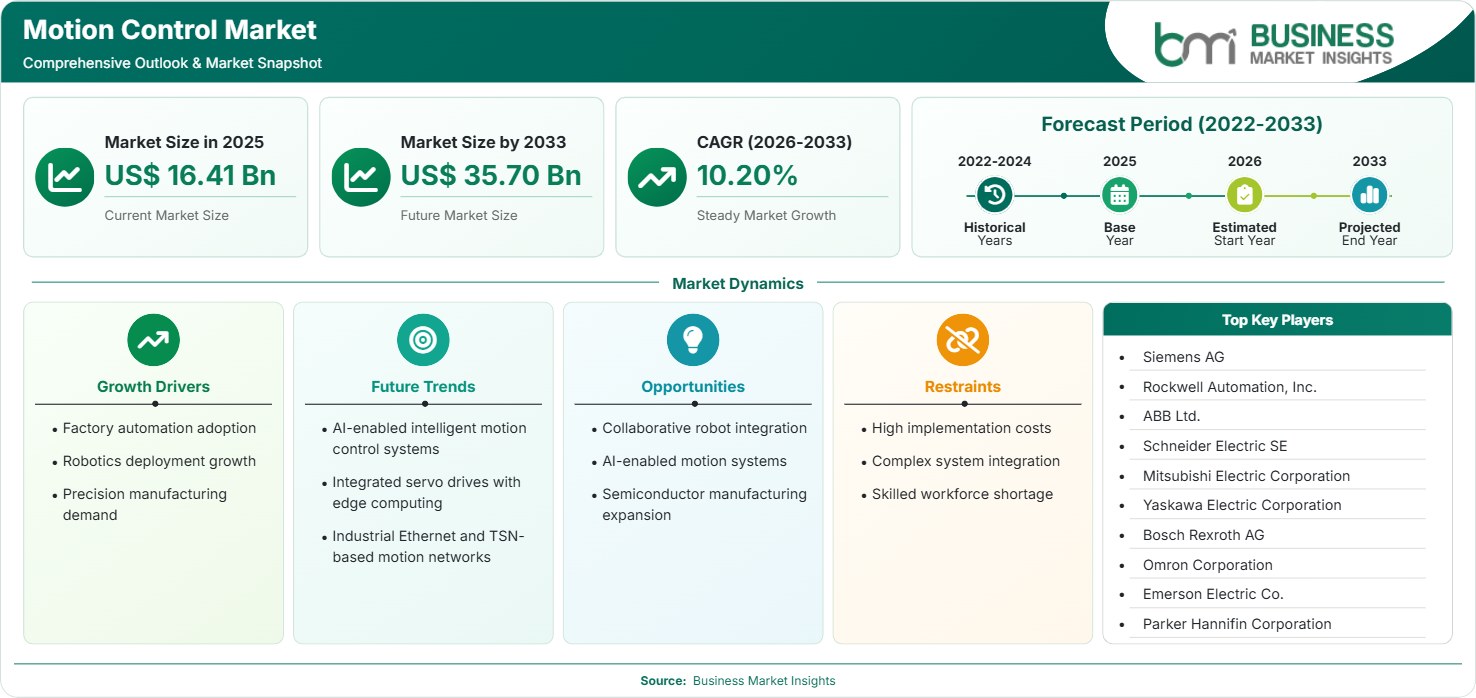
The Motion Control Market size was valued at US$ 16.41 billion in 2025 and is projected to reach US$ 35.70 billion by 2033, growing at a CAGR of 10.20% during 2026–2033. Growth is driven by factory automation adoption, robotics deployment, precision manufacturing requirements, and increasing demand for intelligent motion solutions across industrial applications.

Report Coverage
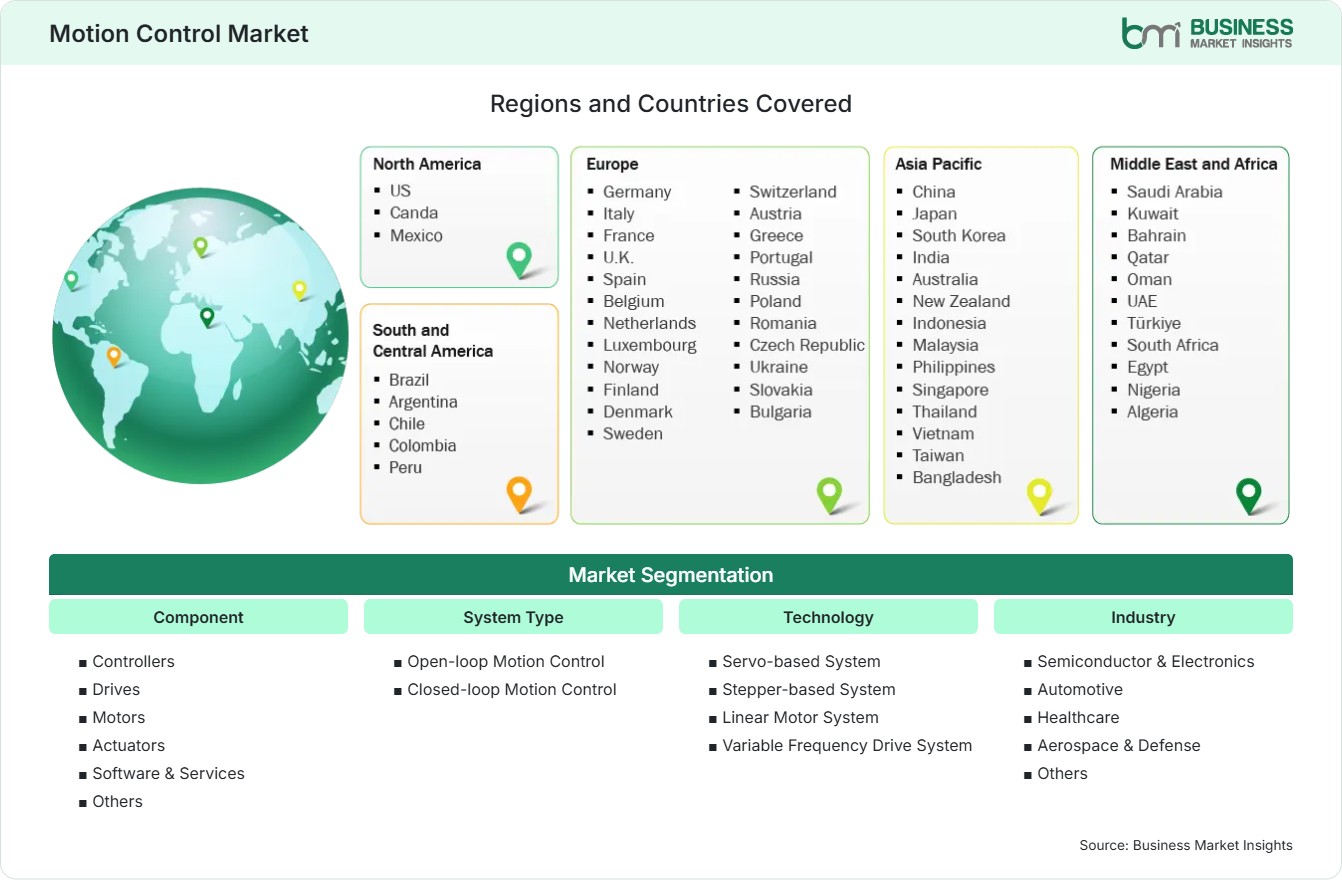
  • Component: Controllers, Drives, Motors, Actuators, Software & Services, Others
  • System Type: Open-loop Motion Control, Closed-loop Motion Control
  • Technology: Servo-based System, Stepper-based System, Linear Motor System, Variable Frequency Drive System
  • Industry: Semiconductor & Electronics, Automotive, Healthcare, Aerospace & Defense, Others
US$ 16.41 Bn Market size in 2025
US$ 35.70 Bn Market Size by 2033
10.20% CAGR, 2026 - 2033
2026-2033 Forecast Period

AI Overview

Motion Control Market Summary

  • North America Region: North America holds an estimated 31%–34% motion control market share in 2025, growing at a 9.2%–9.8% CAGR during 2026–2033. Automation investments, semiconductor manufacturing expansion, industrial robotics adoption, and reshoring initiatives support market development. The US market benefits from advanced manufacturing modernization, with an estimated 9.4%–10.0% CAGR through 2033 driven by smart factories, robotics, and industrial digitalization.
  • Fastest Growing Region: Asia Pacific represents an estimated 36%–39% share in 2025, expanding at a 11.2%–11.8% CAGR during 2026–2033. Manufacturing expansion, electronics production, semiconductor investments, and automation adoption across China, Japan, South Korea, and India accelerate demand for advanced motion control technologies.
  • Leading Segment: Controllers represent an estimated 25%–28% share in 2025, expanding at a 10.0%–10.6% CAGR during 2026–2033. Increasing adoption of programmable automation systems, industrial networks, and integrated control platforms supports demand across manufacturing, robotics, and process automation applications.
  • High Growth Segment: Software & Services represent an estimated 14%–17% share in 2025, growing at a 12.0%–12.6% CAGR during 2026–2033. Digital twins, predictive maintenance, AI-based optimization, and cloud-connected industrial platforms are accelerating adoption of software-driven motion solutions.
  • Key Market Opportunity: Integration of artificial intelligence, collaborative robotics, semiconductor manufacturing expansion, and intelligent automation platforms creates significant opportunities for motion control providers developing adaptive, connected, and energy-efficient systems.
  • Major Market Players: Siemens AG, Rockwell Automation, Inc., ABB Ltd., Schneider Electric SE, Mitsubishi Electric Corporation, Yaskawa Electric Corporation, Bosch Rexroth AG, Omron Corporation, Emerson Electric Co., Parker Hannifin Corporation.
Strategic Insights

Motion Control Market: Strategic Insights

Motion Control Market Strategic Framework
FREE PDF
Request your free sample
Request free sample
Stakeholder View

Key Takeaways

1. The market ecosystem is shifting from standalone motion components toward integrated automation architectures combining controllers, drives, motors, sensors, industrial networks, and software platforms that improve operational visibility and machine performance.

2. Semiconductor manufacturing, automotive electrification, robotics, and precision equipment production represent high-value application areas where advanced motion systems provide measurable improvements in accuracy, throughput, and manufacturing flexibility.

3. Artificial intelligence, machine learning algorithms, digital twins, and predictive analytics are transforming motion control systems by enabling adaptive performance optimization and reducing unexpected equipment failures.

4. Asia Pacific remains a strategic expansion region due to its manufacturing concentration, semiconductor investments, electronics production capacity, and increasing adoption of industrial automation across developing economies.

5. Leading automation companies are strengthening market positions through technology partnerships, software integration capabilities, acquisitions, and expanded industrial automation portfolios focused on connected manufacturing solutions.

Geographic Outlook

Motion Control Market Regional Highlights

North America Motion Control Market

North America maintains a strong position with an estimated 31%–34% market share in 2025, supported by advanced manufacturing infrastructure, industrial automation adoption, and semiconductor investment initiatives. The region is projected to expand at a 9.2%–9.8% CAGR during 2026–2033 as manufacturers increase deployment of robotics, intelligent machinery, and connected production systems. The United States remains the dominant contributor due to its established technology ecosystem and automation-intensive industries.

  • Automotive manufacturers are increasing automation investments to improve production efficiency, particularly across electric vehicle and battery manufacturing facilities.
  • Semiconductor manufacturing expansion is strengthening demand for ultra-precise motion systems supporting advanced fabrication and inspection processes.
  • Industrial reshoring initiatives are encouraging manufacturers to adopt automated production technologies to improve competitiveness and operational resilience.
  • Healthcare equipment manufacturing continues adopting precision motion solutions for advanced diagnostic and laboratory systems.

US Motion Control Market

The US market represents an estimated 80%–84% share of North America's Motion Control Market in 2025 and is projected to grow at a 9.4%–10.0% CAGR through 2033. Strong technology infrastructure, automation investments, and increasing adoption of robotics across manufacturing sectors continue supporting market expansion. Growth is further supported by semiconductor capacity development and industrial modernization programs.

  • Advanced manufacturing initiatives are increasing demand for automated equipment requiring precise positioning, speed control, and integrated monitoring.
  • Aerospace and defense manufacturers are adopting high-performance motion systems for complex production and testing applications.
  • Industrial software integration is improving demand for connected motion platforms supporting predictive maintenance and operational optimization.

Europe Motion Control Market

Europe accounts for an estimated 23%–26% share in 2025, expanding at a 9.5%–10.1% CAGR during 2026–2033. The region benefits from strong industrial automation expertise, automotive manufacturing capabilities, and sustainability-driven factory modernization. Germany remains the leading contributor, while countries including Italy and France continue increasing automation investments across manufacturing sectors.

  • Germany maintains leadership through extensive industrial automation adoption and advanced machinery manufacturing capabilities.
  • Automotive electrification investments are increasing deployment of precision motion systems across production facilities.
  • European manufacturers are prioritizing energy-efficient drives and intelligent automation solutions to reduce operational costs.
  • Industrial digitalization initiatives are encouraging adoption of connected motion control architectures.

Asia Pacific Motion Control Market

Asia Pacific represents the largest regional market with an estimated 36%–39% share in 2025 and the highest growth rate of 11.2%–11.8% CAGR during 2026–2033. Manufacturing expansion, semiconductor production, electronics assembly, and robotics deployment are driving strong demand. China, Japan, South Korea, and India remain key contributors due to industrial modernization and automation investments.

  • China continues leading regional demand through large-scale manufacturing automation and electronics production capacity.
  • Japan maintains strong adoption due to robotics expertise and advanced precision manufacturing industries.
  • India is experiencing increasing automation adoption across automotive, electronics, and industrial manufacturing sectors.
  • South Korea's semiconductor industry supports demand for highly precise motion systems and automated production equipment.
  • Southeast Asian countries are attracting manufacturing investments requiring advanced automation technologies.

Rest of World Motion Control Market

Latin America, the Middle East, and Africa collectively represent an estimated 7%–10% share in 2025, growing at a 9.8%–10.5% CAGR through 2033. Industrial diversification, mining automation, energy investments, and manufacturing modernization are creating opportunities for motion control suppliers. Brazil, Mexico, UAE, and Saudi Arabia represent important growth markets due to expanding industrial infrastructure.

  • Mexico benefits from manufacturing expansion and automotive production integration with North American supply chains.
  • Brazil is increasing automation adoption across food processing, mining, and industrial manufacturing sectors.
  • Middle Eastern countries are investing in industrial diversification programs requiring advanced automation technologies.
  • Energy and infrastructure projects are supporting demand for reliable motion systems.
  • African industrial development initiatives are gradually increasing adoption of automated production solutions.
Global Market Geography
FREE PDF
Request your free sample
Request free sample
Segment Analysis

Motion Control Market Segmentation

Component

The Component segment represents an estimated 34%–37% share in 2025 and is projected to expand at a 10.1%–10.7% CAGR during 2026–2033. Increasing industrial automation adoption, demand for integrated machine architectures, and the transition toward intelligent manufacturing systems are strengthening demand across controllers, drives, motors, actuators, and software platforms. The Motion Control Market trends indicate growing preference for modular, connected components that enable improved machine flexibility, operational monitoring, and real-time performance optimization across manufacturing environments.

  • Controllers: Controllers remain essential for coordinating machine movements, executing automation logic, and enabling communication between industrial equipment, sensors, drives, and enterprise-level automation platforms.
  • Drives: Motion drives are gaining adoption due to increasing demand for precise speed regulation, energy efficiency, torque management, and optimized performance in automated production systems.
  • Motors: Motors continue representing a critical component category as industries adopt high-efficiency servo motors, stepper motors, and precision motor technologies for robotics and manufacturing applications.
  • Actuators: Actuators support automation growth through accurate positioning, linear movement control, and improved machine productivity across assembly, packaging, healthcare, and industrial equipment applications.
  • Software & Services: Software and services are expanding rapidly through industrial analytics, digital twins, predictive maintenance, remote monitoring, and intelligent automation platforms supporting connected manufacturing.

System Type

The System Type segment contributes an estimated 22%–25% share in 2025 and is expected to grow at a 10.0%–10.6% CAGR through 2033. Adoption patterns are shifting toward closed-loop architectures because manufacturers increasingly require higher accuracy, feedback control, and process consistency. Open-loop systems continue maintaining demand in cost-sensitive applications where simpler automation requirements and lower implementation complexity remain important purchasing factors.

  • Open-loop Motion Control: Open-loop systems remain suitable for basic automation applications requiring predetermined movement patterns, lower costs, simplified installation, and reliable operation without feedback mechanisms.
  • Closed-loop Motion Control: Closed-loop systems are increasingly adopted for precision manufacturing, robotics, semiconductor equipment, and advanced automation applications requiring continuous feedback and accurate positioning control.

Technology

The Technology segment accounts for an estimated 28%–31% share in 2025 and is projected to grow at a 10.4%–11.0% CAGR during 2026–2033. Technological advancements in servo systems, linear motors, variable frequency drives, and stepper solutions are improving machine accuracy, productivity, and energy management during motion control market forecasts. Manufacturers increasingly select motion technologies based on application requirements, including speed, precision, load handling capability, and operational efficiency.

  • Servo-based System: Servo-based systems are widely adopted in robotics, CNC machinery, packaging equipment, and semiconductor manufacturing due to superior accuracy, responsiveness, and dynamic performance.
  • Stepper-based System: Stepper-based systems remain valuable for applications requiring controlled positioning, simplified operation, cost efficiency, and reliable movement control in less complex automation environments.
  • Linear Motor System: Linear motor systems are gaining adoption in high-speed manufacturing, semiconductor equipment, and precision inspection applications requiring direct-drive motion and exceptional positioning accuracy.
  • Variable Frequency Drive System: Variable frequency drive systems support industrial energy efficiency by controlling motor speed, improving process management, and optimizing performance across pumps, conveyors, and industrial machinery.

Industry

The Industry segment represents the largest application category with an estimated 41%–44% share in 2025 and a projected 10.6%–11.2% CAGR during 2026–2033. Rising automation requirements across manufacturing sectors, increased robotics adoption, and demand for precision production processes continue supporting market expansion. The Motion Control Market growth is closely connected with industrial transformation initiatives focused on productivity enhancement, manufacturing flexibility, and reduced operational downtime.

  • Semiconductor & Electronics: Semiconductor and electronics manufacturers increasingly deploy advanced motion systems for wafer processing, assembly, inspection, and high-precision production applications.
  • Automotive: Automotive manufacturers adopt motion control technologies for robotic assembly, electric vehicle production, welding, painting, and automated quality inspection processes.
  • Healthcare: Healthcare equipment manufacturers utilize precision motion solutions for diagnostic systems, laboratory automation, medical robotics, and advanced manufacturing of medical devices.
  • Aerospace & Defense: Aerospace and defense industries require high-performance motion technologies for aircraft production, testing equipment, simulation systems, and precision manufacturing applications.
Market Forces

Motion Control Market Dynamics

Key Market Drivers

Factory automation adoption accelerates industrial motion demand

Across the globe, manufacturers have increased their investment in automation to boost their productivity and save on costs while dealing with labor shortages. Automation involves coordinated movement between production lines, robots, packaging machines, and other kinds of industrial machinery, resulting in constant need for motion technologies. Moreover, the introduction of smart manufacturing is prompting more firms to integrate interconnected controllers, intelligent drives, and software solutions for monitoring purposes. Motion Control Market growth is driven by the need for more flexible production, better quality assurance, and increased efficiency on the part of industries. With the rise of Industry 4.0, motion systems have become integral to digitalized production.

Robotics deployment expands across manufacturing sectors

Increasing use of industrial and collaborative robots is boosting the need for accurate motion components that can perform complex motions and repetitive tasks. Robotic systems are being implemented by the automotive industry, electronics, logistics, healthcare, and manufacturing sectors in order to increase accuracy, efficiency, and safety in the workplace. Motion controllers, servo drives, motors, and actuators are important parts without which robot operations cannot be carried out successfully. The need for more robotic systems implies the need for advanced systems that have fast responses, better synchronicity, and communication skills.

Precision manufacturing increases demand for advanced systems

The increase in complexity involved in semiconductor manufacturing, electronics assembly, medical devices manufacturing, and aerospace parts is leading to an increase in the need for precision motion control solutions. Precision manufacturing involves systems that can be able to reach micron precision positioning, repeatability, and stability under tough environments. The advanced servo technology, linear motors, and feedback systems are being used more by manufacturers due to their ability to enhance the quality of products manufactured and reduce the number of production mistakes. There have been many innovations in the area of motion technologies which have enabled manufacturers to produce sophisticated products.

Key Market Opportunities

Collaborative robot integration creates new application opportunities

Collaborative robotics is facilitating more automation among smaller and medium-sized producers by providing a safe way of interaction between people and machines. The systems need efficient motion technologies that should be compact and flexible enough to respond to the changing needs of production processes. The rising use of collaborative robots in assembly, inspection, packaging, and healthcare industries is creating new opportunities for suppliers of motion control systems with comprehensive offerings. Producers of light actuators, smart controllers, and motion technologies driven by software stand to gain from increasing need for versatile automation systems.

AI-enabled motion systems improve automation intelligence

AI adoption is providing new possibilities to motion control vendors to create adaptive systems that are able to optimize motion, predict machinery problems, and increase energy efficiency. AI analysis can improve the work of machinery by processing information and making possible real-time changes. The growing trend is towards intelligent motion automation systems that integrate both hardware and software components. This change provides chances for businesses that invest in machine learning technologies, industrial analytics, and connected automation systems.

Semiconductor manufacturing expansion drives precision demand

Investments in semiconductor production worldwide present major opportunities for motion system manufacturers. The manufacturing and packaging of semiconductors require very accurate motion control and vibration damping with fast positioning capability. With increasing semiconductor manufacturing capacities in the Asia Pacific, North America, and Europe regions, the demand for such specialized motion systems used in wafer handling, wafer inspection, lithography, and packaging is rising. Manufacturers able to supply high-accuracy systems with good reliability and contamination control capabilities can reap from the growth in the semiconductor sector.

Market Restraints and Challenges

High implementation costs limit adoption among smaller manufacturers

Factor: Motion control systems that are more advanced need significant spending on the controller, drive, motor, software platform, engineering expertise, installation, and training.

Impact: The high costs involved may cause automation technology to be delayed in being adopted by SMEs which have restricted budgets. In spite of advanced systems offering productivity gains in the long run, initial costs are a key factor that impedes their adoption in cost-conscious markets.

Complex system integration increases deployment challenges

Factor: Motion control solutions require coordination of various hardware parts, communication technologies, software, sensing technology, and the existing industrial structure.

Impact: The complexity involved in integration may increase the period that such projects take to deploy, as well as the engineering expertise required for implementation and maintenance. Some manufactures may require special skills for configuration and optimization of these systems.

Company Analysis

Competitive Landscape

The competitive landscape reflects heavy involvement from automation equipment suppliers around the world, motion technologies companies, and industrial control systems suppliers. The emphasis in the industry is being placed on hardware-software systems integration, robot integration, energy efficiency, and automation with artificial intelligence. This Motion Control Market analysis highlights increasing competition around digital transformation, precision engineering, and customized solutions for advanced manufacturing applications.

Company Name

Overview

Products and Services Relevant to this Market

Siemens AG

Global industrial technology leader providing automation, digitalization, and motion control solutions across manufacturing industries.

Motion controllers, servo drives, motors, industrial automation software, CNC systems, integrated automation platforms.

Rockwell Automation, Inc.

Industrial automation provider specializing in connected manufacturing, control systems, and smart production technologies.

Motion controllers, servo systems, drives, automation software, industrial networking solutions.

ABB Ltd.

Global technology company offering robotics, electrification, and industrial automation solutions for diverse industries.

Motion drives, motors, robotics solutions, servo systems, industrial control technologies.

Schneider Electric SE

Energy management and industrial automation company supporting digital transformation and efficient manufacturing operations.

Variable frequency drives, motion controllers, automation software, industrial control platforms.

Mitsubishi Electric Corporation

Automation technology provider delivering precision manufacturing solutions across electronics, automotive, and industrial sectors.

Servo motors, motion controllers, drives, PLC systems, industrial automation components.

Yaskawa Electric Corporation

Specialist in robotics and motion control technologies serving manufacturing and automation industries globally.

Servo drives, servo motors, robot controllers, motion automation solutions.

Bosch Rexroth AG

Industrial technology provider specializing in automation, hydraulics, and intelligent manufacturing solutions.

Motion controllers, linear motion systems, servo drives, automation software, industrial control solutions.

Omron Corporation

Automation technology company providing sensing, control, robotics, and manufacturing solutions.

Motion controllers, servo systems, industrial robots, automation components, control software.

Emerson Electric Co.

Global industrial technology provider focused on automation, process control, and operational optimization.

Motion control technologies, industrial software, drives, automation solutions, control systems.

Parker Hannifin Corporation

Motion and control technology manufacturer serving industrial, aerospace, and manufacturing applications.

Motion controllers, servo motors, drives, actuators, precision motion systems.

Industry Activity

Recent Developments

June 2026

Elmo Motion Control launched new additions to its Platinum servo drive family and introduced the Titanium motion control platform at Automate 2026, featuring the Titanium Maestro controller capable of managing up to 256 axes and compact dual-axis servo drives with integrated functional safety for advanced industrial automation.

June 2026

Copley Controls showcased its Nano and Nano Plus compact servo drive modules at Automate 2026, highlighting high-power-density motion control solutions and integrated motor-drive assemblies designed for robotics, medical devices, semiconductor equipment, and other space-constrained precision automation applications.

May 2026

Astute Group and Redler Technologies formed a strategic distribution partnership across the UK and Europe to expand the availability of Redler's solid-state motion control portfolio, including high-density servo drives for robotics, aerospace, defense, and industrial automation applications.

January 2026

Wittenstein announced plans to acquire STXI Motion, expanding its portfolio with standardized servo motors and servo drives optimized for mobile robotics and decentralized motion control architectures, strengthening its position as a comprehensive drivetrain solutions provider for the robotics industry.

Trust & Transparency

Research Methodology

The market analysis combines proprietary research with secondary data from government agencies, company disclosures, regulatory filings, industry databases and expert interviews. Market estimates are validated through data triangulation, cross-market benchmarking and analyst review.

View Full Research Methodology

Questions Answered

Frequently Asked Questions

How is artificial intelligence influencing motion control technologies?

AI enables predictive maintenance, adaptive machine operation, performance optimization, and real-time decision-making, allowing motion systems to become more autonomous, efficient, and responsive to changing manufacturing conditions.

Which industries are major users of motion control solutions?

Semiconductor and electronics, automotive, healthcare, aerospace and defense, packaging, and industrial manufacturing sectors are major users because they require precise, repeatable, and automated production processes.

Why are closed-loop motion control systems gaining popularity?

Closed-loop systems provide continuous feedback, improved positioning accuracy, better process control, and enhanced reliability, making them suitable for advanced applications including robotics, semiconductor manufacturing, and precision industrial equipment.

Which component category has strong growth potential in motion control?

In the motion control market report, software and services are gaining momentum as manufacturers increasingly adopt digital twins, predictive maintenance platforms, AI-based optimization, and connected automation solutions that improve system intelligence and lifecycle performance.

What is driving growth in the Motion Control Market?

Growth is primarily driven by factory automation adoption, increasing robotics deployment, precision manufacturing requirements, semiconductor production expansion, and rising demand for intelligent industrial systems that improve productivity and operational efficiency.

Access the Full Motion Control Market Report

Get segment-level forecasts, regional estimates, competitive benchmarking, company profiles and downloadable Excel datasets.

Access the full Motion Control Market Report
350 pages PDF & Excel | 2026-07-31