Market Summary
Executive Summary and Global Market Analysis
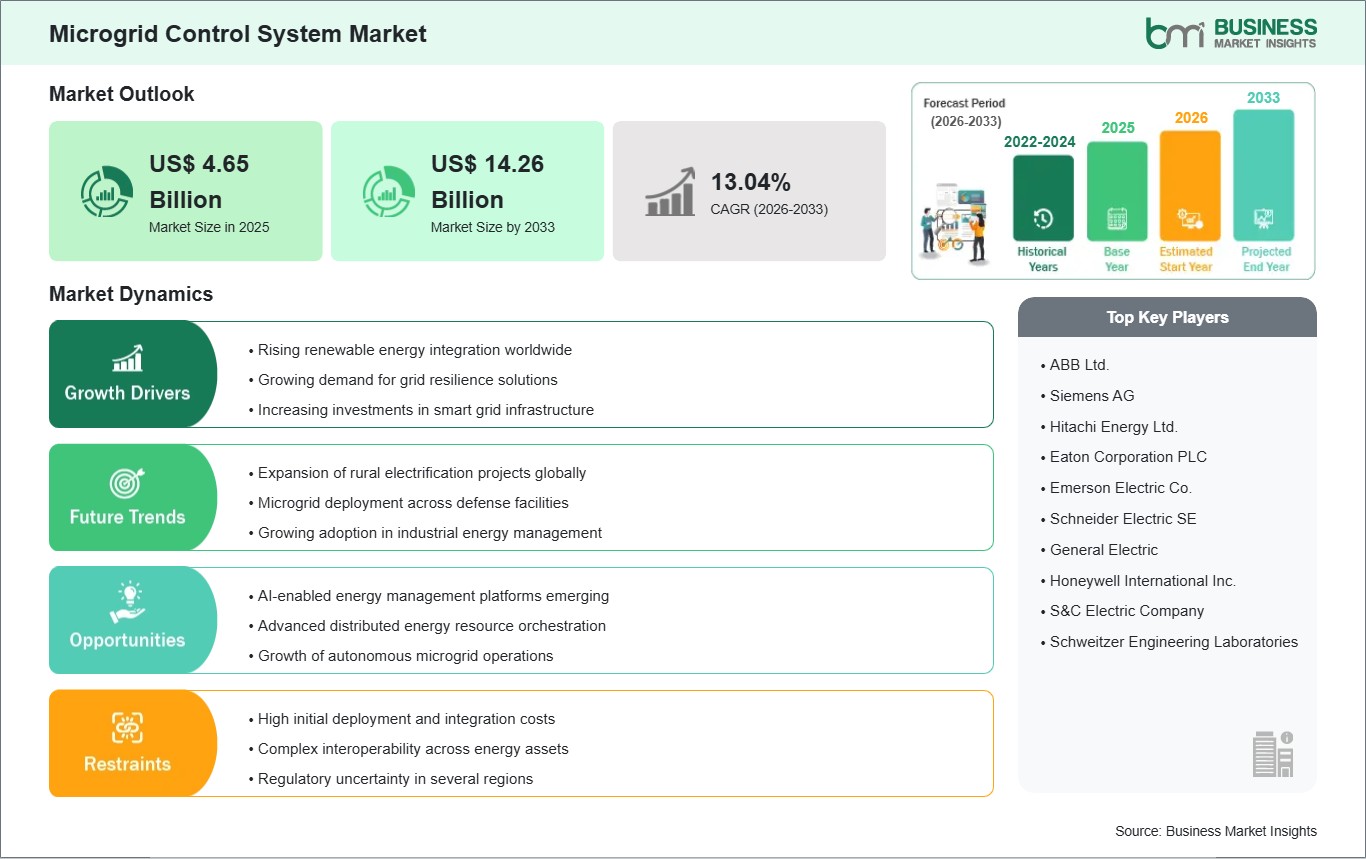
Microgrid control systems are intelligent platforms that coordinate distributed energy resources, storage assets, and controllable loads within localized power networks. They balance generation and consumption, maintain voltage and frequency stability, and enable smooth transitions between grid-connected and islanded operation. Their role has expanded as facilities seek resilient electricity management for complex energy environments.
Adoption is advancing as utilities, industrial sites, defense installations, and municipalities pursue higher power reliability and tighter operational control. Electrification, renewable integration, and exposure to grid disturbances are encouraging investment in controller architectures that can optimize dispatch decisions, support demand response, and improve energy cost management without compromising continuity.
From a segmentation standpoint, grid-connected configurations remain important where sites require economic optimization alongside utility interaction, while off-grid deployments address remote or isolated locations. Hybrid systems attract attention because they combine resilience, flexibility, and asset coordination across multiple operating conditions. On the demand side, utilities and industrial users form a substantial base, with defense and municipal projects supporting broader diversification.
Technology development is shifting this sector toward more predictive, software-driven control environments. Advanced analytics, real-time monitoring, cybersecurity layers, and interoperability with storage, solar, and flexible loads are strengthening system performance. The progression from rule-based control to adaptive optimization is improving dispatch accuracy, fault response, and supervisory visibility across increasingly dynamic distributed energy portfolios.
Competitive conditions are shaped by software capability, integration expertise, and the ability to support site-specific operating strategies. Vendors differentiate through modular control platforms, stronger digital service offerings, and architectures that simplify commissioning and lifecycle management. As project requirements become more customized, market positioning increasingly depends on flexible system design and consistent performance across diverse end-use environments.
Segment Analysis
Microgrid Control System Market Segmentation
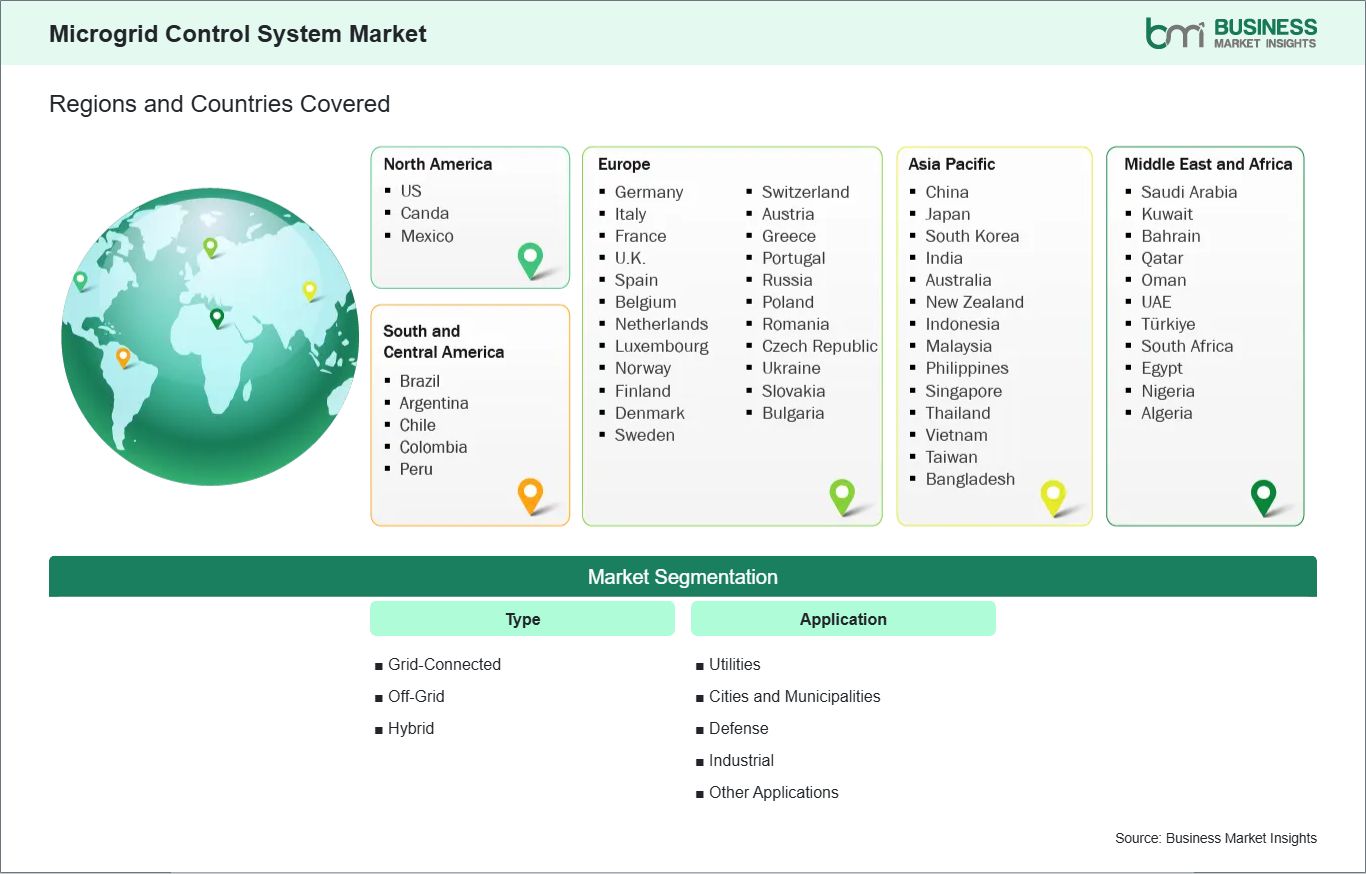
The Microgrid Control System market is segmented by type and application, reflecting different operating models and deployment priorities.
By Type
- Grid-Connected : Favored where grid interaction and cost optimization must coexist.
- Off-Grid : Selected for isolated sites requiring autonomous energy coordination.
- Hybrid : Preferred for flexible switching across diverse supply conditions.
By Application
- Utilities : Prioritize grid balancing, asset visibility, and distributed resource coordination.
- Cities and Municipalities : Support resilient public services through localized supervisory energy control.
- Defense : Emphasize secure operation, islanding capability, and uninterrupted mission support.
- Industrial : Optimize power continuity for energy-intensive processes and on-site assets.
- Other Applications : Address campuses, remote sites, and mixed-use energy environments.
Market Forces
Microgrid Control System Market Drivers and Opportunities
Rising Need for Grid Resilience and Localized Energy Coordination
Power interruptions, grid variability, and distributed energy expansion are reshaping operational priorities across critical facilities. These conditions create a clear requirement for control platforms that can coordinate local generation, storage, and load behavior with precision. As organizations seek dependable power continuity, microgrid control systems gain traction because they enable faster balancing decisions and more stable site-level energy management.
The effect of this shift is most visible in sectors where downtime carries high financial or operational consequences. Utilities, defense facilities, and industrial campuses increasingly treat intelligent control as a practical layer for resilience planning. Its relevance extends beyond emergency backup, as the technology also supports better asset utilization, smoother operating transitions, and stronger energy visibility in environments with mixed power sources.
Expansion of AI-Enabled Optimization and Digital Energy Management
Digital energy platforms are opening new opportunities for microgrid control systems through predictive optimization, automated dispatch, and stronger supervisory intelligence. Innovation is moving toward software environments that interpret site data continuously and refine operating strategies in real time. This trend supports use cases where facilities combine renewable generation, storage assets, and flexible demand under one coordinated control layer.
Future scope remains broad as organizations expand distributed energy portfolios and seek control systems that can scale with changing site requirements. Opportunity is especially notable in multi-asset environments where optimization quality directly influences cost, reliability, and emissions outcomes. As digitalization deepens across this sector, advanced controllers are positioned to support wider deployment models and more intelligent energy orchestration.
Size and Share Analysis
Microgrid Control System Market Size and Share Analysis
The Microgrid Control System market is projected to grow from US$ 4.65 billion in 2025 to US$ 14.26 billion by 2033, registering a CAGR of 13.04% from 2026 to 2033. This trajectory reflects stronger investment in intelligent energy coordination as decentralized power architectures become more common across utility, municipal, defense, and industrial settings.
In segment terms, grid-connected systems hold an important position because many deployments require continuous interaction with utility networks while optimizing local resources. Hybrid configurations also attract sustained attention, supported by their ability to manage multiple operating modes and improve control flexibility where resilience and economic performance must align.
By application, utilities represent a leading area of deployment due to the need for distributed asset orchestration and system stability management. Industrial users also contribute materially, as they prioritize continuity and energy efficiency across complex sites. Cities and municipalities, defense operations, and other specialized environments reinforce demand through resilience-focused control requirements.
Report Coverage
Microgrid Control System Market Report Coverage and Deliverables
The " Microgrid Control System Market Size and Forecast (2022-2033)" report provides a detailed analysis of the market covering below areas:
- Market size and forecast at global, regional, and country levels for all the key market segments covered under the scope
- Market trends, as well as market dynamics such as drivers, restraints, and key opportunities
- Market analysis covering key market trends, global and regional framework, major players, regulations, and recent market developments
- Industry landscape and competition analysis covering market concentration, heat map analysis, prominent players, and recent developments for the market
- Detailed company profiles, including SWOT analysis
Geographic Insights
Microgrid Control System Market Geographic Insights
The Microgrid Control System market shows diverse regional adoption patterns influenced by grid modernization priorities, distributed energy integration, resilience planning, and regulatory maturity. Global demand reflects a broad shift toward localized energy intelligence, where operators need software-centric control to manage storage, renewables, and flexible loads. This creates uneven but meaningful progress across regions, shaped by infrastructure readiness, policy support, and the sophistication of end-user energy strategies.
North America maintains a strong position because utilities, campuses, industrial facilities, and defense sites continue to evaluate resilient power architectures with advanced supervisory control. The region benefits from established distributed energy activity and a clearer commercialization pathway for software-enabled energy management. Project developers and site operators often emphasize reliability, cyber readiness, and operational optimization, which supports demand for more capable control platforms across interconnected and islandable systems.
Asia Pacific presents a compelling growth environment as urban expansion, industrial development, and electrification increase pressure on power systems. The region contains a wide mix of grid conditions, which makes intelligent microgrid coordination relevant for both established networks and remote applications. Demand is further reinforced by rising interest in renewable integration, local energy security, and operational flexibility, particularly where infrastructure expansion must proceed alongside more adaptive control capabilities.
Europe advances through decarbonization-oriented energy management, stronger emphasis on grid flexibility, and integration of distributed assets within mature regulatory settings. Emerging markets in the Middle East and Africa and South and Central America add a different momentum, with adoption shaped by remote power needs, infrastructure resilience, and selective investment in localized energy systems. Together, these markets broaden the industry's geographic base and encourage more tailored control strategies.
Industry Activity
Recent Developments
Recent developments reflect continued investment in scalable microgrid intelligence and deployment readiness. The updates below highlight notable activity shaping this market.
- In May 2026, Delta Electronics Americas has announced the deployment of a microgrid system at its Detroit-area facility, developed in collaboration with DTE Energy through the integration of Delta's smart energy technologies. The system is connected directly to the utility grid through a medium-voltage interconnection, allowing Delta to evaluate grid-interactive energy strategies under real operating conditions and serve as a demonstration platform for customers considering microgrid-based energy solutions. The microgrid combines 425 kW of solar generation, eight Level 2 EV charging stations, and a 400 kW DC fast charger developed through a U.S. Department of Energy-funded program.
- In September 2025, AZZO, a global provider of energy integration and management technologies, today announced the launch of a new offering of standardized, scalable microgrid solutions for the U.S. commercial and industrial market. This initiative is supported by Schneider Electric, the global leader in energy management and automation, whose EcoStruxure Microgrid Flex platform forms the foundation of the solution. The offering, announced today at RE+ 2025, combines Schneider Electrics pre-engineered microgrid architecture with AZZOs EnergyX IoT integration and lifecycle services to deliver rapid-to-deploy, resilient microgrids that enhance sustainability, reduce energy costs, and ensure energy resilience for customers nationwide.
Trust & Transparency
Research Methodology
The market analysis combines proprietary research with secondary data from government agencies, company disclosures, regulatory filings, industry databases and expert interviews. Market estimates are validated through data triangulation, cross-market benchmarking and analyst
review.
View Full Research Methodology
Key Sources Referred:
World Bank -Global Trade Indicators World Trade Organization (WTO) International Monetary Fund (IMF) International Trade Administration (ITA) Company Websites Company Annual Reports Company Investor Presentations