Market Summary
Executive Summary and Global Market Analysis
Mechanical control cables are flexible motion-transmission assemblies that convert manual or mechanical input into precise linear or rotary actuation. They are used where dependable force transfer, routing flexibility, and compact installation are essential. These systems support throttle, braking, clutch, latch, steering, and auxiliary functions across equipment platforms that operate under vibration, load variation, and demanding environmental conditions.
Market momentum is shaped by the need for durable control architectures in automotive systems, aircraft subsystems, marine mechanisms, and industrial equipment. Manufacturers continue to prioritize reliable actuation components that simplify packaging while preserving tactile response and operational accuracy. Replacement demand also supports the industry, especially in applications where serviceability and long product life remain more practical than full electronic conversion.
Segment performance reflects varied usage conditions and control requirements. Push-Pull Cables retain broad relevance because they enable bidirectional motion in compact layouts. Pull-Only Cables remain well aligned with release and engagement functions, while Micro-Diameter Cables address constrained assemblies that require reduced mass and tighter bend capability. Across end users, automotive sustains strong volume requirements, while aerospace and marine prioritize precision, durability, and routing efficiency.
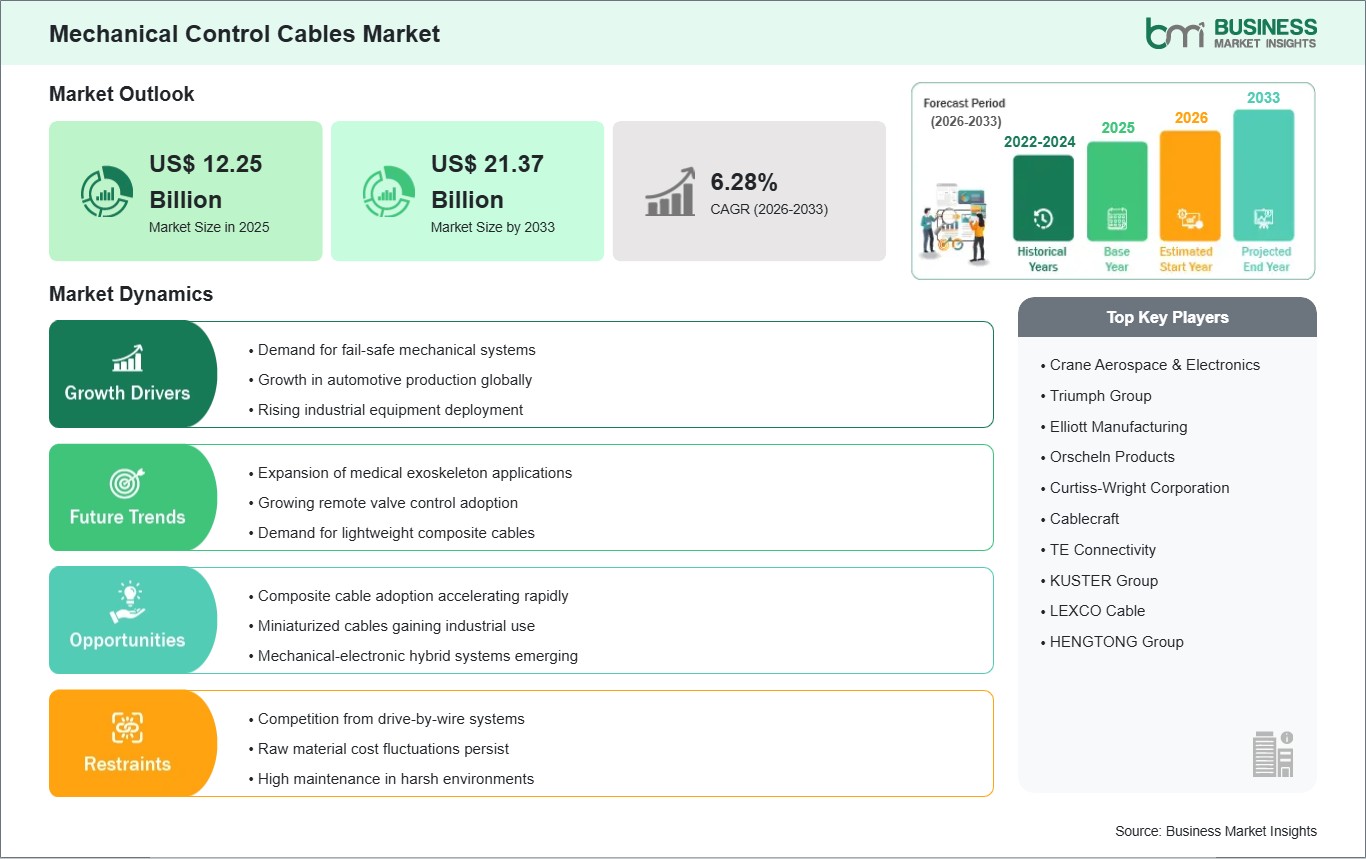
Technology development is advancing through material engineering, lower-friction liners, improved sealing, and tighter tolerance construction. Stainless steel remains important where corrosion resistance and fatigue performance are critical, while composite and hybrid constructions support weight reduction and tailored strength profiles. Design refinement is also improving installation flexibility, control smoothness, and lifecycle stability in equipment exposed to moisture, contamination, or repetitive load cycles.
Competitive conditions are defined by engineering capability, customization speed, manufacturing consistency, and long-term supply relationships. Participants differentiate through application-specific design support, regional production access, and performance validation across demanding operating environments. The market also reflects a balance between high-volume standardized programs and specialized assemblies, creating room for suppliers that can combine scale, responsiveness, and product reliability without compromising mechanical accuracy.
Segment Analysis
Mechanical Control Cables Market Segmentation
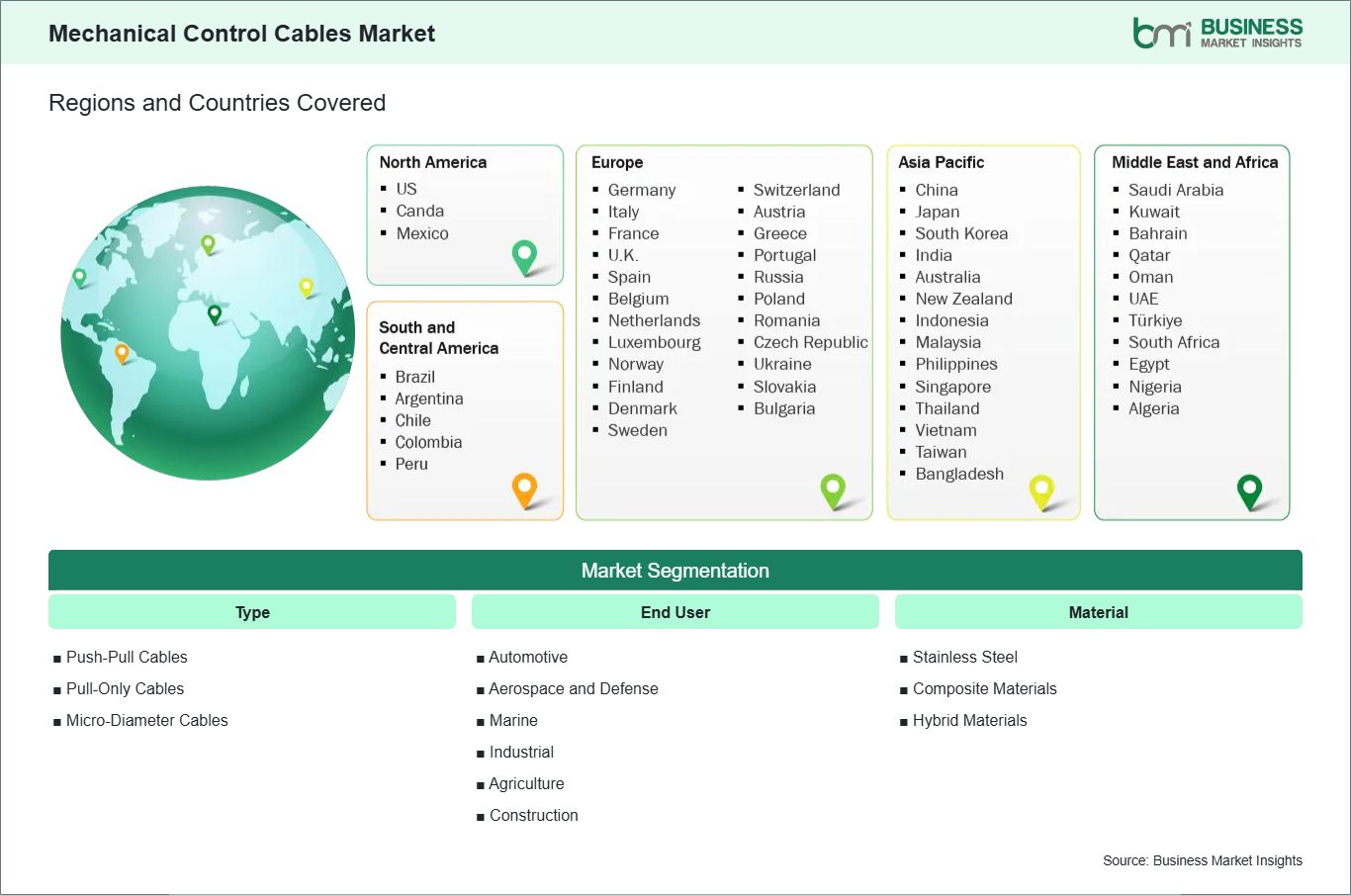
The mechanical control cable market is segmented by Type, End User, and Material. The structure reflects differing motion requirements, durability needs, and platform-specific installation constraints.
By Type
- Push-Pull Cables : Support bidirectional motion in compact mechanical layouts.
- Pull-Only Cables : Suit release, engagement, and single-direction actuation tasks.
- Micro-Diameter Cables : Fit constrained assemblies requiring reduced mass and tighter routing.
By End User
- Automotive : Maintains broad deployment across throttle, brake, hood, and seat mechanisms.
- Aerospace and Defense : Requires precise actuation under strict reliability conditions.
- Marine : Benefits from corrosion-resistant assemblies and dependable routing flexibility.
- Industrial : Serves machinery controls where rugged operation and serviceability matter.
- Agriculture : Supports durable motion transfer in harsh outdoor operating environments.
- Construction : Handles repetitive control inputs in heavy-duty mobile equipment.
- Others : Covers specialized platforms with custom mechanical interface requirements.
By Material
- Stainless Steel : Delivers fatigue strength and corrosion resistance for demanding assemblies.
- Composite Materials : Reduce weight while supporting tailored flexibility characteristics.
- Hybrid Materials : Balance durability, mass reduction, and application-specific performance targets.
Market Forces
Mechanical Control Cables Market Drivers and Opportunities
Higher Equipment Reliability Requirements Across Mobile and Industrial Platforms
Operators across transport, industrial, and off-highway applications are prioritizing components that maintain consistent motion transfer under repeated mechanical stress. That requirement increases the need for cable systems with stable actuation, predictable response, and resistance to wear, contamination, and routing complexity. Mechanical control cables continue to gain preference where equipment designers need dependable control performance without introducing unnecessary architectural complexity or maintenance burden.
The effect is most visible in systems where uptime, operator feedback, and installation flexibility directly influence equipment usability. This context keeps mechanical control cables relevant across established vehicle and machinery categories, particularly where harsh conditions challenge electronic alternatives. Their continued relevance stems from proven field performance, straightforward replacement practices, and compatibility with platform designs that still depend on robust mechanical actuation pathways.
Material Innovation Supporting Lightweight and Application-Specific Cable Design
Material development is opening new possibilities for cable assemblies that must meet tighter packaging, corrosion resistance, and weight objectives. Composite layers, hybrid constructions, and improved liner technologies are enabling smoother motion, lower friction, and better environmental durability. These innovations are particularly useful in aerospace, marine, and compact industrial systems where conventional cable designs may limit routing efficiency or increase maintenance exposure.
Future scope for these innovations extends into broader customization, longer service life, and improved platform integration across diverse end users. As product developers refine cable architectures for specialized loads and environmental conditions, the industry can address more exact performance targets without sacrificing manufacturability. That expansion supports differentiated offerings, deeper penetration in engineered applications, and stronger value creation through application-tuned mechanical control solutions.
Size and Share Analysis
Mechanical Control Cables Market Size and Share Analysis
The mechanical control cable market size is expected to reach US$ 21.37 Billion by 2033 from US$ 12.25 Billion in 2025. The market is estimated to record a CAGR of 6.28% from 2026 to 2033. This trajectory reflects continued relevance in motion-transfer applications where precision, durability, and installation flexibility remain essential. Demand is supported by established use across transportation, industrial equipment, and specialized machinery platforms that continue to rely on engineered mechanical actuation.
By segment, Push-Pull Cables hold a prominent position because they accommodate dual-direction control in compact assemblies. Stainless Steel also retains broad acceptance due to its balance of strength, corrosion resistance, and lifecycle stability. Among end users, automotive sustains leading demand through extensive integration of control cable assemblies in functional systems that require repeatable motion and cost-efficient serviceability.
Application leadership remains centered on automotive usage, where mechanical control cables support a wide range of actuation functions across internal and auxiliary systems. Aerospace and Defense, Marine, and Industrial applications also maintain strong relevance because they value routing flexibility and dependable force transmission. Agriculture and Construction further reinforce market breadth through equipment categories that continue to favor rugged mechanical control architectures.
Report Coverage
Mechanical Control Cables Market Report Coverage and Deliverables
The report provides a detailed analysis of the market covering the below areas:
- Market size and forecast at global, regional, and country levels for all the key market segments covered under the scope
- Market trends, as well as market dynamics such as drivers, restraints, and key opportunities
- Market analysis covering key market trends, global and regional framework, major players, regulations, and recent market developments
- Industry landscape and competition analysis covering market concentration, heat map analysis, prominent players, and recent developments for the market
- Detailed company profiles, including SWOT analysis
Geographic Insights
Mechanical Control Cables Market Geographic Insights
The mechanical control cable market shows diverse regional adoption patterns influenced by manufacturing depth, equipment mix, platform design preferences, and replacement cycles. Across the global landscape, demand reflects the continued use of cable-based actuation in transportation, machinery, and equipment systems that prioritize durable motion transfer. Regional performance therefore depends less on a single demand source and more on how each market balances industrial output, mobility production, and engineering requirements.
North America remains important because its equipment base includes mature automotive, aerospace, and industrial programs that still require dependable mechanical interfaces. The region also benefits from aftermarket activity and replacement demand tied to long operating lifecycles. Design emphasis often centers on reliability, compliance, and performance consistency, which supports suppliers capable of delivering customized assemblies for demanding applications across mobile equipment and specialized machinery.
Asia Pacific presents a broad expansion environment supported by large-scale vehicle manufacturing, rising equipment output, and an extensive supplier ecosystem. The region's role is strengthened by its combination of volume production and evolving engineering capability, allowing both standardized and application-specific cable systems to advance. Demand is particularly well positioned in automotive and industrial settings, while agriculture and construction equipment create additional space for rugged mechanical control solutions.
Europe maintains relevance through precision engineering standards, diversified mobility manufacturing, and sustained use of specialized control assemblies in automotive and industrial equipment. Emerging markets in the Middle East, Africa, and South and Central America contribute through marine activity, construction equipment demand, agricultural mechanization, and industrial modernization. Together, these regions broaden the market's application base and create opportunities for suppliers offering corrosion resistance, durability, and tailored routing performance.
Industry Activity
Recent Developments
Recent developments indicate continued strategic movement across the mechanical control cable industry. Market activity reflects consolidation, footprint optimization, and capability expansion aligned with global supply requirements.
- In April 2026, SIKORA, a member of the MAAG Group and Dover (NYSE: DOV), has unveiled three new solutions aimed at enhancing quality control, boosting production efficiency, and minimizing material consumption in cable and wire manufacturing. The new offerings include an expanded LASER PRO diameter measurement series, the X-RAY 6000 measurement system, and the LM PRO length measurement system.
- In October 2025, JAE has started sales of the MX34T variant, a through-hole reflow compatible version of its compact, high-density, non-waterproof connectors designed for automotive applications. Through-hole reflow, also known as Pin In Paste, involves inserting the connector's through-hole components into PCB through-hole openings and soldering them using the reflow process. This method enables simultaneous mounting with other SMT components, providing strong mechanical performance and high mass-production efficiency.
Trust & Transparency
Research Methodology
The market analysis combines proprietary research with secondary data from government agencies, company disclosures, regulatory filings, industry databases and expert interviews. Market estimates are validated through data triangulation, cross-market benchmarking and analyst
review.
View Full Research Methodology
Key Sources Referred:
World Bank -Global Trade Indicators World Trade Organization (WTO) International Monetary Fund (IMF) International Trade Administration (ITA) Company Websites Company Annual Reports Company Investor Presentations