Market Summary
Executive Summary and Global Market Analysis
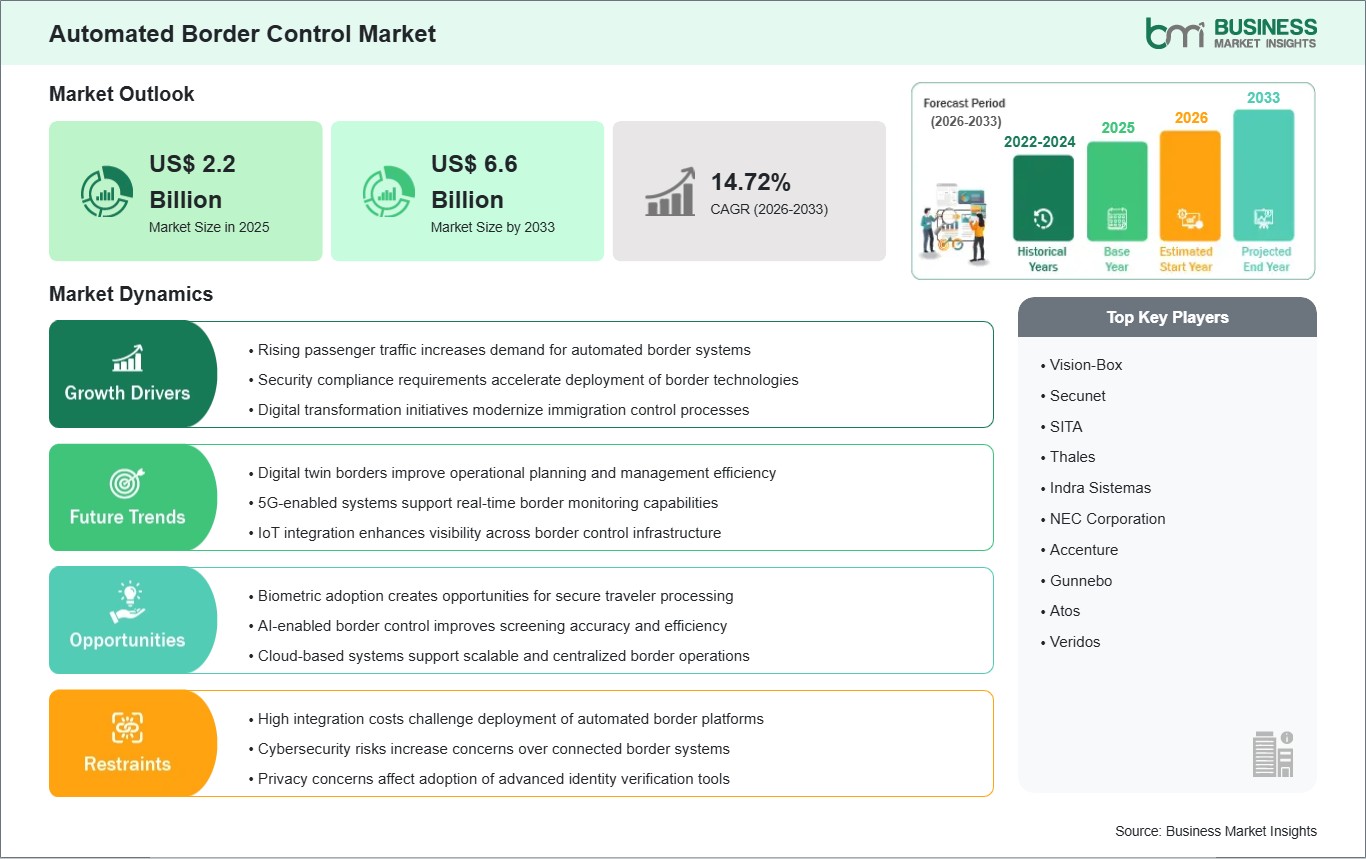
Automated Border Control (ABC) systems are self-service border management solutions that use technologies such as biometrics, RFID, artificial intelligence, and IoT to verify traveler identities and streamline immigration procedures. These systems are widely deployed at airports, land border crossings, and seaports to improve passenger processing efficiency while enhancing security. The Automated Border Control market is gaining momentum as governments and transportation authorities modernize border infrastructure, adopt digital identity verification methods, and focus on improving traveler experiences. Growing international travel volumes, increasing security requirements, and the shift toward contactless processing are supporting the adoption of ABC e-gates and kiosks. Biometric authentication technologies continue to gain preference due to their accuracy and reliability in identity verification. Airports remain the leading application area, while land borders and seaports are increasingly implementing automation solutions to improve operational efficiency.
Despite positive growth prospects, the market faces several challenges. The deployment of automated border control infrastructure requires substantial investment in hardware, software, and integration with existing government databases. Privacy concerns related to biometric data collection and storage remain important considerations for regulatory authorities. In addition, interoperability challenges between different border management systems and varying regulatory requirements across countries can slow implementation timelines. Maintenance requirements and cybersecurity risks also create operational challenges for border management agencies.
The market continues to present significant opportunities as governments pursue digital transformation initiatives and smart border programs. Advancements in artificial intelligence, facial recognition, and cloud-based identity management systems are improving the performance and scalability of automated border control solutions. Increasing investments in airport modernization, smart transportation infrastructure, and secure digital identity ecosystems are expected to create favorable conditions for long-term market expansion. Competitive activity remains focused on innovation, system integration capabilities, and the development of secure and efficient traveler processing solutions.
Segment Analysis
Automated Border Control Market Segmentation
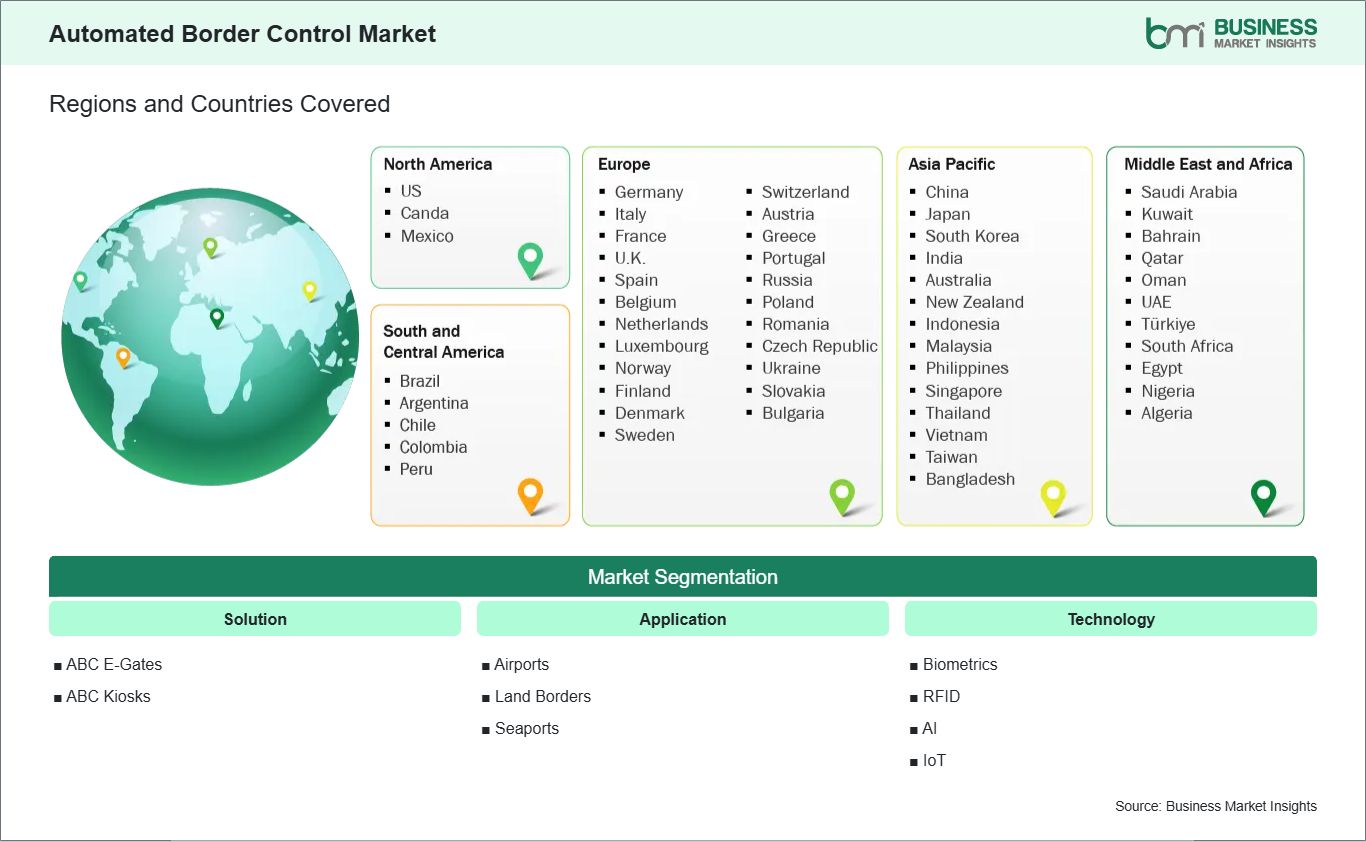
The Automated Border Control market is segmented based on solution, application, and technology, reflecting the diverse requirements of border security and traveler management systems.
By Solution
- ABC E-Gates: Widely adopted for automated passenger verification and immigration clearance
- ABC Kiosks: Used for self-service traveler registration and document authentication
By Application
- Airports: Largest deployment area due to high international passenger traffic
- Land Borders: Increasing adoption for efficient traveler and vehicle processing
- Seaports: Growing implementation to improve maritime passenger management
By Technology
- Biometrics: Supports secure identity verification through facial, fingerprint, and iris recognition
- RFID: Enables automated document and passport authentication
- AI: Enhances decision-making, threat detection, and traveler processing efficiency
- IoT: Supports connected border infrastructure and real-time monitoring
Market Forces
Automated Border Control Market Drivers and Opportunities
Growing Emphasis on Border Security and Digital Identity Verification
The increasing need for secure and efficient border management is driving the adoption of automated border control systems worldwide. Governments are facing growing passenger volumes, evolving security threats, and the need to improve operational efficiency at border checkpoints. Automated border control solutions help authorities process travelers more quickly while maintaining high security standards through biometric verification and automated screening procedures.
The growing adoption of digital identity programs and electronic passports is further supporting market expansion. Regulatory agencies are investing in technologies that strengthen identity authentication and reduce the risk of fraud. Artificial intelligence and advanced biometric technologies are improving the accuracy and speed of traveler verification processes. As countries continue to modernize border infrastructure and implement secure digital identity frameworks, demand for automated border control solutions is expected to remain strong across airports, land crossings, and maritime terminals.
Expansion of Smart Borders and Contactless Travel Technologies
The growing development of smart border initiatives is creating significant opportunities for the Automated Border Control market. Governments, as well as transportation agencies, have turned to digital technologies that make it easier for travelers without compromising their safety. Digital travel technology involving facial recognition is becoming one of the most important tools in today’s border control system.
Emerging technologies such as artificial intelligence, cloud computing, and IoT are enabling the development of more connected and intelligent border control environments. Integration with digital travel credentials and mobile identity management will be seen to boost the experience of travelers as well as decrease process times. Airport improvement programs and intelligent transport networks are also contributing to increased opportunities for implementation. With the ongoing digital revolution taking place within public sector organizations, the need for automated border control systems is set to grow significantly in the coming years.
Size and Share Analysis
Automated Border Control Market Size and Share Analysis
The Automated Border Control market size is expected to reach US$ 6.6 billion by 2033 from US$ 2.2 billion in 2025. The market is estimated to record a CAGR of 14.72% from 2026 to 2033.
By solution, ABC E-Gates account for a significant share due to their widespread deployment at airports and major border checkpoints for automated passenger processing. ABC Kiosks are also gaining traction as border authorities seek flexible self-service solutions for traveler registration, document verification, and identity authentication.
By application, airports dominate the market owing to increasing international passenger traffic and the growing need for efficient immigration processing. Land borders continue to expand adoption as governments modernize border infrastructure and strengthen security measures, while seaports are increasingly implementing automated border control systems to streamline passenger screening and customs procedures.
Report Coverage
Automated Border Control Market Report Coverage and Deliverables
The "Automated Border Control Market Size and Forecast (2022-2033)" report provides a detailed analysis of the market covering below areas:
- Market size and forecast at global, regional, and country levels for all market segments covered under the scope
- Market trends, as well as market dynamics such as drivers, restraints, and key opportunities
- Market analysis covering key market trends, global and regional framework, major players, regulations, and recent market developments
- Industry landscape and competition analysis covering market concentration, heat map analysis, prominent players, and recent developments for the market
- Detailed company profiles, including SWOT analysis
Geographic Insights
Automated Border Control Market Geographic Insights
The Automated Border Control Market shows diverse regional adoption patterns influenced by increasing international travel, border modernization programs, and the growing use of digital identity verification technologies.
North America, being a developed region, has a well-established transportation and border security infrastructure. The region comprises the United States and Canada, which are constantly implementing new measures to improve their biometric verification systems, smart border technologies, and traveler automation systems. Security and convenience of travelers are the key priorities in this region. With the development of digital infrastructures, there are extensive uses of automated border controls all around the airports and borders of this region.
Asia Pacific is growing significantly, driven by expanding international travel, airport development projects, and increasing investments in digital government initiatives. The region comprises countries such as China, India, Japan, Singapore, and Australia, where authorities are implementing biometric authentication systems and automated immigration technologies. The region focuses on enhancing border security, reducing processing times, and improving traveler experiences. Continued investments in transportation infrastructure and smart city development are supporting the adoption of advanced border management solutions.
Both regions are contributing significantly to the growth of the Automated Border Control Market, focusing on border modernization, digital identity management, and advanced security technologies. Growing investments in automated infrastructure and intelligent traveler verification systems continue to support long-term market expansion.
Industry Activity
Recent Developments
The Automated Border Control Market is analyzed using a mix of primary and secondary research sources, including corporate publications, industry associations, and verified databases. This approach ensures accurate tracking of innovation trends and strategic developments influencing the market.
- In May 2026, IDEMIA successfully deployed its latest generation of automated Biometric E-Gates at Oslo Airport Gardermoen. The solution aims to modernize Norwegian border control checkpoints, leveraging advanced computer vision and high-speed facial recognition to enhance airport operational capabilities while ensuring full European regulatory compliance.
- In October 2024, SITA launched its Smart Path biometric solution expansion across multiple international airports to support seamless passenger processing and border management. The development strengthens the use of facial recognition technologies and automated identity verification systems, helping airports improve security and operational efficiency.
Trust & Transparency
Research Methodology
The market analysis combines proprietary research with secondary data from government agencies, company disclosures, regulatory filings, industry databases and expert interviews. Market estimates are validated through data triangulation, cross-market benchmarking and analyst
review.
View Full Research Methodology
Key Sources Referred:
World Bank - Global Trade IndicatorsWorld Trade Organization (WTO)International Monetary Fund (IMF)International Trade Administration (ITA)Company WebsitesCompany Annual ReportsCompany Investor Presentations