Industrial Control Systems Market Regional Highlights
North America Industrial Control Systems Market
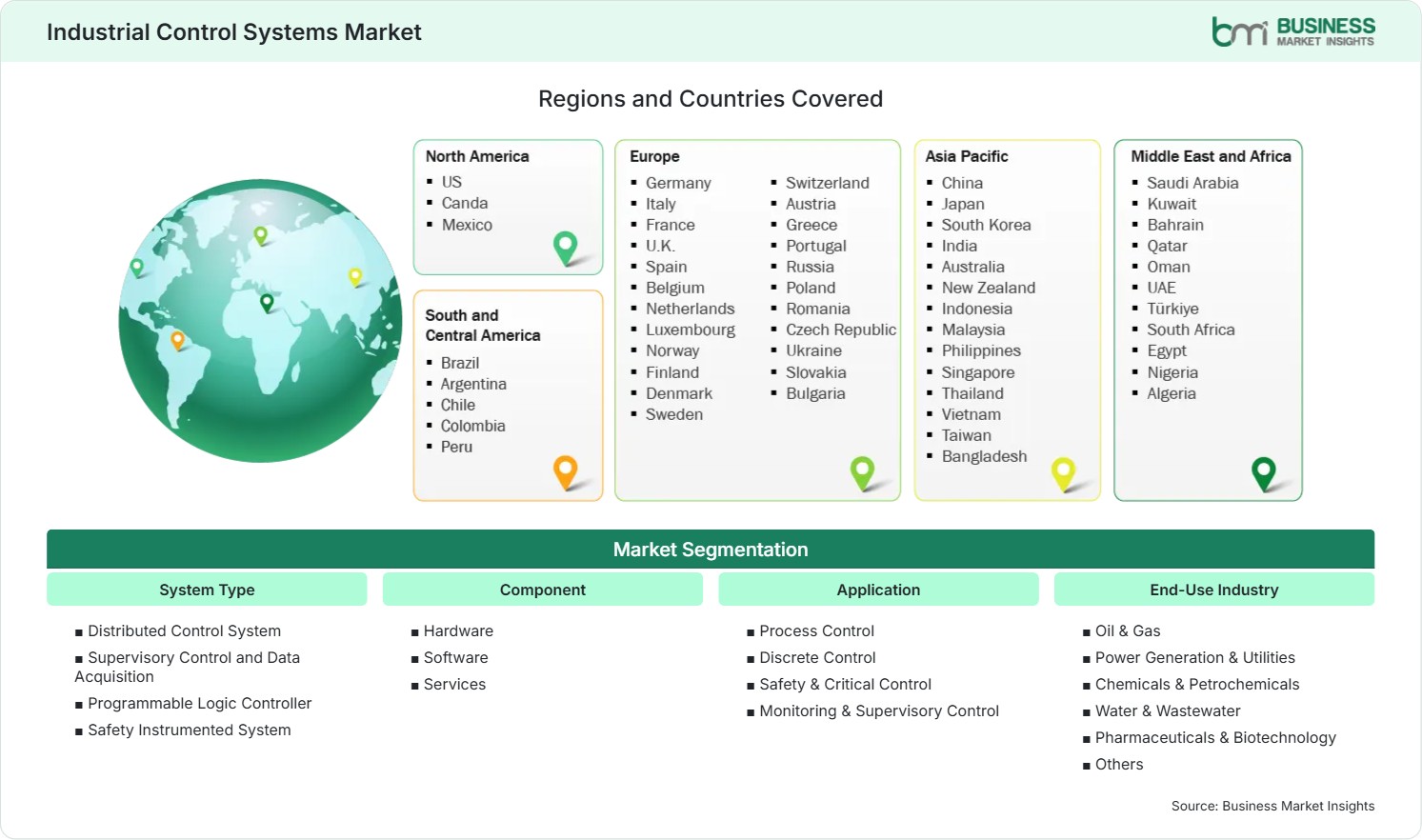
North America holds approximately 29%–33% share in 2025 and is projected to record 8.10%–8.70% CAGR through 2033. Industrial modernization, semiconductor investment, energy infrastructure upgrades, and cybersecurity requirements support demand. The region's installed base creates substantial retrofit opportunities because operators increasingly replace obsolete controllers and networking equipment without rebuilding entire plants. The Industrial Control Systems Market share remains supported by advanced manufacturing capabilities, high automation penetration, and strong demand for secure digital infrastructure across utilities, chemicals, pharmaceuticals, food processing, and discrete manufacturing.
- US manufacturers are prioritizing resilient automation architectures as production localization increases demand for connected controls, industrial networking, cybersecurity, and predictive maintenance across newly expanded and modernized facilities.
- Canada provides opportunities through energy, mining, utilities, food processing, and water infrastructure, where remote monitoring and automated control can improve operational visibility and reduce maintenance requirements.
- Cybersecurity investment is becoming closely integrated with control modernization, encouraging asset discovery, network segmentation, vulnerability management, secure remote access, and continuous monitoring across operational technology environments.
- Industrial software adoption is strengthening as operators seek contextualized production data, real-time dashboards, predictive analytics, and improved coordination between plant-floor systems and enterprise applications.
US Industrial Control Systems Market
The US represents approximately 22%–25% of global demand in 2025 and is estimated to grow at 8.20%–8.80% CAGR during 2026–2033. Key demand drivers include manufacturing reshoring, energy infrastructure, capacity expansion of semiconductor fabrication facilities, pharmaceutical manufacturing, and critical infrastructure security. More and more industrial companies prefer modernization initiatives that ensure the survival of validated equipment while enhancing cybersecurity, connectivity, analytics, and remote support services. The nation is a prominent center of innovation in industrial automation.
- Semiconductor and advanced manufacturing investments increase demand for precise process control, high-availability automation, environmental monitoring, and integrated safety systems.
- Energy and utility operators require resilient control architectures capable of supporting distributed infrastructure while maintaining operational visibility and cybersecurity.
- Industrial cybersecurity is becoming a core modernization requirement. Rockwell Automation introduced its SecureOT suite in November 2025 to combine OT visibility, vulnerability management, professional services, and managed security capabilities.
Europe Industrial Control Systems Market
Europe accounts for approximately 25%–29% share in 2025 and is expected to achieve 7.70%–8.40% CAGR during 2026–2033. Germany remains a leading automation market, while France, Italy, the United Kingdom, and the Netherlands contribute through advanced manufacturing and process industries. The region's Industrial Control Systems Market growth is reinforced by energy transition investments, industrial efficiency targets, cybersecurity requirements, and modernization of established production facilities. Germany is estimated at 8.00%–8.70% CAGR, supported by automation-intensive manufacturing and industrial software adoption.
- Germany provides a strong installed-base replacement opportunity spanning automotive, machinery, chemicals, pharmaceuticals, and electronics production, with demand shifting toward connected and software-enabled automation.
- France is benefiting from industrial modernization across energy, aerospace, pharmaceuticals, and process manufacturing, increasing requirements for safety systems, DCS, PLCs, and supervisory platforms.
- Italy offers opportunities across machinery, food processing, packaging, pharmaceuticals, and discrete manufacturing, where flexible automation supports smaller production batches and higher customization.
- European cybersecurity requirements are increasing demand for secure architectures, vulnerability management, identity controls, network segmentation, and lifecycle services across OT environments.
Asia Pacific Industrial Control Systems Market
Asia Pacific holds approximately 31%–35% share in 2025, making it the largest regional market, and is projected to grow at 9.40%–10.20% CAGR through 2033. China, Japan, South Korea, India, and Southeast Asian manufacturing economies drive demand. China remains the leading regional market, while India and Southeast Asia offer faster expansion opportunities. Industrial Control Systems Market share is supported by factory automation, electronics production, infrastructure development, renewable power investment, chemicals, pharmaceuticals, and expanding digital manufacturing ecosystems.
- China continues to represent a substantial automation opportunity because of large manufacturing capacity, electronics production, automotive investment, process industries, and increasing emphasis on domestic technology capabilities.
- Japan maintains sophisticated demand for PLCs, motion control, robotics, DCS, safety systems, and industrial software because manufacturers prioritize precision, reliability, productivity, and lifecycle efficiency.
- India offers strong potential from electronics manufacturing, pharmaceuticals, chemicals, power, water infrastructure, and factory modernization, creating opportunities for both greenfield and brownfield automation.
- Southeast Asia is attracting manufacturing investment in electronics, automotive, food processing, and chemicals, increasing demand for scalable control systems and industrial networking.
Rest of World Industrial Control Systems Market
Rest of World represents approximately 10%–14% share in 2025 and is projected to grow at 7.90%–9.00% CAGR during 2026–2033. Mining, energy (oil/gas), food processing, utilities, and infrastructure development projects are key to South and Central America. Energy diversification, water infrastructure, petrochemicals, and industry development are the focus for the Middle East and Africa. Brazil and Saudi Arabia continue to be significant investment destinations, and select Gulf countries present modernization opportunities.
- Brazil's mining, energy, food, chemicals, and utilities industries create demand for automation modernization, remote monitoring, safety systems, and process optimization.
- Mexico benefits from manufacturing localization, automotive production, electronics assembly, and cross-border supply chains requiring modern control and supervisory infrastructure.
- Saudi Arabia and the United Arab Emirates are investing in industrial diversification, utilities, water, petrochemicals, and digitally enabled infrastructure, creating opportunities for advanced automation architectures.
- Africa offers selective opportunities in mining, power, water, food processing, and oil and gas, although project financing, skills availability, and infrastructure maturity influence adoption rates.