Cross Border Payments Market Regional Highlights
North America Cross-Border Payments Market
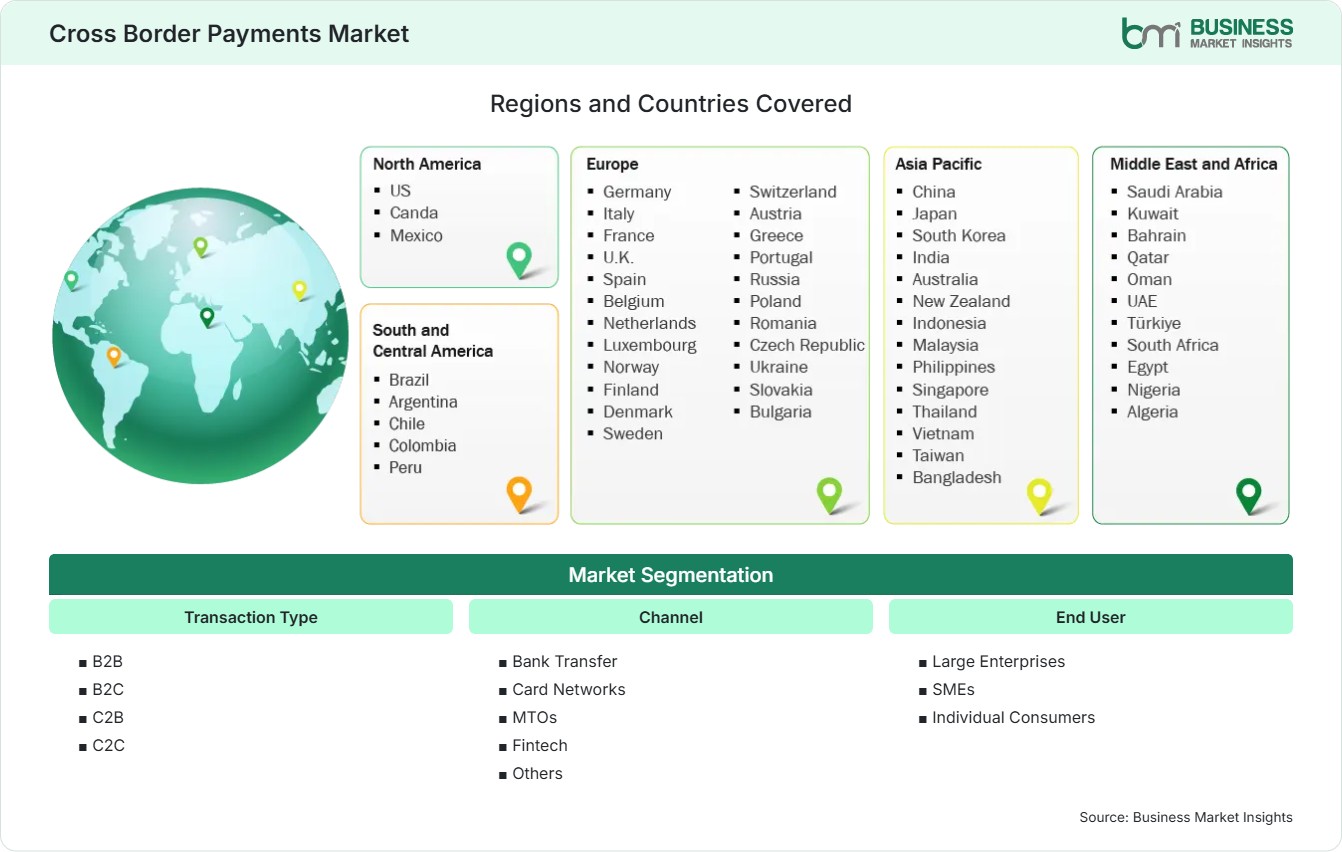
North America accounts for a 32%–35% Cross-Border Payments Market share in 2025, with a CAGR of 7.8%–8.4% through 2033. The region benefits from mature banking infrastructure, deep fintech penetration, sophisticated enterprise treasury systems, and extensive international trade. Canada and the United States remain leading contributors, while Mexico offers additional growth through remittances, nearshoring, and commercial corridors. Demand is shifting toward API-based payment orchestration, multicurrency accounts, embedded finance, and faster settlement capabilities across B2B and consumer transactions.
- Enterprise treasury modernization is increasing demand for automated reconciliation, centralized liquidity management, and integrated foreign exchange execution across multinational payment flows.
- Nearshoring and stronger North American supply-chain integration are supporting recurring supplier payments between the United States, Mexico, and Canada.
- Fintech providers are competing with banks through transparent pricing, digital onboarding, API connectivity, and specialized international payment infrastructure.
- Card networks are expanding beyond traditional transactions into account-based transfers, disbursements, and commercial payment solutions for financial institutions and enterprises.
US Cross-Border Payments Market
The US accounts for 25%–28% of the regional Cross-Border Payments Market share in 2025 and records a CAGR of 7.9%–8.5% through 2033. Its scale reflects extensive international commerce, sophisticated financial infrastructure, strong fintech investment, and high demand for digital payment experiences. Cross-border B2B flows remain strategically important, while consumer transfers and international e-commerce provide additional transaction volume. Regulatory scrutiny surrounding fraud, sanctions, and money laundering is simultaneously increasing investment in compliance automation.
- US enterprises increasingly prioritize integrated payment platforms that combine foreign exchange, supplier settlement, payroll, reconciliation, and treasury controls within centralized workflows.
- International e-commerce and digital services are expanding demand for localized checkout, multicurrency pricing, and rapid merchant payouts across multiple jurisdictions.
- Fintech competition is accelerating innovation in account-based transfers, embedded payment capabilities, and API-driven international payment orchestration.
Europe Cross-Border Payments Market
Europe holds a 24%–27% share of the Cross-Border Payments Market in 2025 and grows at a CAGR of 7.6%–8.3% through 2033. The United Kingdom, Germany, and France remain leading countries, while Poland and Spain offer comparatively faster growth at 9.0%–10.2% and 8.7%–9.8%, respectively. Strong digital banking adoption, open-banking development, cross-border commerce, and regulatory harmonization support modernization. Providers increasingly compete on transparency, instant settlement, fraud prevention, and seamless integration with domestic payment ecosystems.
- The United Kingdom remains a major fintech hub, supporting innovation in international transfers, digital wallets, foreign exchange, and API-based payment services.
- Germany's industrial export base sustains demand for reliable B2B settlement, supplier payments, and treasury automation across international commercial corridors.
- France benefits from growing digital commerce and payment innovation, with providers increasingly integrating local payment methods into international merchant ecosystems.
- Poland offers attractive growth as digital adoption, e-commerce activity, and regional commercial integration increase demand for modern international payment capabilities.
- Spain's expanding tourism, digital commerce, and international SME activity create opportunities for payment providers offering localized acceptance and multicurrency settlement.
Asia Pacific Cross-Border Payments Market
Asia Pacific represents a 25%–29% share of the Cross-Border Payments Market in 2025 and achieves a CAGR of 10.2%–11.3% through 2033. China, Japan, India, Singapore, and Australia are leading contributors, while India and Indonesia offer high growth of 11.5%–13.0% and 11.0%–12.5%, respectively. Mobile wallets, instant payments, e-commerce, remittances, and regional trade are accelerating adoption. Interoperability between domestic payment infrastructures is creating opportunities for fintechs and infrastructure providers.
- India is becoming a major innovation center for interoperable digital payments, with UPI-linked international connectivity creating new pathways for consumer and merchant transactions.
- Southeast Asia's fragmented payment landscape creates demand for orchestration platforms capable of connecting wallets, bank transfers, cards, and alternative payment methods.
- China continues to influence regional payment modernization through extensive digital-wallet adoption and increasingly connected merchant ecosystems.
- Singapore functions as a regional financial hub, supporting high-value treasury flows, fintech infrastructure investment, and multinational corporate payment activity.
- Australia benefits from strong digital banking adoption and established trade relationships across Asia, supporting demand for secure international settlement infrastructure.
Rest of World Cross-Border Payments Market
The rest of the world accounts for a 14%–17% share of the Cross-Border Payments Market in 2025 and grows at a CAGR of 8.9%–10.1% through 2033. South and Central America are supported by remittances, digital wallets, and expanding fintech adoption. Brazil and Mexico lead regional activity, while Colombia offers high growth at 10.0%–11.2%. In the Middle East and Africa, the United Arab Emirates and Saudi Arabia lead, while Nigeria records high growth of 11.0%–12.5% through digital financial inclusion.
Remittance corridors remain strategically important across Latin America, Africa, and the Middle East, while expanding mobile-money ecosystems are creating new alternatives to traditional cash-based transfer networks. Regional opportunities center on wallet interoperability, local currency collection, instant payouts, and compliance automation. Providers that can connect fragmented domestic payment infrastructures with international settlement networks are positioned to capture demand from migrant workers, SMEs, exporters, marketplaces, and digital service providers seeking faster and more transparent transfers.
- Brazil's large digital-payment ecosystem and international trade base support demand for integrated merchant acceptance, remittances, and corporate payment infrastructure.
- The UAE benefits from its position as a global commercial hub, generating demand for payroll, trade, remittance, and treasury-related international transfers.
- Saudi Arabia's economic diversification and digital transformation programs are expanding opportunities for modern financial infrastructure and cross-border commercial settlement.
- Nigeria's growing fintech ecosystem and large remittance corridors are encouraging investment in mobile-enabled payment infrastructure and digital financial services.
- Latin American fintech adoption is creating opportunities for providers connecting domestic wallets and instant-payment systems with international merchant and remittance networks.