Market Summary
Executive Summary and Global Market Analysis
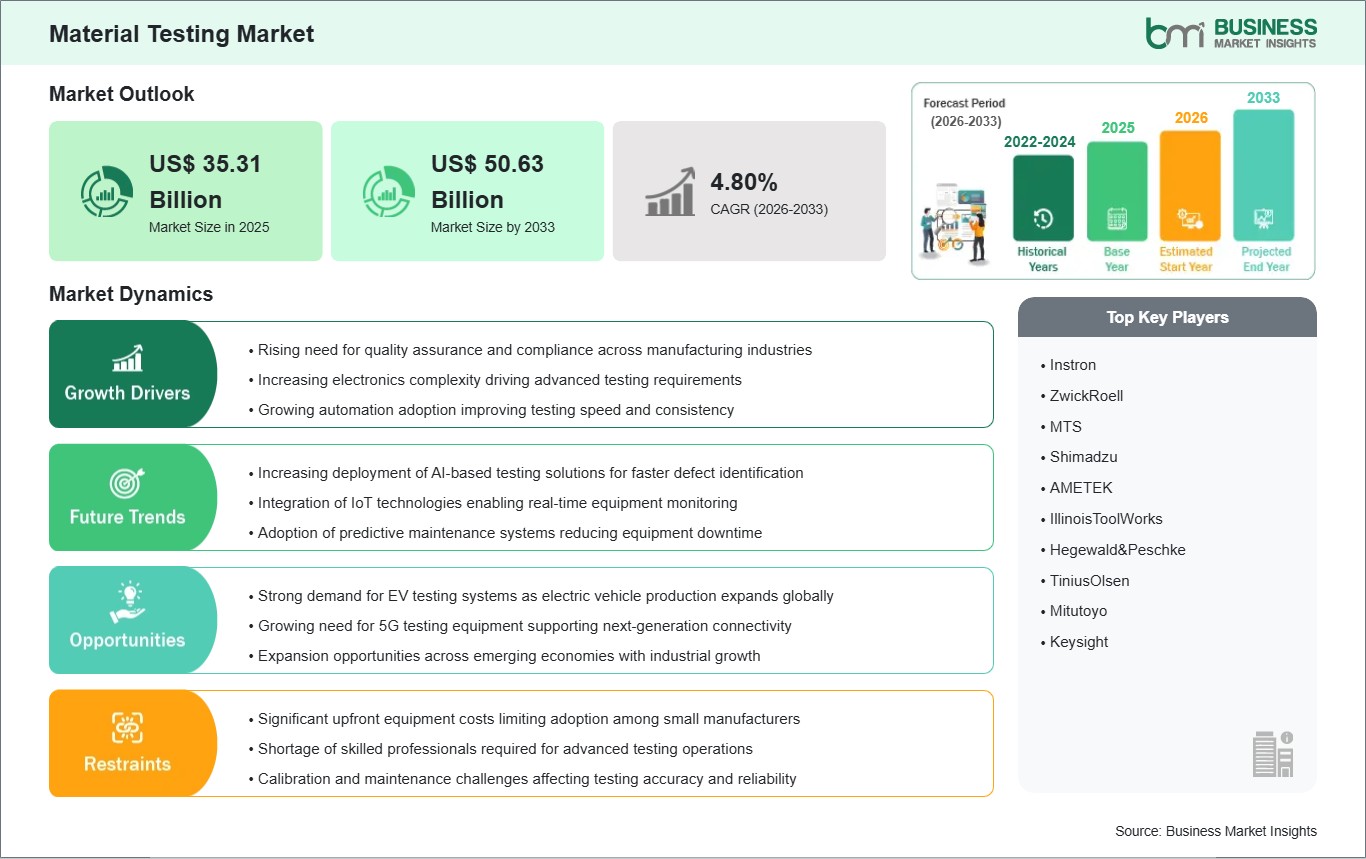
Material testing systems comprise specialized instruments and methodologies used to evaluate the physical, mechanical, and structural properties of materials. These systems assess parameters such as strength, elasticity, durability, and resistance under controlled conditions, enabling manufacturers to validate product quality and compliance with engineering standards across industrial applications.
The industry is experiencing steady traction due to stringent quality control requirements across advanced manufacturing sectors. Heightened expectations for performance reliability in aerospace, automotive, and electronics production have intensified reliance on precise testing processes. This has led to expanded deployment of analytical equipment designed to ensure material integrity throughout production cycles and operational lifespans.
Segmentation patterns reveal mechanical testing solutions capturing significant interest due to their applicability in stress analysis and durability assessments. General-purpose instruments maintain relevance across laboratories and industrial facilities requiring versatile testing capabilities. End-use trends highlight aerospace as a demanding segment due to safety-critical standards, while automotive and electronics sectors sustain consistent equipment utilization.
Technological progress is reshaping testing frameworks through automation, digital data capture, and advanced sensor integration. Emerging solutions incorporate real-time analytics and interconnected monitoring features, improving measurement accuracy and reducing manual intervention. These developments enhance repeatability, streamline workflows, and support data-driven quality management practices.
Segment Analysis
Material Testing Market Segmentation
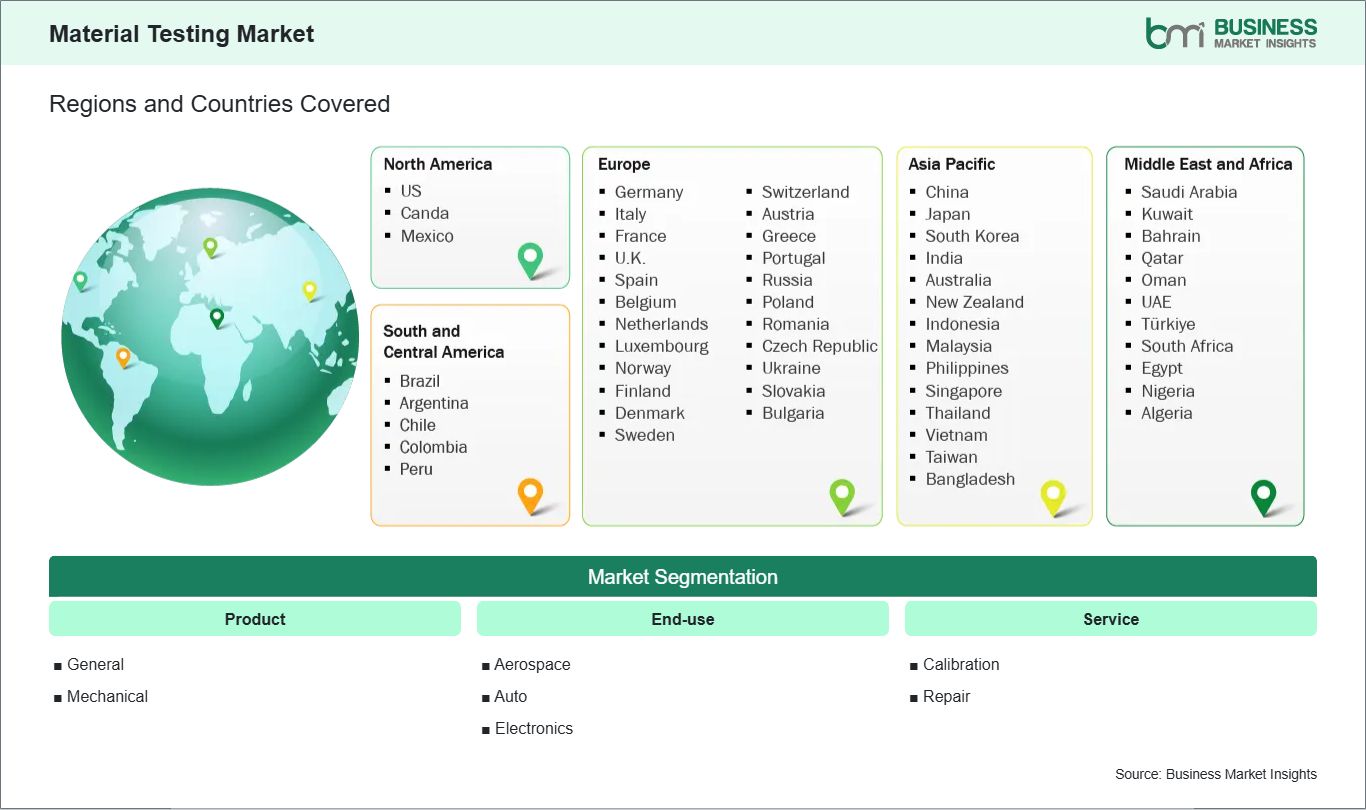
The market is segmented based on product, end-use, and service categories.
By Product
- General - Provides versatile testing functionality across multiple industrial and laboratory environments
- Mechanical - Focuses on stress, fatigue, and load-bearing performance evaluation
By End-use
- Aerospace - Requires strict compliance with safety and structural reliability standards
- Auto - Supports durability testing for components under operational conditions
- Electronics - Evaluates material performance in miniaturized and precision-based applications
By Service
- Calibration - Ensures measurement accuracy and equipment standardization over time
- Repair - Maintains operational continuity through timely servicing and replacement solutions
Market Forces
Material Testing Market Drivers and Opportunities
Stringent quality standards accelerating testing requirements
Industrial sectors are increasingly governed by strict performance benchmarks and safety regulations that mandate rigorous testing protocols. Manufacturers must validate material properties to meet certification standards, prompting wider utilization of high-precision testing systems. This requirement has elevated the importance of structured testing processes in production lines and laboratory environments.
Such regulatory emphasis has strengthened demand for reliable and repeatable testing methods across diverse industries. Compliance obligations have reinforced continuous equipment upgrades, ensuring alignment with evolving standards. The integration of advanced testing technologies provides measurable benefits in quality assurance, supporting operational accuracy and reducing production inconsistencies.
Digitalization enhancing advanced testing capabilities
The shift toward digital manufacturing environments has led to integration of intelligent systems within testing equipment. Advanced analytics, cloud connectivity, and automated testing processes are enabling efficient data acquisition and processing. These capabilities support rapid decision-making while minimizing operational errors in complex testing environments.
Future expansion opportunities are closely linked to digital transformation initiatives within industrial sectors. Organizations are prioritizing investment in smart testing solutions that align with broader automation frameworks. This progression opens pathways for scalable deployment, enabling industries to achieve enhanced precision, improved productivity, and optimized resource utilization.
Size and Share Analysis
Material Testing Market Size and Share Analysis
The Material Testing Market was valued at US$ 35.31 Billion in 2025 to reach US$ 50.63 Billion by 2033, at a CAGR of 4.80% from 2026 to 2033. This stable trajectory reflects sustained industrial reliance on material validation processes. Growth progression indicates steady integration of advanced testing technologies aligned with manufacturing precision and compliance requirements.
Product segmentation highlights mechanical testing equipment maintaining prominence due to its relevance in stress and load evaluation. General-purpose instruments retain widespread utilization for routine testing procedures, ensuring operational flexibility across industries with diverse quality assurance needs.
Application insights reveal aerospace leading in rigorous testing adoption due to safety-critical standards. Automotive applications demonstrate consistent deployment for durability verification, while electronics manufacturing continues to utilize specialized testing systems for precision material performance validation.
Report Coverage
Material Testing Market Report Coverage and Deliverables
The "Material Testing Market Size and Forecast (2022-2033)" report provides a detailed analysis of the market covering below areas:
- Market size and forecast at global, regional, and country levels for all market segments covered under the scope
- Market trends, as well as drivers, restraints, and opportunities
- Market analysis covering key trends, global and regional framework, major players, regulations, and recent developments
- Industry landscape and competition analysis covering market concentration, heat map analysis, prominent players, and recent developments for the market
- Detailed company profiles, including SWOT analysis
Geographic Insights
Material Testing Market Geographic Insights
The Material Testing market shows diverse regional adoption patterns influenced by industrial maturity, regulatory frameworks, and manufacturing specialization across global economies. Developed regions emphasize high-precision testing solutions driven by strict compliance norms, whereas emerging economies prioritize scalable and cost-efficient equipment deployment to support expanding industrial activities.
North America demonstrates a structured adoption landscape supported by advanced manufacturing capabilities and established testing standards. Organizations in this region focus on integrating digital testing frameworks, supporting enhanced measurement accuracy and automation. Regulatory oversight continues to guide consistent utilization of certified testing procedures across industrial sectors.
Asia Pacific reflects strong advancement supported by expanding industrial production and infrastructure development. Manufacturing hubs within the region are increasingly implementing sophisticated testing technologies to maintain product quality and competitiveness. Rising industrial output has strengthened the requirement for efficient testing systems aligned with operational scaling efforts.
Europe maintains a balanced focus on technological innovation and regulatory compliance, reinforcing deployment of advanced testing instruments. Meanwhile, regions such as the Middle East, Africa, and South America showcase gradual adoption influenced by industrial diversification and infrastructure growth. These markets present sustained opportunities for testing solution providers catering to evolving quality assurance requirements.
Industry Activity
Recent Developments
The Material Testing market is evaluated by gathering qualitative and quantitative data post primary and secondary research, which includes important corporate publications, association data, and databases. Recent developments and news in the market include:
- In May 2026, ECO Material Technologies is opening a pilot plant and testing lab in Georgia, expanding capabilities to support infrastructure materials development. The expanded 16,400ft2 facility strengthens the company’s ability to develop, test and validate high-performance cementitious materials at scale. By integrating pilot-scale production with advanced material characterisation and concrete testing, Eco Material can accelerate the path from innovation to real-world construction and infrastructure deployment.
- In September 2025, Instron is excited to announce the release of its new 100 kN table model for the 6800 and 3400 Series universal testing systems. Delivering unprecedented force capacity in a tabletop frame, it offers a powerful and space-efficient solution for labs testing materials such as metals and composites.
Trust & Transparency
Research Methodology
The market analysis combines proprietary research with secondary data from government agencies, company disclosures, regulatory filings, industry databases and expert interviews. Market estimates are validated through data triangulation, cross-market benchmarking and analyst
review.
View Full Research Methodology
Key Sources Referred:
Industry publications on material testing systems and methodologiesGovernment standards and regulatory compliance frameworksEngineering and materials science journalsIndustrial manufacturing reportsCompany WebsitesCompany Annual ReportsCompany Investor Presentations