Market Summary
Executive Summary and Global Market Analysis
Laser technology comprises systems that generate concentrated light through optical amplification for controlled cutting, welding, communication, sensing, marking, and precision microprocessing. These systems convert energy into highly focused beams with defined wavelength and power characteristics, enabling exact material interaction across industrial, scientific, and commercial environments. Their relevance spans manufacturing lines, optical networks, electronics production, and specialized instrumentation where accuracy and repeatability are essential.
Market expansion is supported by broader use of laser-based systems in fabrication, data transmission, and component-level processing. End users are selecting laser platforms where contact-free operation, narrow thermal impact, and programmable beam control improve process consistency. This preference is especially visible in environments that require finer tolerances, cleaner edges, and higher throughput than conventional mechanical or thermal methods typically provide.
Segmentation patterns reflect the technical diversity of the industry. Solid-state lasers maintain broad relevance in precision applications, while gas and liquid systems retain importance in selected operating conditions. Market structure also differs by configuration, power range, wavelength, and end use, with equipment choices closely aligned to beam stability, footprint, process intensity, and the material or signal requirements of each deployment setting.
Technology development is advancing toward smarter control architecture, improved wavelength flexibility, and better integration with automated systems. Vendors are refining compact designs, rack-based deployment, and hybrid arrangements that align with production environments and optical infrastructure. Progress in beam delivery, monitoring, and thermal management is also broadening the practical range of laser systems used in both established and emerging applications.
Competitive conditions are shaped by engineering depth, application fit, system reliability, and the capacity to support differentiated use cases across industries. Buyers compare suppliers on platform adaptability, operating efficiency, and compatibility with surrounding equipment rather than on beam output alone. As procurement decisions become more workflow-specific, the market is favoring manufacturers that combine technical specialization with scalable deployment models.
Segment Analysis
Laser Technology Market Segmentation
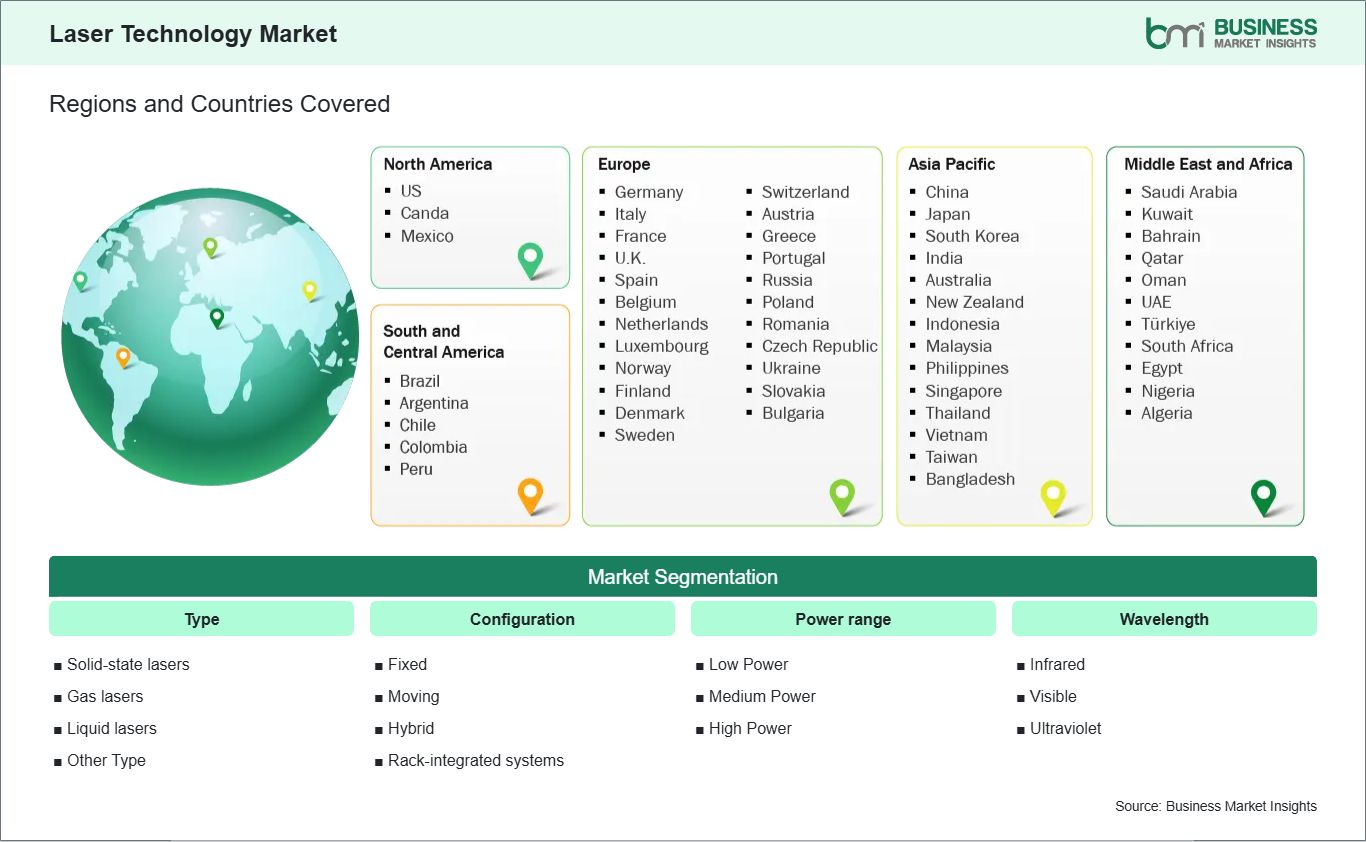
The market is segmented by type, configuration, power range, wavelength, application, and end use, reflecting diverse operating needs across deployment settings.
By Type
- Solid-state lasers: Favored for precision output, compact design, and broad industrial compatibility.
- Gas lasers: Selected where wavelength stability supports continuous processing and optical applications.
- Liquid lasers: Utilized in specialized environments requiring tunable emission characteristics.
- Other Type: Covers emerging and application-specific laser architectures.
By Configuration
- Fixed: Preferred in stable installations with repeatable processing paths.
- Moving: Supports dynamic beam positioning across variable production layouts.
- Hybrid: Combines installation flexibility with broader process adaptability.
- Rack-integrated systems: Fits compact industrial environments requiring centralized equipment organization.
By Power range
- Low Power (1 kW): Applied where controlled output supports fine processing tasks.
- Medium Power (1–10 kW): Balances versatility and process intensity across mainstream operations.
- High Power (>10 kW): Chosen for demanding industrial applications requiring deep energy delivery.
By Wavelength
- Infrared: Widely deployed for material interaction and communication functions.
- Visible: Adopted where alignment, display, and measurement requirements are prominent.
- Ultraviolet: Enables high-precision microprocessing and surface-sensitive applications.
By Application
- Laser processing: Anchors demand where cutting, welding, and marking require precision.
- Optical communication: Gains traction through high-speed transmission and photonic networking needs.
- Optoelectronic devices: Serves component fabrication and performance-critical electronic assemblies.
- Other Application: Includes sensing, measurement, and specialized scientific uses.
By End Use
- Telecommunication: Requires laser systems for transmission efficiency and network component integration.
- Industrial: Depends on programmable beams for repeatable manufacturing operations.
- Semiconductor & Electronics: Values exact energy control for delicate component processing.
- Commercial: Uses laser platforms across instrumentation, display, and service applications.
- Aerospace: Adopts advanced laser systems for precision fabrication and optical functions.
- Other End Use: Captures niche deployments across research and specialized operations.
Market Forces
Laser Technology Market Drivers and Opportunities
Broader Industrial Shift Toward Precision and Non-Contact Processing
Manufacturers are reworking production methods to achieve tighter tolerances, cleaner finishes, and lower material stress during processing. That transition is elevating the appeal of laser systems because they deliver localized energy with reduced tool wear and better process control. As production lines become more quality-sensitive, organizations are expanding deployment of laser platforms that can handle complex geometries and fine-feature requirements with consistent output.
This transition is influencing procurement across industrial, electronics, and semiconductor environments where process uniformity affects yield and downstream performance. Laser-based equipment supports cleaner operation, easier automation alignment, and improved handling of sensitive materials. Its relevance is increasing in contexts where conventional machining creates excess thermal spread, physical contact limitations, or insufficient control over intricate production steps.
Expansion of Integrated Laser Platforms Across Communication and Electronics Workflows
A significant opportunity is forming around integrated laser platforms that combine wavelength control, compact configuration, and digital monitoring in one deployment model. Innovation is extending beyond industrial cutting into optical communication and optoelectronic production, where beam consistency and system footprint matter. This shift is opening new use cases for rack-integrated and hybrid systems in facilities that need precise output without extensive floor-space demands.
Future scope lies in broader deployment across photonic infrastructure, advanced electronics assembly, and automated production cells that require adaptable beam delivery. As system integration improves, suppliers can address wider demand from users seeking simplified installation and multi-application performance. This expansion can strengthen market reach by aligning laser technology with emerging requirements in compact manufacturing, high-speed communication, and precision device fabrication.
Size and Share Analysis
Laser Technology Market Size and Share Analysis
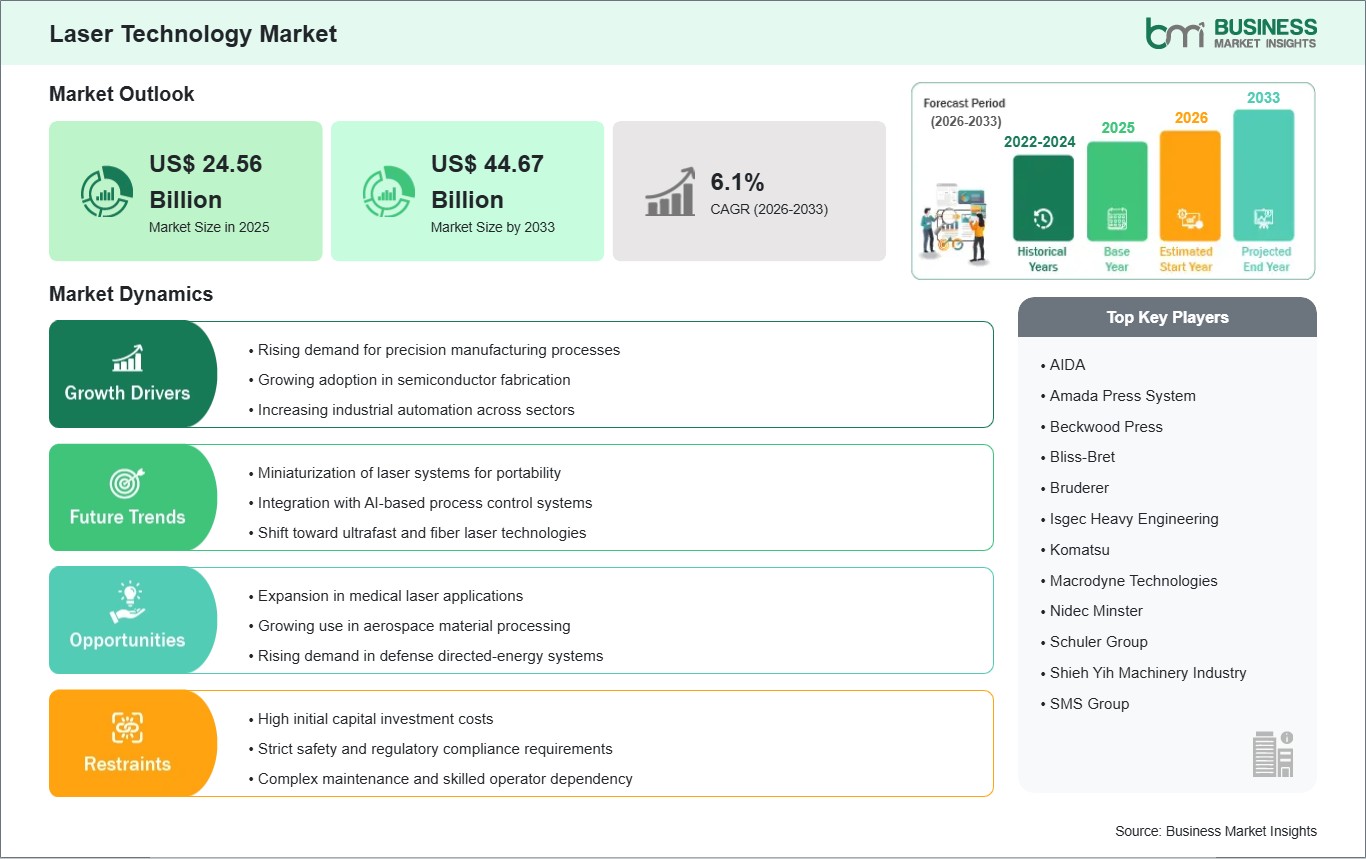
The Laser Technology market size is projected to grow from US$ 24.56 Billion in 2025 to US$ 44.67 Billion by 2033, registering a CAGR of 6.1% during 2026 - 2033. This outlook indicates steady market expansion supported by broader use across industrial processing, optical communication, and electronics-focused production environments where precision and controllability remain central purchasing criteria.
Among segments, solid-state lasers hold a strong position because they align well with compact integration, efficient output, and broad applicability across technical environments. Fixed and rack-integrated systems also maintain relevance where layout discipline and operational consistency are important. In power terms, medium-range platforms support a substantial portion of demand by balancing capability, controllability, and deployment flexibility.
Laser processing represents a leading application area because it intersects directly with production efficiency, component quality, and process repeatability. Telecommunication and semiconductor & electronics end-use environments also account for significant market presence, reflecting the importance of lasers in signal transmission, device fabrication, and optical subsystem performance. These application patterns reinforce the sector’s mix of industrial and photonic demand drivers.
Report Coverage
Laser Technology Market Report Coverage and Deliverables
The "Laser Technology Market Size and Forecast (2022–2033)" report provides a detailed analysis of the market covering below areas:
- Market size and forecast at global, regional, and country levels for all the key market segments covered under the scope
- Market trends, as well as market dynamics such as drivers, restraints, and key opportunities
- Market analysis covering key market trends, global and regional framework, major players, regulations, and recent market developments
- Industry landscape and competition analysis covering market concentration, heat map analysis, prominent players, and recent developments for the market
- Detailed company profiles, including SWOT analysis
Geographic Insights
Laser Technology Market Geographic Insights
The Laser Technology market shows diverse regional adoption patterns influenced by industrial specialization, photonics infrastructure, regulatory priorities, and the maturity of end-use manufacturing ecosystems. At the global level, deployment is shaped by the need for more controlled processing, stronger optical performance, and closer integration between laser platforms and digital production systems. These conditions support demand across both fabrication-intensive industries and communication-oriented technology environments.
North America retains a prominent position because of its advanced semiconductor activity, broad telecommunications infrastructure, and established base of precision manufacturing. Buyers in the region often emphasize performance stability, system integration, and application-specific engineering support when selecting equipment. The market also benefits from steady interest in laser-enabled processing for electronics, aerospace components, and specialized commercial instrumentation.
Asia Pacific continues to strengthen its role as production capacity expands across electronics, semiconductor packaging, and industrial fabrication. Regional demand reflects a practical focus on throughput, equipment flexibility, and scalable integration into automated operations. This environment supports wider deployment of medium- and high-power systems, while also encouraging uptake of compact configurations for communication equipment and optoelectronic component manufacturing.
Europe remains influential through its engineering depth, advanced industrial tooling base, and sustained focus on precision manufacturing technologies. Emerging markets in the Middle East and Africa and South and Central America are developing more selective demand patterns tied to industrial modernization, infrastructure expansion, and specialized commercial uses. In these regions, suppliers that offer adaptable configurations and application-focused support are better positioned to capture expanding opportunities.
Industry Activity
Recent Developments
The Laser Technology market is evaluated by gathering qualitative and quantitative data post primary and secondary research, which includes important corporate publications, association data, and databases. A few of the key developments in the Laser Technology marketare:
- In March 2025, Tesla, Inc. introduced the global deployment of its next-generation Full Self-Driving (FSD) Beta software update, featuring enhanced neural network performance and improved real-time decision-making capabilities. The update delivers stronger handling in complex urban driving scenarios, reinforcing Tesla’s leadership in connected and autonomous vehicle technologies.
- In February 2025, General Motors, through its Cruise subsidiary, revealed the Origin autonomous vehicle purpose-built for ride-hailing and cargo delivery applications, with full integration into smart city infrastructure. The launch highlights GM’s long-term vision focused on achieving zero crashes, zero emissions, and zero congestion through advanced autonomous and connected mobility solutionsts.
Trust & Transparency
Research Methodology
The market analysis combines proprietary research with secondary data from government agencies, company disclosures, regulatory filings, industry databases and expert interviews. Market estimates are validated through data triangulation, cross-market benchmarking and analyst
review.
View Full Research Methodology
Key Sources Referred:
World Bank – Global Trade IndicatorsWorld Trade Organization (WTO)(International Monetary Fund )IMFInternational Trade Administration (ITA)Company websiteCompany annual reportsCompany investor presentations