
3D Scanning Market Segmentation
Component
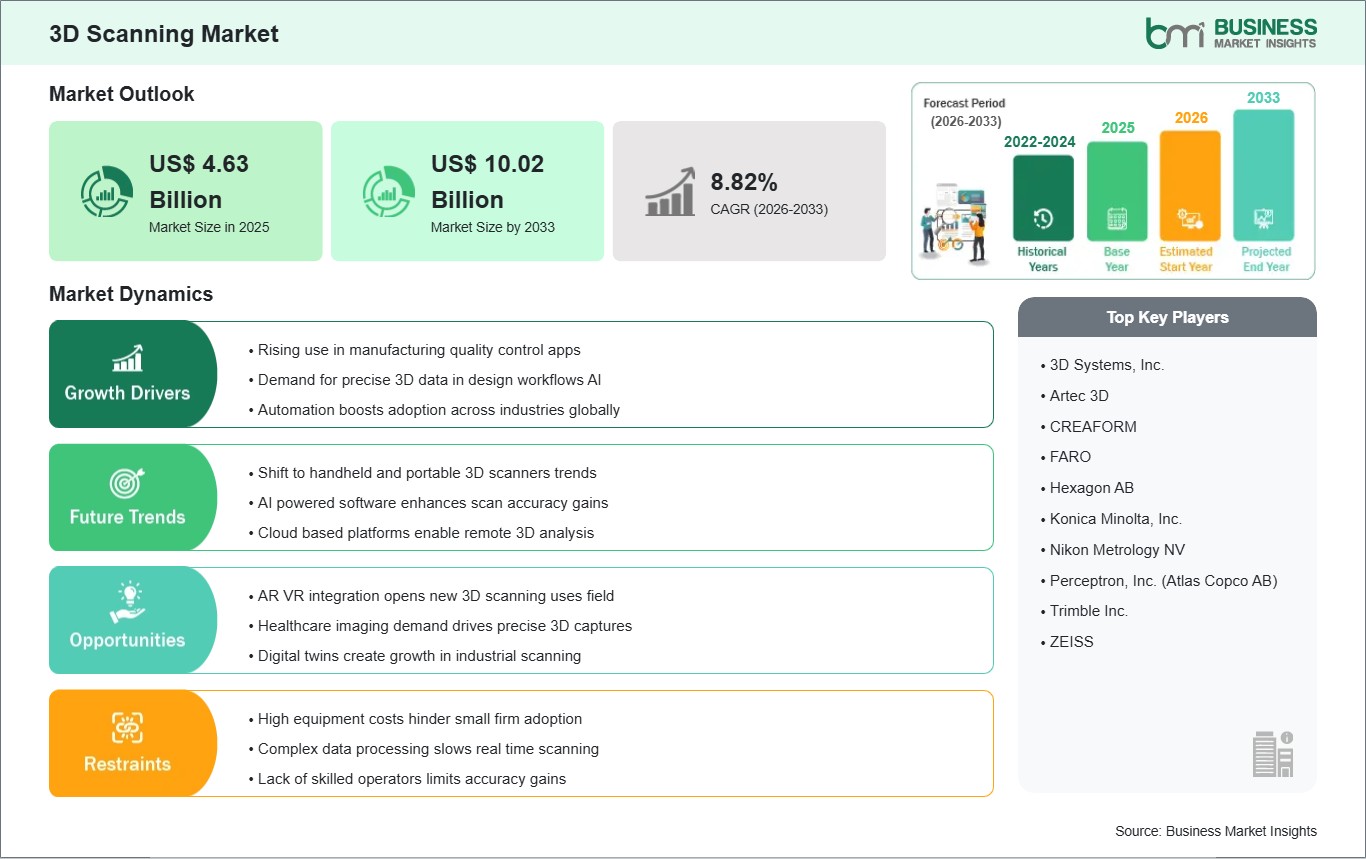
Hardware represents the leading component, holding 61% share in 2025 and growing at 13.5% CAGR through 2033. Hardware demand remains anchored in scanner replacement, sensor upgrades, metrology modernization, and wider field deployment, while software and services capture increasing value from processing, inspection, integration, calibration, and recurring workflows.
- Hardware: Hardware remains central to scanner deployment because improvements in accuracy, speed, portability, sensor resolution, and field usability directly influence inspection productivity and application breadth.
- Software: Software converts point clouds into actionable engineering information through registration, visualization, CAD comparison, inspection, modeling, reverse engineering, and automated reporting.
- Services: Services support customers requiring outsourced inspection, scanning, calibration, reverse engineering, scan-to-CAD, scan-to-BIM, and specialized data-processing expertise.
Scanner Type
Handheld represents the leading scanner type, holding 40% share in 2025 and growing at 15.0% CAGR through 2033. Portable and handheld scanners are gaining popularity owing to the reduction in set up needs, making them capable of measuring near production lines, field locations, and difficult objects. Desktop scanners continue to be useful for laboratory work and small-object measurement processes, while other types of scanners are designed to cater to large environments and special needs in industries.
- Handheld: Handheld systems provide flexible measurement around complex components and production environments, supporting inspection, reverse engineering, prototyping, and maintenance where mobility is essential.
- Portable: Portable scanners combine mobility with metrology capabilities, supporting field inspection, large-part measurement, construction documentation, and distributed manufacturing workflows.
- Desktop: Desktop scanners provide controlled acquisition for small components, product development, inspection, prototyping, healthcare modeling, and applications requiring repeatable laboratory conditions.
Application
Quality inspection and dimensional metrology represent the leading application, holding 33% share in 2025 and growing at 15.2% CAGR through 2033. Quality inspection and dimensional metrology remain a central application because manufacturers require rapid comparison between physical parts and engineering specifications. Reverse engineering, surveying, mapping, product development, BIM, digital twins, and additive manufacturing expand the addressable base by transforming physical environments into reusable digital datasets.
- Quality Inspection & Dimensional Metrology: Scanning enables non-contact dimensional verification, deviation mapping, first-article inspection, tooling validation, and faster identification of production errors.
- Reverse Engineering: Reverse engineering converts legacy or undocumented physical components into digital geometry, supporting CAD reconstruction, replacement-part development, modernization, and product redesign.
- Surveying, Mapping & Reality Capture: Long-range and mobile scanning captures buildings, infrastructure, terrain, industrial facilities, and complex environments for surveying and asset documentation.
- Product Design & Additive Manufacturing: Scanning accelerates design iteration by capturing prototypes and existing components, enabling digital modification, rapid prototyping, and additive manufacturing preparation.
- Building Information Modeling & Digital Twin: Continued convergence of scanning, BIM, cloud platforms, and digital twins supports recurring asset updates and more accurate representation of physical environments.
Industry
Manufacturing represent the leading industry, holding 30% share in 2025 and growing at 11.9% CAGR through 2033. Manufacturing remains a core end-use environment because dimensional accuracy directly influences quality, productivity, tooling, and production engineering. Automotive and aerospace applications require repeatable inspection and reverse engineering, while construction increasingly uses reality capture. Healthcare expands through anatomical modeling and customized applications. The 3D Scanning Market scope is therefore broadening from specialist metrology toward interconnected industrial, infrastructure, clinical, and engineering workflows.
- Automotive: Automotive manufacturers use scanning for body panels, tooling, prototypes, components, quality inspection, reverse engineering, and production-process validation.
- Aerospace & Defense: Aerospace and defense applications require high-accuracy inspection, legacy-part reconstruction, tooling verification, maintenance documentation, and measurement of large or complex assemblies.
- Manufacturing: Manufacturing uses scanners for dimensional control, process validation, quality assurance, reverse engineering, assembly verification, and production optimization.
- Construction: Construction users deploy scanners for as-built capture, BIM, progress monitoring, construction verification, renovation planning, and facility documentation.
- Healthcare: Healthcare applications include anatomical modeling, customized products, prosthetics, orthotics, treatment planning, and clinical visualization.