Market Summary
Executive Summary and Global Market Analysis
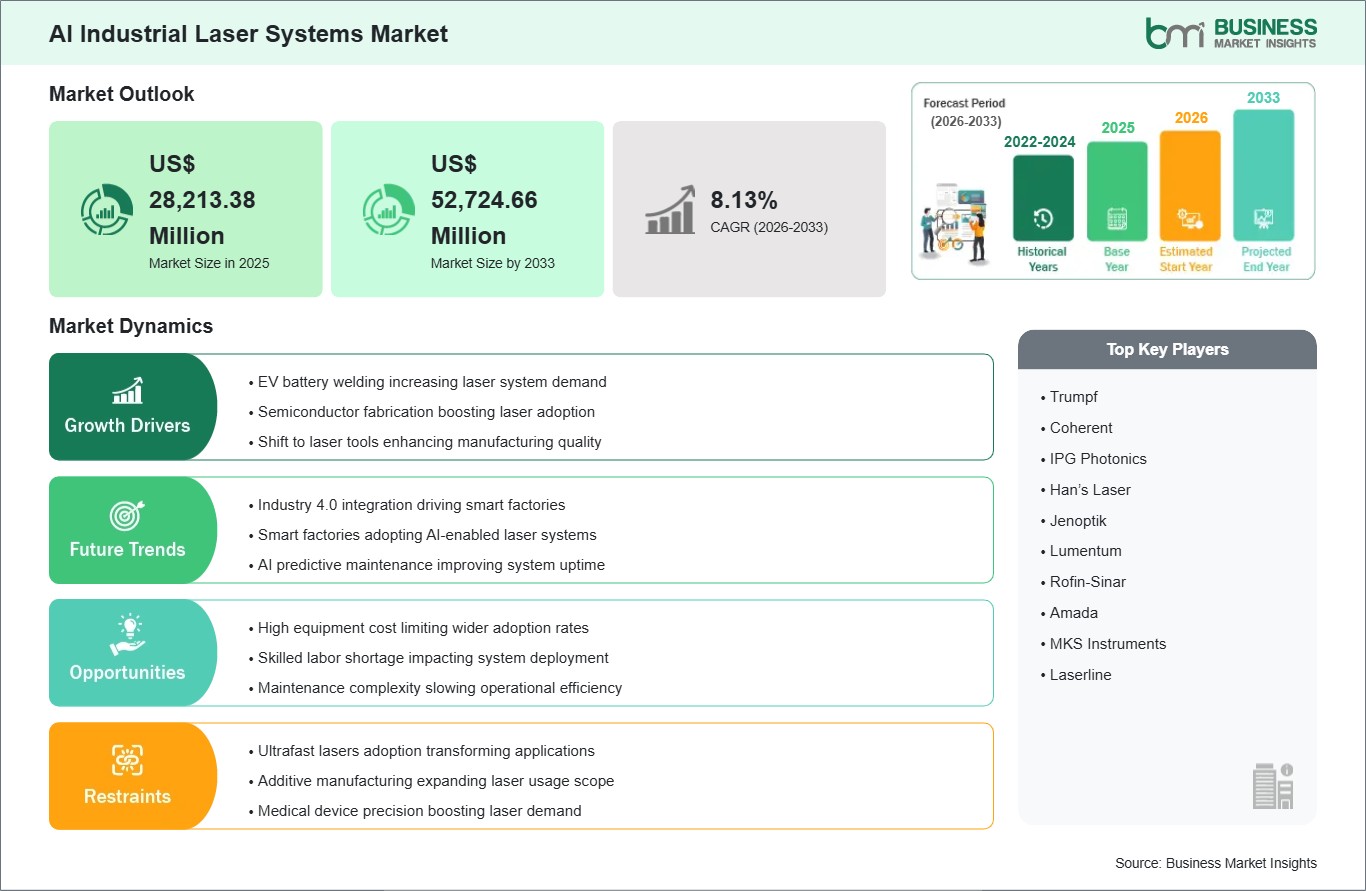
AI Industrial Laser Systems refer to advanced laser-based manufacturing solutions integrated with artificial intelligence technologies to improve precision, automation, operational efficiency, and process control across industrial production environments. These systems are widely used for cutting, welding, marking, engraving, and additive manufacturing applications in industries such as automotive, aerospace, electronics, and medical devices. Growing adoption of smart manufacturing practices, industrial automation, and Industry 4.0 technologies is supporting the demand for AI-enabled laser systems across global manufacturing sectors. Manufacturers are increasingly focusing on improving production accuracy, minimizing material wastage, reducing downtime, and enhancing product consistency through intelligent laser processing technologies. Increasing investments in digital factories, robotic manufacturing systems, and real-time monitoring solutions are further supporting market growth.
Several operational and technological challenges continue to influence the AI Industrial Laser Systems market. High installation and maintenance costs associated with advanced laser equipment may limit adoption among small and medium-sized enterprises. Integration of AI-enabled laser systems with legacy industrial infrastructure often requires significant technical modifications and workforce training. Industries also face challenges related to cybersecurity risks, software compatibility, and data management in connected manufacturing environments. In addition, fluctuations in raw material costs, supply chain disruptions, and the requirement for highly skilled professionals can create operational difficulties for manufacturers. Regulatory requirements related to industrial safety standards and laser system certifications may also increase implementation complexity across certain regions and industrial sectors.
Despite these challenges, the market continues to expand due to increasing demand for high-precision manufacturing and intelligent production systems. By laser type, fiber lasers account for a major share because of their high efficiency, reliability, and suitability for automated industrial applications. Solid-state and ultrafast lasers are also gaining attention in precision microfabrication and electronics manufacturing processes. By application, cutting and welding remain dominant segments due to widespread usage in automotive and aerospace production lines. Marking and additive manufacturing applications are also witnessing growing adoption with increasing focus on traceability and customized production capabilities. Automotive and electronics industries remain key end-users due to rising investments in automated manufacturing infrastructure. Competitive activity within the market is focused on AI integration, process automation, predictive maintenance capabilities, and real-time quality monitoring technologies.
Segment Analysis
AI Industrial Laser Systems Market Segmentation
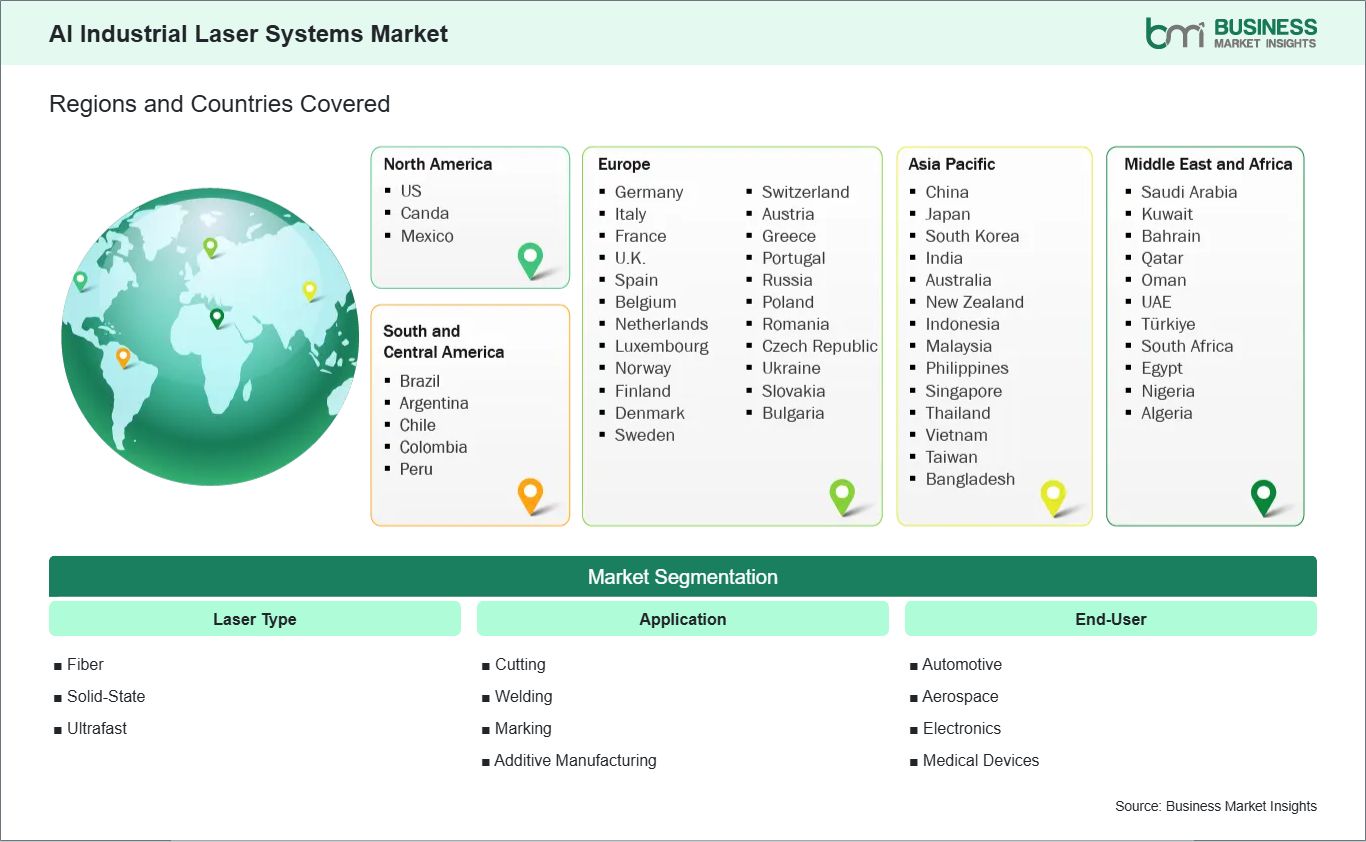
The AI Industrial Laser Systems market is segmented based on laser type, application, and end-user. Growing demand for intelligent manufacturing technologies and precision industrial operations is supporting adoption across multiple industrial sectors.
By Laser Type
- Fiber: Widely used for high-speed cutting and welding applications due to efficiency, durability, and low maintenance requirements.
- Solid-State: Preferred for precision manufacturing processes requiring stable beam quality and high energy output.
- Ultrafast: Increasingly adopted for micro-processing and advanced electronics manufacturing applications requiring minimal thermal damage.
By Application
- Cutting: Major application segment due to extensive use in metal fabrication and automotive manufacturing operations.
- Welding: Growing adoption in aerospace and industrial production lines for high-precision joining applications.
- Marking: Used for traceability, branding, and product identification across electronics and medical devices industries.
- Additive Manufacturing: Expanding with rising adoption of industrial 3D printing and customized component manufacturing.
By End-User
- Automotive: Significant adopter of AI Industrial Laser Systems for automated production and lightweight vehicle manufacturing.
- Aerospace: Uses advanced laser systems for precision component fabrication and maintenance operations.
- Electronics: Increasingly utilizes laser technologies for semiconductor and microelectronics manufacturing processes.
- Medical Devices: Growing demand for precise and clean manufacturing solutions for surgical and diagnostic equipment production.
Market Forces
AI Industrial Laser Systems Market Drivers and Opportunities
AI Industrial Automation Driving Precision Manufacturing
The increasing transition toward automated manufacturing environments is a major factor supporting the growth of the AI Industrial Laser Systems market. Industries are increasingly adopting intelligent production technologies to improve operational efficiency, reduce production downtime, and maintain consistent product quality. AI-enabled laser systems provide advanced process monitoring, predictive maintenance, and automated parameter adjustments, helping manufacturers optimize production workflows and minimize material wastage. These systems are becoming important in industries requiring high precision, such as automotive, aerospace, electronics, and medical devices.
Governments and industrial organizations are also encouraging smart manufacturing and digital transformation initiatives to strengthen industrial productivity and global competitiveness. The integration of AI technologies with industrial laser equipment supports real-time decision-making and improved production flexibility. However, the implementation of advanced laser systems may require significant investment in infrastructure upgrades, workforce training, and cybersecurity measures. Despite these challenges, manufacturers continue to prioritize intelligent automation technologies to meet increasing demand for precision manufacturing and faster production cycles. As industries continue adopting Industry 4.0 frameworks, AI-powered laser systems are expected to play an increasingly important role in modern industrial operations.
Expansion of Additive Manufacturing and Smart Factories
The growing adoption of additive manufacturing and smart factory technologies is creating new growth opportunities for the AI Industrial Laser Systems market. Industries are increasingly focusing on flexible production systems, customized manufacturing, and efficient material utilization. AI-enabled laser technologies support advanced additive manufacturing processes by improving accuracy, reducing defects, and enabling automated quality control during production. This trend is particularly important in aerospace, medical devices, and electronics industries where precision and component complexity are critical.
The expansion of connected manufacturing ecosystems is also supporting demand for intelligent laser systems capable of real-time communication and data analysis. AI integration allows manufacturers to analyze operational data, optimize energy consumption, and improve equipment performance. Emerging developments in ultrafast laser processing and high-precision microfabrication are further expanding industrial applications. In addition, increasing investments in electric vehicles, semiconductor production, and industrial robotics are creating demand for advanced laser-based manufacturing technologies.
Size and Share Analysis
AI Industrial Laser Systems Market Size and Share Analysis
The AI Industrial Laser Systems Market is projected to grow from US$ 28,213.38 Million in 2025 to US$ 52,724.66 Million by 2033 , registering a CAGR of 8.13% from 2026 to 2033.
By laser type, fiber lasers account for a significant market share due to their efficiency, reliability, and suitability for high-speed industrial applications. Solid-state and ultrafast laser systems are also witnessing growing demand in precision processing and advanced microfabrication operations. By application, cutting and welding remain dominant segments because of extensive usage in heavy industrial manufacturing and automotive assembly lines. Marking and additive manufacturing applications are expanding steadily with increasing focus on product traceability and customized production processes.
By end-user, the automotive industry remains a major contributor to market demand due to increasing investments in automated vehicle manufacturing and lightweight component production. Aerospace and electronics industries are also adopting AI Industrial Laser Systems for high-precision fabrication and quality control applications. Continuous innovation in AI-driven manufacturing technologies and smart industrial infrastructure is expected to support long-term market development.
Report Coverage
AI Industrial Laser Systems Market Report Coverage and Deliverables
The "AI Industrial Laser Systems Size and Forecast (2022-2033)" report provides a detailed analysis of the market covering below areas:
- Market size and forecast at global, regional, and country levels for all the key market segments covered under the scope
- Market trends, as well as market dynamics such as drivers, restraints, and key opportunities
- Market analysis covering key market trends, global and regional framework, major players, regulations, and recent market developments
- Industry landscape and competition analysis covering market concentration, heat map analysis, prominent players, and recent developments for the market
- Detailed company profiles, including SWOT analysis
Geographic Insights
AI Industrial Laser Systems Market Geographic Insights
The AI Industrial Laser Systems market shows diverse regional adoption patterns influenced by industrial automation trends, smart manufacturing investments, technological infrastructure, and production modernization initiatives across key manufacturing economies.
North America remains a mature market due to strong adoption of advanced manufacturing technologies across the United States and Canada. Industries such as aerospace, automotive, electronics, and medical devices are increasingly integrating AI-powered laser systems to improve production precision and operational efficiency. The region benefits from well-established industrial automation infrastructure, high investment in Industry 4.0 technologies, and increasing demand for intelligent production systems. Manufacturers are also focusing on predictive maintenance, robotic integration, and digital manufacturing platforms to strengthen competitiveness. Growing emphasis on semiconductor manufacturing and electric vehicle production is further supporting demand for AI Industrial Laser Systems across the region.
Asia Pacific is witnessing rapid market expansion due to increasing industrialization, growing manufacturing activities, and rising automation investments in countries such as China, Japan, South Korea, and India. Electronics manufacturing and automotive production remain key application areas driving demand for intelligent laser systems. Governments and industrial organizations across the region are encouraging smart factory development and advanced manufacturing capabilities to improve productivity and export competitiveness. Expanding industrial robotics adoption, increasing semiconductor fabrication activities, and growing investments in precision engineering are also contributing to market growth. Rising focus on cost-efficient production and high-volume manufacturing is expected to support continued adoption of AI Industrial Laser Systems across Asia Pacific.
Industry Activity
Recent Developments
The AI Industrial Laser Systems market is analyzed using a mix of primary and secondary research sources, including corporate publications, industry associations, and verified databases. This approach ensures accurate tracking of innovation trends and strategic developments influencing the market.
- In April 2024, TRUMPF introduced advanced AI-supported laser processing solutions for smart manufacturing environments. The updated systems were designed to improve process monitoring, predictive maintenance, and automated production optimization across industrial applications. The development strengthened the company's focus on intelligent factory integration and digital manufacturing capabilities.
- In October 2023, IPG Photonics announced new intelligent laser manufacturing technologies focused on automated welding and precision industrial applications. The company highlighted enhanced AI-enabled monitoring and adaptive control capabilities to improve manufacturing efficiency and reduce operational downtime. The development supported growing demand for smart industrial laser systems across automotive and electronics sectors.
Trust & Transparency
Research Methodology
The market analysis combines proprietary research with secondary data from government agencies, company disclosures, regulatory filings, industry databases and expert interviews. Market estimates are validated through data triangulation, cross-market benchmarking and analyst
review.
View Full Research Methodology
Key Sources Referred:
World Bank - Global Trade Indicators World Trade Organization (WTO) International Monetary Fund (IMF) International Trade Administration (ITA) Company Websites Company Annual Reports Company Investor Presentations