
Laser Projection Market Outlook: Size, Share, Trends, Growth Analysis, Competitive Landscape & Forecast, 2026-2033

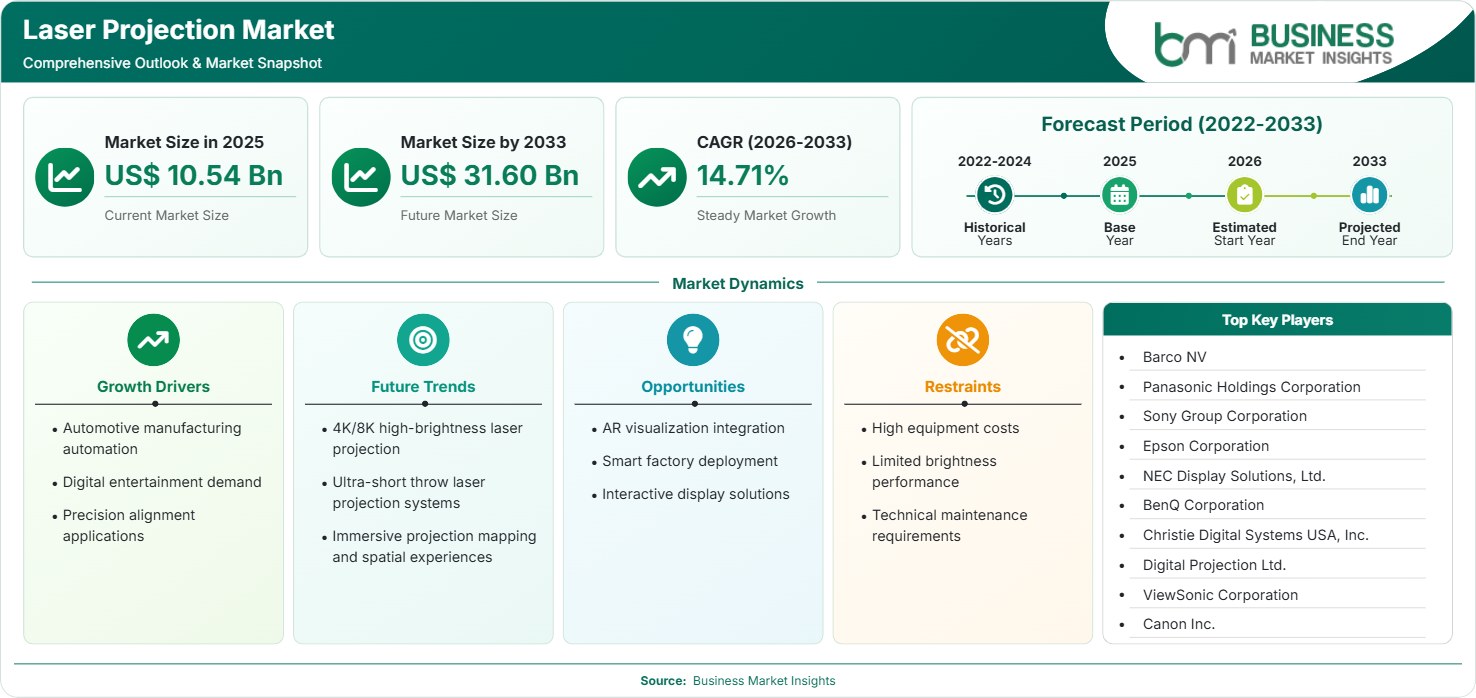
The Laser Projection Market size was valued at US$ 10.54 billion in 2025 and is projected to reach US$ 31.60 billion by 2033, growing at a CAGR of 14.71% during 2026–2033. Growth is driven by automotive manufacturing automation, digital entertainment demand, precision alignment applications, AR visualization integration, smart factory deployment, and interactive display solutions.

Report Coverage
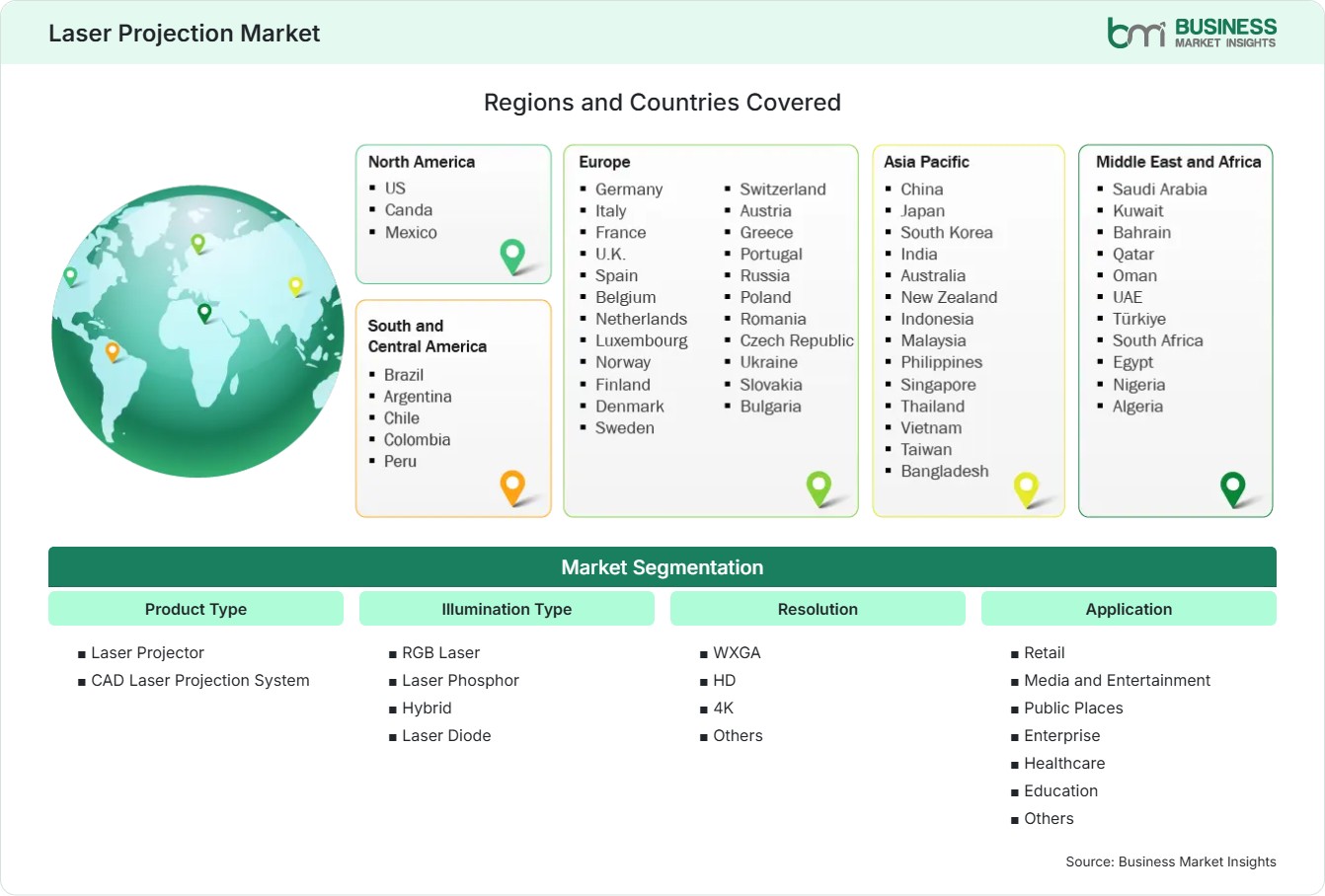
  • Product Type: Laser Projector, CAD Laser Projection System
  • Illumination Type: RGB Laser, Laser Phosphor, Hybrid, Laser Diode
  • Resolution: WXGA, HD, 4K, Others
  • Application: Retail, Media and Entertainment, Public Places, Enterprise, Healthcare, Education, Others
US$ 10.54 Bn Market size in 2025
US$ 31.60 Bn Market Size by 2033
14.71% CAGR, 2026 - 2033
2026-2033 Forecast Period

AI Overview

Laser Projection Market Summary

  • North America Region: North America holds an estimated 30%–34% market share in 2025, growing at a 13.8%–14.5% CAGR during 2026–2033. Demand is supported by digital entertainment infrastructure, enterprise visualization, industrial automation, and healthcare imaging applications. The US market remains the leading contributor, growing at an estimated 14.0%–14.7% CAGR through 2033 due to technology adoption across commercial and industrial sectors.
  • Fastest Growing Region: Asia Pacific represents an estimated 36%–40% share in 2025, expanding at a 15.2%–16.0% CAGR during 2026–2033. Growth is supported by smart manufacturing investments, automotive production automation, consumer electronics expansion, and rising adoption of advanced display technologies.
  • Leading Segment: Laser Projector products account for an estimated 72%–76% share in 2025, growing at a 14.2%–14.9% CAGR during 2026–2033. Demand is supported by long operating life, reduced maintenance requirements, improved image quality, and adoption across entertainment and enterprise applications.
  • High Growth Segment: CAD Laser Projection Systems represent an estimated 18%–22% share in 2025, expanding at a 15.5%–16.3% CAGR during 2026–2033. Growth is driven by manufacturing automation, precision assembly, industrial alignment, and quality control requirements.
  • Key Market Opportunity: AR visualization integration, smart factory deployment, and interactive display solutions are creating opportunities for laser projection providers across industrial, commercial, educational, and entertainment applications systems during laser projection market forecasts.
  • Major Market Players: Barco NV, Panasonic Holdings Corporation, Sony Group Corporation, Epson Corporation, NEC Display Solutions, Ltd., BenQ Corporation, Christie Digital Systems USA, Inc., Digital Projection Ltd., ViewSonic Corporation, Canon Inc.
Strategic Insights

Laser Projection Market: Strategic Insights

Laser Projection Market Strategic Framework
FREE PDF
Request your free sample
Request free sample
Stakeholder View

Key Takeaways

  • The laser projection ecosystem includes projector manufacturers, optical technology providers, software developers, system integrators, and end-use industries requiring advanced visualization capabilities.
  • Industrial manufacturing, entertainment, enterprise collaboration, and education applications represent major growth opportunities due to increasing demand for immersive and high-resolution display.
  • Innovation is shifting toward higher brightness, compact laser engines, improved color performance, interactive projection technologies, and integration with augmented reality platforms.
  • Asia Pacific provides strong investment opportunities due to smart manufacturing expansion, automotive production growth, electronics development, and increasing adoption of digital infrastructure.
  • Companies are pursuing partnerships and technology development initiatives to strengthen laser projection capabilities for specialized industrial and commercial applications, aligning laser projection market trends.
  • Integration of laser projection with automation systems, artificial intelligence, and connected manufacturing platforms is creating new opportunities for advanced visualization workflows.
Geographic Outlook

Laser Projection Market Regional Highlights

North America Laser Projection Market

North America accounts for an estimated 30%–34% share in 2025, supported by entertainment infrastructure, enterprise visualization, healthcare applications, and industrial automation. The region is projected to grow at a 13.8%–14.5% CAGR during 2026–2033. The United States remains the largest contributor due to advanced technology adoption, commercial installations, and demand for high-performance projection solutions.

  • The United States leads regional demand through entertainment, enterprise, and industrial applications.
  • Media companies are adopting laser projection for premium cinema and immersive experiences.
  • Manufacturing companies are using projection systems for precision assembly and workflow improvement.
  • Healthcare organizations are implementing advanced visualization systems for training and communication.

US Laser Projection Market

The US represents an estimated 84%–88% share of North America's market in 2025 and is expected to expand at a 14.0%–14.7% CAGR through 2033. Growth is supported by digital entertainment investments, industrial automation, enterprise modernization, and increasing adoption of advanced visualization technologies across multiple sectors.

  • Entertainment venues are increasing adoption of high-resolution laser projection systems.
  • Automotive manufacturers are implementing projection solutions for production alignment applications.
  • Enterprises are adopting interactive projection technologies for collaboration environments.

Europe Laser Projection Market

Europe represents an estimated 22%–26% share in 2025, growing at a 13.5%–14.2% CAGR during 2026–2033. Regional demand is supported by automotive manufacturing, industrial automation, cultural venues, and enterprise digitization. Germany, France, the United Kingdom, and Italy remain important markets due to advanced manufacturing capabilities and technology adoption.

  • Germany supports growth through automotive automation and industrial projection applications.
  • France is expanding laser projection adoption in entertainment and public installations.
  • The United Kingdom is increasing demand for advanced visualization technologies.
  • European manufacturers are integrating projection systems into smart factory environments.

Asia Pacific Laser Projection Market

Asia Pacific represents an estimated 36%–40% share in 2025 and records the fastest growth at a 15.2%–16.0% CAGR during 2026–2033. Regional expansion is supported by manufacturing automation, automotive production, digital entertainment growth, and technology infrastructure development. China, Japan, South Korea, and India are major contributors.

  • China leads demand through manufacturing automation and entertainment infrastructure expansion.
  • Japan supports adoption through automotive technology and precision engineering applications.
  • South Korea is increasing demand through electronics and advanced display industries.
  • India is adopting laser projection for education, enterprise, and industrial applications.
  • Southeast Asian economies are investing in digital infrastructure and smart manufacturing.

Rest of World Laser Projection Market

Latin America, the Middle East, and Africa collectively represent an estimated 6%–10% share in 2025, expanding at a 13.8%–14.6% CAGR through 2033. Growth is supported by entertainment development, educational modernization, industrial investments, and infrastructure projects. Brazil, Mexico, UAE, Saudi Arabia, and South Africa represent emerging opportunities.

  • Brazil is expanding laser projection adoption through entertainment and commercial applications.
  • Mexico benefits from automotive manufacturing and industrial automation investments.
  • Middle Eastern countries are adopting projection technologies for large-scale public venues.
  • South Africa is increasing demand through education and enterprise applications.
  • Regional infrastructure development supports adoption of advanced display solutions.
Global Market Geography
FREE PDF
Request your free sample
Request free sample
Segment Analysis

Laser Projection Market Segmentation

Product Type

The Product Type segment represents a major category within the Laser Projection Market, accounting for an estimated 94%–98% share in 2025 and expanding at a 14.3%–15.0% CAGR during 2026–2033. Product selection is influenced by brightness requirements, application complexity, operational efficiency, and integration needs. Laser projectors maintain broad adoption due to their versatility across entertainment, enterprise, education, and public applications. CAD laser projection systems are gaining importance in industrial environments where accurate positioning, assembly guidance, and manufacturing precision are required.

  • Laser Projector: Laser projectors provide high image quality, long operating life, low maintenance, and broad adoption across commercial, entertainment, educational, and enterprise applications.
  • CAD Laser Projection System: CAD laser projection systems enable precise manufacturing visualization, assembly guidance, alignment, and quality control across industrial production environments.

Illumination Type

The Illumination Type segment accounts for an estimated 96%–99% Laser Projection Market share in 2025 and is projected to grow at a 14.5%–15.2% CAGR during 2026–2033. Illumination technology selection depends on brightness levels, color accuracy, energy efficiency, and application requirements. RGB laser systems provide superior color performance for premium visual experiences, while laser phosphor technology remains popular due to cost efficiency and reliability. Hybrid and laser diode solutions continue developing for specialized projection applications requiring optimized performance and flexibility.

  • RGB Laser: RGB laser systems deliver enhanced color accuracy, wide color gamut performance, and premium image quality for entertainment and professional visualization applications.
  • Laser Phosphor: Laser phosphor systems provide reliable brightness, energy efficiency, long operating life, and cost-effective solutions for commercial projection environments.
  • Hybrid: Hybrid illumination technologies combine different light sources to improve performance, efficiency, and application flexibility across diverse projection requirements.
  • Laser Diode: Laser diode systems support compact designs, efficient operation, and integration into portable and specialized projection devices.

By Resolution

The Resolution segment represents an estimated 90%–94% Laser Projection Market share in 2025 and is expected to expand at a 14.6%–15.3% CAGR through 2033. Increasing demand for immersive visualization, high-definition content, and professional displays is accelerating adoption of advanced resolution technologies. 4K projection systems are gaining traction in entertainment, enterprise, and simulation applications due to superior image clarity. HD systems continue maintaining strong demand due to affordability, while emerging applications are encouraging development of higher-resolution projection solutions.

  • WXGA: WXGA resolution systems support cost-effective projection requirements across education, business presentations, and basic visualization applications.
  • HD: HD projection systems provide improved image quality and remain widely used across enterprise, education, entertainment, and public display applications.
  • 4K: 4K projection systems deliver superior detail, immersive viewing experiences, and adoption across premium entertainment, simulation, and professional visualization environments.

Application

The Application segment represents an estimated 86%–90% share in 2025 and is expected to expand at a 14.7%–15.4% CAGR through 2033. Increasing digital transformation, automation, and demand for immersive experiences are supporting adoption across multiple industries, supporting laser projection market growth. Media and entertainment applications remain significant users, while enterprise, healthcare, education, and industrial environments are increasingly adopting laser projection technologies. Growing integration with interactive systems, automation platforms, and digital workflows is expanding application opportunities.

  • Retail: Retail applications use laser projection for digital signage, interactive displays, customer engagement, and immersive shopping experiences.
  • Media and Entertainment: Media and entertainment sectors adopt laser projection for cinemas, live events, immersive attractions, and large-format visual experiences.
  • Public Places: Public venues utilize laser projection for exhibitions, museums, transportation hubs, cultural events, and large-scale information displays.
  • Enterprise: Enterprise users implement laser projection for collaboration spaces, presentations, training, and advanced visualization environments.
  • Healthcare: Healthcare applications use projection systems for medical training, visualization, simulation, and communication purposes.
  • Education: Educational institutions adopt laser projection for classrooms, digital learning environments, interactive teaching, and enhanced content delivery.
Market Forces

Laser Projection Market Dynamics

Key Market Drivers

Automotive manufacturing automation increases projection demand

The use of laser projection systems for assembly guidance, alignment, inspection, and production visualization in automotive manufacturing is driving up the demand for such solutions. Manufacturers are turning to projection technology to ensure more accurate workflows, minimize errors, and increase production efficiency. CAD laser projection systems allow workers to view complex assembly instructions right on the working surface, thereby facilitating the modern production process. Rising vehicle electrification and production complexities are prompting automotive manufacturers to incorporate digital manufacturing technologies. Laser Projection Market growth is driven by investments in smart factories, Industry 4.0 concepts, and the need for precise manufacturing processes around the world.

Digital entertainment demand drives advanced displays

The rising number of digital entertainment activities will boost the use of laser projection technology among movies theatres, theme parks, live events, and entertainment destinations. The benefits of using laser projection include increased brightness performance, longer lifespan, and color performance when compared with the use of regular projection technology. Companies in the entertainment industry are adopting high-tech display technology in order to provide premium entertainment services for their customers and display high-definition media. The growth of immersive entertainment facilities and exhibits is increasing demand for laser projection.

Precision alignment applications expand industrial adoption

Increasing demand for precision alignment is leading to higher use of laser projection systems in manufacturing, aerospace, construction, and engineering industries. Laser projection allows for the visualization of the placement of components, assembly guidelines, and layout planning in a precise manner, thus streamlining operations and making manual measurement unnecessary. The industrial sector is incorporating laser projection into their manufacturing process along with digital modelling to achieve greater precision in manufacturing. The need for custom manufacturing, quick assembly, and better-quality control is helping this trend.

Key Market Opportunities

AR visualization integration creates new growth opportunities

Integration of augmented reality visualization into the market presents itself as one of the biggest opportunities in the industry as businesses strive to create more interactive and data-enabled projection experiences. Integration of laser projection technologies together with AR will enable better training, manufacturing guidance, visualization of designs and interactions with customers. Users from industrial settings can use the power of digital content projections alongside their environments for increased efficiency and lower complexity in operations. Laser Projection Market Forecasts depend on growing investments in immersive technology, smart manufacturing, and visualization systems.

Smart factory deployment supports industrial expansion

The implementation of smart factories provides possibilities for the laser projection industry since manufacturers embrace the connected and automated nature of their production process. The use of laser projections allows companies to implement digital work instructions, assemble components, perform quality control and optimize production. Compatibility with CAD software, manufacturing execution systems, and automation provides an enhanced efficiency level. As industries become increasingly more interested in using the technology of the Fourth Industrial Revolution, the demand for flexible visualization solutions is predicted to grow.

Interactive display solutions enhance application potential

Interactive display systems have been contributing to growing possibilities of laser projection in various settings such as education, enterprises, retail spaces, and public places. Enterprises and organizations are now using projection systems that are interactive as a way to promote engagement, collaboration, and information dissemination. Projection systems that integrate touch technology with interactive software platforms are being appreciated in modern workspaces and education settings. The increasing need for communication solutions is driving the industry to come up with solutions that integrate interactive systems with projection equipment.

Market Restraints and Challenges

High equipment costs limit adoption across applications

Factor: Laser-based projection equipment needs state-of-the-art optics, semiconductor lasers, precise engineering, and sophisticated manufacturing techniques that make the equipment more expensive.

Impact: The higher cost at the beginning may prevent smaller businesses, educational institutions, and price-conscious individuals from embracing the technology. Organizations have to prove the advantages of such systems in terms of low maintenance, efficiency, and longevity.

Limited brightness performance affects demanding environments

Factor: A few of the laser projection systems might have a few problems when used in bigger places, outdoors, or in areas with bright surrounding light.

Impact: Limitations on brightness may limit applicability and necessitate more expenditure on equipment for some installations. Improvements in laser projection efficiency, cooling, and optics need to be made by manufacturers.

Company Analysis

Competitive Landscape

Market Competitors include international companies specializing in the production of display technologies, optical solutions, and specialized projection systems. The main areas of interest of companies in the market include the development of laser engines with increased brightness, miniaturization of projectors, enhanced resolution, industrial visualization, and digitalization. The Laser Projection Market analysis indicates that competitive positioning is increasingly influenced by innovation in laser light sources, application-specific systems, software integration, and expansion into entertainment, manufacturing, enterprise, and smart infrastructure applications.

Company Name

Overview

Products and Services relevant to this market

Barco NV

Global visualization technology company providing professional display and projection solutions.

Laser projectors, simulation systems, cinema projection, enterprise visualization solutions.

Panasonic Holdings Corporation

Technology company offering imaging and professional display solutions.

Laser projectors, professional displays, visual systems, business projection solutions.

Sony Group Corporation

Electronics and entertainment company developing advanced imaging technologies.

4K laser projectors, professional projection systems, digital cinema solutions.

Epson Corporation

Global manufacturer specializing in projection and imaging technologies.

Laser projectors, business projectors, education projection systems, display solutions.

NEC Display Solutions, Ltd.

Display technology provider offering professional visualization products.

Laser projectors, digital signage systems, large venue projection solutions.

BenQ Corporation

Display technology company providing commercial and consumer projection systems.

Laser projectors, interactive displays, business and education solutions.

Christie Digital Systems USA, Inc.

Projection technology provider serving entertainment and professional markets.

Laser projection systems, cinema projectors, simulation displays, large venue solutions.

Digital Projection Ltd.

Specialist projection company developing advanced visual display technologies.

High-brightness laser projectors, simulation systems, professional projection products.

ViewSonic Corporation

Visual technology company producing display and projection solutions.

Laser projectors, interactive displays, education and enterprise projection systems.

Canon Inc.

Imaging technology company offering professional projection products.

Laser projectors, imaging solutions, business projection systems, visual technologies.

Industry Activity

Recent Developments

July 2026

Aumovio Group and Yingtang Intelligent Control signed a strategic cooperation memorandum to jointly develop MEMS Laser Beam Scanning (LBS)-based in-vehicle near-field projection solutions, targeting automotive applications such as exterior ground projection lights. The partnership aims to achieve mass production capability by early 2027.

February 2026

Epson showcased its 3-chip 3LCD laser projection technology at ISE 2026, unveiling the immersive "Infinity" installation alongside a new high-lumen laser projector, next-generation professional lenses, and an education-focused projection solution designed to enhance collaborative learning environments.

January 2026

Christie launched the Korus Series at ISE 2026, introducing a family of compact 1DLP laser projectors delivering 4K UHD+ resolution with brightness of up to 14,250 lumens. The series features eight interchangeable lenses, including an ultra-short-throw option, and integrated warping, blending, and alignment capabilities for professional AV applications.

January 2026

Digital Projection marked its 30th anniversary at ISE 2026 by unveiling a flagship 8K laser projector and the first models in its new TITAN Luma series. The compact projectors are approximately 30% smaller than previous generations while delivering high-performance projection for professional visualization and large-venue applications.

Trust & Transparency

Research Methodology

The market analysis combines proprietary research with secondary data from government agencies, company disclosures, regulatory filings, industry databases and expert interviews. Market estimates are validated through data triangulation, cross-market benchmarking and analyst review.

View Full Research Methodology

Questions Answered

Frequently Asked Questions

What challenges affect laser projection adoption?

Major challenges include high equipment costs, brightness limitations in demanding environments, complex installation requirements, and competition from alternative display technologies.

Why are 4K laser projectors gaining popularity?

4K laser projectors are gaining popularity because they provide enhanced image detail, improved viewing experiences, and suitability for premium entertainment, simulation, and professional visualization applications.

How are laser projection systems used in manufacturing?

Manufacturing industries use laser projection systems for assembly guidance, component alignment, production visualization, inspection support, and integration with digital manufacturing workflows.

Which product type dominates the market?

In the market report, laser projectors dominate due to broad adoption across entertainment, enterprise, education, retail, and public applications requiring reliable, high-quality visual performance.

What is driving demand in the Laser Projection Market?

Demand is driven by automotive automation, digital entertainment expansion, precision manufacturing applications, smart factory adoption, interactive displays, and increasing preference for energy-efficient projection technologies.

Access the Full Laser Projection Market Report

Get segment-level forecasts, regional estimates, competitive benchmarking, company profiles and downloadable Excel datasets.

Access the full Laser Projection Market Report
350 pages PDF & Excel | 2026-07-31
Similar Research

Related Market Reports